When you click on links to various merchants on this site and make a purchase, this can result in this site earning a commission. Affiliate programs and affiliations include, but are not limited to, the eBay Partner Network.
“Then cleaned the coil springs and the 2 rubber trims (ditched the bumpstops).”
The B4s don’t have internal bumpstops. You’re supposed to reuse the old one or put new ones in. I recall the bumpstops acts as a secondary spring to help control the travel at the ends of the stroke.
Thanks Chaps - once I get the rear shocks done, I'll be heading to the alignment shop. And (to Zsm) the new bumpstops fitted very nicely thanks.
Another came to mind was that with hindsight, I should have cracked the top nut on the shaft, with the struts still in the car - would have saved the grief later. We live and learn !
So time for some pics of the front end suspension install.
Some pics to remind me where everything should be located Left side out of the steering knuckle Right side out
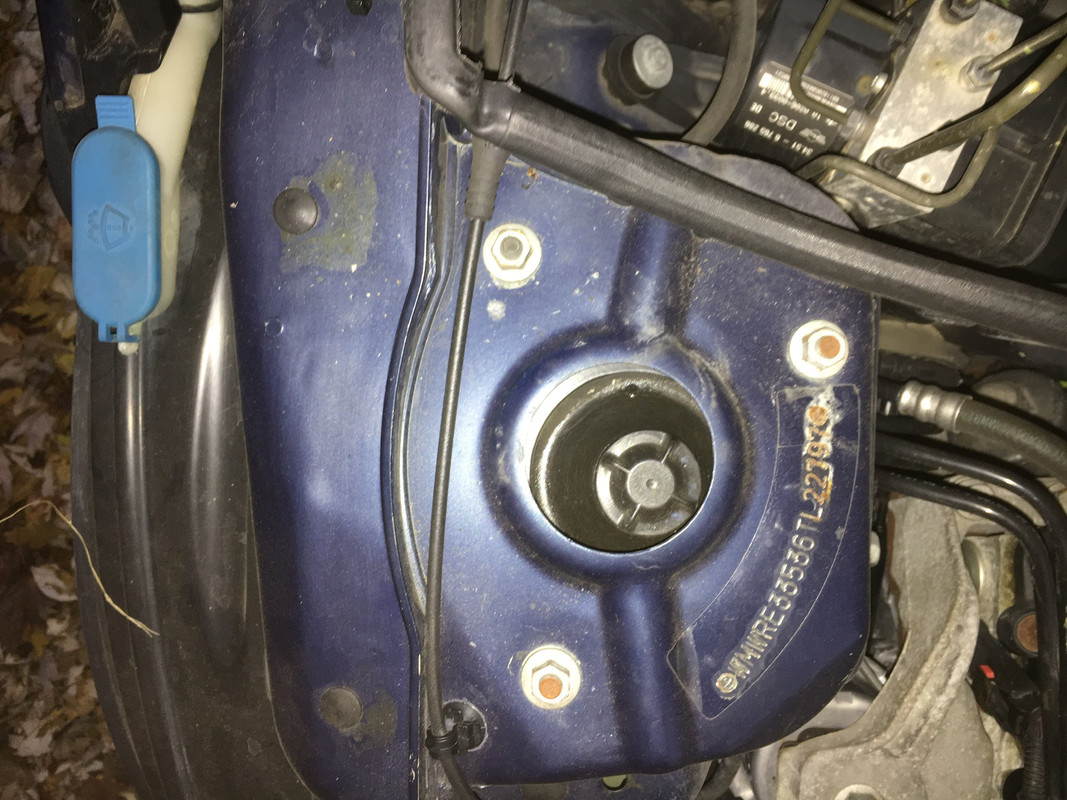
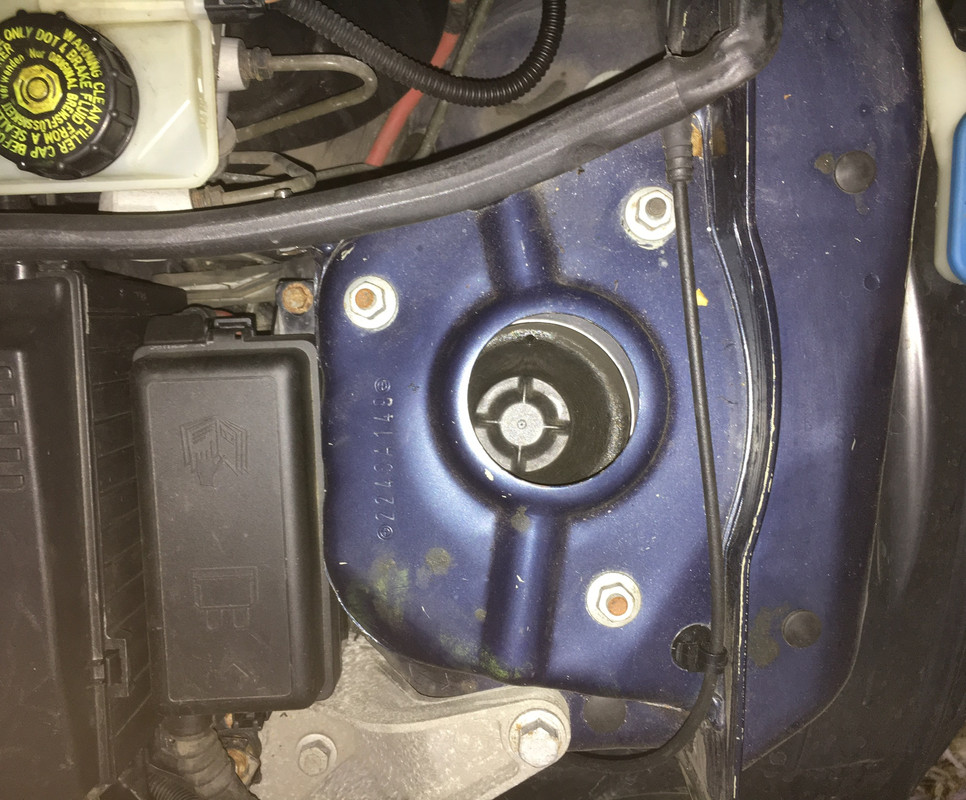
Here's the view from the top before and after Before was pretty much dead centre LEFT (Driver's side) - From the front - Clearly tilted inwards but also forward ?? RIGHT
Another observation was that the front struts could be pushed further down the steering knuckle to compensate for the camber plate thickness - you just need to trim the bracket for the ABS sensor wiring, thats welded into the strut body - which currently prevents the strut from going down any further.
Last edited by QatarJCWR53; Nov 6, 2018 at 10:11 PM.
Reason: correction
Another observation was that the front struts could be pushed further down the steering knuckle to compensate for the camber plate thickness - you just need to trim the bracket for the ABS sensor wiring, thats welded into the strut body - which currently prevents the strut from going down any further.
Wow great observation! Sometimes KISS is right (Keep It Simple Stupid). I think the hole in the tab that the pinch bolt goes through would also need to be opened up.
Here's the view from the top before and after Before was pretty much dead centre LEFT (Driver's side) - From the front - Clearly tilted inwards but also forward ?? RIGHT
Would be nice if you had taken both photos more exact perpendicular to the struct tower hole. It would requires some care. I would first check where the camera imager is on the smartphone and then aim camera. Also help is to tell the camera what you want it to focus on.
The fleeBay plate sure appear to move the top of the strut forward, which means reduction in caster. If indeed so, I suspect it is simply the design constraint of this plates that re-use the stock top mount and by rotating it to gain more negative camber, it simply have to move the strut axis forward to fit the tower. This must be why Ireland fixed plate chose to use Z3 top mount to fabricate theirs.
Would be nice if you had taken both photos more exact perpendicular to the struct tower hole. It would requires some care. I would first check where the camera imager is on the smartphone and then aim camera. Also help is to tell the camera what you want it to focus on.
The fleeBay plate sure appear to move the top of the strut forward, which means reduction in caster. If indeed so, I suspect it is simply the design constraint of this plates that re-use the stock top mount and by rotating it to gain more negative camber, it simply have to move the strut axis forward to fit the tower. This must be why Ireland fixed plate chose to use Z3 top mount to fabricate theirs.
IE trims a lot off the edges of the Z3 top mount and the caster angle meets factory specs; at least on the R56.
If indeed the top of the strut has moved forward, the loss of caster will somewhat negate the added negative camber once the wheels are turned. That is, the caster angle becomes the “camber” of the wheel when the wheel is turned. The more the wheel is turned, the more the caster angle becomes the wheel camber. I’m sure that is clear as mud.
IE trims a lot off the edges of the Z3 top mount and the caster angle meets factory specs; at least on the R56.
If indeed the top of the strut has moved forward, the loss of caster will somewhat negate the added negative camber once the wheels are turned. That is, the caster angle becomes the “camber” of the wheel when the wheel is turned. The more the wheel is turned, the more the caster angle becomes the wheel camber. I’m sure that is clear as mud.
The alignment results will be interesting.
You are the man I can count on to give greater insights. Yes, as you turn the wheel the caster becomes camber. It is as clear as my favorite mud - high quality clay that makes fine porcelain.
From what I infer, Mini's confined strut tower is the biggest constrain in getting more camber with most camber plates.
You are the man I can count on to give greater insights. Yes, as you turn the wheel the caster becomes camber. It is as clear as my favorite mud - high quality clay that makes fine porcelain.
From what I infer, Mini's confined strut tower is the biggest constrain in getting more camber with most camber plates.
That and the diameter of the stock springs. It has been reported that with stock springs you can get just over -2 deg of camber. However, with the smaller dia coilover springs the camber can be up to -3.5 deg on a R53 (probably the same for a R56). I have friend who was really good at autocross with his R53. He was very pleased with the improvement in the car’s handling when he increased the caster on the car along with the camber he already had. Not sure why added caster isn’t a more popular thing to do on MINIs.
Here is a photo that I took today of the IE fixed plate. I noted the image sensor on the phone and place it as perpendicular and center as possible above the circular hole of the strut tower. Do note that all smart phone cameras are wide angle (except those with duel mode) so you cannot just judge base on the evenness of the three studs in the photo as there is geometric distortion of the lens. There is no, or very little change to the caster.
Very informative discussion guys thank you. The last alignment showed caster at just over +4' both sides.
I wonder if 'Fastlane' might post a picture of his strut tops with the caps off - for comparison.
I suppose it is possible I have incorrectly fitted them.
I'll take some better pictures of mine too.
Last edited by QatarJCWR53; Nov 10, 2018 at 08:20 PM.
Ok after a much more productive day yesterday, I managed to fit the rear shocks, in about 2 hours flat. No seized bolts and all was good.
The rubber bushes weren't in perfect shape, but were more than good enough for the job.
I also had the front wheels off the physically inspect the front struts. I wanted to see what the caster angle looked like as you can't really tell from the strut tops.
As you can see below, the front struts are visibly angled in the 'positive caster zone'. Exactly by how much the alignment will tell us. But that was a relief to see.
Even when I jacked up the strut to its normal position, it still retained the same caster angle.
Fully drooped - passenger side Jacked up - passenger side Fully drooped - driver side Jacked up - driver side
Nice to be able to get this done with no seized bolts.
You are correct in the way caster should look, but you are also right in that that only way to know for sure is the alignment. Caster is a bit of an odd measurement and is not a direct measurement of the strut angle. If I remember correctly caster angle is difference between the angle of the wheel, with the wheel point straight ahead (camber), and the “camber” angle of the wheel when it is turned inward by 20 deg. All of this is done with the car on the ground (not jacked up).
At any rate, you are going to really like the car once the alignment is done (figuring the caster is good) and you get it out for a spin. It is amazing what good shocks do for these cars. Why MINI doesn’t use these shocks is beyond me.
Well, we had our first snow today. My S is in the garage being a garage queen and our Cooper will have the snow tires put on today. I just finished installing roof racks (made in the UK, I believe) on the Jeep Wrangler’s hardtop so I have a way to carry my skis. Seasons change. Feel free to post some “warm” looking pictures over the next few months of you and your MINI having fun and remind us of what we have to look forward to.
Very informative discussion guys thank you. The last alignment showed caster at just over +4' both sides.
I wonder if 'Fastlane' might post a picture of his strut tops with the caps off - for comparison.
I suppose it is possible I have incorrectly fitted them.
I'll take some better pictures of mine too.
Here are pics of my strut tops....sorry for bad photos....was running out of daylight. I also dug out my post-alignment specs....also pictured below.
FWIW, I had IE plates on a previous car and honestly the handling improvement using these plates seems pretty much equal to those. It’s a dramatic improvement over stock. As someone mentioned above....the caster shift is likely due to the space restraints under the strut towers.....to make stock mounts fit, they have to be shifted in such a way. IMO, it’s an ok tradeoff so that I can replace mounts later down the line if need be....and because of the cost savings over IE. I’m by no means an alignment expert and don’t know exactly how turning-camber is measured, but my gut tells me that there’s still a substantial yield of negative turning-camber even with the slight caster shift....just judging from my driving experience with the car before/after.
Last edited by Fastlane; Nov 11, 2018 at 04:25 PM.
Thanks Fastlane - for the pics and alignment spec. I took some more pics trying to stay as central as possible over the strut tops - looks very similar to yours. Going for an alignment later today, so should have some figures.
Nice to be able to get this done with no seized bolts.
You are correct in the way caster should look, but you are also right in that that only way to know for sure is the alignment. Caster is a bit of an odd measurement and is not a direct measurement of the strut angle. If I remember correctly caster angle is difference between the angle of the wheel, with the wheel point straight ahead (camber), and the “camber” angle of the wheel when it is turned inward by 20 deg. All of this is done with the car on the ground (not jacked up).
At any rate, you are going to really like the car once the alignment is done (figuring the caster is good) and you get it out for a spin. It is amazing what good shocks do for these cars. Why MINI doesn’t use these shocks is beyond me.
Well, we had our first snow today. My S is in the garage being a garage queen and our Cooper will have the snow tires put on today. I just finished installing roof racks (made in the UK, I believe) on the Jeep Wrangler’s hardtop so I have a way to carry my skis. Seasons change. Feel free to post some “warm” looking pictures over the next few months of you and your MINI having fun and remind us of what we have to look forward to.
Thanks Eddie - we are currently having torrential rainfall and flash floods in the gulf, so you might have to wait for the 'warm' pics. A jeep wrangler and 2 mini coopers - nice - you got all the seasons covered there
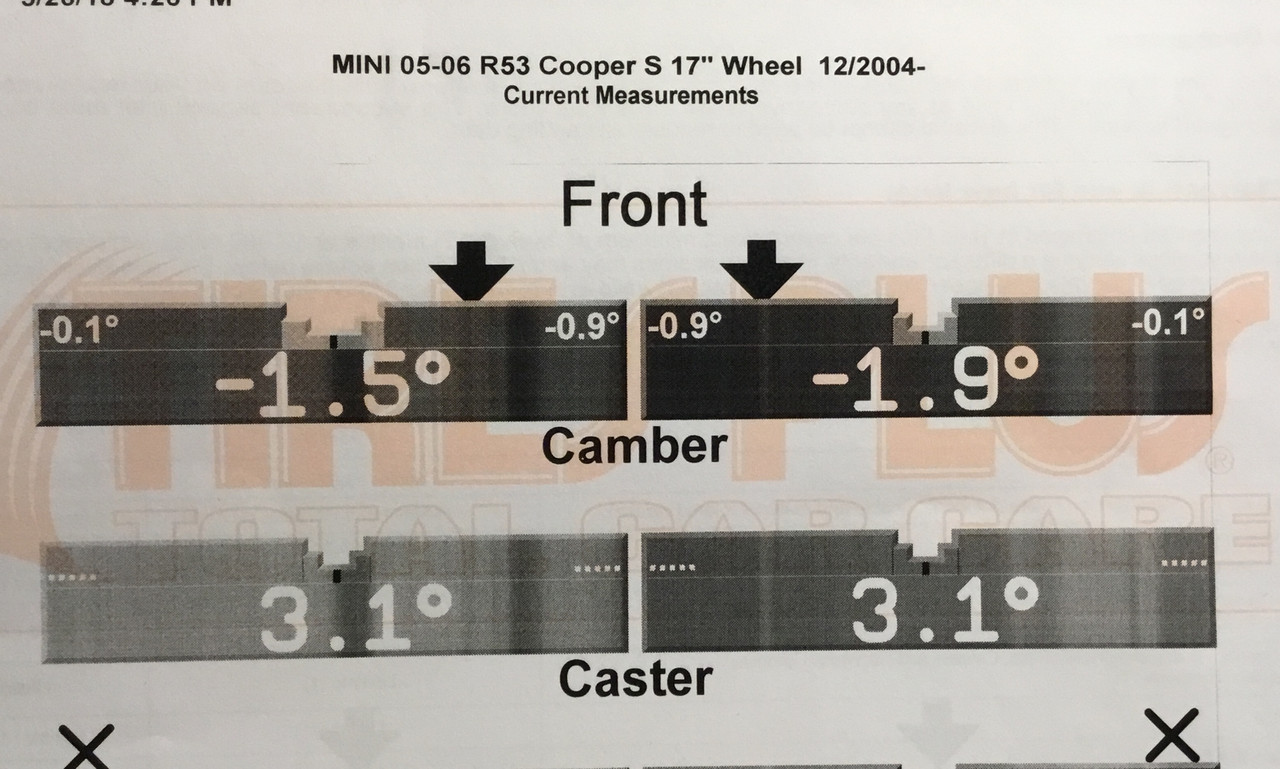
So went for the alignment and results as below. Very happy with the results - steering sharpness is back
3.2 degrees positive caster at the front. (was 4.05 degrees before the Nebraska camber plates) - almost identical to Fastlane.
The technician at the tyre shop, kept on saying that the camber is out of spec and I needed to get it checked urgently as it would cause uneven tyre wear- bless him.
I didn't think he would understand the concept of the camber plates.
Last edited by QatarJCWR53; Nov 12, 2018 at 09:32 PM.
So went for the alignment and results as below. Very happy with the results - steering sharpness is back
3.2 degrees positive caster at the front. (was 4.05 degrees before the Nebraska camber plates) - almost identical to Fastlane.
The technician at the tyre shop, kept on saying that the camber is out of spec and I needed to get it checked urgently as it would cause uneven tyre wear- bless him.
I didn't think he would understand the concept of the camber plates.
“tire wear, handling and safety problems may result.” ......yeah, because now you’re gonna want to drive faster all the time. LOL.