When you click on links to various merchants on this site and make a purchase, this can result in this site earning a commission. Affiliate programs and affiliations include, but are not limited to, the eBay Partner Network.
So Gollum IV has reached 119,000 miles, and I've learned a few things - more good than bad.
Perhaps we can gather the weak points, likely trouble spots, and lessons learned in this thread? The B48 seems like a good candidate for excellent longevity, so I expect more Forum members to hit six figures as time passes.
So the B48 internals have been flawless, but two components secured on the front side of the block, and the associated gaskets that seal the passages from the block are not.
The first is the oil filter housing, with integrated intercooler. I dealt with this last October at 115k miles, The part is plastic! Replacing it is easy, getting to it is not. About a $1,200 job.
The other area of concern is the water pump housing, which may now be weeping a bit - again at the mating surface to the block. That component is metal, but as it is right next to the oil filter housing it is equally inaccessible and the estimate for a possible failure is over $2,000.
So as your B48 gets older, make sure that you pull the engine cover when doing an oil change, don't just use the port provided. Put a strong light on the block, and check the gaskets and mating surfaces as well as you can.
Early detection, although possibly expensive, is much better than losing oil or coolant from an otherwise stout engine.
Just hit 110k on my 2017 f55s. Only problem was the motor mount otherwise has been a good car. Looking to upgrade though once the new models come out.
Afraid of some problems I believe are lingering but not identified yet. Believe leaking coolant from the return hose to expansion tank and believe the blower motor is going as makes strange noises when ac/heat on.
I have a B46 rather than a B48, in a 2017 F56S purchased used and reasonably well maintained mechanically by prior single owner, at 72K miles; recently rolled 106K, and can definitely say “yep” on two issues.
(2) Oil filter housing. @cmt52663 , I appreciate your including the pics because you are now the 4th person (including me) I am personally aware of who has had their unit fail in exactly the same spot on the unit. Pics of mine in this post; here’s
I am also currently chasing a mystery slow coolant leak (let the car sit for 3 days and coolant discernibly “goes away”) that I am pretty sure has been around since before the oil filter housing gave up the ghost. Haven’t disassembled enough to determine whether it is weeping at the water pump housing as @cmt52663 has observed, a leak from the return hose to expansion tank as @lonewolf170 suspects, or something else — but I have noted, peering upwards from just inside the LF wheel well, 2 midsize coolant hoses, running parallel below the battery, that clearly have dried coolant on specific areas of their undersides. I am obviously worried about any/all of these possible failure points until I can firmly ID the source of the slow leak.
2 questions:
(1) Have either of you noted play in your harmonic balancer? I have in mine.
(2) Have either of you noted blow-by gases/oil sheen to the front and rear (meaning vehicle front and rear) of your oil fill cap? I can wipe the areas clean and the sheen returns in a single drive. Replacing the cap (with BMW genuine part) made no difference whatsoever. At an earlier point when I had the intake off I found that the intake gaskets (since replaced) for cylinders 3 and 4 similarly had blow-by, emerging between the two ports and draining straight down into the engine valley. I’m wondering if I have something brewing (intake/crankcase pressure issue?), and more importantly, whether it’s just my MINI or this is a “general creeping thing” for the B46 and possibly B48.
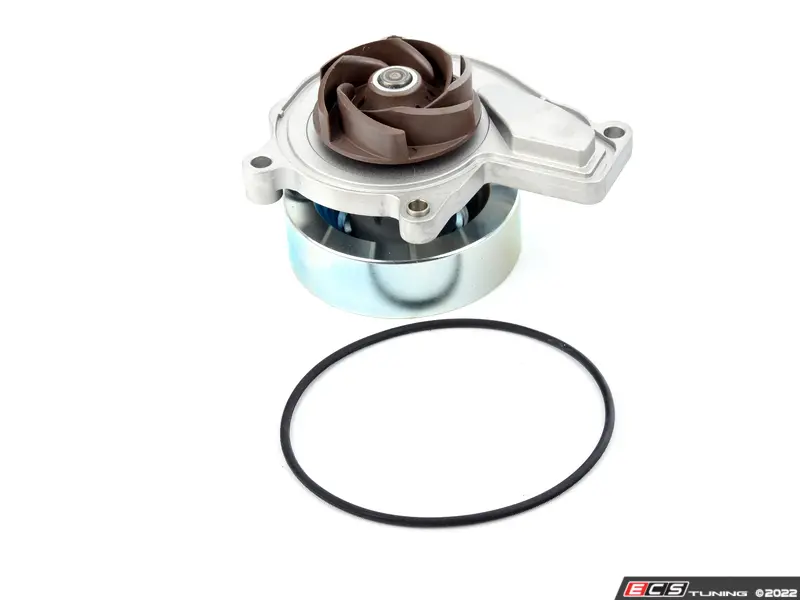
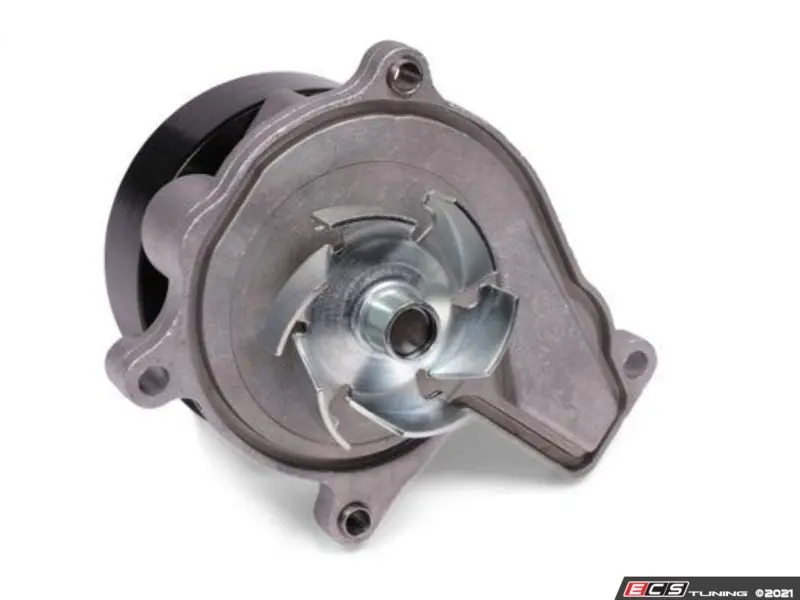
@ECSTuning question, ECS has 2 Meyle water pumps on the site, one HD and one not, but the description on both says "Upgraded seals and metal impeller. Keep your coolant flowing properly and your engine temperature under control!"
What's the difference between the two? I assume it isn't that the non-HD is shaped like the pictured cardboard box
Lol, fixed those pictures, just got copied to the wrong product. They are updated now. Should be able to see them now.
Yep metal impeller and upgraded bearing.
We have lifetime replacement on most parts now also, which if their is a warranty from the manufacture, it will be better then that if marked on the site. Lifetime replacement icon shows when you click in on the product detail page view: https://www.northamericanmotoring.co...t-program.html
Lol, fixed those pictures, just got copied to the wrong product. They are updated now. Should be able to see them now.
Yep metal impeller and upgraded bearing.
We have lifetime replacement on most parts now also, which if their is a warranty from the manufacture, it will be better then that if marked on the site. Lifetime replacement icon shows when you click in on the product detail page view: https://www.northamericanmotoring.co...t-program.html
LOL. So no innovative cardboard box-shaped pump. Dang
So -- just to be clear -- *both* Meyle pumps have a metal impeller and upgraded bearing and seals? Still wondering what the diff is between them if so!
Quick update for the masses. Context reminder: I have a B46, not a B48, and I'm in a 2017 F56S.
(1) Confirmed that my crankshaft pulley aka harmonic balancer aka vibration damper (geez this thing has too many names) had more play than it should have. Even with it off the car I can wobble the outer and inner portions independently of each other with my bare hands. Not good. Replaced the pulley at 108.5k miles with the Way Motor Works-flavored ATI Super Damper.
Tips for those looking to replace it DIY-style:
You DO need to replace the four crankshaft pulley bolts -- they are torque-to-yield, to be turned 180 degrees after initial torque-down to 28Nm (these are 2017 B46 torque specs, be sure to confirm for your vehicle). Don't reuse the old bolts trying to save money. If one of the reused ones snaps you know it will be bad and the money you "saved" will not have been worth it by a long shot.
You MIGHT get the old bolts off without locking the flywheel. Maybe.
You WILL NOT be able to do the proper torque-down without locking the flywheel (or figuring out how to lock the crank pulley itself). Be prepared.
If a shop is willing to do the swap for you at what nets out to 2-ish hours times their hourly labor rate, that's fair pricing. Clearance for dealing with the serpentine belt is effectively nonexistent on the B46 and B48 (the belt is wider than the space in front of several of the pulleys). If you trust that shop, pay them to use their tools and their skills (and did I mention their tools?) and buy yourself some coffee just to not have to deal with the serpentine belt yourself. Plus they'll have a flywheel locking tool. Yay.
(2) I have what appears to be a spontaneous oil pan leak, at the oil pan lip above the starter, wicking down the seam between the starter and crankcase and emerging as what looks to the eye like the starter housing is leaking oil. A starter contains no oil, so it is not leaking; the oil is coming from above. Discovered this when I got under the car to deal with the crankshaft pulley. The leak was not there at the last oil change (106.8k miles). This is a slow leak and there are no other signs of oil leaks, anywhere -- not even elsewhere along the oil pan seam. In any case, an oil pan reseal appears to be something to look forward to (I have not taken this on yet but I will).
Even though I am cursing the design-root-cause of these two items, not to mention the whole oil cooler thing and the upper engine mount thing, the repair/replace ops to date are holding up well. The major takeaway -- which will not be a surprise to many -- is "hey, it's man made, every part is a wear item, the only question is how fast the wear-out is."
For reference again: 2017 F56S, B46 engine rather than B48. The two engines have plenty of parts in common, so germane to this thread. 111.5k miles now.
Because I trust the car enough to do road trips with it but not enough to bet that I will emerge maintenance-unscathed, I have taken to doing two things in particular.
(1) At oil change (every 5k miles), pull the underbody panel, and look around. This has been good tactical -- I have found both oil and coolant leaks this way that I would not have found otherwise.
(2) Scan the car, using Bimmerlink in my case at all levels (Permanent, Error, and Info) to see what the car is up to.
That last one is reinforced by this post. I have found 2 separate issues, both critical if not handled and things where one probably "doesn't want to figure out how bad it has to get for the check engine light to come on," by scanning the car proactively.
Issue one was my turbo running coolant-dry due to materials and then gasket failure of the oil filter housing / engine oil cooler. Posts about that above, from me and others. But I think my experience is the only one that dug out a nasty error-level code that did *not* throw a check engine light, but things were clearly... uh... at risk, or at least the DME thought so. Hit the link for detail.
Issue two is an error-level code, not causing the check engine light to come on. "190F08: Tank ventilation system: malfunction".
This is where things get interesting.
(1) There is a TSB (attached to this post) for the fuel tank vent (breather) purge valve. However, the F56 production range that the TSB names stops four months short of mine (TSB ends 6/2016; my F56S was produced 10/2016). That TSB specifies a warranty extension to 10 years / 120k miles. My VIN is not one of those covered by the vehicle.
(2) I decided, for the heck of it, to pop the valve and be nosy. If you take the "pretty cover" off of the engine top, the valve is literally right in front of you, sitting on the intake manifold. Easy to access, easy to disconnect.
(3) I have removed the valve several times as part of unrelated work that mandated getting the valve physically out of the way. So I know from seeing it plenty of times over the last X years that it should, to the eye and hand alike, be bone dry. One would not look for leaks in it.
(4) Mine not only had a leak (or leaks), but I found the leak when, after pulling the valve off with my hand, I found my fingers covered in a lot of black carbon suspended in a clear fluid. It didn't reek of gasoline but, well, likely condensation of the evap gases that the setup is intended to feed back into the intake in the first place.
(5) The genuine BMW/MINI part number is 13907621174 and the part itself is a Bosch, with Bosch part number 0280142525. This matches the leaking part on my car. This genuine part runs anywhere from $66 - $120 depending upon where you get it. The "aftermarket Bosch part" number appears to be 0280142524 -- one digit off. The "aftermarket Bosch part" can be had for sub-$30 at a few places online (AutohausAZ, ECS Tuning).
(6) Most interesting to me -- my on-car part also has a manufacture date stamped on it. 13 December 2019, which is 3 years and change younger than my car. This tells me it has been replaced before -- despite me not finding it anywhere in the service history under the car's 2019-era owner.
Also, after finding the code for the 2nd time (scans were about 3K miles apart), my fuel economy dropped sharply -- 28-32 mpg down to 24 mpg, no explanation / change in driving / etc. I'm guessing the valve issues finally "got real" during that tank that yielded 24.
My take is that this is a "thing." In other MINI discussion spaces I am seeing it pop up for 2015-2016 MINIs, and there is also discussion in the context of B series engines in BMW forums. Given that any malfunction on it might cause other things dependent upon whatever pressure it might regulate to have issues, I am glad that my nosiness found this. But of significant note is that without me scanning the car proactively, I would not have found it at all.
I could go one of two ways on this. The obvious one is "why doesn't BMW have this throw a light, and this car is too electronically fancy." But the other is that my other ride is a not-electronically-fancy car, and without some code to find -- even by digging -- I would never have decided to grab this valve by hand and find out serendipitously that it was leaking.
So my recommend to all is: scan your car on the regular if you can. If nothing else, do it at every oil change (and your oil changes should be more frequent han every 10k, regardless of BMW recommend).
Stuff attached for reference.
Circled: one of multiple wet locations on the valve. I ended up with stuff all over my fingers. Prior to this inspection, every time I had handled this valve, going back 2 years, it was bone-dry to the touch.
I made a list of failure points when I was looking at purchasing a Fxx. Over time I have added to it. This is the current list. Feel free to correct/add/change as I am just an untrained enthusiast. I will note in my board walks there are several people with 170k mile cars with minimal issues.
1. FIrst two years had potential bearing shell issues in manuals that resulted in new shells or new engine. Crank moved laterally, "crank walk”/. There was a campaign so should be resolved.
2. First year maybe two had leaking oil filter cartridge housings, apparently fixed right away. Also hearing failures at higher miles not sure years
3. Serious issue, wire harness under hood in rear corner opposite transmission side allowed water intrusion and rotting wires. Expensive to fix replacing part of the wire harness. Fix ranges from $1500 to $2500 it seems Fixed in 2018.
4. Front control arm bushings fail early, perhaps 30-40K miles. An upgrades part came out, don/t know the date
5. Top motor mounts fails early. There was a first revision that also failed. A second revision October 2020 we still don't know if works
6. Top strut bearing. I learned of that relatively recently. Don't know the frequency
7. Left rear tail light corrosion or melting including harness plug. Right side unaffected. Don't know if Union Jack light has the same issue
8. Automatic before electronic shift lever has a lever position switch the spring breaks on. About $1500-$2000 to replace assembly. It will break again.
9. B pillar door rub and pain wear at shoulder. After market clear vinyl shield highly recommended!
10. (only a couple) 3 cylinder sounds like rattling marbles upon start at idle for minute or more. I experienced this once in very cold. Cleared up.
11. Harmonic balancer (not sure this miles)
Looks like it is missing the evap valve. Also some seem to have boot and interior water collection.
I visually inspected the purge valve today. It took me an entire 30 seconds to disconnect it.
MINI wants me to leave the car for AT LEAST a day. Dealership isn't near me. Don't know what to do. They told me to leave a voicemail to the service manager to see if they might give me a loaner. Doubt it.
Funny thing is I didn't know if there was any way to test the purge valve so i just randomly blew into it hearing that air was going through the other end and apparently this is how you tell that it's stuck open. I'm thinking to just buy it on ebay for $20 and replace it myself instead of going through the dealer hassle.
Funny thing is I didn't know if there was any way to test the purge valve so i just randomly blew into it hearing that air was going through the other end and apparently this is how you tell that it's stuck open. I'm thinking to just buy it on ebay for $20 and replace it myself instead of going through the dealer hassle.
Different TSB here, with pics pertaining to how to inspect. May be useful.
I have a Bosch valve on order for $35 including shipping, from AutohausAZ. I figure it's worth my time given that mine is clearly broken, especially at that price.
Personally, I'd be wary of "eBay specials." The location of manufacture is written on the valve -- compare to my pic above for reference.
Don't think it's really a part that would make a huge difference in manufacturer. Plus if anything it can be replaced again affordably if anything happens. The difference is like $20 between Bosch and China which most likely is just a brand premium any way. Of course I agree that for more complicated parts OEM is always the best.
Don't think it's really a part that would make a huge difference in manufacturer. Plus if anything it can be replaced again affordably if anything happens. The difference is like $20 between Bosch and China which most likely is just a brand premium any way. Of course I agree that for more complicated parts OEM is always the best.
From a cost and ease of replacement perspective -- of the valve proper -- I follow. Same in re name premium.
That said, given that the valve in question is literally a feed into the intake manifold, with no filter between it and the intake valves, my take is simultaneously "if something breaks inside that thing because by bad luck I landed a cheap knockoff, I kinda don't want whatever broke or fragments of whatever broke finding their way into my intake manifold, valves, etc."
Visual on leaking fuel tank vent valve (purge valve)
For interested parties, confirmed that the fuel tank vent valve (EVAP purge valve, if one wants to speak generally), which sits right on the front of the intake so access is easy, was indeed leaking. See video.
Old valve had a manufacture date of 13 Dec 2019, well after the car was produced so someone replaced this valve previously. New valve has a manufacture date of 2 Jun 2023 (I said July in the video but you can see the date, so forgive my misspeak).
I think this valve can actually cause a myriad of issues if it goes bad. First off, even if its stuck open, you're not guaranteed to get a CEL for it. The other thing is that the car probably runs rich all the time because the valve keeps venting fuel back when its not needed and doesnt have enough to vent when it is.
I think this valve can actually cause a myriad of issues if it goes bad. First off, even if its stuck open, you're not guaranteed to get a CEL for it. The other thing is that the car probably runs rich all the time because the valve keeps venting fuel back when its not needed and doesnt have enough to vent when it is.
Absolutely. And that no-CEL business — for this and other conditions — is why I recommend proactively scanning the car for codes that aren’t making the CEL come on. I plan to scan my car at each oil change (5k miles), if not more often.
And yes, what you said about the myriad of crazy things that you can wind up with when this valve goes bad. My MPG went into the tank (no pun intended) shortly after I found the quiet-code for the second time — down to 24 mpg from high 20s/low 30s. Didn’t take much to draw the connection, but wow. Clearly I started running rich.
I read on a BMW forum that one is supposed to reset the fuel mixture adaptations after replacing the valve (I believe the source of that guidance is actually ISTA). I did that after replacing mine. But nobody without ISTA or a real scanner (Foxwell for example) can execute that. So folks running into this concern should get ready for some fun.
Hmm. In any case AFR is adjusted in real time so there shouldn't be much issue as long as MAF is reading correctly and the purge is working as it should.
Hmm. In any case AFR is adjusted in real time so there shouldn't be much issue as long as MAF is reading correctly and the purge is working as it should.
Yeah, I would imagine the reset business is more about getting the car to unlearn stuff from the bad valve (or whatever the circumstance) more or less immediately vs over time.











 Should be able to see them now.