


Drivetrain Operation Hot Air Intake


6th Gear
Joined: Aug 2002
Posts: 2,253
Likes: 0
From: NY NY
actually, i was unhappy with how hot the water gets before the fan turns on (215 degrees) so I attempted to put in a standalone thermostat control. blew fuses do to a meager relay system and my meager understanding, so I went back. nine months later it is biting me in the ***.

Thread Starter
|
6th Gear
Joined: Oct 2002
Posts: 3,652
Likes: 6
From: Lansdale, PA
Ryan,
I'd be curious to see you MAP data with the Unichip removed. I realize that doesn't have anything to do with the HAI, but your MAP readings do not reflect actual manifold pressure. I noticed that in your revised runs with RPM, the low-boost anomaly with the HAI is gone.
I'd be curious to see you MAP data with the Unichip removed. I realize that doesn't have anything to do with the HAI, but your MAP readings do not reflect actual manifold pressure. I noticed that in your revised runs with RPM, the low-boost anomaly with the HAI is gone.


6th Gear
Joined: Jan 2003
Posts: 1,816
Likes: 2
From: New Jersey
Originally Posted by Ryephile
Part 1: RPM vs. MAP, ALTA CAI vs. K&N 1550 "HAI", WOT, 2nd gear, ambient temp: 41F

In raw numbers - the ALTA CAI had a peak MAP reading of 0.6 inHg (or 0.29PSI) higher than the "HAI". The ALTA also has slightly higher MAP across the board. As you can see, this is in RPM, so there's no chance of funky data sample rates.
Coming soon - Part 2; Dyno, HP and Lb-Ft.
In raw numbers - the ALTA CAI had a peak MAP reading of 0.6 inHg (or 0.29PSI) higher than the "HAI". The ALTA also has slightly higher MAP across the board. As you can see, this is in RPM, so there's no chance of funky data sample rates.
Coming soon - Part 2; Dyno, HP and Lb-Ft.
How are you calculating PSI to two decimal place precision? My OBDII reads only integer values of kPa on the Cooper S. Im not sure if better resolution is possible via OBD II.
6th Gear
Joined: Jan 2003
Posts: 1,816
Likes: 2
From: New Jersey
Originally Posted by Ryephile
Part 2: wheel HP & wheel Lb-Ft; ALTA CAI vs. K&N 1550 "HAI", 2nd gear, WOT, SAE J1349 corrected

As you can see - the ALTA CAI has a power and torque gain over the HAI through most of the band. This explains why my car didn't feel as quick with the HAI. It also shows that MAP isn't the whole story with making power. Perhaps acoustics play factor, and perhaps the velocity stack effect the UNI filter has going into the silicone tube. Perhaps it's just my car, but these are the figures.
I applaud macncheese for coming up with the HAI idea - it's a brilliant one. I encourage everyone to take innovative approaches to getting more performance out of the MINI. For my MINI, the HAI didn't work that well. I wish it had, but hope doesn't fuel dyno figures.
Cheers,
Ryan
As you can see - the ALTA CAI has a power and torque gain over the HAI through most of the band. This explains why my car didn't feel as quick with the HAI. It also shows that MAP isn't the whole story with making power. Perhaps acoustics play factor, and perhaps the velocity stack effect the UNI filter has going into the silicone tube. Perhaps it's just my car, but these are the figures.
I applaud macncheese for coming up with the HAI idea - it's a brilliant one. I encourage everyone to take innovative approaches to getting more performance out of the MINI. For my MINI, the HAI didn't work that well. I wish it had, but hope doesn't fuel dyno figures.
Cheers,
Ryan
--
Cheese

To put it simply - the HAI made it tough to spin the tires in 2nd gear whereas the ALTA CAI was more effortless to spin the tires in 2nd gear. It's possible the HAI yielded less power on my car than the stock airbox, though I have not done measurements recently that would be relevant. I must say I did prefer the smooth drivability of the HAI - however the ultimate lack of power made the less refined drivability of the ALTA worth the compromise.

Now I'm all confused!
Originally Posted by andy@ross-tech.com
Here's a couple graphs. Note that these were done on different days. Air temps were similar and the same stretch of road was used.
I'll need to do multiple runs with each configuration on the same day to get a good picture of the pressure drop. Also, I plan to log temps with all of those runs as well.
That said, the HAI looks very promising:
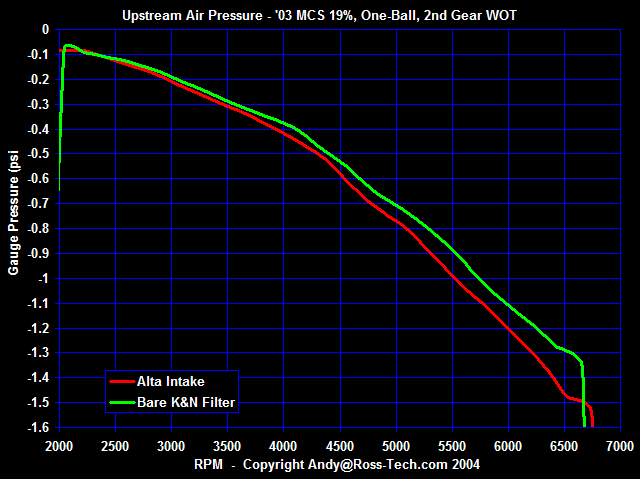
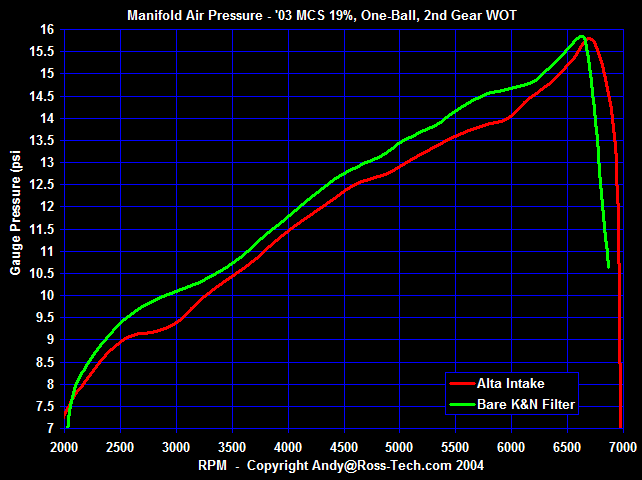
I'll need to do multiple runs with each configuration on the same day to get a good picture of the pressure drop. Also, I plan to log temps with all of those runs as well.
That said, the HAI looks very promising:
Matt
Matt: Andy has not performed dyno runs of any sort on his HAI, so the MAP readings only show part of the story. Pressure does not equal [laminar] airflow. Andy also didn't log those runs on the same day. While he states the temps were simlar, that does not mean the atmospheric pressures were similar.
Ryan
Ryan

Manufacturer
Joined: Dec 2002
Posts: 995
Likes: 0
From: Oregon
Ryephile,
Wow, thanks again for the hard work, and pruving what we have always said, "Our intake gains 10-12WHP". It doesn't surprise me at all with the upstream intake pressure, and it being lower than the KN. With our larger intake tube and better higher flowing filter, it should be lower. Although the boost graph is kind of wierd?????It looks like it needs to be offset back a little for the peak boost/redline to line up. These were on different days, right? This is something i would expect to see (boost dropping) when an exhaust and header are installed, but not with an intake.
Great work, and if you would like our dyno graphs with stock intake vs. ours let me know!
maxmini, asked whats next? I too have been looking for the comparo with our part vs. the AGS. When can we all plan on seeing this? I also would love to see the JCW intake vs. ours. I think people will be completly surprised that our intake still out performs the JCW part.
ALTA performance
Wow, thanks again for the hard work, and pruving what we have always said, "Our intake gains 10-12WHP". It doesn't surprise me at all with the upstream intake pressure, and it being lower than the KN. With our larger intake tube and better higher flowing filter, it should be lower. Although the boost graph is kind of wierd?????It looks like it needs to be offset back a little for the peak boost/redline to line up. These were on different days, right? This is something i would expect to see (boost dropping) when an exhaust and header are installed, but not with an intake.
Great work, and if you would like our dyno graphs with stock intake vs. ours let me know!
maxmini, asked whats next? I too have been looking for the comparo with our part vs. the AGS. When can we all plan on seeing this? I also would love to see the JCW intake vs. ours. I think people will be completly surprised that our intake still out performs the JCW part.
ALTA performance
Thread Starter
|
6th Gear
Joined: Oct 2002
Posts: 3,652
Likes: 6
From: Lansdale, PA
Originally Posted by ALTA2
Ryephile,
Wow, thanks again for the hard work, and pruving what we have always said, "Our intake gains 10-12WHP". It doesn't surprise me at all with the upstream intake pressure, and it being lower than the KN. With our larger intake tube and better higher flowing filter, it should be lower. Although the boost graph is kind of wierd?????It looks like it needs to be offset back a little for the peak boost/redline to line up. These were on different days, right? This is something i would expect to see (boost dropping) when an exhaust and header are installed, but not with an intake.
Wow, thanks again for the hard work, and pruving what we have always said, "Our intake gains 10-12WHP". It doesn't surprise me at all with the upstream intake pressure, and it being lower than the KN. With our larger intake tube and better higher flowing filter, it should be lower. Although the boost graph is kind of wierd?????It looks like it needs to be offset back a little for the peak boost/redline to line up. These were on different days, right? This is something i would expect to see (boost dropping) when an exhaust and header are installed, but not with an intake.
These comparisons were not done between the K&N Typhoon and the Alta. They were done between a bare K&N RU-1551 clamped directly to the throttle body, compared to the Alta intake. So, your statement about the "larger intake tube" makes no sense. There is no tube at all in the HAI setup.
That said, I'd like to see your dyno plots.
Manufacturer
Joined: Dec 2002
Posts: 995
Likes: 0
From: Oregon
andy,
I was first refering to the upstream graph and how it was lower, then refering to the boost pressure graph. I missed the fact the unichip is involved, that would explain some differences in the manifold pressure being off.
As for the intake tube, i should have thought before i typed, you are right.
Here are the graphs, note the 10peak WHP gain, and the 13WHP gain at 6k. Torque gained 10ft/lbs from 5k up with a peak of 6ft/lbs at 4k. And this was back when we were using a slightly more restrictive filter! Here is the MD graph!
I was first refering to the upstream graph and how it was lower, then refering to the boost pressure graph. I missed the fact the unichip is involved, that would explain some differences in the manifold pressure being off.
As for the intake tube, i should have thought before i typed, you are right.
Here are the graphs, note the 10peak WHP gain, and the 13WHP gain at 6k. Torque gained 10ft/lbs from 5k up with a peak of 6ft/lbs at 4k. And this was back when we were using a slightly more restrictive filter! Here is the MD graph!
6th Gear
Joined: Jan 2003
Posts: 1,816
Likes: 2
From: New Jersey
Originally Posted by ALTA2
I was first refering to the upstream graph and how it was lower,
--
Cheese

6th Gear
Joined: Jan 2003
Posts: 3,301
Likes: 1
Originally Posted by ALTA2
andy,
I was first refering to the upstream graph and how it was lower, then refering to the boost pressure graph. I missed the fact the unichip is involved, that would explain some differences in the manifold pressure being off.
As for the intake tube, i should have thought before i typed, you are right.
Here are the graphs, note the 10peak WHP gain, and the 13WHP gain at 6k. Torque gained 10ft/lbs from 5k up with a peak of 6ft/lbs at 4k. And this was back when we were using a slightly more restrictive filter! Here is the MD graph!
I was first refering to the upstream graph and how it was lower, then refering to the boost pressure graph. I missed the fact the unichip is involved, that would explain some differences in the manifold pressure being off.
As for the intake tube, i should have thought before i typed, you are right.
Here are the graphs, note the 10peak WHP gain, and the 13WHP gain at 6k. Torque gained 10ft/lbs from 5k up with a peak of 6ft/lbs at 4k. And this was back when we were using a slightly more restrictive filter! Here is the MD graph!
Have you had the opportunity to compare the 05 JCW dual stage AI to your current Alta? On and otherwise stock 05 JCW - in an effort to keep all things equal.
Manufacturer
Joined: Dec 2002
Posts: 995
Likes: 0
From: Oregon
Originally Posted by macncheese
You're looking at a graph of negative pressure. Yours is lower only graphically, its HIGHER numerically. The larger absolute pressure value indicates more work is being done to pull the desired ammount of air into the system. ie your system performs worse
--
Cheese
--
Cheese
Your right, i was just not reading the graph correctly. But since was done on a different day with different AP, then the very slight .1 psi is nothing to even worry about. And it is obvious that our intake doesn't perform worse from the dyno graph. There are to many variables with these graphs to make a difinative descision about what they mean. Logs from the Same day, same road, 5 minutes apart would clear that up for us.
meb,
I have looked at one very closely, and i hate to say it is a waste of money. The filter/airbox is basically the same as the S, except for this rather small hole that opens up under some peticular load. I say small hole because compared to ours, which removes that whole plastic wall, it is small. The rubber hose that runs from the air box to the TB looks like the same small size. I think the price that mini is charging is way too much for what it does. I would put our intake up agaist the JCW anyday, because i am sure it will make more power and for less money.
ALTA PERFORMANCE
6th Gear
Joined: Jan 2003
Posts: 1,816
Likes: 2
From: New Jersey
Originally Posted by ALTA2
Cheese,
Your right, i was just not reading the graph correctly. But since was done on a different day with different AP, then the very slight .1 psi is nothing to even worry about. And it is obvious that our intake doesn't perform worse from the dyno graph. There are to many variables with these graphs to make a difinative descision about what they mean. Logs from the Same day, same road, 5 minutes apart would clear that up for us.
Your right, i was just not reading the graph correctly. But since was done on a different day with different AP, then the very slight .1 psi is nothing to even worry about. And it is obvious that our intake doesn't perform worse from the dyno graph. There are to many variables with these graphs to make a difinative descision about what they mean. Logs from the Same day, same road, 5 minutes apart would clear that up for us.
The .2 PSI upstream difference between the two is nothing to sneeze at. That about 15% different, no? That "dyno graph" isn't exactly legit. It's also generated/computed from OBDII data. --
Cheese
6th Gear
Joined: Jan 2003
Posts: 3,301
Likes: 1
Thought so...I wrote an entire reply regarding the thinking that went into the JCW kit. Thought I would be kind and spared all of you, I erased it. But really, $6,000???
The more I learn about this kit the more I feel like making like Jim Carrey in Liar Liar - beating himself up in the bathroom. I need a tylenol!
The more I learn about this kit the more I feel like making like Jim Carrey in Liar Liar - beating himself up in the bathroom. I need a tylenol!

1st Gear
Joined: Jul 2003
Posts: 36
Likes: 0
From: Texas
Well....to add to all this dyno "theory"
I'll be putting my hai\one-ball\15% pulley up to the dyno (248c dynojet) in the next coming weeks.
It will be 3 pulls. 1 with the above setup, 1 with stock intake and above, and 1 with k&N drop in panel filter, stock box and above setup.
I'll post the 3 pulls when i get them. Wish i had an alta to throw in the mix ...
...
Maybe ill see about buying a used one soon.
Will.
I'll be putting my hai\one-ball\15% pulley up to the dyno (248c dynojet) in the next coming weeks.
It will be 3 pulls. 1 with the above setup, 1 with stock intake and above, and 1 with k&N drop in panel filter, stock box and above setup.
I'll post the 3 pulls when i get them. Wish i had an alta to throw in the mix
...Maybe ill see about buying a used one soon.
Will.
6th Gear
Joined: Jan 2003
Posts: 1,816
Likes: 2
From: New Jersey
Originally Posted by sevin626
Well....to add to all this dyno "theory"
I'll be putting my hai\one-ball\15% pulley up to the dyno (248c dynojet) in the next coming weeks.
It will be 3 pulls. 1 with the above setup, 1 with stock intake and above, and 1 with k&N drop in panel filter, stock box and above setup.
I'll post the 3 pulls when i get them. Wish i had an alta to throw in the mix...
Maybe ill see about buying a used one soon.
Will.
I'll be putting my hai\one-ball\15% pulley up to the dyno (248c dynojet) in the next coming weeks.
It will be 3 pulls. 1 with the above setup, 1 with stock intake and above, and 1 with k&N drop in panel filter, stock box and above setup.
I'll post the 3 pulls when i get them. Wish i had an alta to throw in the mix
...Maybe ill see about buying a used one soon.
Will.
--
Cheese
4th Gear
Joined: Dec 2004
Posts: 421
Likes: 0
From: Apex, NC
The hard thing about dynos... it's completely different in terms of airflow than if you were accelerating on a road, even with big fans. Especially since on the road - the hood is down, and on a dyno it's pretty much always up.

What is next? Here you go....
I believe this is the right time to share this modification that I have done to my car over a year ago.
SAI - Split Air Intake
Because the opening on the hood for the Intercooler is larger than the intercooler itself, I wanted to use this wasted space and channel the air to the air filter intake. I made the modified cover for the Intercooler of aluminum. Notice that there is a divider for the side of the intercooler and the new air path to the air filter.
When anyone sees this setup, the first question is always: does this not reduce the air that goes to intercooler? I asked the thermal engineer in my company if this was a concern. He models airflow for a living and has done this for over 25 years. He agreed with my observation that the extra space area not used as an intercooler creates a vortex that would create back pressure and decrease the efficience of the intercooler. By forcing the air that goes to the intercooler to stay in a straght direction to the intercooler, air keeps its velocity better and more will flow through it than in the other set up. Granted, I have not done any experiments to measure this, but it is logical.
Notice that I had kept the air coming from the stock air source, but modified it by increasing the diameter at the later part to the airbox. Just to help some with the backpressure.
I have driven this for over 10K miles and not had any problems at all in heavy rain.
Your comments are welcomed.
Bomboasy
PS. The modified divider cost me about $7 for the "L" aluminum pieces and I cut a piece of an aluminum rack shelf for the rest. I did all the cutting myself. Finding a rubber piece to go the last distance to the air box was not easy. The gap allows water to drop off.
SAI - Split Air Intake
Because the opening on the hood for the Intercooler is larger than the intercooler itself, I wanted to use this wasted space and channel the air to the air filter intake. I made the modified cover for the Intercooler of aluminum. Notice that there is a divider for the side of the intercooler and the new air path to the air filter.
When anyone sees this setup, the first question is always: does this not reduce the air that goes to intercooler? I asked the thermal engineer in my company if this was a concern. He models airflow for a living and has done this for over 25 years. He agreed with my observation that the extra space area not used as an intercooler creates a vortex that would create back pressure and decrease the efficience of the intercooler. By forcing the air that goes to the intercooler to stay in a straght direction to the intercooler, air keeps its velocity better and more will flow through it than in the other set up. Granted, I have not done any experiments to measure this, but it is logical.
Notice that I had kept the air coming from the stock air source, but modified it by increasing the diameter at the later part to the airbox. Just to help some with the backpressure.
I have driven this for over 10K miles and not had any problems at all in heavy rain.
Your comments are welcomed.
Bomboasy
PS. The modified divider cost me about $7 for the "L" aluminum pieces and I cut a piece of an aluminum rack shelf for the rest. I did all the cutting myself. Finding a rubber piece to go the last distance to the air box was not easy. The gap allows water to drop off.

3rd Gear
Joined: Apr 2004
Posts: 155
Likes: 0
From: Twin Falls, Idaho
Originally Posted by bomboasy
When anyone sees this setup, the first question is always: does this not reduce the air that goes to intercooler?

Air intake
Bomboasy,
Would it be possible to remove the inside of the scoop(under the hood) and put some kind of rubber boot or maybe a rubber hose, split to fit over the top of the aluminum so you get a better seal to the hood. It is something I have been playing around with also, but I was using ABS plastic instead of aluminum. Also, you are right, there is more air coming in and just swirling around in the engine compartment, just need to funnel it to the right place. Just curious.
Chuck
Would it be possible to remove the inside of the scoop(under the hood) and put some kind of rubber boot or maybe a rubber hose, split to fit over the top of the aluminum so you get a better seal to the hood. It is something I have been playing around with also, but I was using ABS plastic instead of aluminum. Also, you are right, there is more air coming in and just swirling around in the engine compartment, just need to funnel it to the right place. Just curious.
Chuck
1st Gear
Joined: Jul 2003
Posts: 36
Likes: 0
From: Texas
Originally Posted by WindMeUp
The hard thing about dynos... it's completely different in terms of airflow than if you were accelerating on a road, even with big fans. Especially since on the road - the hood is down, and on a dyno it's pretty much always up.
Like i said, ill post up some charts when i get this done. But first, my cars going in for a new clutch
 .
.Will.