


Drivetrain BSH catch can and dual boost port install


I was under the assumption just do it w/ oil changes, but they say if you drive in winter, the more you drive the more often to check because the can will trap water too which could freeze if the car sits, and gets cold enough


Former Vendor
Joined: Feb 2010
Posts: 62
Likes: 0
Each car is going to be different, so there is no good blanket time period. When you first get the CC, check it often as 09MellowJCW has been and you will be able to set your schedule of when to empty.
Glad to hear the Catch Can is doing its job and protecting your turbo and engine!
We supply a drain plug and if you wrap it in teflon, you should not have an issue with leaking. Tighten the plug until it is flush with the can.
Yes, a Catch can will create separation of blow by and prevent carbon build in the intake on an Automatic.
Actually they posted in this thread. I checked under the hood today and the drain plug was dripping a little. I guess I'll have to find another solution to that problem. The O ring isn't working. I'll probably try a flatter rubber washer with a metal washer over it. I'm trying to avoid wrapping it with teflon tape. Maybe a tappered plastic plug?
We'll see...
It did catch a LOT of oil and water though! I was surprised just how much was in there actually.
We'll see...
It did catch a LOT of oil and water though! I was surprised just how much was in there actually.
We supply a drain plug and if you wrap it in teflon, you should not have an issue with leaking. Tighten the plug until it is flush with the can.
Yes, a Catch can will create separation of blow by and prevent carbon build in the intake on an Automatic.
Last edited by Sales@BSH; Mar 2, 2010 at 11:02 AM.


I just want to clear something up here.
The BSH catch can is a great product in my opinion. The drain plug really is a non-issue. I'm sure it would work just fine with the teflon tape. I just wanted to find a way to not have to use tape. Not that using it is really THAT big of a deal...
Anyway, I went to Home Depot yesterday and picked up a teflon 3/8 flat washer and a flat rubber washer and installed them on the plug. I think this will take care of the problem nicely. The Plastic washer allowing the head of the bolt to put pressure on the rubber without trying to pull through.
As far as the freezing issue? That is one more reason, IMO, to buy the BSH can over the others. The lines don't neck down to a smaller size than factory like all the rest. This, I would think, would greatly reduce the chance of water freezing in them. As far as water freezing in the can itself? First, you have to remember that it's mixed with oil. It's also located in a hot engine bay.
Next, the can would have to be full beyond the top fittings to stop the gasses from flowing through the lines. I'm not worried about a freezing issue at all.
If you are on the fence about this can, take it from someone who has it. Buy it. From the amount of water and oil it caught in the first two weeks I had it, I only wish I had gotten one sooner.
The BSH catch can is a great product in my opinion. The drain plug really is a non-issue. I'm sure it would work just fine with the teflon tape. I just wanted to find a way to not have to use tape. Not that using it is really THAT big of a deal...
Anyway, I went to Home Depot yesterday and picked up a teflon 3/8 flat washer and a flat rubber washer and installed them on the plug. I think this will take care of the problem nicely. The Plastic washer allowing the head of the bolt to put pressure on the rubber without trying to pull through.
As far as the freezing issue? That is one more reason, IMO, to buy the BSH can over the others. The lines don't neck down to a smaller size than factory like all the rest. This, I would think, would greatly reduce the chance of water freezing in them. As far as water freezing in the can itself? First, you have to remember that it's mixed with oil. It's also located in a hot engine bay.
Next, the can would have to be full beyond the top fittings to stop the gasses from flowing through the lines. I'm not worried about a freezing issue at all.
If you are on the fence about this can, take it from someone who has it. Buy it. From the amount of water and oil it caught in the first two weeks I had it, I only wish I had gotten one sooner.

considering i had some in mine just yesterday... nothing... it's gonna happen that you have some water in the catch can and not just oil. if it freezes, which it most likely wont, its outside the engine and since the catch can isn't a moving part (i'd be scared if it did... might come dump excess oil on my head when i sleep if i don't change it enough). not to mention chances are it wouldnt be pure water anyway... unless your catch can is randomly catching a blue tinted water... then check your coolant overflow for drops of oil in it, if you see that that means you have a coolant leak somewhere and THAT"S no bueno.


2nd Gear
Joined: Jul 2009
Posts: 127
Likes: 1
I would like to install an OCC, but I'm having a hard time figuring out where to put it. I have a DoS CAI, which seems to effectively bar me from placing the OCC in either of the two usual spots. Any suggestions - perhaps from other folks with DoS CAI's installed?
You can take out the original intake tube and install it in the alternative position. It really looks good see my pictures above.

I just put the DoS intake on today. The good thing about it is that it opens up a LOT of room on the firewall to put anything you want on it.
Here's what I did with my can. I just made a bracket and put it on the firewall. Actually, I got a bracket from Home Depot and tweaked it a Little. I was going to put it closer to the drivers side but I didn't like the sharp bends it put in the hoses.


Former Vendor
Joined: Dec 2009
Posts: 59
Likes: 0
From: Speedshop, Arizona
No, you don't want to do that. The DoS intake uses the factory intake pipe in conjunction with air from the cowl.
I just put the DoS intake on today. The good thing about it is that it opens up a LOT of room on the firewall to put anything you want on it.
Here's what I did with my can. I just made a bracket and put it on the firewall. Actually, I got a bracket from Home Depot and tweaked it a Little. I was going to put it closer to the drivers side but I didn't like the sharp bends it put in the hoses.
I just put the DoS intake on today. The good thing about it is that it opens up a LOT of room on the firewall to put anything you want on it.
Here's what I did with my can. I just made a bracket and put it on the firewall. Actually, I got a bracket from Home Depot and tweaked it a Little. I was going to put it closer to the drivers side but I didn't like the sharp bends it put in the hoses.

Catch Can and DoS Intake

Drained about 10 oz. of stuff out of the can after 500 miles. When I first looked at fluid that came out it looked like rusty water with a cloud of white emulsified oil on top, After sitting for a week it has settled to three layers; rusty water (70%), emulsified oil (15%) and thin black oil (15%). This makes sense when you think that blow-by gas is mostly water and carbon monoxide.
The catch can is a Draft Design can which has three levels of baffles between the inlet (lower connection) and the outlet (upper connection). That seems to be a good design to me.
Cheers,
Greg
Former Vendor
Joined: Dec 2009
Posts: 59
Likes: 0
From: Speedshop, Arizona
Here is a photo of where I put my catch can. It is connected in the PCV vent line going from the passanger's side of the valve cover to the intake manifold. If you are going to use only one catch can this IS the line to put it in.
Drained about 10 oz. of stuff out of the can after 500 miles. When I first looked at fluid that came out it looked like rusty water with a cloud of white emulsified oil on top, After sitting for a week it has settled to three layers; rusty water (70%), emulsified oil (15%) and thin black oil (15%). This makes sense when you think that blow-by gas is mostly water and carbon monoxide.
The catch can is a Draft Design can which has three levels of baffles between the inlet (lower connection) and the outlet (upper connection). That seems to be a good design to me.
Cheers,
Greg
Drained about 10 oz. of stuff out of the can after 500 miles. When I first looked at fluid that came out it looked like rusty water with a cloud of white emulsified oil on top, After sitting for a week it has settled to three layers; rusty water (70%), emulsified oil (15%) and thin black oil (15%). This makes sense when you think that blow-by gas is mostly water and carbon monoxide.
The catch can is a Draft Design can which has three levels of baffles between the inlet (lower connection) and the outlet (upper connection). That seems to be a good design to me.
Cheers,
Greg

The positioning looks good, I am assuming you had to get more hose though?
Former Vendor
Joined: Dec 2009
Posts: 59
Likes: 0
From: Speedshop, Arizona
Keep an eye on that heater hose. Its ok with temperature but might/most likely will sweat oil. If you have an issue with this down the road please feel free to contact us for some hose, we keep the hose we supply on hand in bulk and would be happy to cut you a custom length if you require it.
Keep an eye on that heater hose. Its ok with temperature but might/most likely will sweat oil. If you have an issue with this down the road please feel free to contact us for some hose, we keep the hose we supply on hand in bulk and would be happy to cut you a custom length if you require it.
I'll give you a call on Mon. and get the correct hose. I must admit that I was only thinking of heat and pressure when I bought the heater hose. I didn't even consider the oil.
About running the catch can on that other pass side line.... That is still not going to keep all the oil out of the turbo and intercooler though is it? That just stops it from entering the intake after the intercooler, correct?
Just trying to clarify. My whole goal is trying to keep that stuff clean in there lol
Just trying to clarify. My whole goal is trying to keep that stuff clean in there lol
About running the catch can on that other pass side line.... That is still not going to keep all the oil out of the turbo and intercooler though is it? That just stops it from entering the intake after the intercooler, correct?
Just trying to clarify. My whole goal is trying to keep that stuff clean in there lol
Just trying to clarify. My whole goal is trying to keep that stuff clean in there lol
Now you are getting into a somewhat tricky area - how does the MINI PCV system really work? I have been looking into this for a couple of weeks and I think I have a pretty good idea, but am going to confirm it with a Ph.D. automotive engineer at work (who used to do design work for Ford on their engines).
The two lines are part of the same system, but they perform generally different functions. For a PVC system to work the way it is suppose to there needs to be a line which brings clean air in, and a line which discharges the blow-by gas, oil vapor, water vapor, etc. The "air in" line needs to be after the MAF on our cars otherwise the ECU would be incorrectly accounting for air in the intake. The primary purpose of the line on the driver's side (from the side of the valve cover to the turbo inlet) is to SUPPLY fresh air to the crank case. The air is then circulated through the crank case, picks up moisture, blow-by gas, etc, and DISCHARGES out the line on the passanger side of the crank case that leads to the intake manifold.
This route work most of the time because at idle the intake manifold is at about 10 psi of vacuum and the turbo inlet side is at a higher pressure (or less vacuum if you will). As you increase rpm the pressure in the intake manifold rises. At some point with increasing rpm the pressure approaches atmospheric (if you have a Scangage II you will see a MAP pressure of around 14 psi absolute). There is a "PCV type" valve in the cylinder head cover on the passanger side line (the discharge line) which closes to keep the higher pressure air (and any potential backfire) from coming into the crankcase. When this happens, the line on the driver's side, which has been acting as an air supply line, now becomes the discharge line. It can do this because the pressure in front of the turbo decreases with increasing flow rate into the turbo as the rpm go up.
So, to answer your question, the only time the line going to the turbo discharges is when the manifold pressure is around or above atmospheric, which means as your boost goes up. If you have a boost gage you will see that this only happens at very high rpm and wheel loading. So if you are racing, the driver's side line sees more duty as the discharge side. For normal driving it doesn't do it very often or for very long.
There have been several folks posting on different threads here who installed their cans the way m7 tells them to (in the driver's side line) and find it doesn't catch much. As I said in an earlier post my can (in the passanger's side line) caught almost 10 oz of fluid in 500 miles.
Now BSH has a proposed system where they plug the line going from the passanger's side to the manifold and put the catch can on the driver's side line. This effectively make the PCV system a one line system and will catch ALL of the fluid ALL of the time. Sounds good, but I am uncomfortable with that idea for one reason. They are defeating the normal operation of the PCV system. Everything I've read on PCV systems say that you need to have an "air in" source to scour the crank case of vapors and that choked or clogged air inlet lines can lead to trouble.
From what I can tell the BSH guys work very hard at getting a good prouduct out and they seem to be very responsive to customer needs. I hope they will also look into this and check on the effects of running a one line PCV system for extended periods.
Sorry for the long response, but getting paid to profess for as long as I have makes me do it even when I don't have to.
Cheers,
Greg
Last edited by NAProf; Mar 13, 2010 at 12:08 PM. Reason: fixed typos
About running the catch can on that other pass side line.... That is still not going to keep all the oil out of the turbo and intercooler though is it? That just stops it from entering the intake after the intercooler, correct?
Just trying to clarify. My whole goal is trying to keep that stuff clean in there lol
Just trying to clarify. My whole goal is trying to keep that stuff clean in there lol
That is the beautiful thing about the BSH can. You put the can in line on the drivers side. Then you buy their Dual Boost Port. The catch an comes with a plug to put in the Dual Boost Port. With the plug installed it blocks off the PCV port on the passenger side. This causes ALL of the gasses to flow through a single catch can, taking care of BOTH PCV ports. This fixes the carbon buildup on the valves AND oil buildup in the turbo and intercooler.

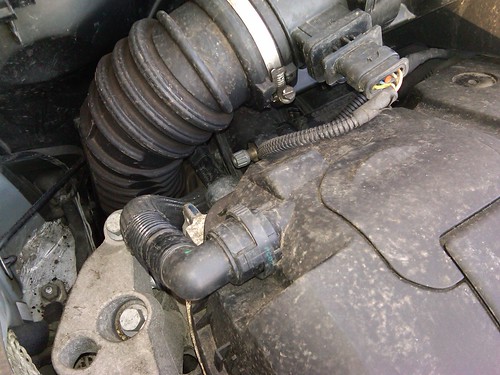
Naturally Aspirated R56 and Catch Can
IMHO you don't need a catch can. You could do as well or better by running something like BG44K, Techron Fuel additive, or the BMW Fuel System Cleaner (part # 82 140413341) every third tank of gas. The reason is that the NA R56 engine (designated N12 engine) injects the gas into the intake manifold. The air gas mixture then is sucked into the cylinder. This allows all the cleaning additives in the fuel to clean the intake manifold and the backside of the intake valves.
The R56 S engine (designated N14) is a direct-injection engine. Here the fuel is injected into the cylinder and is mixed with the air in the cylinder. This means no fuel to clean the intake and the back side of the valves. Thus the PCV discharge can cause harmful buildup in this engine.
So for the $150 for a good catch can you can get a bunch of Techron (not so much BG44K, aka liquid gold) and won't have to worry about emptying a catch can.
Cheers,
Greg
Last edited by NAProf; Mar 13, 2010 at 06:16 PM. Reason: Fixed typos
Greg thanks for clearing that up. Personally I want to avoid oil buildup in the intercooler at all costs mainly, and am also not comfortable closing a line off. I put mine on the Drivers side line about a week ago. We'll see how much i get!... I do DD the car alot, and hit boost quite a bit too lol..
Sounds like the best way, would be a dual (and independent) catch can way.
We need some sweet combined, dual can made up haha
Sounds like the best way, would be a dual (and independent) catch can way.
We need some sweet combined, dual can made up haha