


import shop in Pasadena, CA


Thread Starter
|
1st Gear
Joined: May 2008
Posts: 40
Likes: 1
import shop in Pasadena, CA
Hi all, I'm new to this classic mini scene. I'm very interested in getting a classic mini. I found a deal from the importer in Pasadena, CA called Pasadena British Motors, I'm just wondering if there's anyone who has any experience with this shop?
The owner will help me to import a RHD mk3 mini from New Zealand; he will also help me to register the car and get me the title so that I don't need to go through customs and all the paperwork.
thanks.
The owner will help me to import a RHD mk3 mini from New Zealand; he will also help me to register the car and get me the title so that I don't need to go through customs and all the paperwork.
thanks.
Last edited by ahwest; May 20, 2008 at 03:03 PM.

4th Gear
Joined: Dec 2004
Posts: 438
Likes: 0
From: O-Town
A couple years ago it made a lot of sense importing a Mini from OZ (or even the UK), but not so much anymore. Their dollar was quite weak compared to the US dollar so you got a lot for your money, but the exchange rate is about equal now. Also, the locals had no idea what Americans would dish out for cool cars so you could find real steals, but it's common knowledge now. The sales market for collector/niche cars here in the US is taking a bit of a slump as well with the downturn of the economy, making it more of a buyers market than a few years ago. Plenty of good cars already available here in the States, most likely for less than it would cost you to purchase and import a comparable car. If I were in the market for a Mini (and I've personally imported three in the past), I'd be looking for a car currently registered here in the States.
Thread Starter
|
1st Gear
Joined: May 2008
Posts: 40
Likes: 1
what if it's a very reasonable price with everything included like customs, trucking and registration?
i know it's a little bit risky when buying sight-unseen; however, i don't think i can ever find a mini with that price in the US. I think there's always a trade off.
btw I've read through the Minifinity buyers guide about using magnet going over the body, I dont quite understand this part, can someone please explain this to me?
i know it's a little bit risky when buying sight-unseen; however, i don't think i can ever find a mini with that price in the US. I think there's always a trade off.
btw I've read through the Minifinity buyers guide about using magnet going over the body, I dont quite understand this part, can someone please explain this to me?

1st Gear
Joined: Apr 2008
Posts: 14
Likes: 0
theres sure to be a mini just right for you on mini mania you might have to wait some time to find the right one.
you use the magnet to see what part of the car is steel. if theres a hole that some one just put fiberglass or body filler over you will know because the magnet wont stick to it
you use the magnet to see what part of the car is steel. if theres a hole that some one just put fiberglass or body filler over you will know because the magnet wont stick to it

2nd Gear
Joined: Jan 2007
Posts: 79
Likes: 0
I found my Classic on ebay and got a great deal and LOVE IT! You can find one here. It may take some time, but it's worth it. I only had one Classic sold before I could get to it before I got Ms. Sasha.
Trending Topics

5th Gear
Joined: Dec 2006
Posts: 915
Likes: 0
From: bay area
i passed by that place last week and almost threw a fit. they had so many old minis on the lot! has anyone had experience w/ that shop? i think it's the shop that spawned that really awesome san marino land rover shop on huntington
why not just buy one of the ones on their lot right now?
why not just buy one of the ones on their lot right now?

6th Gear
Joined: Dec 2002
Posts: 1,539
Likes: 0
what if it's a very reasonable price with everything included like customs, trucking and registration?
i know it's a little bit risky when buying sight-unseen; however, i don't think i can ever find a mini with that price in the US. I think there's always a trade off.
btw I've read through the Minifinity buyers guide about using magnet going over the body, I dont quite understand this part, can someone please explain this to me?
i know it's a little bit risky when buying sight-unseen; however, i don't think i can ever find a mini with that price in the US. I think there's always a trade off.
btw I've read through the Minifinity buyers guide about using magnet going over the body, I dont quite understand this part, can someone please explain this to me?
Dock fees = $100 or so (JAX, FL)
Trucking (?) to where, from where? Pick it up at the docks and trailer it, dolly it, or drive it home.
Registration = same as any other car of similar age in your state. If you're in CA you need to buy a 73 or earlier, I believe or you'll have issues with CARB stds. Check it out before buying anything.
OZ cars - while most have little rust, people have universally said that everything else needed replaced (rubbers, seals, upholstery etc) because of the weather.
RUST: (thanks MiniMania.com)
----------------------------------------
[FONT=arial][SIZE=3]Rust and Minis have a great affinity for each other. Sooner or later all owners of non-restored old Minis will have to tackle this problem. This article covers rust detection, prevention and repair. [/FONT][/SIZE]
[SIZE=3][FONT=arial][/FONT][/SIZE]
[SIZE=3][FONT=arial]Rust Detection [/FONT][/SIZE]
[SIZE=3][FONT=arial][/FONT][/SIZE]
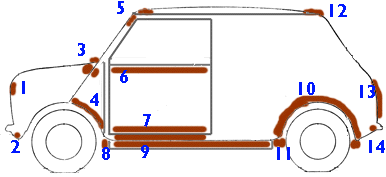
[SIZE=3][FONT=arial]When checking a Mini over before purchasing, it is important to check carefully for rust. The diagram below shows the typical rust areas:
[SIZE=3][FONT=arial][/FONT][/SIZE]
[SIZE=3][FONT=arial][/FONT][/SIZE]
[SIZE=3][FONT=arial][/FONT][/SIZE]
[SIZE=3][FONT=arial]Key:
- Headlamp surround and bowl (part of front wing). These rust out from behind due to accumulation of road dirt and moisture, usually only in locales where salt is used on ice.
- Lower front valance. Often kerbed and hit by stones, and therefore prone to rust where paint is chipped away.
- Lower windscreen surround, top of wing, top of a-panel. These areas rust because of the box section inside this area, which accumulates road dirt and water. The rear seam of the bonnet also rusts because of the foam soundproofing it sits in that retains water.
- Lower edge of a-panel. Rusts out from the inside.
- Roof skin edge/cant rail. A trap for dirt and rain, prone to rust from the outside in as paint wears. Rust is accelerated greatly on Mk1 cars with sound proofing foam inside the cant rail.
- Rain channel (Mk1/2 cars). Does not drain properly, by design.
- Door lower edge. Rusts due to blocked door drainage holes.
- Inner wing/front of sill. Very prone to rust from accumulated road dirt.
- Outer/inner sills. Very prone to rust from road dirt/water trapped inside, and paint chips.
- Lower edge of body sides. More common where road salt is used.
- Rear subframe. A common casualty of inadequate factory rustproofing. The heelboard is also likely to be rusted.
- Roof skin/cant rail See 5.
- Boot lid. Prone to rust along the bottom edge. The same applies to van/estate rear doors.
- Rear panel/rear valance/rear bumper mounting flange and boot floor.
[SIZE=3][FONT=arial]Rust is also common in the floor pan, particularly the front quarters. For those intending to restore a car, patch panels are available for most common rust areas. Rust may also occur where crash damage has been improperly repaired and covered over with filler. [/FONT][/SIZE]
[SIZE=3][FONT=arial][/FONT][/SIZE]
[SIZE=3][FONT=arial]There are two major types of rust. First, "surface rust" or rust that works from the outside of a panel inwards. This rust starts when paint wears or chips away. Depending on environmental conditions (humidity, temperature and use of road salt), this rust may progress at a slow rate and can often be sanded or blasted off. This type of rust is usually found in the roof channels and external body seams, and where the paint has become chipped. This rust can be prevented from developing into a problem if it is sanded out and repainted - if your car has any rust like this, treat it now. [/FONT][/SIZE]
[SIZE=3][FONT=arial][/FONT][/SIZE]
[SIZE=3][FONT=arial]Second is rust that works from the inside out. This is usually characterised by loose rust flakes and bubbles in paint work, and has worked its way to the outside from the other side of the panel, e.g. from the inside of the A-panel to the outside. This type of rust is far worse and is more common in countries that put salt on the roads during winter. The only hope for repair is cutting out the rust and replacing it with new metal. [/FONT][/SIZE]
[SIZE=3][FONT=arial][/FONT][/SIZE]
[SIZE=3][FONT=arial]If a car has rusted to the extent where holes can be found in any of the above locations, heavy-duty repairs are needed. A car with rust in the roof pillars, roof skin, floors, or worse, should be avoided unless it is a collectible model or intended for restoration. [/FONT][/SIZE]
[SIZE=3][FONT=arial][/FONT][/SIZE]
[SIZE=3][FONT=arial]Beware of a car with fresh paintwork. It can take from six months to one year for painted-over rust to bubble out again. Meanwhile, it has been spreading under the paint causing severe problems that may not be detected until it is too late. Stay away from any car with blisters in the paint as it is a sign of hidden problems and poor paint preparation work. [/FONT][/SIZE]
[SIZE=3][FONT=arial][/FONT][/SIZE]
[SIZE=3][FONT=arial]Rust Prevention [/FONT][/SIZE]
[SIZE=3][FONT=arial][/FONT][/SIZE]
[SIZE=3][FONT=arial]If your car body is in good condition, rustproofing it is an effective means of keeping it that way. Minis have until recently been delivered with almost non-existent rustproofing. It is not uncommon to find the insides of sills and other box sections to be bare-metal, having not even received a coat of primer. As the car was assembled before painting, the inside of the door hinges is usually bare metal. [/FONT][/SIZE]
[SIZE=3][FONT=arial][/FONT][/SIZE]
[SIZE=3][FONT=arial]Undersealing the floor and wheel arches is an excellent method of preventing rust. It can be applied professionally, or can be purchased in a form that can be painted or sprayed on. It then dries into a tough, flexible coating. The areas to be undersealed must be absolutely free of rust, or the underseal will allow it to spread while hiding it from observation. Car must be taken not to paint shut any drain channels such as those in the sills. [/FONT][/SIZE]
[SIZE=3][FONT=arial][/FONT][/SIZE]
[SIZE=3][FONT=arial]Box sections, such as the sills and floor cross member can be protected by injecting rust-proofing wax into them. The wax/fluid is applied with a special nozzle designed to reach into enclosed areas through a small opening. For best results the wax is heated to thin it, and after application it sets into a moisture-proof layer. [/FONT][/SIZE]
[SIZE=3][FONT=arial][/FONT][/SIZE]
[SIZE=3][FONT=arial]Small crevices and awkward areas, such as the drain channels in the doors, and the external body seam covers may be protected by applying deodorised fish oil or a similar oil designed for the same purpose. This oil is usually provided in a spray can and has the ability to creep between welded metal flanges to protect otherwise-unreachable areas. [/FONT][/SIZE]
[SIZE=3][FONT=arial][/FONT][/SIZE]
[SIZE=3][FONT=arial]To delay the onset of rust, keep your clean and dry and ensure the underside is regularly cleaned, especially [/FONT][/SIZE]
[SIZE=3][FONT=arial][/FONT][/SIZE]
[SIZE=3][FONT=arial]Rust Repair [/FONT][/SIZE]
[SIZE=3][FONT=arial][/FONT][/SIZE]
[SIZE=3][FONT=arial]The most important principle of rust repair is to catch it as soon as possible. The cost of repair increases dramatically as rust progresses from being superficial to structural. [/FONT][/SIZE]
[SIZE=3][FONT=arial][/FONT][/SIZE]
[SIZE=3][FONT=arial]Superficial rust can be removed by several means. The most convenient is bead/abrasive blasting, which will remove all rust and paint with minimal effort. Providing no holes were revealed, the surface is then ready for rustproofing and painting. Other methods are by hand sanding or machine grinding (use 80 grit sandpaper and finish off with 120 grit to remove visible surface scoring), use of a Sand-n-Strip disc or acid dipping. See the body stripping page for more detail. [/FONT][/SIZE]
[SIZE=3][FONT=arial][/FONT][/SIZE]
[SIZE=3][FONT=arial]The various rust-treating gels and fluids do not give very good results. It is better to remove the rust by abrasive means and then use metal conditioner to prevent rusting, as the rust-treating products are essentially the same as metal-conditioner. If you use them, use the type that dries to a harmless coating rather than the type that must be washed off, as this type is liable to become trapped in body seams from where it can leak out onto your new paintwork. [/FONT][/SIZE]
[SIZE=3][FONT=arial][/FONT][/SIZE]
[SIZE=3][FONT=arial]If your car has surface rust, the time to fix it is NOW. At the least, use a Sand-n-Strip disc, grinder or hand sanding to remove the surface rust. A wire wheel may be used to get into incovenient areas such as the roof gutters. If you do not wish to remove all the rust, or cannot get at it, use POR-15 or similar "Paint over Rust" type paint - use only a recognised brand name as many of these paints do not live up to their claims. At the least, apply metal conditioner and primer, followed by top coat as soon as possible. Even if the results looks ugly, the rust problem is reduced or eliminated. If your car is better than a tatty runabout you may desire a better quality finish, in which case it is best to leave the painting to a professional. [/FONT][/SIZE]
[SIZE=3][FONT=arial][/FONT][/SIZE]
[SIZE=3][FONT=arial]If the rust is more than superficial, it must be cut out and replaced with new metal. Either the entire panel containing the rust should be replaced, or a patch several inches larger in diameter than the rust should be welded in. This ensures that no smaller outcroppings of rust remain in the panel. [/FONT][/SIZE]
[SIZE=3][FONT=arial][/FONT][/SIZE]
[SIZE=3][FONT=arial]Mini body panels such as the wings, sills and front panel, which often rust, are available so cheaply that it is not worthwhile to patch them. Panels are spot welded together; these spot welds must be drilled out for the panel to be removed. A new panel may then be spot or MIG welded in place. If you are paying someone to do the work for you, it will be cheaper to have the panel replaced than patched. [/FONT][/SIZE]
[SIZE=3][FONT=arial][/FONT][/SIZE]
[SIZE=3][FONT=arial]Patching is a skilled art. It is easy to weld a patch into a piece of metal, but very hard to do so without causing welding distortion which is hard to straighten out, especially if gas welding is used. However, it is far more practical than replacing the entire floor pan or a body side. Pre-made patches are available for most common Mini rust-spots. [/FONT][/SIZE]
[SIZE=3][FONT=arial][/FONT][/SIZE]
[SIZE=3][FONT=arial]When repairing the floor and sills, it is possible to remove too much metal causing the body shell to twist. If you intend to remove both outer sills at once, or more than half of the floor pan, the car will need to be jigged or at least have its weight supported by bracing. [/FONT][/SIZE]
[SIZE=3][FONT=arial]The need to do bodywork when restoring a car is caused by rust 99% of the time. Articles giving more detail on body shell repair will be added to this site over the coming weeks.[/FONT][/SIZE]
[SIZE=3][FONT=arial][/SIZE][/FONT]---------------------------------
My best advice:
- Shop the US first.
- Take your time.
- Learn all you can about Minis.
- Learn all you can about importation rules
- Learn all you can about your state & local registration and emissions laws
- Attend local Mini club events & meetings
- Talk to owners
- Don't buy sight unseen or w/o a knowledgeable inspection
- Buy a Mini appropriate to your use. A too hopped up Mini makes a miserable daily driver. An 850cc is okay, but no freeway or mountain car.
- Go to Mini Meet West http://www.minimeetwest2008.com/




2nd Gear
Joined: Nov 2007
Posts: 135
Likes: 0
Also: Always remember that when a seller says "rust free" you must ask if he means the rust doesnt cost extra or the car does not have rust.
I am still amazed at mini owners that drive their cars in the rain. If its daily driver I get it. Driving a mini with the kind of money we have in these cars, knowing the way they rust, is nuts to me.
Before anyone asks, I do wash mine but I do it one panel at a time. My neighbors and wife just don't understand....lol.
I am still amazed at mini owners that drive their cars in the rain. If its daily driver I get it. Driving a mini with the kind of money we have in these cars, knowing the way they rust, is nuts to me.
Before anyone asks, I do wash mine but I do it one panel at a time. My neighbors and wife just don't understand....lol.
 Nothing worse thn showing up owning a newer car & being denied.

1st Gear
Joined: Dec 2006
Posts: 45
Likes: 0
From: Richmond,Va
I got plenty of Free rust with mine. I imported from the U.K. Had to replace both inner and outer sills, rear valence. Also had to patch multiple holes in the floor, and metal that was just too thin. Mine had also been hit. Fortunately no damage to the main structure, but it had half an inch of bondo on the left wing behind the headlight, (Replaced Wing), and the right side behind the door was pushed in and filled with bondo. (Metal was streched pretty well, so that was cut out and replaced w/fabricated piece). Things are fairly well sorted with the body now, but unless you like doing the work or paying for it, best to get something you can look at and inspect before parting with hard earned cash.

I am still amazed at mini owners that drive their cars in the rain. If its daily driver I get it. Driving a mini with the kind of money we have in these cars, knowing the way they rust, is nuts to me.
Before anyone asks, I do wash mine but I do it one panel at a time. My neighbors and wife just don't understand....lol.

Thread
Thread Starter
Forum
Replies
Last Post
jarymo
Hawaii MINI Motoring Club
3
Sep 30, 2015 04:19 PM
Interior/Exterior Filler neck/gas cap insert piece, paint peeling for the 8th time now?!
Systemlord
Interior/Exterior
0
Sep 19, 2015 02:57 PM

