


Do you understand A/F? (I thought I did but now not sure)


Thread Starter
|
6th Gear
Joined: Sep 2004
Posts: 5,149
Likes: 0
Do you understand A/F? (I thought I did but now not sure)
I looked and did not see one..... has anyone tested what the A/F ratio is for most power with safety..... Are you looking for a flat consistent curve or a more dynamic one..... should it change with load? I have heard/seen conflicting reports. I hope this turns into a good discussion...... sort of a "everything you ever wanted to know about the Mini and A/F ratios"......

2nd Gear
Joined: Apr 2005
Posts: 75
Likes: 0
From: Sammamish WA
I too would like to know..
What the optimum A/F ratio is through RPM/Powerband. I have only a vague idea of the relationships and suspect it is more involved than dialog on a thread can cover....hope not, but...
A publication on the subject with regard to charged vehicles would be a good read. Eventually it comes down to the ability to gather information, understand it and manipulate the parameters, which requires data logging, I would love to have Andys BIM-Com or in lieu of that the wideband logger by innovate motorsports....spendy. Anticipate an agressive learning curve?
A publication on the subject with regard to charged vehicles would be a good read. Eventually it comes down to the ability to gather information, understand it and manipulate the parameters, which requires data logging, I would love to have Andys BIM-Com or in lieu of that the wideband logger by innovate motorsports....spendy. Anticipate an agressive learning curve?

6th Gear
Joined: Oct 2002
Posts: 3,652
Likes: 6
From: Lansdale, PA
Here's a writeup I did on A/F a while back:
http://www.ross-tech.com/vag-com/cars/fuel-trim.html
As far as measuring A/F, you need to add a wideband A/F meter. The MINI only has narrow-band sensors stock and no scan tool can display data that isn't there. This shows wideband and narrowband on the same car at the same time. Narrowband sucks!
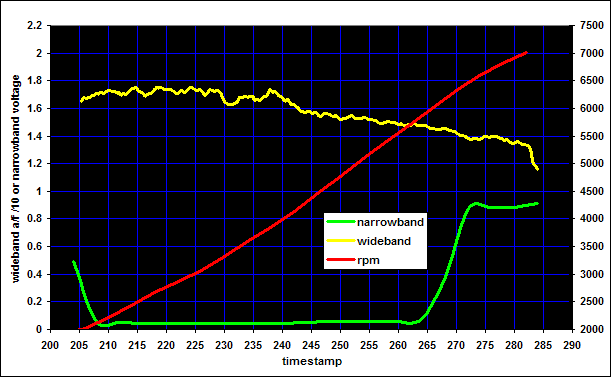
As far as the actual question that SpiderX posed, it's sort of a gray area. Different tuners aim for different A/F readings at WOT. Some choose to run a little richer, to try to cool the combustion chamber with excess fuel to help fight off detonation. Others run a little leaner, trying to maximize the combustion energy. A decent working range for the MCS seems to be 11:1 to 13:1 at WOT. As RPM climbs, mixture tends to get richer and as boost pressure increases, mixture tends to get richer as well. In the MCS, boost increases as RPM climbs, so the effect may be more pronounced.
http://www.ross-tech.com/vag-com/cars/fuel-trim.html
As far as measuring A/F, you need to add a wideband A/F meter. The MINI only has narrow-band sensors stock and no scan tool can display data that isn't there. This shows wideband and narrowband on the same car at the same time. Narrowband sucks!
As far as the actual question that SpiderX posed, it's sort of a gray area. Different tuners aim for different A/F readings at WOT. Some choose to run a little richer, to try to cool the combustion chamber with excess fuel to help fight off detonation. Others run a little leaner, trying to maximize the combustion energy. A decent working range for the MCS seems to be 11:1 to 13:1 at WOT. As RPM climbs, mixture tends to get richer and as boost pressure increases, mixture tends to get richer as well. In the MCS, boost increases as RPM climbs, so the effect may be more pronounced.
Thread Starter
|
6th Gear
Joined: Sep 2004
Posts: 5,149
Likes: 0
Originally Posted by andy@ross-tech.com
Here's a writeup I did on A/F a while back:
http://www.ross-tech.com/vag-com/cars/fuel-trim.html
As far as measuring A/F, you need to add a wideband A/F meter. The MINI only has narrow-band sensors stock and no scan tool can display data that isn't there. This shows wideband and narrowband on the same car at the same time. Narrowband sucks!
As far as the actual question that SpiderX posed, it's sort of a gray area. Different tuners aim for different A/F readings at WOT. Some choose to run a little richer, to try to cool the combustion chamber with excess fuel to help fight off detonation. Others run a little leaner, trying to maximize the combustion energy. A decent working range for the MCS seems to be 11:1 to 13:1 at WOT. As RPM climbs, mixture tends to get richer and as boost pressure increases, mixture tends to get richer as well. In the MCS, boost increases as RPM climbs, so the effect may be more pronounced.
http://www.ross-tech.com/vag-com/cars/fuel-trim.html
As far as measuring A/F, you need to add a wideband A/F meter. The MINI only has narrow-band sensors stock and no scan tool can display data that isn't there. This shows wideband and narrowband on the same car at the same time. Narrowband sucks!
As far as the actual question that SpiderX posed, it's sort of a gray area. Different tuners aim for different A/F readings at WOT. Some choose to run a little richer, to try to cool the combustion chamber with excess fuel to help fight off detonation. Others run a little leaner, trying to maximize the combustion energy. A decent working range for the MCS seems to be 11:1 to 13:1 at WOT. As RPM climbs, mixture tends to get richer and as boost pressure increases, mixture tends to get richer as well. In the MCS, boost increases as RPM climbs, so the effect may be more pronounced.
6th Gear
Joined: Oct 2002
Posts: 3,652
Likes: 6
From: Lansdale, PA
You may want to try getting some custom Unichip programs to shift that up and down while dynoing to see what the results are. Or try something like an AFC instead of the Unichip, since that would allow you to make the changes yourself.
Originally Posted by SpiderX
Thanks for the info....I also read the article.....from 3500 and up my A/F runs between 13 and 11.36 mostly at 12 from 5K and up....any thoughts?

6th Gear
Joined: Oct 2002
Posts: 3,652
Likes: 6
From: Lansdale, PA
The second y-axis is RPM. The first y-axis is A/F ratio divided by 10 for the wideband. For example, at 5500 rpm the wideband shows about 15:1 A/F ratio. Meanwhile, the narrowband voltage at the same RPM is about 0.05 volts. What the graph shows is that even as A/F varies considerably (as the wideband shows), the narrowband hardly budges at all until it gets to about 14.7:1 where it swings wildly from close to zero volts to close to 1 volt. This chart shows how the only really useable information that a narrowband provides is whether the A/F is either higher or lower than stoichiometric.

Originally Posted by fishbulb
andy, can you explain what the scale is in the ratio as opposed to the voltage read out.
I'm sure it's right in front of me....just not making sense right now!
thanks!
-jac
I'm sure it's right in front of me....just not making sense right now!
thanks!
-jac
Trending Topics
Thread Starter
|
6th Gear
Joined: Sep 2004
Posts: 5,149
Likes: 0
Originally Posted by andy@ross-tech.com
The second y-axis is RPM. The first y-axis is A/F ratio divided by 10 for the wideband. For example, at 5500 rpm the wideband shows about 15:1 A/F ratio. Meanwhile, the narrowband voltage at the same RPM is about 0.05 volts. What the graph shows is that even as A/F varies considerably (as the wideband shows), the narrowband hardly budges at all until it gets to about 14.7:1 where it swings wildly from close to zero volts to close to 1 volt. This chart shows how the only really useable information that a narrowband provides is whether the A/F is either higher or lower than stoichiometric.

I have not found a "How to Understand and Mod your MCS Engine for Dummies" either online or at Barnes and Noble.......can you or anyone recommend a few titles?
TIA,
Bob
6th Gear
Joined: Oct 2002
Posts: 3,652
Likes: 6
From: Lansdale, PA
Start with Supercharged! by Corky Bell:
https://www.northamericanmotoring.co...ad.php?t=21367
https://www.northamericanmotoring.co...ad.php?t=21367
Originally Posted by SpiderX
Thank you for your doing this, very generous
I have not found a "How to Understand and Mod your MCS Engine for Dummies" either online or at Barnes and Noble.......can you or anyone recommend a few titles?
TIA,
Bob
I have not found a "How to Understand and Mod your MCS Engine for Dummies" either online or at Barnes and Noble.......can you or anyone recommend a few titles?
TIA,
Bob

Thread
Thread Starter
Forum
Replies
Last Post
Interior/Exterior Must see: Liberty Walk body kit for Mini Cooper R56
carid
Interior/Exterior
16
Dec 28, 2025 04:11 AM