


R56 First Dyno


Thread Starter
|
3rd Gear
Joined: May 2008
Posts: 267
Likes: 0
First Dyno
10k miles 2007 R56 Cooper S with Alta Intake and Alta Turbo Inlet Hose.
180.30whp
205.35 max torque
Run Conditions 93.29 F
30.28 in-HG
Humidity 28%
Tomorrow I will go to a different dyno because I didn't like this one. I am installing the new Invidia 2.5 exhaust thanks to jscspeed.com and I want to be sure of the before and after.
180.30whp
205.35 max torque
Run Conditions 93.29 F
30.28 in-HG
Humidity 28%
Tomorrow I will go to a different dyno because I didn't like this one. I am installing the new Invidia 2.5 exhaust thanks to jscspeed.com and I want to be sure of the before and after.


Thread Starter
|
3rd Gear
Joined: May 2008
Posts: 267
Likes: 0

Trending Topics

If you're going to do a before and after, you should do them on the same dyno and the same method of operation [same gear, atmospheric correction formula, etc.] Your baseline numbers are very good compared to a DynoJet or DynaPack, what brand of dyno was it on? Why are you displeased with the numbers?

You want to run the car in 4th gear to get the most accurate torque data.

Former Vendor
Joined: Feb 2007
Posts: 1,472
Likes: 2
From: Sterling, VA
Here's some details on a typical Dynojet chart:
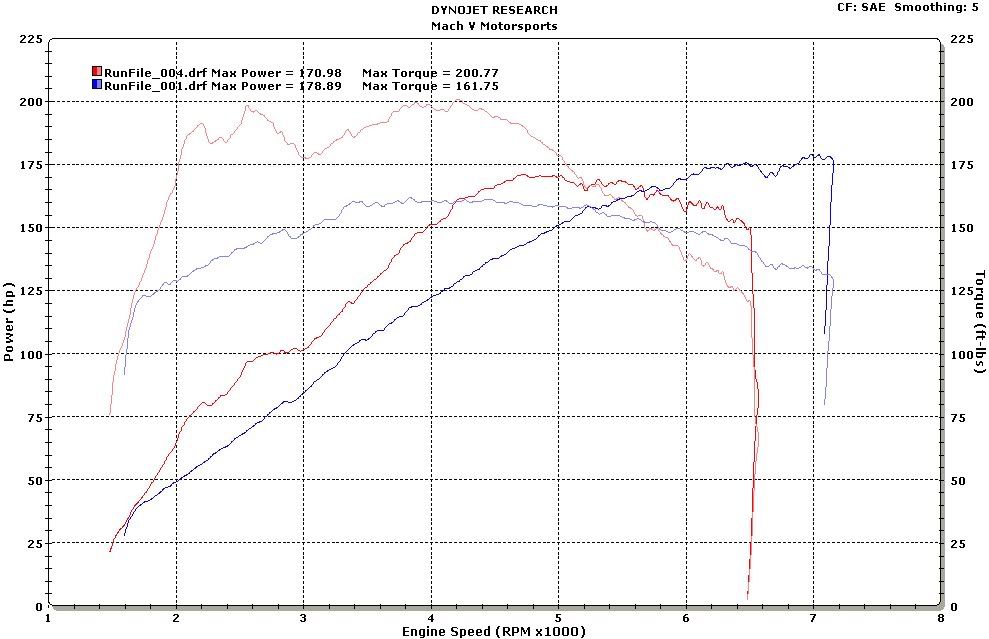
This is a plot of an R53 GP along with a 2007 Cooper S.
First, let's look at the maximum values. Simple, right? Not so fast! First of all, those are the maximum numbers pictured ON THE GRAPH, not the max the car made on that dyno run. If were were to scale the X axis to only read to 4000 rpm, the maximums would be different. If we use a different correction factor or smoothing number, the maximums will change. And if the tach lead were to lose track of the RPM for a bit, we might miss the torque during part of the dyno run. (More on that later.)
Note at the top right, it says CF: SAE. That means SAE correction, which is a standard formula that tries to normalize runs across weather (temp and barometric pressure) conditions. (SAE = Society of Automotive Engineers, and they have set a standard for this.) Other choices are STD, DIN, and some weirder ones. Honestly, SAE is the only factor anyone that I know uses. The actual amount corrected will be on the "Run notes," which are usually printed out either on your dyno chart or on the following page. It'll be a percentage by which the numbers are scaled up for down. It might be, say, 99% because on this particular day it was a little cooler than the "ideal" day, so to normalize against the warmer ideal day, the power (as shown on the graph) is slightly reduced.
There's also a note saying Smoothing: 5. The Dynojet software allows you to set that between 1 and 5. I always use 5, because I want to see overall trends, not teeny little spikes. (Set it on 1 and you'll see very, very small perturbations in the power delivery. Basically noise.) But smaller smoothering numbers will mean higher actualy maximums in most cases, because the spikes will be slightly higher.
Also note that the scale for HP and Torque are the same on each side. This is NOT locked in, and it can be confusing if the two axes are scaled differently. I try to always make sure they're scaled the same.
Note too that if the scales ARE the same, the HP and Torque lines will ALWAYS cross at 5252 rpm. It's the law.

Seriously, that's because one is derived directly from the other. In this case, the Dynojet directly measures the acceleration of a heavy drum to determine horsepower. it divides the power number by engine RPM to figure out torque. If you leave the tach pickup off the car, you get no torque number. (Although if you knew the gear ratios and/or the engine speed at a given road speed, you could calculate it...)
--Dan
Mach V

Thread
Thread Starter
Forum
Replies
Last Post