


New Hampshire Mini Meets? Anyone interested?


6th Gear
Joined: Nov 2011
Posts: 1,409
Likes: 0
From: Southern NH
I would like to put together a quick drain kit like this for the BSH OCC I bought.
http://store.42draftdesigns.com/Catc...Kit_p_325.html
http://store.42draftdesigns.com/Catc...Kit_p_325.html

Oh man if you had a lift. My neighbor has one but no MINI. Maybe I should concoct a master plan and convert him to minis and then eventually let us meet there Hehe

3rd Gear
Joined: May 2012
Posts: 263
Likes: 0
From: Northern NH
I want that cold air intake that actually bolts to underside of hood and seals air box..lower springs..rear sway bar,strut bars,intercooler all new hoses in red..Borla exhaust passport programmer and a heavy foot..then I will drive the **** out of it Untill motor gives out and I go bigger cubes head and turbo...


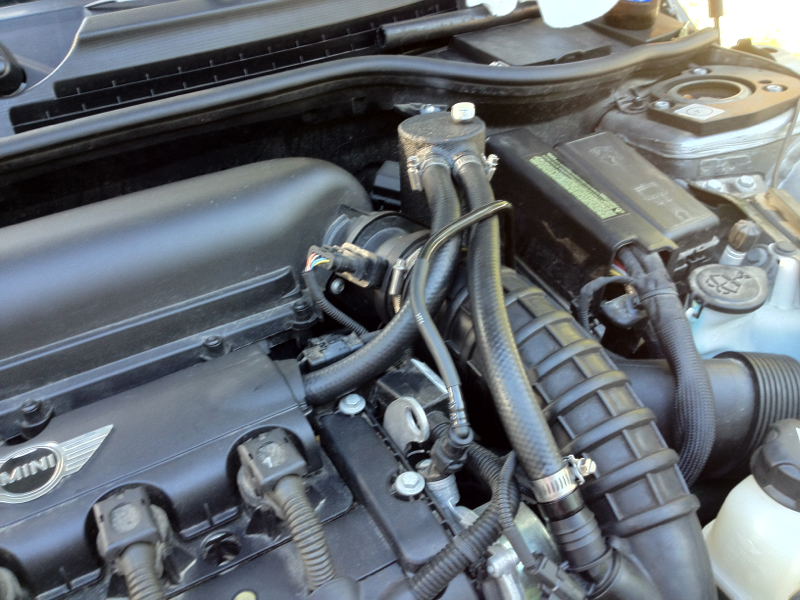

You should be fine on the hoses, I think the can itself would be in the way, though. It would entirely depend on the strut brace. Why would you start with a strut brace on the front of the mini? Put a bigger sway bar in the back if you're going to spend the money... Just a thought.

I agree. RSB. I may eventually pick up the cross bar for my M7 plates. Still on the fence... Worst case you can move the can down by bringing the bracket up to the top hole. You will only have one screw in the can but i've seen people do it to lower it.

6th Gear
Joined: Nov 2011
Posts: 1,409
Likes: 0
From: Southern NH
Modern engines feature a variety of emission control devices and systems to reduce the toxic gases released into the atmosphere. One of these is called the Positive Crankcase Ventilation (PCV) system. During the combustion process a small amount of gases leak or “blow-by” the piston rings and create a positive pressure in the crankcase. The PCV system vents these gases along with oil mist from the crankcase and routes it back into the intake manifold so it can be burned off. The problem is, over time the excess oil vapor collects along the inside of the intake tract and forms a “gunk”. This can lead to a variety of issues including carbon build up, retarded timing, detonation, and power loss.
An oil-air separator is an aftermarket device that will condense and collect the oil vapor before it has a chance to reach the intake system. As the gases and oil vapor enter the can they typically pass through a screening mechanism that gives the oil vapor something to adhere to. As the droplets form they drop harmlessly into the bottom of the reservoir so that they can later be drained. The other gases are allowed to pass through so that they can be burned of as intended. These devices are often referred to as “catch cans”, though that term is truly more accurate when describing a fluid overflow tank designed to just capture leaking or overflowing fluids.
An oil-air separator is an aftermarket device that will condense and collect the oil vapor before it has a chance to reach the intake system. As the gases and oil vapor enter the can they typically pass through a screening mechanism that gives the oil vapor something to adhere to. As the droplets form they drop harmlessly into the bottom of the reservoir so that they can later be drained. The other gases are allowed to pass through so that they can be burned of as intended. These devices are often referred to as “catch cans”, though that term is truly more accurate when describing a fluid overflow tank designed to just capture leaking or overflowing fluids.