


How To Electrical :: Radar Detector Hardwiring (12v Line) Above the Rearview Mirror...


I hardwired my BEL RX65 to the passenger fuse box as well, using an add-a-fuse connector to #32 (PDC). I utilized the #25 TORX screw at the glove box for ground.
Unit is secured with suction cup mount high and left of rearview. Works great and is on/off with ignition.
By the way, car is 2011 Clubman S.
Jeff
Unit is secured with suction cup mount high and left of rearview. Works great and is on/off with ignition.
By the way, car is 2011 Clubman S.
Jeff
Good to know, I have been wanting to do this any my coiled cord hanging from my RX65 is getting way too annoying. I will be doing this this weekend.


 .. ditched that a long time ago..

3rd Gear
Joined: Jun 2007
Posts: 257
Likes: 4
From: Plano, TX
Hey everyone!
Don't really think anyone has managed to get a completely stealth install... Most people just cut up the included power cable for Passport series radar detectors or just buy the remote button/led. I decided to do a couple things a bit differently with my 9500ix though.
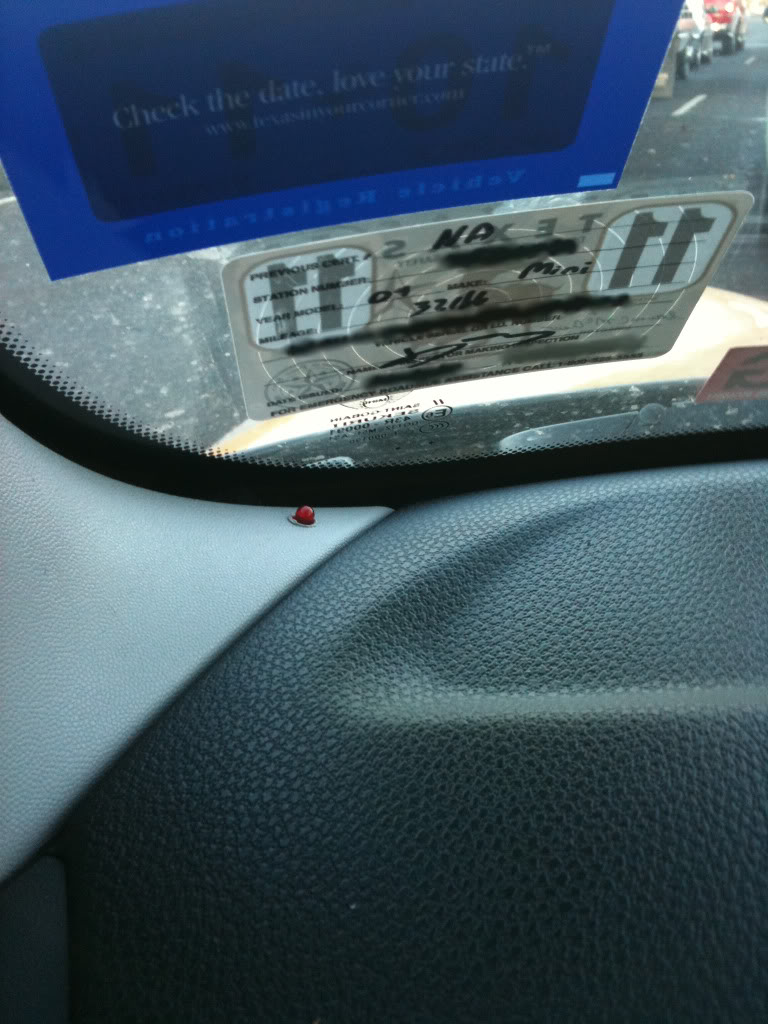
Went ahead and moved the LED from the connector over to the left side of the dash, that way, if the detector is triggered, the LED lights up the area around the windshield without me having to take my eyes off the road or having the sound drowned out by music.
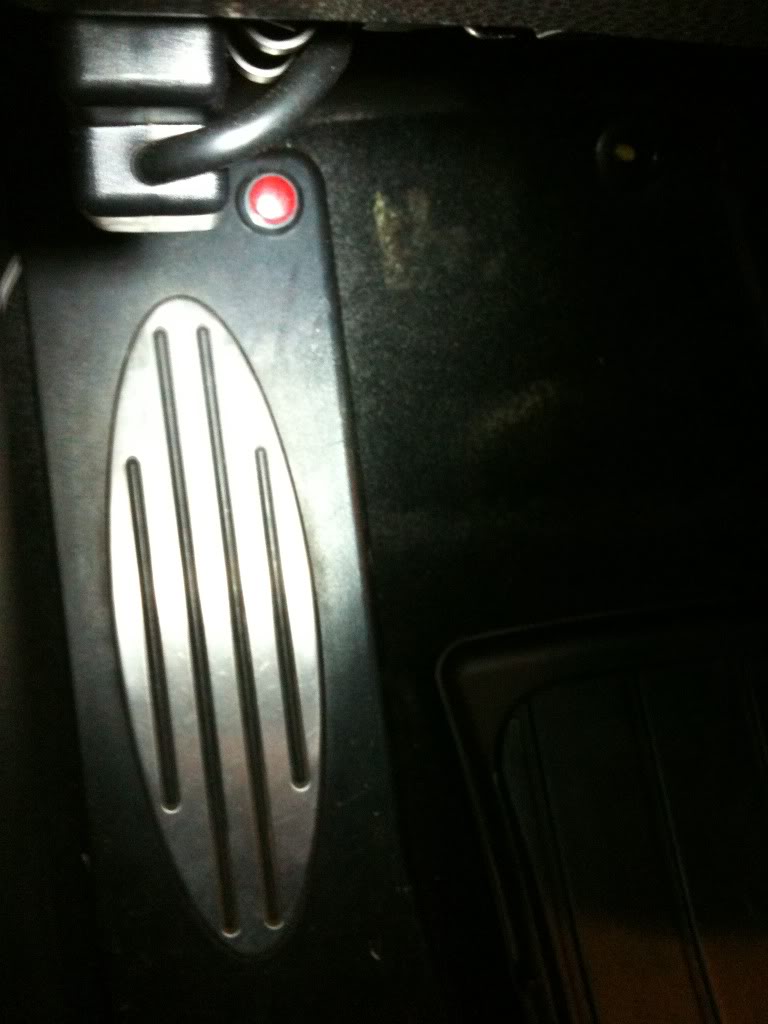
2nd, I decided to move the button down to where the clutch should be (I have an auto). This way, I don't have to take my hands off the steering wheel in order to make the detector quiet.
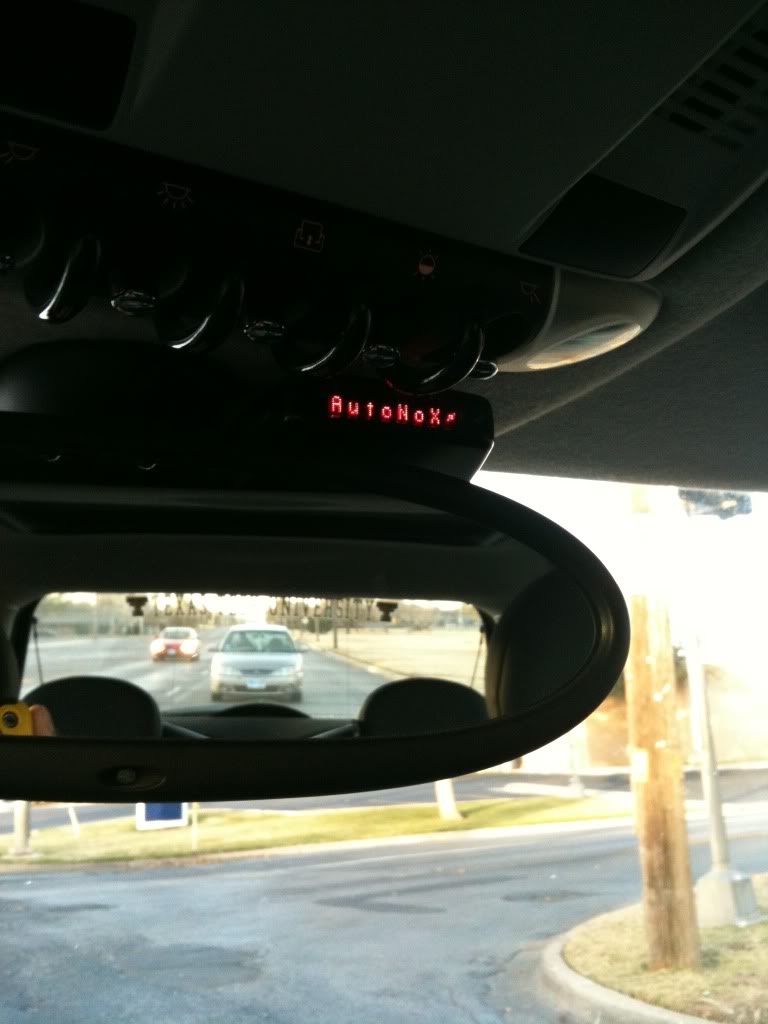
Also, it's implied that the detector is hard-wired into the car and mounted to the roof using two bolts and a couple washers.
GPS works great too!
Don't really think anyone has managed to get a completely stealth install... Most people just cut up the included power cable for Passport series radar detectors or just buy the remote button/led. I decided to do a couple things a bit differently with my 9500ix though.
Went ahead and moved the LED from the connector over to the left side of the dash, that way, if the detector is triggered, the LED lights up the area around the windshield without me having to take my eyes off the road or having the sound drowned out by music.
2nd, I decided to move the button down to where the clutch should be (I have an auto). This way, I don't have to take my hands off the steering wheel in order to make the detector quiet.
Also, it's implied that the detector is hard-wired into the car and mounted to the roof using two bolts and a couple washers.
GPS works great too!


 what kind of mount?


hey it's a mount I got from http://www.countryjoycrafts.com/Conn...arDetector.htm
They had a few MINI branded ones they made; these are all hand-machined. I ended up trading out my Escort for a Valentine 1 though, so I have this mount sitting in a drawer. I'd be happy to sell it to you if you're interested. Note, it does only work with Escort detectors. Shoot me a PM if you're interested.
They had a few MINI branded ones they made; these are all hand-machined. I ended up trading out my Escort for a Valentine 1 though, so I have this mount sitting in a drawer. I'd be happy to sell it to you if you're interested. Note, it does only work with Escort detectors. Shoot me a PM if you're interested.
just a heads up cause i noticed your in CA..., not sure thats legal in CA... would be interesting to know though..here is what I do know cause I just asked an officer at the station earlier this week... nothing can be mounted on the windsheild at all (gps, radar, mp3 ect..) or in your line of sight exept for one spot, and mounting it next to the rear view (like I have btw) would give them probabal cause should they be looking for a reason to find one... you can however mount devices in the lower left, drivers side corner, in a "4x4 square", in the lower left most corner.. (doubt they'll measure again, unless you give them a reason to stop you and look) he also said that radar detectors are legal to use which i often wondered as long as they are not in the above mentioned area and in the lower 4x4 square. he also said, and i agree, 'but thats not the most ideal location of a radar detector and often they wont have the best readings in that area"
just my 2cents
just my 2cents

1st Gear
Joined: Jun 2009
Posts: 39
Likes: 0
From: California
just a heads up cause i noticed your in CA..., not sure thats legal in CA... would be interesting to know though..here is what I do know cause I just asked an officer at the station earlier this week... nothing can be mounted on the windsheild at all (gps, radar, mp3 ect..) or in your line of sight exept for one spot, and mounting it next to the rear view (like I have btw) would give them probabal cause should they be looking for a reason to find one... you can however mount devices in the lower left, drivers side corner, in a "4x4 square", in the lower left most corner.. (doubt they'll measure again, unless you give them a reason to stop you and look) he also said that radar detectors are legal to use which i often wondered as long as they are not in the above mentioned area and in the lower 4x4 square. he also said, and i agree, 'but thats not the most ideal location of a radar detector and often they wont have the best readings in that area"
just my 2cents
just my 2cents
Thanks, probably not legal to mount there, but what from what I see that people are putting on their windshields around here, I'm not worried. Plenty of people w/Gps, phones, etc., so hopefully the gendarmes won't be too concerned.
cheers.


6th Gear
Joined: Jul 2007
Posts: 2,881
Likes: 6
just a heads up cause i noticed your in CA..., not sure thats legal in CA... would be interesting to know though..here is what I do know cause I just asked an officer at the station earlier this week... nothing can be mounted on the windsheild at all (gps, radar, mp3 ect..) or in your line of sight exept for one spot, and mounting it next to the rear view (like I have btw) would give them probabal cause should they be looking for a reason to find one... you can however mount devices in the lower left, drivers side corner, in a "4x4 square", in the lower left most corner.. (doubt they'll measure again, unless you give them a reason to stop you and look) he also said that radar detectors are legal to use which i often wondered as long as they are not in the above mentioned area and in the lower 4x4 square. he also said, and i agree, 'but thats not the most ideal location of a radar detector and often they wont have the best readings in that area"
just my 2cents
just my 2cents
http://dmv.ca.gov/pubs/vctop/d12/vc26708.htm
I find this section interesting.
(11) An electronic communication device affixed to the center uppermost portion of the interior of a windshield within an area that is not greater than 5 inches square, if the device provides either of the following:
(A) The capability for enforcement facilities of the Department of the California Highway Patrol to communicate with a vehicle equipped with the device.
(B) The capability for electronic toll and traffic management on public or private roads or facilities.
So what is "the device" in section A referring to?
"CHP to communicate with a vehicle equipped with the device."
Sounds like a radar detector to me. CHP communicates with my V1 all the time.
Last edited by Minidrivr; Dec 17, 2010 at 07:41 PM.

OVERDRIVE


Joined: Aug 2006
Posts: 7,201
Likes: 8
From: Norfolk, VA
From the CA Vehicle Code:
26708. (a) (1) No person shall drive any motor vehicle with any
object or material placed, displayed, installed, affixed, or applied
upon the windshield or side or rear windows.
(2) No person shall drive any motor vehicle with any object or
material placed, displayed, installed, affixed, or applied in or upon
the vehicle which obstructs or reduces the driver's clear view
through the windshield or side windows.
(3) This subdivision applies to a person driving a motor vehicle
with the driver's clear vision through the windshield, or side or
rear windows, obstructed by snow or ice.
(b) This section does not apply to any of the following:
(1) Rearview mirrors.
(2) Adjustable nontransparent sunvisors which are mounted forward
of the side windows and are not attached to the glass.
(3) Signs, stickers, or other materials which are displayed in a
7-inch square in the lower corner of the windshield farthest removed
from the driver, signs, stickers, or other materials which are
displayed in a 7-inch square in the lower corner of the rear window
farthest removed from the driver, or signs, stickers, or other
materials which are displayed in a 5-inch square in the lower corner
of the windshield nearest the driver.
(4) Side windows which are to the rear of the driver.
(5) Direction, destination, or termini signs upon a passenger
common carrier motor vehicle or a schoolbus, if those signs do not
interfere with the driver's clear view of approaching traffic.
(6) Rear window wiper motor.
(7) Rear trunk lid handle or hinges.
(8) The rear window or windows, when the motor vehicle is equipped
with outside mirrors on both the left- and right-hand sides of the
vehicle that are so located as to reflect to the driver a view of the
highway through each mirror for a distance of at least 200 feet to
the rear of the vehicle.
(9) A clear, transparent lens affixed to the side window opposite
the driver on a vehicle greater than 80 inches in width and which
occupies an area not exceeding 50 square inches of the lowest corner
toward the rear of that window and which provides the driver with a
wide-angle view through the lens.
(10) Sun screening devices meeting the requirements of Section
26708.2 installed on the side windows on either side of the vehicle's
front seat, if the driver or a passenger in the front seat has in
his or her possession a letter or other document signed by a licensed
physician and surgeon certifying that the person must be shaded from
the sun due to a medical condition, or has in his or her possession
a letter or other document signed by a licensed optometrist
certifying that the person must be shaded from the sun due to a
visual condition. The devices authorized by this paragraph shall not
be used during darkness.
(11) An electronic communication device affixed to the center
uppermost portion of the interior of a windshield within an area that
is not greater than 5 inches square, if the device provides either
of the following:
(A) The capability for enforcement facilities of the Department of
the California Highway Patrol to communicate with a vehicle equipped
with the device.
(B) The capability for electronic toll and traffic management on
public or private roads or facilities.
(c) Notwithstanding subdivision (a), transparent material may be
installed, affixed, or applied to the topmost portion of the
windshield if the following conditions apply:
(1) The bottom edge of the material is at least 29 inches above
the undepressed driver's seat when measured from a point 5 inches in
front of the bottom of the backrest with the driver's seat in its
rearmost and lowermost position with the vehicle on a level surface.
(2) The material is not red or amber in color.
(3) There is no opaque lettering on the material and any other
lettering does not affect primary colors or distort vision through
the windshield.
(4) The material does not reflect sunlight or headlight glare into
the eyes of occupants of oncoming or following vehicles to any
greater extent than the windshield without the material.
(d) Notwithstanding subdivision (a), clear, colorless, and
transparent material may be installed, affixed, or applied to the
front side windows, located to the immediate left and right of the
front seat if the following conditions are met:
(1) The material has a minimum visible light transmittance of 88
percent.
(2) The window glazing with the material applied meets all
requirements of Federal Motor Vehicle Safety Standard No. 205 (49
C.F.R. 571.205), including the specified minimum light transmittance
of 70 percent and the abrasion resistance of AS-14 glazing, as
specified in that federal standard.
(3) The material is designed and manufactured to enhance the
ability of the existing window glass to block the sun's harmful
ultraviolet A rays.
(4) The driver has in his or her possession, or within the
vehicle, a certificate signed by the installing company certifying
that the windows with the material installed meet the requirements of
this subdivision and identifies the installing company and the
material's manufacturer by full name and street address, or, if the
material was installed by the vehicle owner, a certificate signed by
the material's manufacturer certifying that the windows with the
material installed according to manufacturer's instructions meets the
requirements of this subdivision and identifies the material's
manufacturer by full name and street address.
(5) If the material described in this subdivision tears or
bubbles, or is otherwise worn to prohibit clear vision, it shall be
removed or replaced.
26708. (a) (1) No person shall drive any motor vehicle with any
object or material placed, displayed, installed, affixed, or applied
upon the windshield or side or rear windows.
(2) No person shall drive any motor vehicle with any object or
material placed, displayed, installed, affixed, or applied in or upon
the vehicle which obstructs or reduces the driver's clear view
through the windshield or side windows.
(3) This subdivision applies to a person driving a motor vehicle
with the driver's clear vision through the windshield, or side or
rear windows, obstructed by snow or ice.
(b) This section does not apply to any of the following:
(1) Rearview mirrors.
(2) Adjustable nontransparent sunvisors which are mounted forward
of the side windows and are not attached to the glass.
(3) Signs, stickers, or other materials which are displayed in a
7-inch square in the lower corner of the windshield farthest removed
from the driver, signs, stickers, or other materials which are
displayed in a 7-inch square in the lower corner of the rear window
farthest removed from the driver, or signs, stickers, or other
materials which are displayed in a 5-inch square in the lower corner
of the windshield nearest the driver.
(4) Side windows which are to the rear of the driver.
(5) Direction, destination, or termini signs upon a passenger
common carrier motor vehicle or a schoolbus, if those signs do not
interfere with the driver's clear view of approaching traffic.
(6) Rear window wiper motor.
(7) Rear trunk lid handle or hinges.
(8) The rear window or windows, when the motor vehicle is equipped
with outside mirrors on both the left- and right-hand sides of the
vehicle that are so located as to reflect to the driver a view of the
highway through each mirror for a distance of at least 200 feet to
the rear of the vehicle.
(9) A clear, transparent lens affixed to the side window opposite
the driver on a vehicle greater than 80 inches in width and which
occupies an area not exceeding 50 square inches of the lowest corner
toward the rear of that window and which provides the driver with a
wide-angle view through the lens.
(10) Sun screening devices meeting the requirements of Section
26708.2 installed on the side windows on either side of the vehicle's
front seat, if the driver or a passenger in the front seat has in
his or her possession a letter or other document signed by a licensed
physician and surgeon certifying that the person must be shaded from
the sun due to a medical condition, or has in his or her possession
a letter or other document signed by a licensed optometrist
certifying that the person must be shaded from the sun due to a
visual condition. The devices authorized by this paragraph shall not
be used during darkness.
(11) An electronic communication device affixed to the center
uppermost portion of the interior of a windshield within an area that
is not greater than 5 inches square, if the device provides either
of the following:
(A) The capability for enforcement facilities of the Department of
the California Highway Patrol to communicate with a vehicle equipped
with the device.
(B) The capability for electronic toll and traffic management on
public or private roads or facilities.
(c) Notwithstanding subdivision (a), transparent material may be
installed, affixed, or applied to the topmost portion of the
windshield if the following conditions apply:
(1) The bottom edge of the material is at least 29 inches above
the undepressed driver's seat when measured from a point 5 inches in
front of the bottom of the backrest with the driver's seat in its
rearmost and lowermost position with the vehicle on a level surface.
(2) The material is not red or amber in color.
(3) There is no opaque lettering on the material and any other
lettering does not affect primary colors or distort vision through
the windshield.
(4) The material does not reflect sunlight or headlight glare into
the eyes of occupants of oncoming or following vehicles to any
greater extent than the windshield without the material.
(d) Notwithstanding subdivision (a), clear, colorless, and
transparent material may be installed, affixed, or applied to the
front side windows, located to the immediate left and right of the
front seat if the following conditions are met:
(1) The material has a minimum visible light transmittance of 88
percent.
(2) The window glazing with the material applied meets all
requirements of Federal Motor Vehicle Safety Standard No. 205 (49
C.F.R. 571.205), including the specified minimum light transmittance
of 70 percent and the abrasion resistance of AS-14 glazing, as
specified in that federal standard.
(3) The material is designed and manufactured to enhance the
ability of the existing window glass to block the sun's harmful
ultraviolet A rays.
(4) The driver has in his or her possession, or within the
vehicle, a certificate signed by the installing company certifying
that the windows with the material installed meet the requirements of
this subdivision and identifies the installing company and the
material's manufacturer by full name and street address, or, if the
material was installed by the vehicle owner, a certificate signed by
the material's manufacturer certifying that the windows with the
material installed according to manufacturer's instructions meets the
requirements of this subdivision and identifies the material's
manufacturer by full name and street address.
(5) If the material described in this subdivision tears or
bubbles, or is otherwise worn to prohibit clear vision, it shall be
removed or replaced.
Finally posted some pics of the custom install for my V1


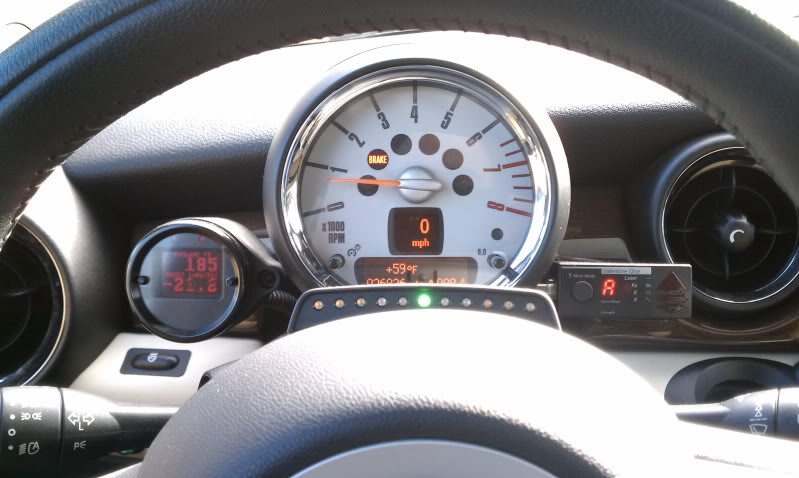

This green switch is an on/off kill switch in case I ever want to just turn it off... Very happy with the install and I didnt have to hard wire anything.. I just got a longer wire and ran it through the head bord to the remote unit..
This green switch is an on/off kill switch in case I ever want to just turn it off... Very happy with the install and I didnt have to hard wire anything.. I just got a longer wire and ran it through the head bord to the remote unit..
6th Gear
Joined: Jul 2007
Posts: 2,881
Likes: 6
How's the glare on the Aeroforce Gauge with it on the left side of the tach? I have mine on the right and get a lot of glare from the rear sunroof over my shoulder. I may try it on the left if you aren't having trouble with glare.
Ya there is some glare but it works for me. Prob not as bad as it sounds like. I'd think right side might be more. I like this little gauge. Just the look I was going for. The little V1 remote gauge is perfect for me too. Perfect for my line of sight...

From Valentine 1
From Escort (Bel)
Can I mount my detector on my sun visor?
We generally do not recommend mounting detectors on the sun visor because the dark tint at the top of most windshields significantly reduces laser detection range, and the GPS-powered features of the Passport 9500i will not function if satellite reception is blocked. So, we do not include a visor mount as a standard accessory. While not recommended, we do offer an optional visor mount that can be seen by clicking this visor clip link.
As a rule of thumb, a lower detector mounting position is better for laser and a higher position is better for radar. But, in most vehicles, the difference in height between the top and bottom of the windshield is not enough to make any perceptible difference in radar reception. It's best to mount your detector where it has a clear field of view front and rear (plus a clear view of the sky for the Passport 9500i), and where you can see it without obstructing your own view of the road.
- When properly mounted, the front antenna will look forward through the glass. It must have an unobstructed view. Don’t put it behind the parked windshield wipers, or directly behind an in-glass antenna. Don’t position it so that it "looks" into the rearview mirror.
- The rear antenna will look rearward, between passengers and out the rear glass. It, too, must have an unobstructed view.
- Detector performance is enhanced by a high mounting position. Two reasons. For radar, a longer sight line to the horizon always helps. For laser, moving away from the hood and its sun reflections helps a lot.
From Escort (Bel)
Can I mount my detector on my sun visor?
We generally do not recommend mounting detectors on the sun visor because the dark tint at the top of most windshields significantly reduces laser detection range, and the GPS-powered features of the Passport 9500i will not function if satellite reception is blocked. So, we do not include a visor mount as a standard accessory. While not recommended, we do offer an optional visor mount that can be seen by clicking this visor clip link.
As a rule of thumb, a lower detector mounting position is better for laser and a higher position is better for radar. But, in most vehicles, the difference in height between the top and bottom of the windshield is not enough to make any perceptible difference in radar reception. It's best to mount your detector where it has a clear field of view front and rear (plus a clear view of the sky for the Passport 9500i), and where you can see it without obstructing your own view of the road.

I tried doing this install for my Beltronics STI, however instead of the power cable connection, my hard wire kit uses the "telephone" cable. Now, I have an issue where the power to the radar detector appears to be independent of whether the car is on or off. So now I have to hit the power button on to turn it on each time I get in the car, and REMEMBER to turn it off when getting out. I will appreciate some help to make this automatic.
I should also mention that I did see two purple wires. I connected to the thicker wire.
I should also mention that I did see two purple wires. I connected to the thicker wire.

Now, I have an issue where the power to the radar detector appears to be independent of whether the car is on or off. So now I have to hit the power button on to turn it on each time I get in the car, and REMEMBER to turn it off when getting out. I will appreciate some help to make this automatic.
I should also mention that I did see two purple wires. I connected to the thicker wire.
I should also mention that I did see two purple wires. I connected to the thicker wire.
Tom
Thanks. I was reading some earlier posts and it looks like this occurred with other folks. Apparently if I leave the detector powered on, it will eventually power off around the 15-17 minutes after removing the key. I will test this in the morning and provide an update.
Thanks. I tested it out this morning and it works like you described yetti96. However, it takes 30 minutes to shut off! Is it the same for you? I did see a post on this thread that the sunroof is operable for 30 minutes but, no reference to the detector being the same.