


Drivetrain M7 AGS......Air flow #'s


6th Gear
Joined: Oct 2002
Posts: 3,652
Likes: 6
From: Lansdale, PA
Although it seems like a great idea to get "cooler" air into the supercharger, there are a few things to keep in mind:
1) Testing has shown that there is pretty good airflow under the hood once you are moving, such that the air filter approaches ambient regardless of where it is located under the hood:
http://www.mini2.com/forum/showthread.php?t=42063
2) Testing has shown that the intercooler consistently removes over 60% of the temp difference between the compressed air and ambient:
https://www.northamericanmotoring.co...ad.php?t=23248
What this means is that even if the air filter inhales air that is 10 degrees hotter than ambient, by the time that air gets to the engine, the difference is only 4 degrees or less.
Bottom line is that cooler air is good, but not if it is at the expense of a more restrictive intake path (I'm talking complete path from the filter surface to the supercharger).
1) Testing has shown that there is pretty good airflow under the hood once you are moving, such that the air filter approaches ambient regardless of where it is located under the hood:
http://www.mini2.com/forum/showthread.php?t=42063
2) Testing has shown that the intercooler consistently removes over 60% of the temp difference between the compressed air and ambient:
https://www.northamericanmotoring.co...ad.php?t=23248
What this means is that even if the air filter inhales air that is 10 degrees hotter than ambient, by the time that air gets to the engine, the difference is only 4 degrees or less.
Bottom line is that cooler air is good, but not if it is at the expense of a more restrictive intake path (I'm talking complete path from the filter surface to the supercharger).

1st Gear
Joined: May 2005
Posts: 32
Likes: 0
Wow. I didn't realized the intercooler did it's job that well. It always seemed like people are disappionted by it's performance. But what about pre-compressed air. If a ram style intake could be brought down to that intake it wouldn't make a difference off the line but lower RPM's seem like they would definitely be helped in the higher gears. Keep in mind, these are all just questions. I know a pretty good amount about cars for my age...but i'm only 17. It seems like you guys really know your stuff. I know i'm dreamin with this whole thing but i can't help wanting the most out of every element of my car.

Thread Starter
|
Former Vendor
Joined: Jul 2003
Posts: 1,594
Likes: 2
From: los angeles
[QUOTE
BTW, was a different lift used for each of the runs? It looks like the valve was open more for the AGS runs? [/QUOTE]
Same lift, it's Loyning's standard setup for testing engines. no valve lift applies.
[QUOTE Does anyone else feel like it could be further improved?[/QUOTE]
This is why we prefer not to post #'s.
peter
BTW, was a different lift used for each of the runs? It looks like the valve was open more for the AGS runs?
[/QUOTE]Same lift, it's Loyning's standard setup for testing engines. no valve lift applies.
[QUOTE Does anyone else feel like it could be further improved?[/QUOTE]
This is why we prefer not to post #'s.
peter

3rd Gear
Joined: Mar 2005
Posts: 204
Likes: 0
From: Sammamish, WA
AGS Tube
Peter,
I am no mechanic, but I do understand heat dissipation. I believe that the AGS tube would benefit from heat sink fins, cast into its body, running its length. This would indeed lower the temperature of the intake charge. The question is would it be worth the more difficult manufacturing?
Thanks. I enjoyed your numbers. All I (a neophite) understand is that a 21% increase is better than a 21% decrease.
Ordering from Speedware Motorsports soon...
Rob
I am no mechanic, but I do understand heat dissipation. I believe that the AGS tube would benefit from heat sink fins, cast into its body, running its length. This would indeed lower the temperature of the intake charge. The question is would it be worth the more difficult manufacturing?
Thanks. I enjoyed your numbers. All I (a neophite) understand is that a 21% increase is better than a 21% decrease.
Ordering from Speedware Motorsports soon...
Rob
Thread Starter
|
Former Vendor
Joined: Jul 2003
Posts: 1,594
Likes: 2
From: los angeles
Originally Posted by webstrands
Peter,
I am no mechanic, but I do understand heat dissipation. I believe that the AGS tube would benefit from heat sink fins, cast into its body, running its length. This would indeed lower the temperature of the intake charge. The question is would it be worth the more difficult manufacturing?
I am no mechanic, but I do understand heat dissipation. I believe that the AGS tube would benefit from heat sink fins, cast into its body, running its length. This would indeed lower the temperature of the intake charge. The question is would it be worth the more difficult manufacturing?
Thank you for the input....
But honestly, there's zero space for anything but the AGS tube.
We also molded the AGS in a crosslinked polymer material that does not
retain heat very well keeping the AGS tube comparibly cool.
peter
6th Gear
Joined: Oct 2002
Posts: 3,652
Likes: 6
From: Lansdale, PA
Originally Posted by M7
[QUOTE Does anyone else feel like it could be further improved?
peter[/QUOTE]
Why do you post anywhere but Vendor Announcements if you get defensive about feedback from forum members?
6th Gear
Joined: Oct 2002
Posts: 3,652
Likes: 6
From: Lansdale, PA
Originally Posted by minizeeg
Wow. I didn't realized the intercooler did it's job that well. It always seemed like people are disappionted by it's performance. But what about pre-compressed air. If a ram style intake could be brought down to that intake it wouldn't make a difference off the line but lower RPM's seem like they would definitely be helped in the higher gears. Keep in mind, these are all just questions. I know a pretty good amount about cars for my age...but i'm only 17. It seems like you guys really know your stuff. I know i'm dreamin with this whole thing but i can't help wanting the most out of every element of my car.
Thread Starter
|
Former Vendor
Joined: Jul 2003
Posts: 1,594
Likes: 2
From: los angeles
Side by side view
Here's another image of the M7 AGS Vs. stock supercharger tube.
This image was shot 6 month's ago when I had the original (first article) AGS tube in my possesion. That's the reason for the release compound on the surface (not pretty).
peter

This image was shot 6 month's ago when I had the original (first article) AGS tube in my possesion. That's the reason for the release compound on the surface (not pretty).
peter

5th Gear
Joined: Feb 2003
Posts: 696
Likes: 0
From: Ohio
Originally Posted by JeffS
Maybe you need to re-think where the intake attaches on a turbo car.
Threads like this make it evident why vendors don't need to provide any numbers to back up their claims... most of their customers don't know how to interpret them anyway.
Threads like this make it evident why vendors don't need to provide any numbers to back up their claims... most of their customers don't know how to interpret them anyway.
Hubie is using that big horn-like velocity tube for intake duty. EDIT: OK, so Hubie has a totally custom piece - my bad.
But, just to be clear...
I did not imply that there would be any use for the AGS heat sheild or filter. JUST the tube.
My point was that if restriction does exist with the OEM tube that Peter's AGS tube might allow less restricted flow at WOT, under high load - even though the turbo would be pressurizing the intake air.
But its all MOOT anyhow.


5th Gear
Joined: Feb 2003
Posts: 696
Likes: 0
From: Ohio
Stole this from the original thread.
Originally Posted by andy@ross-tech.com
I made some notes on SPI's picture that I think illustrate the flow path.
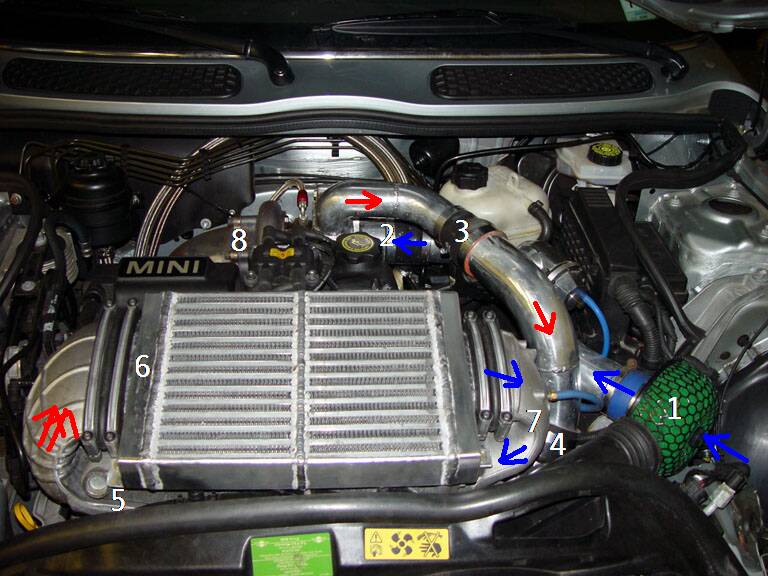
1 - Cool air is inhaled through the HKS filter, which has the factory grille scoop blowing onto it
2 - Cool air enters the turbo compressor
3 - After being compressed and heated by the turbo, hot air travels toward the throttle body
4 - Hot air enters the throttle body and travels into the supercharger
5 - After being compressed and heated by the supercharger, very hot air exits the supercharger - it has been heated twice now (compressor efficiencies are multuplied) so if the turbo is 70% efficient and the supercharger is 60% efficient, overall efficiency would be 42 %
6 - Very hot air enters the intercooler. Intercoolers deliver a % temperature drop, so if the intercooler is 80% efficient, it removes 80% of the difference between the very hot air and ambient
7 - Cooler air (still very warm, I'm sure) exits the intercooler and enters the intake manifold.
8 - After combustion, exhaust gases exit the cylinder head into a custom exhaust manifold and are routed through the turbo, exiting on the left into a custom downpipe.
1 - Cool air is inhaled through the HKS filter, which has the factory grille scoop blowing onto it
2 - Cool air enters the turbo compressor
3 - After being compressed and heated by the turbo, hot air travels toward the throttle body
4 - Hot air enters the throttle body and travels into the supercharger
5 - After being compressed and heated by the supercharger, very hot air exits the supercharger - it has been heated twice now (compressor efficiencies are multuplied) so if the turbo is 70% efficient and the supercharger is 60% efficient, overall efficiency would be 42 %
6 - Very hot air enters the intercooler. Intercoolers deliver a % temperature drop, so if the intercooler is 80% efficient, it removes 80% of the difference between the very hot air and ambient
7 - Cooler air (still very warm, I'm sure) exits the intercooler and enters the intake manifold.
8 - After combustion, exhaust gases exit the cylinder head into a custom exhaust manifold and are routed through the turbo, exiting on the left into a custom downpipe.
5th Gear
Joined: Feb 2003
Posts: 696
Likes: 0
From: Ohio
Originally Posted by JeffS
I was just thinking that the change would require a re-work of the existing turbo to throttlebody tube, introducing another variable.
Regardless, I guess I'm just missing the point of such a test.
Regardless, I guess I'm just missing the point of such a test.
I was thinking that any measurable change in flow on a bone-stock MCS might be difficult to measure. My next thought was that a Twincharger would give a larger volume of air to 'sample' and look for change.
If the AGS tube flowed better than OEM, then its doing something.
Further modification of the turb T/B supply tube would throw a wrench in for sure.
Sorry if I got the thread off track.


6th Gear
Joined: Jan 2003
Posts: 1,816
Likes: 2
From: New Jersey
Peter & Randy & Spike & Loyning,
I'm not sure who to address this to but: What's the relevance of this number? I understand its a steady state measurement of how much airflow passes through each tube for a given time interval, but I'm not sure what it I'm supposed to do with it. Am I to assume that bigger is better? Why?
Common sense tells me that more water will flow through a hose than a straw, but I dont want to drink through a hose no matter how thirsty I am!
meb brings up a pretty valid point about time's importance. Correct me if I'm wrong, meb, but the VTEC varies valve event timing to allow for bigger flow numbers at higher RPMS. The reason they have to do this is because that engine would run like crap at low RPMs if it had the huge cam profile that VTEC brings to life.
--
Cheese
I'm not sure who to address this to but: What's the relevance of this number? I understand its a steady state measurement of how much airflow passes through each tube for a given time interval, but I'm not sure what it I'm supposed to do with it. Am I to assume that bigger is better? Why?
Common sense tells me that more water will flow through a hose than a straw, but I dont want to drink through a hose no matter how thirsty I am!
meb brings up a pretty valid point about time's importance. Correct me if I'm wrong, meb, but the VTEC varies valve event timing to allow for bigger flow numbers at higher RPMS. The reason they have to do this is because that engine would run like crap at low RPMs if it had the huge cam profile that VTEC brings to life.
--
Cheese
Thread Starter
|
Former Vendor
Joined: Jul 2003
Posts: 1,594
Likes: 2
From: los angeles
Originally Posted by macncheese
Peter & Randy & Spike & Loyning,
I'm not sure who to address this to but: What's the relevance of this number? I understand its a steady state measurement of how much airflow passes through each tube for a given time interval, but I'm not sure what it I'm supposed to do with it. Am I to assume that bigger is better? Why?
Common sense tells me that more water will flow through a hose than a straw, but I dont want to drink through a hose no matter how thirsty I am!
meb brings up a pretty valid point about time's importance. Correct me if I'm wrong, meb, but the VTEC varies valve event timing to allow for bigger flow numbers at higher RPMS. The reason they have to do this is because that engine would run like crap at low RPMs if it had the huge cam profile that VTEC brings to life.
--
Cheese
I'm not sure who to address this to but: What's the relevance of this number? I understand its a steady state measurement of how much airflow passes through each tube for a given time interval, but I'm not sure what it I'm supposed to do with it. Am I to assume that bigger is better? Why?
Common sense tells me that more water will flow through a hose than a straw, but I dont want to drink through a hose no matter how thirsty I am!
meb brings up a pretty valid point about time's importance. Correct me if I'm wrong, meb, but the VTEC varies valve event timing to allow for bigger flow numbers at higher RPMS. The reason they have to do this is because that engine would run like crap at low RPMs if it had the huge cam profile that VTEC brings to life.
--
Cheese
This would be the perfect example to why giving any numbers are counter
productive and leading to nothing but time wasting arguments.
If we show excellent air flow numbers, people will question the validity of the test, giving all sort of reasons to tell the world that it makes no difference,
or it has no relevance to real world driving....etc. etc. etc.
If we show OK flow numbers we are toast and we will never hear the end of it
and all the other vendors gloat. etc. etc. etc
If the numbers are crappy ( you fill in the blank).
So now you know why no one in their right mind (Business) will post any
numbers or dyno charts to back up their claims.....To bad.
peter
M7 Tuning
562-608-8123

Turbius Maximus
Joined: Mar 2004
Posts: 4,416
Likes: 0
From: Infinity and beyond
Originally Posted by M7
Hi Cheese long time no hear.....
This would be the perfect example to why giving any numbers are counter
productive and leading to nothing but time wasting arguments.
If we show excellent air flow numbers, people will question the validity of the test, giving all sort of reasons to tell the world that it makes no difference,
or it has no relevance to real world driving....etc. etc. etc.
If we show OK flow numbers we are toast and we will never hear the end of it
and all the other vendors gloat. etc. etc. etc
If the numbers are crappy ( you fill in the blank).
So now you know why no one in their right mind (Business) will post any
numbers or dyno charts to back up their claims.....To bad.
peter
M7 Tuning
562-608-8123
This would be the perfect example to why giving any numbers are counter
productive and leading to nothing but time wasting arguments.
If we show excellent air flow numbers, people will question the validity of the test, giving all sort of reasons to tell the world that it makes no difference,
or it has no relevance to real world driving....etc. etc. etc.
If we show OK flow numbers we are toast and we will never hear the end of it
and all the other vendors gloat. etc. etc. etc
If the numbers are crappy ( you fill in the blank).
So now you know why no one in their right mind (Business) will post any
numbers or dyno charts to back up their claims.....To bad.
peter
M7 Tuning
562-608-8123
Thread Starter
|
Former Vendor
Joined: Jul 2003
Posts: 1,594
Likes: 2
From: los angeles
Originally Posted by Tuls
I don't think anyone wanted flow #s alone...I think some or mayb4e even most wanted to see the relative dyno #s to see the proof of why it's the #1 intake...flow is great...but if it doesnt' create more power and only creates kewl sound...that's ok however for some that would not make it #1...only a kewl effect to have....
As we said early on* we as a company would not put out numbers, as no matter what we posted it would be taken out of context, misconstrued.
dissected to it's molecules and finally satisfying no one.
And we did keep our word, the report was not ours, but a very nice customer who payed for the test with his own money, decided to share with us and now with you.
Will horse power numbers come next....that's a silly question that all of us know the answer to....
* Please we already know what you will say...
peter
Team M7
562-608-8123


6th Gear
Joined: Aug 2002
Posts: 2,253
Likes: 0
From: NY NY
All M7 has to do to rebuild their credibility is:
post flow numbers comparing stock system to AGS; make no conclusions except to point out improved flow;
post dyno numbers comparing to stock; make no conclusions except to point out the numbers.
where M7 loses credibility is:
assuming the numbers and making the conclusions;
and compounds the problem by:
initially stating they would have all the numbers;
and compounds it even further by:
refusing to post any numbers but still making the conclusions.
post flow numbers comparing stock system to AGS; make no conclusions except to point out improved flow;
post dyno numbers comparing to stock; make no conclusions except to point out the numbers.
where M7 loses credibility is:
assuming the numbers and making the conclusions;
and compounds the problem by:
initially stating they would have all the numbers;
and compounds it even further by:
refusing to post any numbers but still making the conclusions.
6th Gear
Joined: Jan 2003
Posts: 1,816
Likes: 2
From: New Jersey
Originally Posted by M7
Hi Cheese long time no hear.....
This would be the perfect example to why giving any numbers are counter
productive and leading to nothing but time wasting arguments.
If we show excellent air flow numbers, people will question the validity of the test, giving all sort of reasons to tell the world that it makes no difference,
or it has no relevance to real world driving....etc. etc. etc.
If we show OK flow numbers we are toast and we will never hear the end of it
and all the other vendors gloat. etc. etc. etc
If the numbers are crappy ( you fill in the blank).
So now you know why no one in their right mind (Business) will post any
numbers or dyno charts to back up their claims.....To bad.
peter
M7 Tuning
562-608-8123
This would be the perfect example to why giving any numbers are counter
productive and leading to nothing but time wasting arguments.
If we show excellent air flow numbers, people will question the validity of the test, giving all sort of reasons to tell the world that it makes no difference,
or it has no relevance to real world driving....etc. etc. etc.
If we show OK flow numbers we are toast and we will never hear the end of it
and all the other vendors gloat. etc. etc. etc
If the numbers are crappy ( you fill in the blank).
So now you know why no one in their right mind (Business) will post any
numbers or dyno charts to back up their claims.....To bad.
peter
M7 Tuning
562-608-8123
I actually just wanted to hear your take (or spikes or loynings) on what the numbers mean. I dont even know if those are good or bad numbers, so even if I wanted to turn this thread into some sort of crusade against the evils wrongdoers, otherwise known as M7, I can't. Let me know, or point me to the guy who knows.

2nd Gear
Joined: Jun 2004
Posts: 108
Likes: 0
From: Houston, TX
I say don't post them and distribute them in the box. Too many people cryin' about "well what about this", or "if you do this then..". I tired of people complaining and acting like fools. It is just a car and just an intake and if you don't like it shut the hell up. Stop making this into a soap opera, oh wait it already is b/c the drama queens have entered...
ZM
ZM
Turbius Maximus
Joined: Mar 2004
Posts: 4,416
Likes: 0
From: Infinity and beyond
Originally Posted by M7
Tuls.....
As we said early on* we as a company would not put out numbers, as no matter what we posted it would be taken out of context, misconstrued.
dissected to it's molecules and finally satisfying no one.
And we did keep our word, the report was not ours, but a very nice customer who payed for the test with his own money, decided to share with us and now with you.
Will horse power numbers come next....that's a silly question that all of us know the answer to....
* Please we already know what you will say...
peter
Team M7
562-608-8123
As we said early on* we as a company would not put out numbers, as no matter what we posted it would be taken out of context, misconstrued.
dissected to it's molecules and finally satisfying no one.
And we did keep our word, the report was not ours, but a very nice customer who payed for the test with his own money, decided to share with us and now with you.
Will horse power numbers come next....that's a silly question that all of us know the answer to....
* Please we already know what you will say...
peter
Team M7
562-608-8123
Send me an AGS...I'll pay for dyno time...I'll pay for install...
I just wanna know....cuase I am a performance guy...I wanna know the facts...not the hype...
that's all...nothing personal...that's why I like #s...cuase they are not personal...just logical
6 months is way too long..I am I the only one who wants tested, tried, and trued, prodects BEFORE release??

5th Gear
Joined: Sep 2003
Posts: 949
Likes: 0
From: Charlotte, NC
Here we go again? Say it ain't so!
I suspect that if we can all just exercise a bit more patience, AGS owners will go to the rollers and share their results, good, bad or indifferent.
I know we've been talking about this product like it's a silver bullet since late last year, but 6 months is not really that long to wait for an answer. The rub is that we all want the answers now. The buzz around this product started maybe a bit too early in the devlopment cycle, that's all.
I suspect that if we can all just exercise a bit more patience, AGS owners will go to the rollers and share their results, good, bad or indifferent.
I know we've been talking about this product like it's a silver bullet since late last year, but 6 months is not really that long to wait for an answer. The rub is that we all want the answers now. The buzz around this product started maybe a bit too early in the devlopment cycle, that's all.

I'm no expert on engine air intakes, but this M7 AGS thread raises the following questions in my mind:
21% air flow increase is huge -- if this were applied across the rpm band, the AGS would make a bigger difference than a 19% pulley.
Can this 21% flow increase be attributed mostly to the AGS tube, or does the larger filter contribute?
Most likely the 21% increase occurs only at high rpm, so what is the flow vs rpm curve?
Why would M7 refuse to post their own air flow data, but willingly post someone elses?
Why does M7 do apparently misleading things, like photograph the AGS and stock tube in different orientations to exaggerate the improved AGS flow path?
21% air flow increase is huge -- if this were applied across the rpm band, the AGS would make a bigger difference than a 19% pulley.
Can this 21% flow increase be attributed mostly to the AGS tube, or does the larger filter contribute?
Most likely the 21% increase occurs only at high rpm, so what is the flow vs rpm curve?
Why would M7 refuse to post their own air flow data, but willingly post someone elses?
Why does M7 do apparently misleading things, like photograph the AGS and stock tube in different orientations to exaggerate the improved AGS flow path?