


Drivetrain Twincharged MCS


3rd Gear
Joined: Apr 2003
Posts: 280
Likes: 3
From: north carolina
so from the looks of it, the air gets sucked in by the turbo, shoved into the intake BEFORE the supercharger, and then compressed again by the supercharger, then through the intercooler into the engine?
what size pulley on the supercharger?
what turbocharger did you use?
custom exhaust manifold?
enquiring minds want to know...
what size pulley on the supercharger?
what turbocharger did you use?
custom exhaust manifold?
enquiring minds want to know...


5th Gear
Joined: Jun 2003
Posts: 715
Likes: 0
>>so from the looks of it, the air gets sucked in by the turbo, shoved into the intake BEFORE the supercharger, and then compressed again by the supercharger, then through the intercooler into the engine?
>>what size pulley on the supercharger?
>>what turbocharger did you use?
>>custom exhaust manifold?
>>
>>enquiring minds want to know...
He posted this information
"The supercharger is still stock, so is the pulley. I am using a Garrett T28 with a custom manifold, down pipe, and exhaust system. I upgraded the intercooler with a larger top mount and custom piping for the turbo. Other than larger injectors, everything else is stock. I also believe that I am the first person to install and tune a twincharged MCS with an APEX S-AFC II. "
>>what size pulley on the supercharger?
>>what turbocharger did you use?
>>custom exhaust manifold?
>>
>>enquiring minds want to know...
He posted this information
"The supercharger is still stock, so is the pulley. I am using a Garrett T28 with a custom manifold, down pipe, and exhaust system. I upgraded the intercooler with a larger top mount and custom piping for the turbo. Other than larger injectors, everything else is stock. I also believe that I am the first person to install and tune a twincharged MCS with an APEX S-AFC II. "

Thread Starter
|
Former Vendor
Joined: Nov 2003
Posts: 66
Likes: 0
>>Somebody pinch me I must be dreaming....  Looks fantastic, I look forward to more updates.
>>
>>Twincharged: do you plan any modifications to the drivetrain, transmission, clutch etc., perhaps adding a L.S.D.? Seems like you would have some trouble with all the added torque keeping the rubber in contact with the road.
>>
>>


>>His, Chile RED over, Madness intake, Magnaflow exhaust, Helix Pulley & RDR Swaybar
>>Hers, Electric Blue / Union Jack on top and BONE Stock
Other than the turbo kit, everything is still currently stock. Most of the time was spent developing and testing the kit. We will start addressing the other aspects of the car such as the clutch, LSD, suspension, brakes, interior, exterior, etc. in preparation for our first show and magazine photoshoots.
Looks fantastic, I look forward to more updates. >>
>>Twincharged: do you plan any modifications to the drivetrain, transmission, clutch etc., perhaps adding a L.S.D.? Seems like you would have some trouble with all the added torque keeping the rubber in contact with the road.
>>
>>
>>His, Chile RED over, Madness intake, Magnaflow exhaust, Helix Pulley & RDR Swaybar
>>Hers, Electric Blue / Union Jack on top and BONE Stock
Other than the turbo kit, everything is still currently stock. Most of the time was spent developing and testing the kit. We will start addressing the other aspects of the car such as the clutch, LSD, suspension, brakes, interior, exterior, etc. in preparation for our first show and magazine photoshoots.
Thread Starter
|
Former Vendor
Joined: Nov 2003
Posts: 66
Likes: 0
>>>>
>>
>>That's a beefy looking intercooler - are you planning on selling them by any chance?
>>
>>_________________
>>'04 MCS IB/W on order with SSR's wrapped in Yoko's ready to go on!
Thanks for the comments! A lot of hours were spent just staring at the engine compartment trying to visualize how everything would fit. My main concerns were functionality and presentation since this will be one of our project cars for the coming year. There is a lot going on under the hood and I did not want to lose sight of what has been engineered into the MCS. That is why I decided to develop a twincharged setup. Other than being unique, there are benefits to twincharging. Most of which pertain to driveability, rather than max hp. Honestly, we would probably make more power by removing the Eaton, but that was not the goal of this project.
The intercooler posed an interesting problem. My first intentions were to design a front mount, but space limitations and the modifications required to fit a properly sized front mount quickly killed that idea. What we ended up with is the largest top mount intercooler than can fit between the spark plugs and front edge of the hood scoop. We tested this design against the stock intercooler with some interesting results. On the dyno, we lost 3 PSI of boost but gained approximately 30 FWHP. I was extremely happy with both situations since I was somewhat nervous about exceeding the limitations of this motor with all that cylinder pressure. The extra HP was expected do to increased charge air density with lower intake air temps.
We will be testing this core on a stock MCS just out of curiousity. But my guess is that most likely, it will not be of any benefit due to the percentage of pressure drop out weighing the benefit in cooling. Obviously, other modifications that increase boost, such as pulleys, will benefit from this larger top mount.
As we finish this project and develop a production kit, the intercooler will be a standard part. It will be a bolt on part with minor modifications to allow fitment.
>>
>>That's a beefy looking intercooler - are you planning on selling them by any chance?
>>
>>_________________
>>'04 MCS IB/W on order with SSR's wrapped in Yoko's ready to go on!
Thanks for the comments! A lot of hours were spent just staring at the engine compartment trying to visualize how everything would fit. My main concerns were functionality and presentation since this will be one of our project cars for the coming year. There is a lot going on under the hood and I did not want to lose sight of what has been engineered into the MCS. That is why I decided to develop a twincharged setup. Other than being unique, there are benefits to twincharging. Most of which pertain to driveability, rather than max hp. Honestly, we would probably make more power by removing the Eaton, but that was not the goal of this project.
The intercooler posed an interesting problem. My first intentions were to design a front mount, but space limitations and the modifications required to fit a properly sized front mount quickly killed that idea. What we ended up with is the largest top mount intercooler than can fit between the spark plugs and front edge of the hood scoop. We tested this design against the stock intercooler with some interesting results. On the dyno, we lost 3 PSI of boost but gained approximately 30 FWHP. I was extremely happy with both situations since I was somewhat nervous about exceeding the limitations of this motor with all that cylinder pressure. The extra HP was expected do to increased charge air density with lower intake air temps.
We will be testing this core on a stock MCS just out of curiousity. But my guess is that most likely, it will not be of any benefit due to the percentage of pressure drop out weighing the benefit in cooling. Obviously, other modifications that increase boost, such as pulleys, will benefit from this larger top mount.
As we finish this project and develop a production kit, the intercooler will be a standard part. It will be a bolt on part with minor modifications to allow fitment.

6th Gear
Joined: Apr 2003
Posts: 1,706
Likes: 0
From: Tallahassee FL
Thanks for that longer description, Twincharged.
This might be asking too much, but do you have some kind of flow diagram or illustration you could post? I'm curious to know if the description of the routing by sonichris is correct.
This might be asking too much, but do you have some kind of flow diagram or illustration you could post? I'm curious to know if the description of the routing by sonichris is correct.

6th Gear
Joined: Oct 2002
Posts: 3,652
Likes: 6
From: Lansdale, PA
I made some notes on SPI's picture that I think illustrate the flow path.
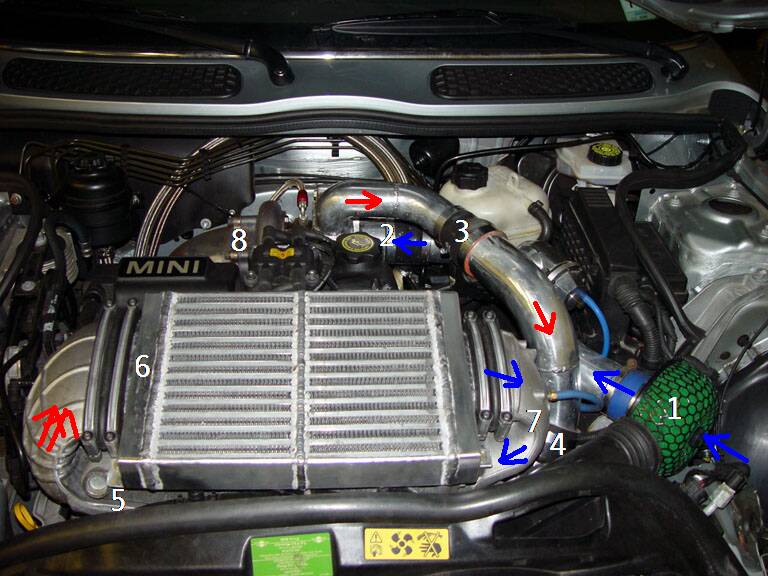
1 - Cool air is inhaled through the HKS filter, which has the factory grille scoop blowing onto it
2 - Cool air enters the turbo compressor
3 - After being compressed and heated by the turbo, hot air travels toward the throttle body
4 - Hot air enters the throttle body and travels into the supercharger
5 - After being compressed and heated by the supercharger, very hot air exits the supercharger - it has been heated twice now (compressor efficiencies are multuplied) so if the turbo is 70% efficient and the supercharger is 60% efficient, overall efficiency would be 42 %
6 - Very hot air enters the intercooler. Intercoolers deliver a % temperature drop, so if the intercooler is 80% efficient, it removes 80% of the difference between the very hot air and ambient
7 - Cooler air (still very warm, I'm sure) exits the intercooler and enters the intake manifold.
8 - After combustion, exhaust gases exit the cylinder head into a custom exhaust manifold and are routed through the turbo, exiting on the left into a custom downpipe.
Is that pretty much how it works?
1 - Cool air is inhaled through the HKS filter, which has the factory grille scoop blowing onto it
2 - Cool air enters the turbo compressor
3 - After being compressed and heated by the turbo, hot air travels toward the throttle body
4 - Hot air enters the throttle body and travels into the supercharger
5 - After being compressed and heated by the supercharger, very hot air exits the supercharger - it has been heated twice now (compressor efficiencies are multuplied) so if the turbo is 70% efficient and the supercharger is 60% efficient, overall efficiency would be 42 %
6 - Very hot air enters the intercooler. Intercoolers deliver a % temperature drop, so if the intercooler is 80% efficient, it removes 80% of the difference between the very hot air and ambient
7 - Cooler air (still very warm, I'm sure) exits the intercooler and enters the intake manifold.
8 - After combustion, exhaust gases exit the cylinder head into a custom exhaust manifold and are routed through the turbo, exiting on the left into a custom downpipe.
Is that pretty much how it works?


6th Gear
Joined: Aug 2003
Posts: 1,231
Likes: 1
From: PA/NJ
>>I never knew you could supercharge and turbocharge an engine. I mean, I figured you could, just have never heard of it. I'd like to see that, mate!
Twin charging is not new.
Back in the mid 80's, there was a custom hot rod builder who built a Pro-Street show car with a small-block Chevy fitted with TWO roots-type superchargers mounted on a custom intake manifold. The superchargers were fed by TWO turbos from each bank of cylinders. Everything was chromed. The guy becaem reasonably famous at the time. The car toured the national auto-show circuit and there was even a plastic model of it. The funny part is I think the original car was a Olds Cutlass Ciera. :smile:
Twin charging is not new.
Back in the mid 80's, there was a custom hot rod builder who built a Pro-Street show car with a small-block Chevy fitted with TWO roots-type superchargers mounted on a custom intake manifold. The superchargers were fed by TWO turbos from each bank of cylinders. Everything was chromed. The guy becaem reasonably famous at the time. The car toured the national auto-show circuit and there was even a plastic model of it. The funny part is I think the original car was a Olds Cutlass Ciera. :smile:


6th Gear
Joined: Jan 2003
Posts: 2,193
Likes: 1
From: CT, Litchfield County
Just got back from SPI and all I have to say is WOW! This thing is a monster. My head was forced back into the seat like I have never felt before. This car makes POWER! I couldn't believe that a basically stock car can make that kind of power. I was told that they are planning on offering this as a kit, but price in up in the air right now. You have to stop by and see and feel and hear this thing for yourself. The BOV is awesome. This is still a work in progress though, but stay tuned to see the finished product. SPI also had a few of their monsters out in the back. They even have a dyno right in the shop. This is a mod all of you will want to do in the future!
P.S. - They are waiting for you Macandcheese...
P.S. - They are waiting for you Macandcheese...
 ...
...
5th Gear
Joined: Feb 2003
Posts: 696
Likes: 0
From: Ohio
>>Just got back from SPI and all I have to say is WOW! This thing is a monster. My head was forced back into the seat like I have never felt before. This car makes POWER! I couldn't believe that a basically stock car can make that kind of power. I was told that they are planning on offering this as a kit, but price in up in the air right now. You have to stop by and see and feel and hear this thing for yourself. The BOV is awesome. This is still a work in progress though, but stay tuned to see the finished product. SPI also had a few of their monsters out in the back. They even have a dyno right in the shop. This is a mod all of you will want to do in the future!
>>
Thanks for sharing your experience Ace! Sounded like fun
I bet they have more than a few things on their to do/wish list. If it were me I'd be paranoid about further cooling the post-turbo air charge & finding ways to smooth out that torque curve some
Don't want to sound like I'm picking nits here... I know that its far too easy to critique someone else’s work. Still impressed & liking the TC the project!
>>
Thanks for sharing your experience Ace! Sounded like fun
I bet they have more than a few things on their to do/wish list. If it were me I'd be paranoid about further cooling the post-turbo air charge & finding ways to smooth out that torque curve some
Don't want to sound like I'm picking nits here... I know that its far too easy to critique someone else’s work. Still impressed & liking the TC the project!

6th Gear
Joined: Jan 2003
Posts: 1,816
Likes: 2
From: New Jersey
Stopped by this place this afternoon. nice guys, nice car. This thing is the real deal. I'll post some more pics and a more indepth writeup later on. Make sure your drool bibs are washed.
--
Cheese
--
Cheese

6th Gear
Joined: Jan 2003
Posts: 1,816
Likes: 2
From: New Jersey
:smile: I stopped by SPI today to meet with Hubie and snap some pics of the car. Had a bit of trouble finding the place but when i saw the 700HP Supra I knew I was probably in the right place. The twin turbo IS300 wasnt too shabby either. The little silver MINI looked so innocent parked next to these bad boys. The car looks fairly stock on the outside, save for painted lower cladding and a custom exhaust but when open the door you notice some some "extra" little screens. Hmmm more gadgets :smile: Turn the key and something isn't right. It idles perfectly smooth but it doesnt sound like the stock mini at all... there is nothing mini about the sound. Its not overly loud, just different.
Pulling out of the parking lot, i could tell i was in for treat. The sound of the blowoff between my 1-2 shift is hinting at whats about to happen. As we round the corner, I get on the gas and before I know it, the blowoff is wooshing and I'm shifting into third. What just happened? Even my girlfriend says "that thing was fast"
Thats all the time I have for this post.... I'll let the pictures speak for themselves. Top notch quality. Top notch guy. I let him drive my 17% car :smile: It used to impressive to me, but now Im spoiled Thanks Hubie!
--
Cheese
Pulling out of the parking lot, i could tell i was in for treat. The sound of the blowoff between my 1-2 shift is hinting at whats about to happen. As we round the corner, I get on the gas and before I know it, the blowoff is wooshing and I'm shifting into third. What just happened? Even my girlfriend says "that thing was fast"
Thats all the time I have for this post.... I'll let the pictures speak for themselves. Top notch quality. Top notch guy. I let him drive my 17% car :smile: It used to impressive to me, but now Im spoiled
Thanks Hubie!--
Cheese

3rd Gear
Joined: Sep 2003
Posts: 231
Likes: 0
From: Washington, US
>>Got my drool bib on
>>Can Anyone enlighten me as to why the torque curve posted by Twincharged is not smooth? Just curious.
>>
>>
There are peaks relative to the resonances of the system. The stock intake and the header are tuned to operate within certain RPM ranges (also means flow rates), and they're probably not the same. The manufacturer will typically design these components for a broad midrange. Aftermarket headers are designed for high end, often sacrificing low-end torque for high-end HP. When the optimum flow-rate is exceeded, the turbulance and resonances cause the air and fuel to mix differently. In this case, the intake is quickly overcome by the increased air flow. When the air flow comes reachs the header's designed flow region, the gases are literally sucked out and the response become smoother. Both Honda and Toyota have implemented variable length intake manifolds to be able to tune for low-end torque and high-end HP. A properly designed (for the application) intake manifold on the TwinCharger would probably as another 15 top-end HP and would keep the torque curve above 250 for far longer. Jackson Racing spends a lot of time flowing their intake manifolds to extract the most out of their low boost systems. I bet part of the TwinCharger's issue is also the relatively small valves. A big valve head and new intake manifold would be the next upgrade.
Of course, this is just my opinion. There will undoubted be others.
>>Can Anyone enlighten me as to why the torque curve posted by Twincharged is not smooth? Just curious.
>>
>>
There are peaks relative to the resonances of the system. The stock intake and the header are tuned to operate within certain RPM ranges (also means flow rates), and they're probably not the same. The manufacturer will typically design these components for a broad midrange. Aftermarket headers are designed for high end, often sacrificing low-end torque for high-end HP. When the optimum flow-rate is exceeded, the turbulance and resonances cause the air and fuel to mix differently. In this case, the intake is quickly overcome by the increased air flow. When the air flow comes reachs the header's designed flow region, the gases are literally sucked out and the response become smoother. Both Honda and Toyota have implemented variable length intake manifolds to be able to tune for low-end torque and high-end HP. A properly designed (for the application) intake manifold on the TwinCharger would probably as another 15 top-end HP and would keep the torque curve above 250 for far longer. Jackson Racing spends a lot of time flowing their intake manifolds to extract the most out of their low boost systems. I bet part of the TwinCharger's issue is also the relatively small valves. A big valve head and new intake manifold would be the next upgrade.
Of course, this is just my opinion. There will undoubted be others.
Thread Starter
|
Former Vendor
Joined: Nov 2003
Posts: 66
Likes: 0
>>Got my drool bib on 
The reason why the torque and hp curves are not smooth between 3500 to 4500 rpms is because we were adjusting the gain settings on the Greddy Profec B spec II in order to obtain data on the boost curves of the twincharged setup. The T28 turbo uses an internal wastegate which we can control with the Profec. As the supercharger builds boost with rpm, we can control the power and torque curves of the engine by adjusting the boost curve of the turbo. This is done via the electronic control of the actuator. We were experiencing some boost creep as we were trying to adjust the settings to maximize turbo spool and maintain a constant 20 PSI. If necessary, I can post different dyno sheets of different adjustments as reference. The ability to control engine output with varying boost levels is one of the major benefits of turbocharging.
The reason why the torque and hp curves are not smooth between 3500 to 4500 rpms is because we were adjusting the gain settings on the Greddy Profec B spec II in order to obtain data on the boost curves of the twincharged setup. The T28 turbo uses an internal wastegate which we can control with the Profec. As the supercharger builds boost with rpm, we can control the power and torque curves of the engine by adjusting the boost curve of the turbo. This is done via the electronic control of the actuator. We were experiencing some boost creep as we were trying to adjust the settings to maximize turbo spool and maintain a constant 20 PSI. If necessary, I can post different dyno sheets of different adjustments as reference. The ability to control engine output with varying boost levels is one of the major benefits of turbocharging.
