Drivetrain FIREBALLED! RACING - The "PROJECT" formerly known as "MARY"


6th Gear
Joined: Aug 2005
Posts: 1,335
Likes: 0
From: Tucson, AZ


Manufacturer
Joined: Sep 2004
Posts: 1,230
Likes: 0
From: Southern California
513 was with a little n2o I cant remember the final # without nitrous but it was higher than the previous 412.

Thread Starter
|
Former Vendor
Joined: Nov 2003
Posts: 66
Likes: 0
REV3 - HEADER AND EXHAUST
SUMMARY OF CHANGES:
REV1: STAGE THREE CYLINDER HEAD
REV2B: REV1 + CAM
REV3: REV2B + HEADER + EXHAUST
Project "M" is nearing the end of PHASE ONE testing. We bolted on our prototype header and full race exhaust. The header has been sitting on our shelves for quite some time, gathering dust and taking up space. None of our projects remain supercharged only, so testing has been long overdue.
Unfortunately, the header was designed for our STAGE TWO HEAD, which currently powers the race car, Brian's MINI, and come to think of it, every high HP MINI out there. We decided to continue testing since the header is far superior to the factory design even though the ports are not matched and runner size is barely acceptable for our STAGE THREE HEAD. The TRI-Y design, however, is ideal for our head and cam combination and the specifications were close to what we calculated.
Next step was to fabricate an appropriate exhaust so we went ahead and threw together a three inch SS catback with dual Burns Race Mufflers and massive "old school" 130MM APEXi Dunk Tips. This is way more exhaust than what any S/C MINI requires, but we were thinking ahead to PHASE THREE and didn't want to build an exhaust twice.
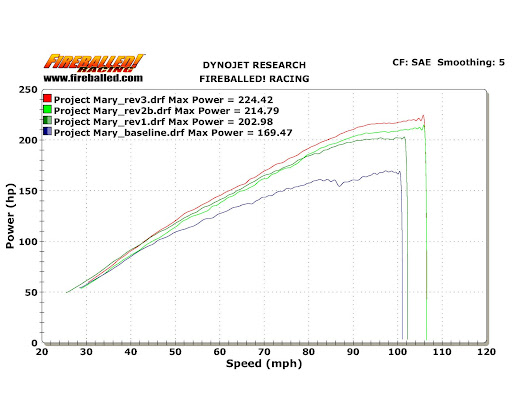
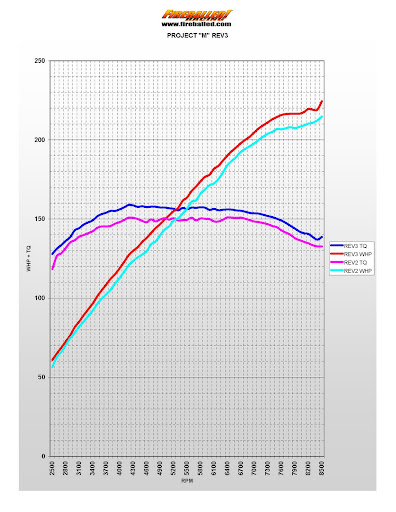
Off to the dyno we went and immediately, Project "M" felt more responsive and "revved" freely to redline. The only drawback was the exhaust note, which now bordered on ridiculous. The dyno confirmed what we felt while driving and we were rewarded with nice gains across the board. The low end power that was lost with the cam change was recovered and improved upon, while we continued to see gains on top. This was exciting since we basically "threw" stuff together and were finally able to obtain valuable data on a part long forgotten.
NEXT UP - MORE BOOST!!
STOCK: 169.47
REV1: 202.98WHP (+33.51WHP)
REV2B: 214.79WHP (+45.32WHP)
REV3: 224.42WHP (+54.95WHP)
REV1: 202.98WHP (+33.51WHP)
REV2B: 214.79WHP (+45.32WHP)
REV3: 224.42WHP (+54.95WHP)
REV1: STAGE THREE CYLINDER HEAD
REV2B: REV1 + CAM
REV3: REV2B + HEADER + EXHAUST
Project "M" is nearing the end of PHASE ONE testing. We bolted on our prototype header and full race exhaust. The header has been sitting on our shelves for quite some time, gathering dust and taking up space. None of our projects remain supercharged only, so testing has been long overdue.
Unfortunately, the header was designed for our STAGE TWO HEAD, which currently powers the race car, Brian's MINI, and come to think of it, every high HP MINI out there. We decided to continue testing since the header is far superior to the factory design even though the ports are not matched and runner size is barely acceptable for our STAGE THREE HEAD. The TRI-Y design, however, is ideal for our head and cam combination and the specifications were close to what we calculated.
Next step was to fabricate an appropriate exhaust so we went ahead and threw together a three inch SS catback with dual Burns Race Mufflers and massive "old school" 130MM APEXi Dunk Tips. This is way more exhaust than what any S/C MINI requires, but we were thinking ahead to PHASE THREE and didn't want to build an exhaust twice.
Off to the dyno we went and immediately, Project "M" felt more responsive and "revved" freely to redline. The only drawback was the exhaust note, which now bordered on ridiculous. The dyno confirmed what we felt while driving and we were rewarded with nice gains across the board. The low end power that was lost with the cam change was recovered and improved upon, while we continued to see gains on top. This was exciting since we basically "threw" stuff together and were finally able to obtain valuable data on a part long forgotten.
NEXT UP - MORE BOOST!!

6th Gear
Joined: Sep 2002
Posts: 2,196
Likes: 0
From: Hampton, VA
SUMMARY OF CHANGES:
REV1: STAGE THREE CYLINDER HEAD
REV2B: REV1 + CAM
REV3: REV2B + HEADER + EXHAUST
Project "M" is nearing the end of PHASE ONE testing. We bolted on our prototype header and full race exhaust. The header has been sitting on our shelves for quite some time, gathering dust and taking up space. None of our projects remain supercharged only, so testing has been long overdue.
Unfortunately, the header was designed for our STAGE TWO HEAD, which currently powers the race car, Brian's MINI, and come to think of it, every high HP MINI out there. We decided to continue testing since the header is far superior to the factory design even though the ports are not matched and runner size is barely acceptable for our STAGE THREE HEAD. The TRI-Y design, however, is ideal for our head and cam combination and the specifications were close to what we calculated.
Next step was to fabricate an appropriate exhaust so we went ahead and threw together a three inch SS catback with dual Burns Race Mufflers and massive "old school" 130MM APEXi Dunk Tips. This is way more exhaust than what any S/C MINI requires, but we were thinking ahead to PHASE THREE and didn't want to build an exhaust twice.
Off to the dyno we went and immediately, Project "M" felt more responsive and "revved" freely to redline. The only drawback was the exhaust note, which now bordered on ridiculous. The dyno confirmed what we felt while driving and we were rewarded with nice gains across the board. The low end power that was lost with the cam change was recovered and improved upon, while we continued to see gains on top. This was exciting since we basically "threw" stuff together and were finally able to obtain valuable data on a part long forgotten.
NEXT UP - MORE BOOST!!
STOCK: 169.47
REV1: 202.98WHP (+33.51WHP)
REV2B: 214.79WHP (+45.32WHP)
REV3: 224.42WHP (+54.95WHP)
REV1: 202.98WHP (+33.51WHP)
REV2B: 214.79WHP (+45.32WHP)
REV3: 224.42WHP (+54.95WHP)
REV1: STAGE THREE CYLINDER HEAD
REV2B: REV1 + CAM
REV3: REV2B + HEADER + EXHAUST
Project "M" is nearing the end of PHASE ONE testing. We bolted on our prototype header and full race exhaust. The header has been sitting on our shelves for quite some time, gathering dust and taking up space. None of our projects remain supercharged only, so testing has been long overdue.
Unfortunately, the header was designed for our STAGE TWO HEAD, which currently powers the race car, Brian's MINI, and come to think of it, every high HP MINI out there. We decided to continue testing since the header is far superior to the factory design even though the ports are not matched and runner size is barely acceptable for our STAGE THREE HEAD. The TRI-Y design, however, is ideal for our head and cam combination and the specifications were close to what we calculated.
Next step was to fabricate an appropriate exhaust so we went ahead and threw together a three inch SS catback with dual Burns Race Mufflers and massive "old school" 130MM APEXi Dunk Tips. This is way more exhaust than what any S/C MINI requires, but we were thinking ahead to PHASE THREE and didn't want to build an exhaust twice.
Off to the dyno we went and immediately, Project "M" felt more responsive and "revved" freely to redline. The only drawback was the exhaust note, which now bordered on ridiculous. The dyno confirmed what we felt while driving and we were rewarded with nice gains across the board. The low end power that was lost with the cam change was recovered and improved upon, while we continued to see gains on top. This was exciting since we basically "threw" stuff together and were finally able to obtain valuable data on a part long forgotten.
NEXT UP - MORE BOOST!!

Nice numbers...
I have to admit I am getting old and its very hard to read these charts, but it looks as if you are pulling to an unrealistic 8500 rpm to achieve these numbers.
Maybe if all ya'll's (Texas plural) that are sharing data with us used the same limit, we as consumers could compare apples to apples. I propose its set to a more realistic and useable to the masses; 7000rpm.
I have to admit I am getting old and its very hard to read these charts, but it looks as if you are pulling to an unrealistic 8500 rpm to achieve these numbers.
Maybe if all ya'll's (Texas plural) that are sharing data with us used the same limit, we as consumers could compare apples to apples. I propose its set to a more realistic and useable to the masses; 7000rpm.
6th Gear
Joined: Sep 2002
Posts: 2,196
Likes: 0
From: Hampton, VA
Nice numbers...
I have to admit I am getting old and its very hard to read these charts, but it looks as if you are pulling to an unrealistic 8500 rpm to achieve these numbers.
Maybe if all ya'll's (Texas plural) that are sharing data with us used the same limit, we as consumers could compare apples to apples. I propose its set to a more realistic and useable to the masses; 7000rpm.
I have to admit I am getting old and its very hard to read these charts, but it looks as if you are pulling to an unrealistic 8500 rpm to achieve these numbers.
Maybe if all ya'll's (Texas plural) that are sharing data with us used the same limit, we as consumers could compare apples to apples. I propose its set to a more realistic and useable to the masses; 7000rpm.
We just need to learn how to interpret what we're really seeing and not be drawn into just a numbers game.

I agree in a way but also concede that track guys will be loving this and need to see what can be done. Real racing is about being at the limit. That's valuable for the few that really race.
We just need to learn how to interpret what we're really seeing and not be drawn into just a numbers game.
We just need to learn how to interpret what we're really seeing and not be drawn into just a numbers game.
So then either publish a graph that we can read, larger size.
And/Or
Report 2 sets of results. One set at 7000 and one set at rpm limit such as.
The below is at 8500 RPM
STOCK: 169.47
REV1: 202.98WHP (+33.51WHP)
REV2B: 214.79WHP (+45.32WHP)
REV3: 224.42WHP (+54.95WHP)
At 7000 RPM we achieved the following
REV1: 202.98WHP (+33.51WHP)
REV2B: 214.79WHP (+45.32WHP)
REV3: 224.42WHP (+54.95WHP)
At 7000 RPM we achieved the following
STOCK: 169.47
REV1: xxx.xxWHP (+xx.xxWHP)
REV2B: yyy.yyWHP (+yy.yyWHP)
REV3: zzz.zzWHP (+zz.zzWHP)
Then everyone can be on the same page. But then again, this thread is probably not the place to debate this. Maybe we should start a new thread to discuss the relative merits off all vendors reporting from the same level. (OK I just cracked myself up on thinking they would ever do that.)
REV1: xxx.xxWHP (+xx.xxWHP)
REV2B: yyy.yyWHP (+yy.yyWHP)
REV3: zzz.zzWHP (+zz.zzWHP)
Then everyone can be on the same page. But then again, this thread is probably not the place to debate this. Maybe we should start a new thread to discuss the relative merits off all vendors reporting from the same level. (OK I just cracked myself up on thinking they would ever do that.)

6th Gear
Joined: Aug 2005
Posts: 1,335
Likes: 0
From: Tucson, AZ
Nice numbers...
I have to admit I am getting old and its very hard to read these charts, but it looks as if you are pulling to an unrealistic 8500 rpm to achieve these numbers.
Maybe if all ya'll's (Texas plural) that are sharing data with us used the same limit, we as consumers could compare apples to apples. I propose its set to a more realistic and useable to the masses; 7000rpm.
I have to admit I am getting old and its very hard to read these charts, but it looks as if you are pulling to an unrealistic 8500 rpm to achieve these numbers.
Maybe if all ya'll's (Texas plural) that are sharing data with us used the same limit, we as consumers could compare apples to apples. I propose its set to a more realistic and useable to the masses; 7000rpm.
It's pretty easy, with a bigger graph granted, to see where you would be at "only" 7200.....
6th Gear
Joined: Aug 2005
Posts: 1,335
Likes: 0
From: Tucson, AZ
To add to my post, if you are in a turbo setup you really need that extra room. I am finding with a stock rev limit I tend to fall out of boost when I am forced to shift. Having another 1000 rpms to work with would solve this problem completely...I am sure this factored into the decison to measure peaks at 8K+ rpms.....

Banned
Joined: Jul 2005
Posts: 1,640
Likes: 0
From: Flitwick UK
Personally I believe you've got the best of all worlds that you're still making more power and torque than your stock s below 6800 but now when you want u can hang it out in each gear upto a sensible speed. its nice to have the option available to you.
I wish I had it,I would then have a 12sec street car instead of a 13sec one
I wish I had it,I would then have a 12sec street car instead of a 13sec one
Banned
Joined: Jul 2005
Posts: 1,640
Likes: 0
From: Flitwick UK
Makes sense...
So then either publish a graph that we can read, larger size.
And/Or
Report 2 sets of results. One set at 7000 and one set at rpm limit such as.
The below is at 8500 RPM
So then either publish a graph that we can read, larger size.
And/Or
Report 2 sets of results. One set at 7000 and one set at rpm limit such as.
The below is at 8500 RPM
STOCK: 169.47
REV1: 202.98WHP (+33.51WHP)
REV2B: 214.79WHP (+45.32WHP)
REV3: 224.42WHP (+54.95WHP)
REV1: 202.98WHP (+33.51WHP)
REV2B: 214.79WHP (+45.32WHP)
REV3: 224.42WHP (+54.95WHP)
At 7000 RPM we achieved the following
STOCK: 169.47
REV1: xxx.xxWHP (+xx.xxWHP)
REV2B: yyy.yyWHP (+yy.yyWHP)
REV3: zzz.zzWHP (+zz.zzWHP)
REV2B: yyy.yyWHP (+yy.yyWHP)
REV3: zzz.zzWHP (+zz.zzWHP)
Then everyone can be on the same page. But then again, this thread is probably not the place to debate this. Maybe we should start a new thread to discuss the relative merits off all vendors reporting from the same level. (OK I just cracked myself up on thinking they would ever do that.)
I think you're right gnaster, I do like LDG dyno sheets every 200 rpm, this is much like an engine dyno sheet and easy to read and compare to.
Hubie's graph is easy to read if you save it then open again and keep hiting that + sign.
I do find the dyno dynamics graph quite hard to figure due to the different scales which change as they go up in 27s and 23s, I suppose an average of 5 should be used.
Have you visited any dynos lately??

6th Gear
Joined: Apr 2005
Posts: 1,425
Likes: 0
From: Metro Detroit Area, MI
I am drawing a blank. What is baseline TQ for our cars? It looks like the combo here is making 150-160, does that seem about right for the mods? Or is this a setup that sacrifices some torque for higher HP?
Thread Starter
|
Former Vendor
Joined: Nov 2003
Posts: 66
Likes: 0
Makes sense...
So then either publish a graph that we can read, larger size.
And/Or
Report 2 sets of results. One set at 7000 and one set at rpm limit such as.
The below is at 8500 RPM
So then either publish a graph that we can read, larger size.
And/Or
Report 2 sets of results. One set at 7000 and one set at rpm limit such as.
The below is at 8500 RPM
STOCK: 169.47
REV1: 202.98WHP (+33.51WHP)
REV2B: 214.79WHP (+45.32WHP)
REV3: 224.42WHP (+54.95WHP)
REV1: 202.98WHP (+33.51WHP)
REV2B: 214.79WHP (+45.32WHP)
REV3: 224.42WHP (+54.95WHP)
At 7000 RPM we achieved the following
STOCK: 169.47
REV1: xxx.xxWHP (+xx.xxWHP)
REV1: xxx.xxWHP (+xx.xxWHP)
REV2B: yyy.yyWHP (+yy.yyWHP)
REV3: zzz.zzWHP (+zz.zzWHP)
REV3: zzz.zzWHP (+zz.zzWHP)
Then everyone can be on the same page. But then again, this thread is probably not the place to debate this. Maybe we should start a new thread to discuss the relative merits off all vendors reporting from the same level. (OK I just cracked myself up on thinking they would ever do that.)
MAX NUMBERS BASED ON 6950 REV LIMIT
STOCK 160.22 WHP/140.06 TQ
REV1 193.97 WHP/154.08 TQ +33.75 WHP/+14.02 TQ
REV2B 196.97 WHP/150.74 TQ +36.75 WHP/+10.68 TQ
REV3 203.41 WHP/158.86 TQ +43.19 WHP/+18.80 TQ
STOCK: NO AIR FILTER
REV1 MODS: HEAD/NO AIR FILTER
REV2B MODS: HEAD/CAM/NO AIR FILTER
REV3 MODS: HEAD/CAM/HEADER/EXHAUST/NO AIR FILTER
6th Gear
Joined: Apr 2005
Posts: 1,425
Likes: 0
From: Metro Detroit Area, MI
Oh wow, I missed that part first time around. Great work guys


Thread Starter
|
Former Vendor
Joined: Nov 2003
Posts: 66
Likes: 0
PHASE ONE TESTING COMPLETED
Phase One of Project "M" is completed and we are quite satisfied with the results. Each of our revisions performed as expected and we will create a staged power package that will provide the performance gains as indicated.
Our goal was to demonstrate that a broad cross section of universal components can be systematically incorporated around our Stage Three Head, incrementally unleashing the horsepower potential of our innovative design. Parts are all bolt on, no port matching of intake manifold or exhaust header, supercharger inlet and outlet are stock, with stock intercooler, factory bypass valve, and throttle body.
Modifications:
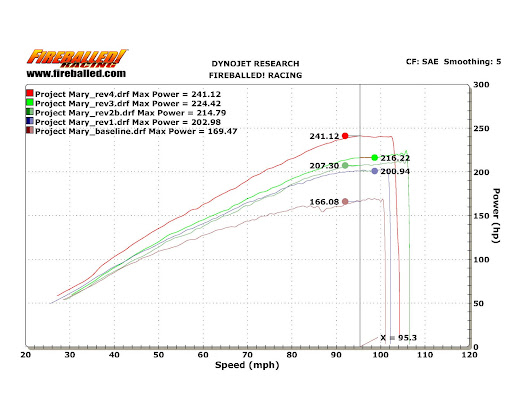
Rev1: stage three head
Rev2b: stage three head + cam
Rev 3: stage three head + cam + header + exhaust
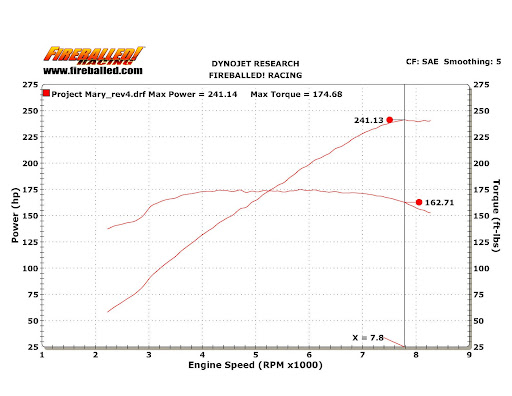
Rev 4: stage three head + cam + header + exhaust + 380cc INJ + 15% pulley
Summary of WHP gains: (7800 RPM reference)
Rev4: 241.12 WHP +75.04 WHP
Rev3: 216.22 WHP +50.14 WHP
Rev2b: 207.30 WHP +41.22 WHP
Rev1: 200.94 WHP +34.86 WHP
Baseline: 166.08 WHP
Our data indicates that with proper tuning and optimized parts configurations, we CAN extract more HP out of PHASE ONE.
But honestly, what REALLY excites us more than finding the few extra HP needed to achieve the 250 WHP mark, is entering PHASE TWO of Project "M" which will evolve the factory supercharger configuration into a more efficient and innovative system capable of producing power levels once thought to be unattainable.
NEXT UP: "PHASE TWO....."
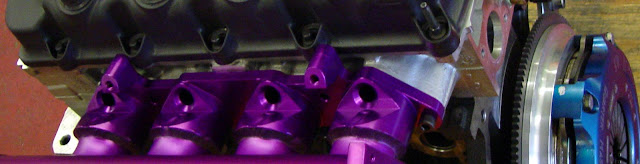

.
Our goal was to demonstrate that a broad cross section of universal components can be systematically incorporated around our Stage Three Head, incrementally unleashing the horsepower potential of our innovative design. Parts are all bolt on, no port matching of intake manifold or exhaust header, supercharger inlet and outlet are stock, with stock intercooler, factory bypass valve, and throttle body.
Modifications:
Rev1: stage three head
Rev2b: stage three head + cam
Rev 3: stage three head + cam + header + exhaust
Rev 4: stage three head + cam + header + exhaust + 380cc INJ + 15% pulley
Summary of WHP gains: (7800 RPM reference)
Rev4: 241.12 WHP +75.04 WHP
Rev3: 216.22 WHP +50.14 WHP
Rev2b: 207.30 WHP +41.22 WHP
Rev1: 200.94 WHP +34.86 WHP
Baseline: 166.08 WHP
Our data indicates that with proper tuning and optimized parts configurations, we CAN extract more HP out of PHASE ONE.
But honestly, what REALLY excites us more than finding the few extra HP needed to achieve the 250 WHP mark, is entering PHASE TWO of Project "M" which will evolve the factory supercharger configuration into a more efficient and innovative system capable of producing power levels once thought to be unattainable.
NEXT UP: "PHASE TWO....."
.