


Suspension Megan Coilover Owner Update


6th Gear
Joined: Jan 2003
Posts: 3,301
Likes: 1
...one other thought here...one of the conclusions I came to a long time ago - perhaps incorrectly - is that a linear rate spring is very easy to work with.
Lets use a 400# spring as an example. It takes 400# of force to compress this spring one inch, an additional 400#s to compress another inch or a total of 800#s. However, it doesn't matter to the spring how much preload we've applied to it since we are concerned with movement from rest...the first inch of travel requires 400#s of force no matter how much preload we have... which is why I purchsed springs long or short enough to perform the job.
I am not an engineer, so I could have been wrong all these years.
EDIT - ah, but I did forget to mentioned that a preloaded spring has more stored/potential energy - for rebound.
Per above, the available travel is based upon both the spring and the damper. This is not really confusing...since a heavier rate spring of the same length has less travel and vise versa. But also, a heavier rate spring may not be heavy enough in a given application to reach block hieght at steady state and vise versa.
I think we're on the same page.
Lets use a 400# spring as an example. It takes 400# of force to compress this spring one inch, an additional 400#s to compress another inch or a total of 800#s. However, it doesn't matter to the spring how much preload we've applied to it since we are concerned with movement from rest...the first inch of travel requires 400#s of force no matter how much preload we have... which is why I purchsed springs long or short enough to perform the job.
I am not an engineer, so I could have been wrong all these years.
EDIT - ah, but I did forget to mentioned that a preloaded spring has more stored/potential energy - for rebound.
Per above, the available travel is based upon both the spring and the damper. This is not really confusing...since a heavier rate spring of the same length has less travel and vise versa. But also, a heavier rate spring may not be heavy enough in a given application to reach block hieght at steady state and vise versa.
I think we're on the same page.
Last edited by meb; Jun 23, 2008 at 12:07 PM.

Former Vendor
Joined: Apr 2006
Posts: 436
Likes: 0
From: Nor. Cal. Bay Are
Just to make sure I'm following, looking at just the spring, you're saying that it will take 400# to compress the first 1" of the spring and the same amount of force (400#) to compress and additional 1" regardless of how much the spring has already been compressed. And that this is due to the linear characteristics of the spring.
This assumes that this relationship exists throughout the useful range of the spring. I believe we have mis-understood the term "linear" and have been mis-using it. I think the term refers to a "linearity" (is that even a word?) accross the useful range of the spring such that for a given compression X it requires 1.5Y load (as an example). This means that the more the spring gets compressed, the more load that's required to compress that amount. Not necessarily the same load to distance relationship as pointed at the begining.
Here is a graph that depicts this relationship much better. Notice the line for the Helical spring. Here is the link to the short article as well.
http://www.accusealmfg.com/sealdesign/loadvsdef.asp

Here is an interesting definition of a Linear spring
Now taking the whole system, here are my real world findings with the Megans and would be the case with any other C/O. For clarification purposes, when preloading a spring the damper shaft is not being extended any, the spring is simply being compressed between the upper and lower perches (since the length of the shaft is fixed) thus additional load is being applied:
By preloading the spring, the car would not settle as low as w/o preload. This was measured by 1) ride heigth 2) damper travel. And this is directly in line with the above graph in that - as the spring was compressed, the more load was require for the additional deflection/compression. In essence, the rate of the spring is changing as it's being compressed. But it is still a linear relationship.
Here is a quick read illustrating this point.
I agree that a preloaded spring will have more stored energy. So, this begs the question, How much preload can you put on a given spring so that the damper is able to effectively control the rebound? Another question, does the damper dictate the spring or is it the other way round? I would think is the spring that dictates the damper since the spring manages the weight. Digressing, sorry getting tired time for bed!
IMO the goal of the system is to maintain the damper shaft as close to the middle as possible and this can best be achieved by pre-loading.
I'm confused by this:
"since a heavier rate spring of the same length has less travel and vise versa."
Is this because for a given weight the heavier spring will compress less?
enough for now.....
This assumes that this relationship exists throughout the useful range of the spring. I believe we have mis-understood the term "linear" and have been mis-using it. I think the term refers to a "linearity" (is that even a word?) accross the useful range of the spring such that for a given compression X it requires 1.5Y load (as an example). This means that the more the spring gets compressed, the more load that's required to compress that amount. Not necessarily the same load to distance relationship as pointed at the begining.
Here is a graph that depicts this relationship much better. Notice the line for the Helical spring. Here is the link to the short article as well.
http://www.accusealmfg.com/sealdesign/loadvsdef.asp
Here is an interesting definition of a Linear spring
Now taking the whole system, here are my real world findings with the Megans and would be the case with any other C/O. For clarification purposes, when preloading a spring the damper shaft is not being extended any, the spring is simply being compressed between the upper and lower perches (since the length of the shaft is fixed) thus additional load is being applied:
By preloading the spring, the car would not settle as low as w/o preload. This was measured by 1) ride heigth 2) damper travel. And this is directly in line with the above graph in that - as the spring was compressed, the more load was require for the additional deflection/compression. In essence, the rate of the spring is changing as it's being compressed. But it is still a linear relationship.
Here is a quick read illustrating this point.
I agree that a preloaded spring will have more stored energy. So, this begs the question, How much preload can you put on a given spring so that the damper is able to effectively control the rebound? Another question, does the damper dictate the spring or is it the other way round? I would think is the spring that dictates the damper since the spring manages the weight. Digressing, sorry getting tired time for bed!
IMO the goal of the system is to maintain the damper shaft as close to the middle as possible and this can best be achieved by pre-loading.
I'm confused by this:
"since a heavier rate spring of the same length has less travel and vise versa."
Is this because for a given weight the heavier spring will compress less?
enough for now.....
6th Gear
Joined: Jan 2003
Posts: 3,301
Likes: 1
no no! to the first sentence...400lbs for the first inch, an additional 400lbs for the second inch or 800lbs - 1,200 lbs for the third inch. Perhaps I did not write this very well.
i'll read on a little later - great stuff here!
i'll read on a little later - great stuff here!


2nd Gear
Joined: Dec 2004
Posts: 87
Likes: 0
It's because a higher rate spring has thicker coils, so spring travel reduces.
6th Gear
Joined: Jan 2003
Posts: 3,301
Likes: 1
Exactly. Obviously a heavier spring will resist weight transfer a little more so in theory it shouldn't matter that there is less travel. But transient wieght shift and steady state ask different things from a spring.
EDIT IN BOLD
EDIT IN BOLD
Last edited by meb; Jun 27, 2008 at 06:34 AM.
6th Gear
Joined: Jan 2003
Posts: 3,301
Likes: 1
Hooks Law, yes...I this law also discuses the dual nature of a spring - potential and kinetic...but I cannot remember.

5th Gear
Joined: Mar 2007
Posts: 678
Likes: 5
I just switched from stock to Megan's, Also ran some Helix Rear Control Arms Upper/Lower.
I'm not sure the over all drop, but I find it to have a nice ride.
I'll know better once the Alignment is dialed in this week.
The megan's are used so there broken in and the car settled quite well.
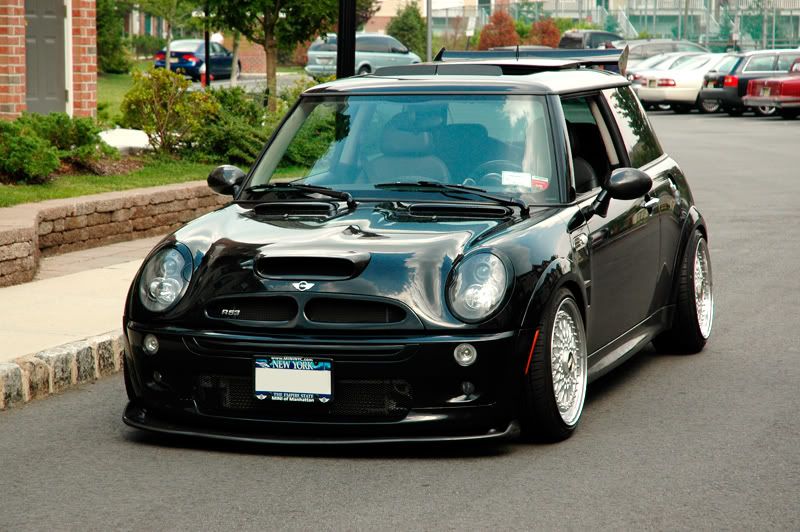
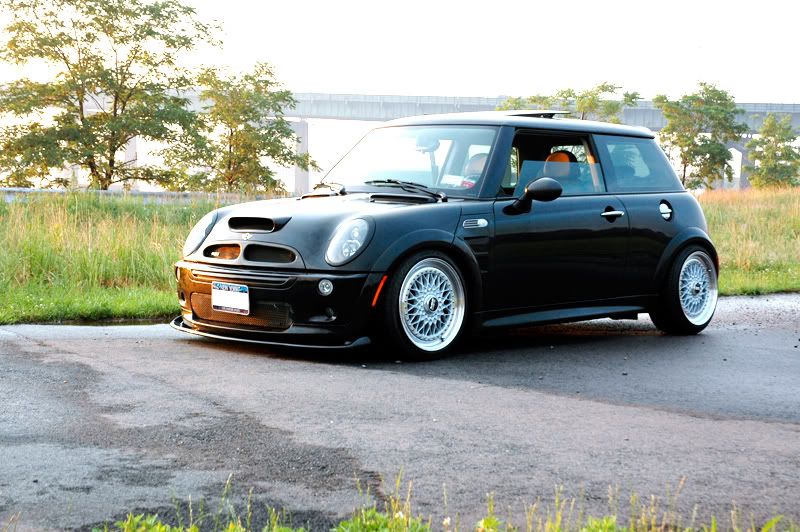
I'm not sure the over all drop, but I find it to have a nice ride.
I'll know better once the Alignment is dialed in this week.
The megan's are used so there broken in and the car settled quite well.


i put a set of megans on yesterday. They were hand me downs from thatvguy. That means i'm running 6" barrel shaped 440lb front springs from ground control and stock megan rear springs. I've got it set so there is 1 finger width between the arch and the tire in front and 1.5 finger width's in back.
I'm not slammed by any means but it's functional. As far as ride comfort I went out looking for a few bumps that used to make me shudder with my hsport/oem damper setup. With the megans the car just glides over them and absorbs it. That's not hard to believe because before I tore the car down I put my hand in the hsport spring to check and found i had about 3/4" of travel between the start of the damper shaft and the totally destroyed hsport bump stop.
Overall I'm quite pleased with the setup, it's a touch bouncy but compared to a crappy progressive rate spring mated with a damper it wasn't designed for... it's a big improvement. I mean... 1.75" of travel isn't much at all.. but it sure is better then 3/4.
I'm not slammed by any means but it's functional. As far as ride comfort I went out looking for a few bumps that used to make me shudder with my hsport/oem damper setup. With the megans the car just glides over them and absorbs it. That's not hard to believe because before I tore the car down I put my hand in the hsport spring to check and found i had about 3/4" of travel between the start of the damper shaft and the totally destroyed hsport bump stop.
Overall I'm quite pleased with the setup, it's a touch bouncy but compared to a crappy progressive rate spring mated with a damper it wasn't designed for... it's a big improvement. I mean... 1.75" of travel isn't much at all.. but it sure is better then 3/4.
5th Gear
Joined: Mar 2007
Posts: 678
Likes: 5
Thanks man, I really appreciate the kind words
I must say that the switch to the megan's has made for a nice ride.
It's actually softer than I thought it would be.
I really like the ride height it allowed me to pull off with the new wider wheels. I may in a bit think of upgrading to some Eibach springs to make it a bit more firm and I will soon need to update the front endlinks, since they have more stress due to the added camber.
It very well might be toed out a bit, I'm taking it in tomorrow for an alignment, it's riding great although a bit shifty on the road. Will let you know how it goes once all is dialed in.
I must say that the switch to the megan's has made for a nice ride.
It's actually softer than I thought it would be.
I really like the ride height it allowed me to pull off with the new wider wheels. I may in a bit think of upgrading to some Eibach springs to make it a bit more firm and I will soon need to update the front endlinks, since they have more stress due to the added camber.
It very well might be toed out a bit, I'm taking it in tomorrow for an alignment, it's riding great although a bit shifty on the road. Will let you know how it goes once all is dialed in.


User Title's are Silly
Joined: Jul 2003
Posts: 2,022
Likes: 0
From: Arvada, Colorado
i put a set of megans on yesterday. They were hand me downs from thatvguy. That means i'm running 6" barrel shaped 440lb front springs from ground control and stock megan rear springs. I've got it set so there is 1 finger width between the arch and the tire in front and 1.5 finger width's in back.
I'm not slammed by any means but it's functional. As far as ride comfort I went out looking for a few bumps that used to make me shudder with my hsport/oem damper setup. With the megans the car just glides over them and absorbs it. That's not hard to believe because before I tore the car down I put my hand in the hsport spring to check and found i had about 3/4" of travel between the start of the damper shaft and the totally destroyed hsport bump stop.
Overall I'm quite pleased with the setup, it's a touch bouncy but compared to a crappy progressive rate spring mated with a damper it wasn't designed for... it's a big improvement. I mean... 1.75" of travel isn't much at all.. but it sure is better then 3/4.
I'm not slammed by any means but it's functional. As far as ride comfort I went out looking for a few bumps that used to make me shudder with my hsport/oem damper setup. With the megans the car just glides over them and absorbs it. That's not hard to believe because before I tore the car down I put my hand in the hsport spring to check and found i had about 3/4" of travel between the start of the damper shaft and the totally destroyed hsport bump stop.
Overall I'm quite pleased with the setup, it's a touch bouncy but compared to a crappy progressive rate spring mated with a damper it wasn't designed for... it's a big improvement. I mean... 1.75" of travel isn't much at all.. but it sure is better then 3/4.
Congrats on the new set up, and getting it where you want it


5th Gear
Joined: Mar 2007
Posts: 678
Likes: 5
Yup, Rally hooked me up with his set.
One of the big reasons I wanted them was since they were already settled.
Made it easier to do the one time install instead of having to return then and have the car lowered after it settled. I really like the ride so far, I find the car to be better balanced with them than the stock setup. Down the road I may upgrade to some eibach springs. All in all having made the change I couldn't be more pleased with them..
One of the big reasons I wanted them was since they were already settled.
Made it easier to do the one time install instead of having to return then and have the car lowered after it settled. I really like the ride so far, I find the car to be better balanced with them than the stock setup. Down the road I may upgrade to some eibach springs. All in all having made the change I couldn't be more pleased with them..
User Title's are Silly
Joined: Jul 2003
Posts: 2,022
Likes: 0
From: Arvada, Colorado
I got them from another member, and I think I paid $60 for them. Do a search for Eibach's site, then they will show who their retail vendors are, you can contact those shops. You can expect to pay between $80-100 for a pair of front springs.
You can also CALL the guys at Texas Speed Works, a vendor here on NAM. If you call them, they will help you out and get you some springs, may be Swift springs, or something like that, but those are amazing springs. I was going to call them, but the Eibachs came up for sale, so that was that. But TXwerks was my first choice.
You can also CALL the guys at Texas Speed Works, a vendor here on NAM. If you call them, they will help you out and get you some springs, may be Swift springs, or something like that, but those are amazing springs. I was going to call them, but the Eibachs came up for sale, so that was that. But TXwerks was my first choice.


4th Gear
Joined: Feb 2006
Posts: 437
Likes: 0
From: Greenville, SC
Eibach info listed on their site. Based on you having a "standard" 2.5" ID coilover. I'm sure that this is not all that they have. I can provide other rate calcs, if you need.
Part number is as follows: Lenth (0600) ID (2.5" or 64mm) Rate (0450 = 450 lbs/in)
Rate in table is in newton/meters. Everything else is metric. (ie. mm)

Part number is as follows: Lenth (0600) ID (2.5" or 64mm) Rate (0450 = 450 lbs/in)
Rate in table is in newton/meters. Everything else is metric. (ie. mm)

Gonna bring this thread back from the dead to bring up some questions. Now keep in mind I dont own a track car but love curvy roads and spirited driving, it is not a DD and I am use to some stiffness in suspensions.
I am currently running the Megan V3 with the 160.008 fronts and 180.006 rears. I had a set of 7k springs in the front but they were to short at 5.5" and liked to bottom out. Today I put my original 160.008 spring on the the front with the perch all the way down, needless to say there is no preload on the springs in the front or rear. Is this a bad thing or will I not have issues? I made an attempt to preload and the damn front set about stock height! I have the threaded strut body's all the way down into the brakets as well.
I am currently running the Megan V3 with the 160.008 fronts and 180.006 rears. I had a set of 7k springs in the front but they were to short at 5.5" and liked to bottom out. Today I put my original 160.008 spring on the the front with the perch all the way down, needless to say there is no preload on the springs in the front or rear. Is this a bad thing or will I not have issues? I made an attempt to preload and the damn front set about stock height! I have the threaded strut body's all the way down into the brakets as well.