When you click on links to various merchants on this site and make a purchase, this can result in this site earning a commission. Affiliate programs and affiliations include, but are not limited to, the eBay Partner Network.
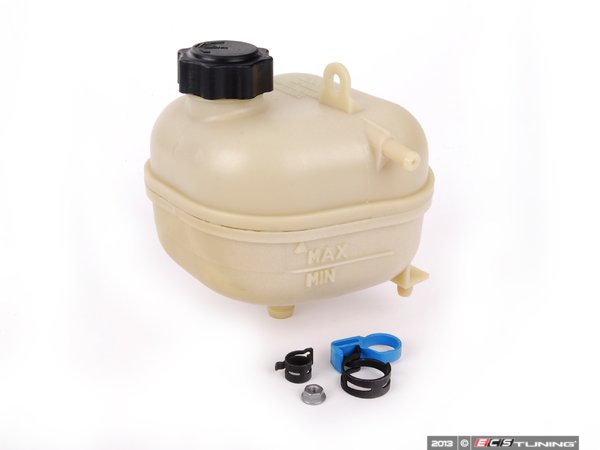
[B][/B FYI--Purchased a round metal coolant tank(using the OEM cap) to replace the ten year old original OEM plastic tank in a proactive anticipation of a failure at the seams due to age. I read and viewed every source of information concerning the installation process that exists. Everything went easily according to plan on the installation except fastening the metal tank to the frame with the provided bolts. In my case with slightly above average size hands and forearms, I could not insert the bolt to attach the tank due to limited room between the coolant and PS fluid tank. I even removed the coil pack as suggested online, wedged my hands in evey angle of the dangle I could imagine and still no luck. I was suffering from the fat hands syndrome. So to resist further frustration and the potential agony of defeat, I humbly called upon my charming bride for assistance. After explaining the installation process to her, she and her tiny hands completed the task in a matter of minutes. There was no way I could have fastened that tank without the valued assistance my wife and her diminutive hands. She is truly a saint. So I thought I would share this heads up with the MINI community and possibly reduce any installation frustrations for future customers comtemplating this DIY. PS- the quality and price of the tank is superb. I did reuse the OEM spring clamps and experienced no leaks after
running the engine up to normal temps.
Good move with going with an aluminum tank. This is a good alternative to first gen MINI owners since there is an apparent manufacturing defect. For anyone else looking for a aluminum tank, we have them HERE. Glad your wife was able to assist you with the install, it definitely helps having smaller hands to work in the engine bay. HERE is some info about coolant tank caps for the aluminum ones. We also have a tech article on our site for anyone else in the future under MINI > Tech Info (tab at top) > Water Cooling.
This is a good alternative to first gen MINI owners since there is an apparent manufacturing defect.
Not sure I would label the OEM R53 coolant tanks as being "defective" per se'.
It's made from two halves of molded plastic, heat sealed together usually containing pressurized fluids that have temps in excess of 200* and is situated in a hot engine bay just 6-8 inches above a very hot exhaust manifold.
The fact that most of them last longer than 60K miles is IMO, a miracle.
And when one considers the coolant leaks these cars have at both the oil filter housings and the thermostats, I prefer a tank I can perform a quick visual to see the fluid level without resorting to removing a cap, which can only be done when cold on the metal tank....For most it's something done more often than changing a this tank due to leaks.
Not sure I would label the OEM R53 coolant tanks as being "defective" per se'.
It's made from two halves of molded plastic, heat sealed together usually containing pressurized fluids that have temps in excess of 200* and is situated in a hot engine bay just 6-8 inches above a very hot exhaust manifold.
The fact that most of them last longer than 60K miles is IMO, a miracle.
And when one considers the coolant leaks these cars have at both the oil filter housings and the thermostats, I prefer a tank I can perform a quick visual to see the fluid level without resorting to removing a cap, which can only be done when cold on the metal tank....For most it's something done more often than changing a this tank due to leaks.
This defect was supposedly fixed on cars from 2005-up, however it still seems to strike at random. When the car warms up, both the heat and pressure of the coolant starts to attack the seam along the edge of the tank, eventually causing it to fail and the car starts leaking coolant.
The oem tank I had was the dark version and I had to open the cap to visually check the coolant level any way so checking the level in a metal tank was no problem. Had read so much about failures on both pre and post facelift models that at after ten years I considered the changing to a metal tank a time item as I did with oil dipstick when I converted from fiberglass to metal. If figured the money spent now would more than offset the potential cost and inconvenience down the road. Now that the leak free installation is complete, I must admit that this product has superb quality and actually appears to open up that area a tad more for airflow. I have no regrets on the purchase- none and again would advise customers with larger than average hands to employ some one with the dexterity to install the attaching bolts.
After replacing two of the factory ones due to the seam leaking I purchased a aluminum one. It has been working great for hundreds of thousands of miles.
This defect was supposedly fixed on cars from 2005-up, however it still seems to strike at random. When the car warms up, both the heat and pressure of the coolant starts to attack the seam along the edge of the tank, eventually causing it to fail and the car starts leaking coolant.
Like I said not a defect. When parts typically reach their end point they are replaced....like any other part. If it was a defect then please present us with the TSB or other data Doh!
They are less opaque when new, but get darker with time Usually by then you are at 60+K miles so almost time for new one anyways. If you put a flashlight up to the bottle level can be seen.
Like I said not a defect. When parts typically reach their end point they are replaced....like any other part. If it was a defect then please present us with the TSB or other data Doh!
They actually came up with an updated design of the coolant tanks. We use the term defect in our tech article due to them updating the design several times.
2004 - The MCS had notorious problems with the coolant tank failing at the seams even though the 2004 had an updated design.
2005 - While the coolant tank was again updated, there continue to be reports of the 2005 design eventually failing at the seam.
If a part has a repeated history of failure that could strand or place me in peril and the manufacturer offers no solution, then it only makes sense for me to install an improved aftermarket version if available that would reduce or eliminate that risk of failure. With today's traffic density the old adage of being able to pull over to the side of the road may not be a viable alternative.
If a part has a repeated history of failure that could strand or place me in peril and the manufacturer offers no solution, then it only makes sense for me to install an improved aftermarket version if available that would reduce or eliminate that risk of failure. With today's traffic density the old adage of being able to pull over to the side of the road may not be a viable alternative.
I replaced my 12 year old OEM coolant tank 10 months ago with OEM coolant tank. Now it's leaking again from the same spot. Dealer told me if it leak before a year I can bring it back to get a new one. Not sure if I want to put another OEM tank again and knowing in 10 months it will leak again.
I replaced my 12 year old OEM coolant tank 10 months ago with OEM coolant tank. Now it's leaking again from the same spot. Dealer told me if it leak before a year I can bring it back to get a new one. Not sure if I want to put another OEM tank again and knowing in 10 months it will leak again.
It's due to the dozens of posts like the one above that I viewed over the last ten years that I finally concluded that my tank was running on borrowed time. Unlike the power steering pump which also has a notorious failure history and eventually forced an extended warranty by MINI on certain build dates, a failed coolant tank not only could strand me but it also could cause untold damage to the engine due to over heating. So my proactive decision to spend a miniscule amount of money on the part and the effort on the installation to me was a smart move. Now if there is a concern about the cost of a metal tank versus the oem, consider that prorated over ten years of ownership, the cost is 83 cents a month--well worth it. In this case I know an ounce of prevention is truly worth a pound of cure.
The seam no matter what year over a period of time from, expansion and contraction they tend to leak at that seam. Seen many do this from heat cycles and age. The older they get the more yellow brown they are. If you co with the aluminum version, it should be the lifetime of the MINI. Other then the OEM cap if its reused. Make sure you mix it 50/ 50 with distilled water.
Then just top it off and bleed the system with 50/50 distilled water and the Blue color MINI coolant.