When you click on links to various merchants on this site and make a purchase, this can result in this site earning a commission. Affiliate programs and affiliations include, but are not limited to, the eBay Partner Network.
Need Help - 2012 Clubman JCW Low Power P2177/P2096/P0190
Hello Everyone!
I am going to explain my car issue in details, and I hope that I can get some help from some of the experts. First, let me say that I have about 35 years of mechanical/automotive experience, and I have most tools, so I am hoping to follow the advice here and repair the car myself.
And here we go:
I own a 2012 Clubman JCW (M/T) which I have owned for 1 year and I am the second owner.
The car now has 33K miles, and the last 10K miles have been under my ownership.
The first owner had it dealer maintained, she did not skimp on stuff, but I do NOT have any service records.
During my ownership: I have changed all the fluids, filters, spark plugs, coils, new battery (always on trickle charger), car is garaged, and it runs perfect, until recently!!
Over the past month or 1,000 miles, a few times, and randomly, I have noticed that the car was "bucking", very low on power, no boost, and Fuel Rail Pressure dropped to ~120-150. But it never set CEL, only one "Pending" code P2171 "System to Lean Off Idle Bank 1". So, I removed the Mass Air Filter sensor and cleaned it, as well as the First O2 sensor which looked OK to me.
The problem would go away, but intermittently would come back.
Today I had to drive to the airport which is a 70mi drive and it finally set the CEL and now I have 3 "pending" codes: P2177/P2096/P0190
Before I start changing parts, can I get some input here please? I have heard about the HPFP needing to be replaced. Could that cause this?
Photos attached and you can see the displayed Fuel Rail Pressure drops when this happens, but I am not sure if that is the cause or if that is the effect!
That's why trained mechanics get paid a lot of money to diagnose problems. But I've heard of horror stores about dealerships (so called trained mechanics) loading the parts cannon and firing it at the car.
So if the forum is of no help; you'll have to educate yourself. I'd suggest Paul Danner's book Performance Diagnostics. It's available at AESWave.com
From the pictures you've posted, you have two O2 sensors telling you the engine is running lean. You also have a code indicating a problem with the fuel rail pressure sensor, so the fuel rail pressure of 115 is suspect and not to be trusted. No offense, but pulling an O2 sensor and looking at it won't tell you if it's functioning properly. However, with your scan tool you can pull up the STFT & LTFT and inject propane in the intake. Both sensors should go full rich. Now remember the upstream sensor is a wideband and the downstream sensor is a narrow band. Meaning, when you inject the propane you'll be looking at the upstream sensors current do drop (rich condition) and the downstream sensors voltage to rise (rich condition). If your scan tool has an OBDII menu, use it instead of the MINI menu.
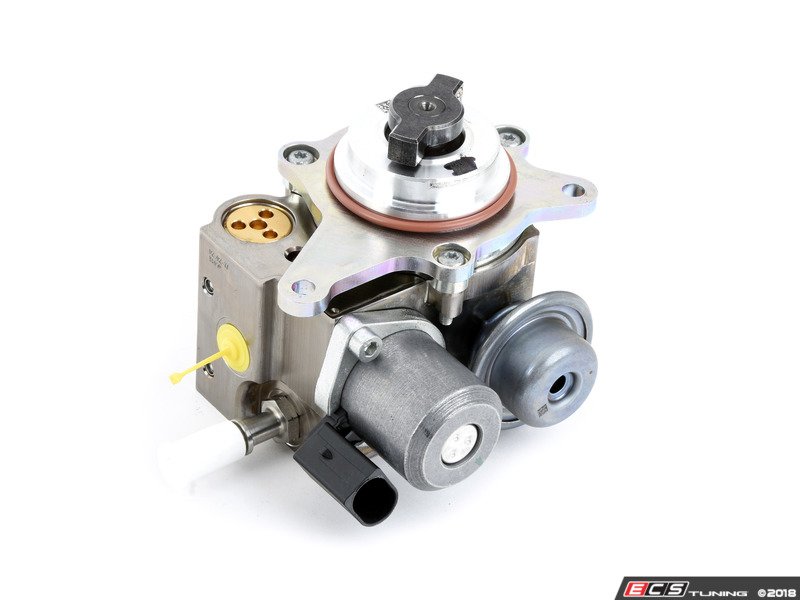
The first step would be to read up on the engine fuel system theory of operation as many components can cause a lean fuel trim condition. What I would want to know is the fuel pressure sensor downstream of the HPFP or upstream. Meaning, which fuel pressure discharge pressure are you reading ... the pump in the tank or the one on the cylinder head? I'd also want to know where all the fuel pressure relief valves live; from the picture of the pump posted by ECS, it looks like the relief valve is on the HPFP.
Next, use your scan tool to pull up short term fuel trim (STFT) and long term fuel trim (LTFT). Paul's book has a great section on how to use these numbers for diagnostic purposes. Write down your fuel trim numbers at idle, 1500 RPM, and 3000 RPM. I understand you have 35 years of experience, but how much formal schooling to you have? Heck, I have an A&P license and worked on fighter aircraft for 26 years in the Air Force, and I still learned a lot from Paul's course. (Scannerdanner.com)
For $11.00 per month you can become a premium member and have access to all of his formal training class videos; The videos are aligned with the chapters in the book, so it's handy to have to book while you're watching the videos. Paul even has a comments section for each chapter, so if you don't understand something in the material, you can ask him directly.