


R56 Re-installing fuel injectors questions


Thread Starter
|
1st Gear
Joined: Apr 2014
Posts: 24
Likes: 0
Re-installing fuel injectors questions
I'll be reinstalling the injectors this weekend, but going through the procedure there is a special tool (130220) that's apparently required to re-install the fuel line (Bentley Page 130-48).
Looks like this holds the line in a static position while tightening the line to prevent flex? Is there a shade-tree way to get around towing this thing to the dealer for this step? My plan was to hand-tighten, check the most "neutral" position, then have a friend place a tool between the line and the head to prevent it from moving, and torque it.
Looks like this holds the line in a static position while tightening the line to prevent flex? Is there a shade-tree way to get around towing this thing to the dealer for this step? My plan was to hand-tighten, check the most "neutral" position, then have a friend place a tool between the line and the head to prevent it from moving, and torque it.

6th Gear
Joined: Mar 2011
Posts: 1,945
Likes: 203
From: Northern NV
Hi Doc --- I've been on vacation and haven't been checking the forum. When I assembled my FI system, I didn't use a special tool, just installed it hand tight, ensuring no binding, then torqued it tight --- all by myself. Both rail and HPFP were already tightened, and the pipe went in place smoothly. No grief yet, but only have about 300 miles into break-in. Taking it to the Mini Mania event this weekend in Nevada City --- rack up a few more break-in miles.
What did your machine shop do for you --- re your previous thread on head removal?
What did your machine shop do for you --- re your previous thread on head removal?
Thread Starter
|
1st Gear
Joined: Apr 2014
Posts: 24
Likes: 0
No problem.
The shop replaced both exhaust valves on cylinder 1, replaced 8 valve seals, and did standard clean-up, etc. Pressure tested fine, no warpage, etc.
Ended up having the dealer re-install the injectors. They of course attempted to charge $200 over standard market price for the injector seals, so I righted that situation.
Put everything back together this weekend. Used a flared crows foot to tighten the high pressure fuel line to spec, seems fine. Started it up, ran great!
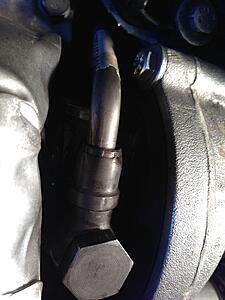
That is until we noticed oil leaking from the oil feed line on top of the turbo!! The crimp fitting I guess broke at some point during disassembly or re-assembly, I'm not sure which. Basically the pipe moves freely within the crimp that attaches to the banjo. It does this at the block side of the line as well. I feel like this must be something you have to replace each time you pull off the turbo, but maybe it just has to be handled very carefully.
Either way, looks like I will be pulling the turbo off for a second time after a new feed line comes in. I feel a flexible line with AN fittings would be better, but I have no idea where to source one or the parts to build one myself.
The feed is disconnected in the more zoomed out picture on top of the turbo.

The shop replaced both exhaust valves on cylinder 1, replaced 8 valve seals, and did standard clean-up, etc. Pressure tested fine, no warpage, etc.
Ended up having the dealer re-install the injectors. They of course attempted to charge $200 over standard market price for the injector seals, so I righted that situation.
Put everything back together this weekend. Used a flared crows foot to tighten the high pressure fuel line to spec, seems fine. Started it up, ran great!
That is until we noticed oil leaking from the oil feed line on top of the turbo!! The crimp fitting I guess broke at some point during disassembly or re-assembly, I'm not sure which. Basically the pipe moves freely within the crimp that attaches to the banjo. It does this at the block side of the line as well. I feel like this must be something you have to replace each time you pull off the turbo, but maybe it just has to be handled very carefully.
Either way, looks like I will be pulling the turbo off for a second time after a new feed line comes in. I feel a flexible line with AN fittings would be better, but I have no idea where to source one or the parts to build one myself.
The feed is disconnected in the more zoomed out picture on top of the turbo.


Last edited by DocRob; May 26, 2014 at 01:49 PM. Reason: Added Pictures
6th Gear
Joined: Mar 2011
Posts: 1,945
Likes: 203
From: Northern NV
This oil feed line appears to be a common problem. I've read that a couple of the forum vendors have new and improved versions available. ECS Tuning is the first one that comes to mind. There's gotta be others. You might search their web sites.
Congrats on getting it back together and running. One "do-over" isn't bad for a Mini first timer. I had more than my share.
Congrats on getting it back together and running. One "do-over" isn't bad for a Mini first timer. I had more than my share.
Thread Starter
|
1st Gear
Joined: Apr 2014
Posts: 24
Likes: 0
Thanks.
I'm not surprised about it being common, it appears to be a poor design. I've done some more research and I think there's a couple shops in Los Angeles that can create a custom flex line with AN fittings.
I'm not surprised about it being common, it appears to be a poor design. I've done some more research and I think there's a couple shops in Los Angeles that can create a custom flex line with AN fittings.
Thread Starter
|
1st Gear
Joined: Apr 2014
Posts: 24
Likes: 0
Well, bad news. Got it all back together, AGAIN, and we're having loss of power. Idles fine, but throws code 0190 and 0597 (IIRC), which I believe have to do with the thermostat and fuel pressure.
I rechecked the fuel line and it is torqued to spec and not leaking that I can see. I wonder if mini installed the injectors and rail improperly.
However, I noticed some smoke coming from the turbo, and I don't hear it spooling really or any blow-off noise. I don't know how the turbo would be damaged as I didn't touch any of its internals and I plugged it up when it was off the car.
Any ideas?
I rechecked the fuel line and it is torqued to spec and not leaking that I can see. I wonder if mini installed the injectors and rail improperly.
However, I noticed some smoke coming from the turbo, and I don't hear it spooling really or any blow-off noise. I don't know how the turbo would be damaged as I didn't touch any of its internals and I plugged it up when it was off the car.
Any ideas?
Trending Topics

6th Gear
Joined: Mar 2013
Posts: 3,428
Likes: 37
From: Mission Viejo, CA
Well, bad news. Got it all back together, AGAIN, and we're having loss of power. Idles fine, but throws code 0190 and 0597 (IIRC), which I believe have to do with the thermostat and fuel pressure.
I rechecked the fuel line and it is torqued to spec and not leaking that I can see. I wonder if mini installed the injectors and rail improperly.
However, I noticed some smoke coming from the turbo, and I don't hear it spooling really or any blow-off noise. I don't know how the turbo would be damaged as I didn't touch any of its internals and I plugged it up when it was off the car.
Any ideas?
I rechecked the fuel line and it is torqued to spec and not leaking that I can see. I wonder if mini installed the injectors and rail improperly.
However, I noticed some smoke coming from the turbo, and I don't hear it spooling really or any blow-off noise. I don't know how the turbo would be damaged as I didn't touch any of its internals and I plugged it up when it was off the car.
Any ideas?
Thread Starter
|
1st Gear
Joined: Apr 2014
Posts: 24
Likes: 0
Gray/white? Seemed to just come from around the area where the oil/coolant lines all connect but I don't recall exactly the location. Some oil was coating the turbo from when the feed line failed and leaked, so I initially thought that's all it was. But now I'm wondering if the bearings got cooked when the feed line failed.
Any time the oil feed line or cooling lines are replaced ( turbo's ), the feed line, banjo bolt/2 metal washers and the two metal washers for the coolant line should be replaced. They are like crush rings and cannot be re-used. The feed lines should not be re-used since even when handled gingerly, it will almost never align exactly as it should. Not doing any of the above will result in leaks. And since it's about a 3 hr job to do, well.... you know how the saying goes.
GL.
GL.
Thread Starter
|
1st Gear
Joined: Apr 2014
Posts: 24
Likes: 0
Any time the oil feed line or cooling lines are replaced ( turbo's ), the feed line, banjo bolt/2 metal washers and the two metal washers for the coolant line should be replaced. They are like crush rings and cannot be re-used. The feed lines should not be re-used since even when handled gingerly, it will almost never align exactly as it should. Not doing any of the above will result in leaks. And since it's about a 3 hr job to do, well.... you know how the saying goes.
GL.
GL.
6th Gear
Joined: Mar 2011
Posts: 1,945
Likes: 203
From: Northern NV
Gray/white? Seemed to just come from around the area where the oil/coolant lines all connect but I don't recall exactly the location. Some oil was coating the turbo from when the feed line failed and leaked, so I initially thought that's all it was. But now I'm wondering if the bearings got cooked when the feed line failed.
In my case (not typical) the turbo will not provide boost when the car is not being driven --- not in gear and / or drive wheels not turning. This is why the "launch RPM" is so important. Mine has been raised to 5500RPM, to allow for my Garrett and lightened flywheel --- bad combination! So, if no boost then no blow-off to hear.
6th Gear
Joined: Mar 2013
Posts: 3,428
Likes: 37
From: Mission Viejo, CA
How to Assess Smoke Coming from an Automobile
By Deanna Sclar from Auto Repair For Dummies, 2nd Edition
Exhaust coming from your vehicle's tailpipe should be clear. If you see smoke coming from your tailpipe, pay attention to the color of the smoke; you can use it to troubleshoot engine problems. It can tell you whether you have a leaky gasket or give you hints about your air/fuel mixture:
You see white vapor on a cold morning: Disregard it if it stops after the vehicle warms up. If it continues after the engine is warm, a cracked engine block or cylinder head or a leaky head gasket may be letting coolant into the engine. You need professional help with this one.
You see black smoke and you drive an older vehicle with a carburetor: The fuel/air mixture may need to be adjusted to a leaner setting or the carburetor float may have absorbed gasoline and is flooding the engine.
Black smoke from a vehicle with fuel injection usually requires special diagnosis and should be left to a repair facility.
Check to see whether the fuel/air mixture on either type of vehicle is too rich by running your finger around the inside edge of the tailpipe. (First make sure that it’s not hot.) If carbon comes off on your finger, the mixture is probably too rich.
The smoke is light or dark blue: The vehicle is burning oil, which can indicate that oil is leaking into the combustion chambers and you may need to have your valve stem seals replaced or your engine rebuilt or replaced.
The smoke is light gray: The car may be burning automatic transmission fluid. Check the transmission dipstick. Is the fluid dark and burned-looking? Does it smell burned? If so, changing the fluid may solve your problem.
A faulty transmission vacuum modulator, as found on very old cars, also can suck transmission fluid into the engine, where it’s burned in the cylinders and causes light gray smoke to come out of the tailpipe. Have the mechanic check the problem.
By Deanna Sclar from Auto Repair For Dummies, 2nd Edition
Exhaust coming from your vehicle's tailpipe should be clear. If you see smoke coming from your tailpipe, pay attention to the color of the smoke; you can use it to troubleshoot engine problems. It can tell you whether you have a leaky gasket or give you hints about your air/fuel mixture:
You see white vapor on a cold morning: Disregard it if it stops after the vehicle warms up. If it continues after the engine is warm, a cracked engine block or cylinder head or a leaky head gasket may be letting coolant into the engine. You need professional help with this one.
You see black smoke and you drive an older vehicle with a carburetor: The fuel/air mixture may need to be adjusted to a leaner setting or the carburetor float may have absorbed gasoline and is flooding the engine.
Black smoke from a vehicle with fuel injection usually requires special diagnosis and should be left to a repair facility.
Check to see whether the fuel/air mixture on either type of vehicle is too rich by running your finger around the inside edge of the tailpipe. (First make sure that it’s not hot.) If carbon comes off on your finger, the mixture is probably too rich.
The smoke is light or dark blue: The vehicle is burning oil, which can indicate that oil is leaking into the combustion chambers and you may need to have your valve stem seals replaced or your engine rebuilt or replaced.
The smoke is light gray: The car may be burning automatic transmission fluid. Check the transmission dipstick. Is the fluid dark and burned-looking? Does it smell burned? If so, changing the fluid may solve your problem.
A faulty transmission vacuum modulator, as found on very old cars, also can suck transmission fluid into the engine, where it’s burned in the cylinders and causes light gray smoke to come out of the tailpipe. Have the mechanic check the problem.

Thread Starter
|
1st Gear
Joined: Apr 2014
Posts: 24
Likes: 0
Turbo is pretty much a sealed unit --- any smoke from it is either from surface contamination or a crack in the case --- unless you took it apart and now have a re-assembly issue. If you're confident there's no more oil leaks, concentrate on your two codes.
In my case (not typical) the turbo will not provide boost when the car is not being driven --- not in gear and / or drive wheels not turning. This is why the "launch RPM" is so important. Mine has been raised to 5500RPM, to allow for my Garrett and lightened flywheel --- bad combination! So, if no boost then no blow-off to hear.
In my case (not typical) the turbo will not provide boost when the car is not being driven --- not in gear and / or drive wheels not turning. This is why the "launch RPM" is so important. Mine has been raised to 5500RPM, to allow for my Garrett and lightened flywheel --- bad combination! So, if no boost then no blow-off to hear.
I have no clue what's going on with the fuel code, not really sure where to begin unless I buy a pressure tester.

Thread Starter
|
1st Gear
Joined: Apr 2014
Posts: 24
Likes: 0
It was something stupid, of course. I managed to somehow not connect the sensor underneath the intake manifold (I disconnected it a few weeks ago, but I never completely removed the manifold from the car, so when re-mounting it to the head I had forgotten it was unplugged). Also, one of the coolant sensor connectors was not seated properly.
And, to top it off, a vacuum line underneath the intake manifold had popped off. Must have happened when manipulating the manifold. Took me an hour to wedge my hands in just the right way to reconnect it.
No codes, runs great so far.
6th Gear
Joined: Mar 2011
Posts: 1,945
Likes: 203
From: Northern NV
Fixed it!
It was something stupid, of course. I managed to somehow not connect the sensor underneath the intake manifold (I disconnected it a few weeks ago, but I never completely removed the manifold from the car, so when re-mounting it to the head I had forgotten it was unplugged). Also, one of the coolant sensor connectors was not seated properly.
And, to top it off, a vacuum line underneath the intake manifold had popped off. Must have happened when manipulating the manifold. Took me an hour to wedge my hands in just the right way to reconnect it.
No codes, runs great so far.
It was something stupid, of course. I managed to somehow not connect the sensor underneath the intake manifold (I disconnected it a few weeks ago, but I never completely removed the manifold from the car, so when re-mounting it to the head I had forgotten it was unplugged). Also, one of the coolant sensor connectors was not seated properly.
And, to top it off, a vacuum line underneath the intake manifold had popped off. Must have happened when manipulating the manifold. Took me an hour to wedge my hands in just the right way to reconnect it.
No codes, runs great so far.
How about the smoking turbo --- just oil residue?

Thread
Thread Starter
Forum
Replies
Last Post
R50/53 2002 R53 Creaking/Clacking
maestro39
R50/R53 :: Hatch Talk (2002-2006)
3
Oct 27, 2015 02:38 PM
Getrieben
R56 :: Hatch Talk (2007+)
2
Aug 15, 2015 09:09 PM