


Drivetrain DFIC numbers


6th Gear
Joined: Mar 2006
Posts: 1,710
Likes: 1
From: Northampton MA
Originally Posted by obehave
Cool 

6th Gear
Joined: Sep 2002
Posts: 2,196
Likes: 0
From: Hampton, VA
Originally Posted by stevecars60
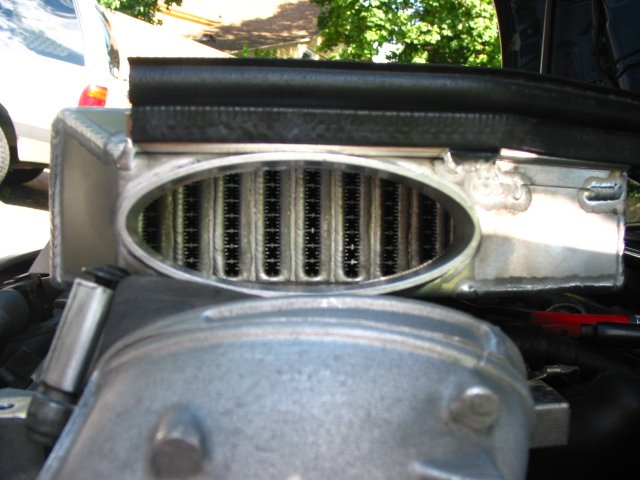
Here you go. This thing seems to work very well, no presure loss & quick recovery. The core design is interesting, not too sure what to think about it. The bad thing is there is no where you can put any temp sensors ( that I have ).
Forge
GRS


Not sure I agree...
Originally Posted by stevecars60
The inside of your GRS is like what I expected. A good high flow design.
I read somewhere (I think) that the GP has a slightly different IC... Wonder if they did that to decrease the pressure drop.
In general, I'm more a fan of brazed or bonded fins than extrusions... But to each their own.
Matt

Thread Starter
|
6th Gear
Joined: Sep 2004
Posts: 5,149
Likes: 0
Originally Posted by Dr Obnxs
This, and the forge posted later, look like extrusions. The problem with that is they don't break up laminar flow as well. So while the pressure drop is small, the thermal efficiency isn't what it could be. I think it's better to have a lower density of turbulators that break up laminar flow than a higher density of ones that don't. I'd really like to get my hands on a stock unit, except with a row or two extra, and about 1/5" thicker. The ends of the tubes inside are great, and the turbulators are very thin (low heat capacity, don't take much flow cross section) and wiggly (break up the laminar flow).
I read somewhere (I think) that the GP has a slightly different IC... Wonder if they did that to decrease the pressure drop.
In general, I'm more a fan of brazed or bonded fins than extrusions... But to each their own.
Matt
I read somewhere (I think) that the GP has a slightly different IC... Wonder if they did that to decrease the pressure drop.
In general, I'm more a fan of brazed or bonded fins than extrusions... But to each their own.
Matt
My little dose of LITHIUM
iTrader: (1)
Joined: Jul 2005
Posts: 2,435
Likes: 2
From: Albuquerque New Mexico
I can't post a photo as Im away from my server, but the internal fins on the DFIC are extremely similar (exactly?) to those in the stock IC, and not at all like those in the photos of the GRS or Forge.
6th Gear
Joined: Mar 2006
Posts: 1,710
Likes: 1
From: Northampton MA
"Tube design looks very similar to the GRS. A bit more crude in attaching them to the end plates though"
Yes they are similar, both extrusions. As far as the end plates, 2 different ways of attachment ( hard to know why - the GRS looks like a better method ).
The thermal efficency would depend on how much transfer there is between the fins on the 2 extrusions to the honey comb. Break of laminar flow can be very good or very bad. Like the OE unit tubulaters, if the IC is cool the break up is very good but as the IC becomes heat soaked, you end up using the intake air to cool the IC. Yes? I belive with a larger area, IC, the laminar flow break up is not as important as the volumn of air is dictated by the TB - engine demand & held in the IC for a longer period of time.
"I read somewhere (I think) that the GP has a slightly different IC... Wonder if they did that to decrease the pressure drop." I'de bet on it.
Yes they are similar, both extrusions. As far as the end plates, 2 different ways of attachment ( hard to know why - the GRS looks like a better method ).
The thermal efficency would depend on how much transfer there is between the fins on the 2 extrusions to the honey comb. Break of laminar flow can be very good or very bad. Like the OE unit tubulaters, if the IC is cool the break up is very good but as the IC becomes heat soaked, you end up using the intake air to cool the IC. Yes? I belive with a larger area, IC, the laminar flow break up is not as important as the volumn of air is dictated by the TB - engine demand & held in the IC for a longer period of time.
"I read somewhere (I think) that the GP has a slightly different IC... Wonder if they did that to decrease the pressure drop." I'de bet on it.

Where did the heat come from?
Originally Posted by stevecars60
as the IC becomes heat soaked, you end up using the intake air to cool the IC. Yes?
but anyway, the idea of optimizing the air-turbulator interface for maximum heat exchange is somewhat decoupled from the thermal mass of the unit. I say somewhat decoupled, because I think you can use thinner turbulator materials with braze or bond than you can with extrusions, so extruding tends to have more mass if they are made of the same material. But you could design a brazed or bonded turbulator fin set that was more massive if you wanted too..
I don't know for sure, but I'd guess that extruded cores are less expensive to make.
Matt
My little dose of LITHIUM
iTrader: (1)
Joined: Jul 2005
Posts: 2,435
Likes: 2
From: Albuquerque New Mexico
Originally Posted by stevecars60
Are we looking at the outside?
6th Gear
Joined: Mar 2006
Posts: 1,710
Likes: 1
From: Northampton MA
Originally Posted by gandini
As I stated earlier, the fins on the inside of the DFIC look almost exactly the same as those on the outside.
6th Gear
Joined: Mar 2006
Posts: 1,710
Likes: 1
From: Northampton MA
"I don't know for sure, but I'd guess that extruded cores are less expensive to make." Matt, Yes they are, but not by as much as you would think. Wall thickness can be uneven with certain extrusions. There is no way to measure wall thickness unless you cut the tubes. Some of the latest extrusions are CNC'd to very thin walls with very close tolerance. I can't say that either GRS or Forge are using ultra thin walls, the fins are the only tell tail. I don't think either company would volunteer any of that info.

6th Gear
Joined: Jul 2002
Posts: 3,446
Likes: 10
From: L.A ca
Originally Posted by stevecars60
Are we looking at the outside?


My little dose of LITHIUM
iTrader: (1)
Joined: Jul 2005
Posts: 2,435
Likes: 2
From: Albuquerque New Mexico
Where's that popcorn icon? I *know* this is going to be good, just to sit and wait as the anticipation rises, and rises...to a gigantic swell to the conclusion that it's not all smoke and mirrors. (That last bit is what I expect, anyone taking bets yet?)
lookin' good, Dr O.
lookin' good, Dr O.