When you click on links to various merchants on this site and make a purchase, this can result in this site earning a commission. Affiliate programs and affiliations include, but are not limited to, the eBay Partner Network.
I read elsewhere that the PCV system in the valve cover is routed as pictured (this is the valve cover for a BMW N13 engine, but is the same except the outlet #12 is on the opposite side on our N18 engines) The N13/N18 engines have an oil separator built into the valve cover, #2. Blow-by gases come up through #9, go through the separator and then take one of two paths depending on whether the turbo is producing boost or not. Under boost the gases escape through #12 and go to the intake duct upstream of the turbo, where there's enough of a vacuum generated by the turbo to pull them through. Under non-boost, the check valve at #12 remains closed and all the gases go through 1, 5 and 6 which feed directly into the intake ports.
So #12 opens when boost is applied. On our N18 engines it is the hose on the drivers side of the engine that connects to the inlet pipe to the turbo. So what I'm trying to understand is that when you close the ports 1, 5 and 6 as mentioned in this thread, would that not cause issues with the crank case pressure? Where does the vapor go to? Non boost situations would be at idle, constant speeds (?) and off throttle/engine braking.
I know this is a very old thread. I'm trying to get as much info as I can about how the PCV system works on the N18 engine.
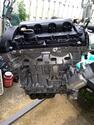
I have the engine as shown in the picture below (not my engine but same type) with the 'simple' pcv sytem as I call it. It's just a single hose from the valve cover to the inlet tube. So not with the sensors at the Y insert near the turbo and to the side of the inlet pipe. Which I highlighted in blue.
The 4 little holes shown in the cilinderhead that are blocked/plugged in this thread. These actually connect to the inlet ports? So if I theoretically would poor water in those tiny ports that would flow onto the intake valves? Is that correct?
So in other words these ports allow crank case vapor and oil mist to be sucked up through the valve cover directly into the intake and doing so partially cause carbon build up on the valves. Or is this considered the main cause?
So blocking off these ports solves carbon build up by a big extend? Looking at the valve cover you could also block the ports in there instead of the cylinder head and save a lot of hassle. maybe glue a tiny blocking plate onto the valve cover that fits nicely in the gasket.
This won't hurt the engine by causing an increase in crank case pressure or other issues?
I've read in an other thread that for the PCV system to do its work (any PCV for that matter) you need a vacuum to suck out those vapors because these are very bad for the oil quality and engine life. So you can not just vent to air unfortunately. So what do these little ports do compared to the tube that goes in to the inlet pipe just before the turbo?
Sorry, lots of questions. Just trying the wrap my head around these direct injected engines and PCV systems and how to mitigate carbon build up.
Questions are a good thing. Yes it is primarily the US version of the N18 that received the additional crackcase ventilation pictured below. The N14 has the same threaded fitting in the lower crankcase but it is plugged. Interestingly, the B48 uses the same additional vent.
In post #8 you'll see a visual representation of the PCV gas path. Notice in this instance the torn diaphragm. This diaphragm is forced closed when the engine is under boost, preventing boost pressure from flowing through the valve cover and back into the intake tract just before the turbo. If they are closed the crankcase still vents just it all goes back via the pre-turbo path.
Will this modification completely solve carbon buildup on the N18?
No it will not. The PRIMARY cause of carbon accumulation on the intake valves is valve overlap when the intake valve is opening and the exhaust valve has not fully closed and the engine is not in boost. At this point the exhaust pressure in the cylinder is still higher than the pressure in the intake and exhaust gases back up past the intake valve into the intake ports. This allows carbon accumulation and occurs most heavily on cold start when intake vacuum is the highest. This is compounded by any oil that may have seeped passed the intake valve seals overnight.
Will this modification reduce carbon accumulation?
Yes it will. But is the cost / benefit ratio worth all the effort. In my opinion no not really.
Options to reduce carbon accumulation are:
1) Driving it like you stole it. In boost, exhaust gas reversion doesn't occur since intake pressure is higher than residual cylinder pressure.
2) Methanol injection. Your passing a solvent across the intake valve while in boost which will remove "some" carbon accumulation.
3) installing a billet intake manifold with additional fuel injectors that operate continuously. (Not cheap nor for the faint of heart but it eliminates the problem altogether)
The primary benefit of an OCC on the N18 is principally the reduction of oil mist entering the intake tract while in boost. A small amount of oil can reduce the effective octane rating of the intake charge to as low as 87 resulting in detonation.
I understand that carbon build up is not just the way the PCV system works but also the way the variable valve lift causes overlap. among other thing. If you have massive blow by, or faulty valve seals oil will accumulate rapidly.
But lets assume we have a healthy engine. It says that when under boost the gases evacuate through the front port into the intake pipe just before the turbo which is the most left blue circle I painted so professionally and is the #12 pictured. The boost creates pressure in the crank case because there will always be some blow by to some degree. But also a vacuum on the inlet side at #12 because that's the valve that opens under boost. Is that correct?
But when not on boost it will vent trough the holes on the backside of the cover directly into the intake just before the intake valves. It supposed to suck the gasses through there. If you block those off like you did, how will that be evacuated when not under boost? Check valve 8 can't open anymore, because no vacuum from the intake valve in the ports # 1, 5, 6. Would that not create issues within the crank case atmosphere?
Trying to follow the N13 diagram can be misleading. Take a look at the lines indicating direction of flow in post 8. On the right hand side the flow diverges at the Y. There are two rubber flappers that prevent flow through. The torn one depicted that prevents back flow when the higher pressure differential is on the manifold side. The second is inside the tube that goes to the turbo side. This one prevent backflow when the pressure differential is higher on the turbo side. Both paths meet in the middle AFTER the large diaphragm in the upper left.
If the ports through the head are blocked, any positive case pressure will always pass through the pre-turbo port. The area just forward of the turbo will always have a somewhat lower pressure than ambient even when not in boost. In addition, the pcv ties into the air path on the inside radius of the bend there. When air passes through a 90 degree bend, the change in direction and mass of the air will force the air to crowd the outside of the bend creating a vacuum on the inside of the radius.
BMW uses the same technique on the B48 by venting the pcv into the inlet just after a 90 bend.
Appreciate your input and knowledge. It's not misleading. #12 on the N13 engine is just opposite of the N18 engine. They share the same air chamber just located at different ends on the cover. So the inner workings are exactly the same. I also just realized that the big PCV cap on our N18's are the same as the N13. The half round notch is there so it fits the #12 outlet. Otherwise it would't fit .
So with the mod you did several years ago. You stil drive the same mini? what are your results doing so?
hic sunt dracones "Here be Dragon's" Hunt-Lenox Globe circa 1500ad
That was posted for a reason. I myself have over 25 years experience as a licensed aircraft technician and am equally at home tearing apart a 3.5 million dollar turbine engine, operating a lathe, designing a structural repair in autocad or reading a dual trace O scope. I'm routinely called in for troubleshooting and root cause analysis. Solving problems is fun for a guy like me.
1. Problem
2. Analysis
3. Design
4. Implement
5. Evaluate
1. Carbon accumulation on intake valves. Produces problems ranging from mild (decreased performance, rough idle) to severe (Uneven fuel distribution as A/F ratios are not monitored for each cylinder resulting in pre-ignition)
2. Carbon accumulation a result of direct injection and suboptimal PCV design. (Believe it or not some BMW engines use an OCC that empties back into the crankcase.) Analysis of valve cover reveals possible fix.
3. Rubber plug fabricated to block aft ports in valve cover. However during design further internal inspection utilizing 180 degree 4 way articulating 4mm boroscope revealed additional failure point. Second design > evaluate blocking ports in head to eliminate all known failure points.
4. Block ports in head linking intake tract and crankcase ventilation system.
5. See below
Approximately 85 cc's removed from OCC after 1000 miles of operation.
Oil consumption - no increase in oil usage noted.
I'm pretty happy with the results and that this sludge is no longer coating my valves or passing through my engine. Hopefully some have found this little experiment interesting and informative. I will also update with results again at 5000 miles.
Happy Motoring
ive never designed an internal combustion engine before but I did stay at a Holiday Inn last night.
so why can’t we just engineer piston rings to eliminate blow by gases? Problem solved right? My apologies in advance to those who just spit coffee in their laptop laughing so hard at my post :-)
ive never designed an internal combustion engine before but I did stay at a Holiday Inn last night.
so why can’t we just engineer piston rings to eliminate blow by gases? Problem solved right? My apologies in advance to those who just spit coffee in their laptop laughing so hard at my post :-)
Piston rings are asked to handle a LOT. They’ve gotten better over the years too. Its an ever evolving compromise between sealing combustion gases, preventing oil seepage, reducing friction for efficiency, and surviving the heat…
ive never designed an internal combustion engine before but I did stay at a Holiday Inn last night.
so why can’t we just engineer piston rings to eliminate blow by gases? Problem solved right? My apologies in advance to those who just spit coffee in their laptop laughing so hard at my post :-)
Probably the biggest issue is how to seal between the piston and the cylinder wall with the temperatures involved. For example, a hydraulic cylinder shaft is sealed between it and the housing with no leakage. Because it operates at a modestly low temperature the seal can be made with a material that goes 360 deg around the shaft and can be compressed to seal against the housing. No leakage.
A quick Google search returns about 4500 deg F for the typical temperature of combustion. Piston temperatures will be something between that and the temperature of the oil, which cools them from the underside. Then there is the difference between the piston and the cylinder wall. At these temperatures the only materials to use for sealing are metals. With the differences in temperatures that are being dealt with, any metal being used to seal the piston to the cylinder wall and within the gap in the piston will need to be designed to accommodate differences in thermal expansion. Hence rings are not continuous for 360 deg around. They are cut and have a defined gap. Without that cut and without a gap of a large enough size, the ring will expand and become a band brake against the cylinder wall. I’ve been there, done that with an engine that I built.
Built-in leakage as a consequence of design needs.








 In boost, exhaust gas reversion doesn't occur since intake pressure is higher than residual cylinder pressure.