


Tire pressure confusion


Thread Starter
|
6th Gear
Joined: Jun 2005
Posts: 2,315
Likes: 0
From: Austin, TX
Tire pressure confusion
Now I am really confused. I have an 03 MCS with Falken 215/35/19 tires. I searched NAM to try to figure out what tire pressure to fill with. I came up with many different answers, most falling between 35-40 PSI. I first did 35 all around, and then tried increasing the front a bit.
Here's where the confusion arises. I then asked my shop, who does mostly alfa romeos and vintage racing, and they reccommended a lower pressure, 30-32 PSI. So I decreased a bit. But then I went to Les Schwab and the tech reccommended and filled them to 45 PSI. I asked a different tech for a second opinion, and he said 45 was fine but reccommended 36-40 PSI. I told the first tech that, and he insisted that since they were so low profile that they should be pumped higher, as in 45, where he left them. I tried them out, and the ride was actually quite nice. But I am confused with all of the conflicting answers. I guess I am hoping that someone who really knows there stuff can give me a solid answer, maybe a Tire Rack guy? Thanks.
Here's where the confusion arises. I then asked my shop, who does mostly alfa romeos and vintage racing, and they reccommended a lower pressure, 30-32 PSI. So I decreased a bit. But then I went to Les Schwab and the tech reccommended and filled them to 45 PSI. I asked a different tech for a second opinion, and he said 45 was fine but reccommended 36-40 PSI. I told the first tech that, and he insisted that since they were so low profile that they should be pumped higher, as in 45, where he left them. I tried them out, and the ride was actually quite nice. But I am confused with all of the conflicting answers. I guess I am hoping that someone who really knows there stuff can give me a solid answer, maybe a Tire Rack guy? Thanks.


4th Gear
Joined: Jun 2005
Posts: 557
Likes: 0
From: Calgary, Alberta, Canada
There are a couple of reasons why you would want to adjust the pressure.
1. Load capacity and pot hole protection
2. Tire wear and grip
3. Ride comfort
4. Tire heat
There are probably more, but those are the ones I can think of. Since your tires have very low profile, and 19" rims are expensive, pot hole protection should be a high piority, so you do want higher pressure (37 psi or higher), 45 is fine, but you're sacrificing ride comfort and/or tire wear (too much wear in the middle) at that pressure.
I have no idea how your tire wears and how it feels at what PSI, so my suggestion is 37-38psi like Kenchan, and you decide if you need more or less based on how you feel about the performance and comfort of the tires.
1. Load capacity and pot hole protection
2. Tire wear and grip
3. Ride comfort
4. Tire heat
There are probably more, but those are the ones I can think of. Since your tires have very low profile, and 19" rims are expensive, pot hole protection should be a high piority, so you do want higher pressure (37 psi or higher), 45 is fine, but you're sacrificing ride comfort and/or tire wear (too much wear in the middle) at that pressure.
I have no idea how your tire wears and how it feels at what PSI, so my suggestion is 37-38psi like Kenchan, and you decide if you need more or less based on how you feel about the performance and comfort of the tires.
even on street during the summer, tire pressure will increase 5-6psi just
from heat at around 85-88F depending on how you're driving your car.
in the winter months i pump 2 extra psi because the ambient temps and
road surface prevent the tires from inflating to its optium levels.
the 37-38psi suggestion is for summer. winter, i would pump 39-40
but was thinking you would't be using that wheel/tire set in the
colder months in Seattle...
from heat at around 85-88F depending on how you're driving your car.
in the winter months i pump 2 extra psi because the ambient temps and
road surface prevent the tires from inflating to its optium levels.
the 37-38psi suggestion is for summer. winter, i would pump 39-40
but was thinking you would't be using that wheel/tire set in the
colder months in Seattle...
Thread Starter
|
6th Gear
Joined: Jun 2005
Posts: 2,315
Likes: 0
From: Austin, TX
Thanks for the info. I am using these tires/rims in the winter as I'm pretty broke after buying the car, but it doesnt ever snow around here so its fine. I will try 39-40 as you said.
Thread Starter
|
6th Gear
Joined: Jun 2005
Posts: 2,315
Likes: 0
From: Austin, TX
Originally Posted by kenchan
i checked weather channel to see what kind of temps you got over there....
49F (bout 10:30pm your time). you should use 38.5 - 39 psi.
49F (bout 10:30pm your time). you should use 38.5 - 39 psi.
 Do you have some sort of chart or equasion I should know about?
Seriously though, thank you.
So I went to go let some air out since the Les Schwabb guy said he filled them all to 45 psi, and the idiot only filled one tire to 45 and left the other 3 at 33.
 And worse, he said that he couldn't find a leak in the tire that he filled, but in the dark and rain, I could hear the frickin leak. Maybe I'll take it back in tomorrow morning.
Trending Topics
minitor- no problem ... no these are figures ive tired in the past
while using similar tire sizes with much success. after a while
you sense how much to pump as baseline based on the temp and
tweak later. but that pressure should get you very close to where
you should be.
sorry to hear about your leak. is it coming from the valve stems by
any chance?
some people unknowingly crank(!) their valve caps on too tight and while
loosening the caps they also loosen the valve stem nut inside the wheel.
also, check your valve caps to make sure the seal inside has not deformed
and pushing against the pin while you tighten down the cap. some seals
bend out of shape when tightened too far.
... no these are figures ive tired in the pastwhile using similar tire sizes with much success. after a while
you sense how much to pump as baseline based on the temp and
tweak later. but that pressure should get you very close to where
you should be.
sorry to hear about your leak. is it coming from the valve stems by
any chance?
some people unknowingly crank(!) their valve caps on too tight and while
loosening the caps they also loosen the valve stem nut inside the wheel.
also, check your valve caps to make sure the seal inside has not deformed
and pushing against the pin while you tighten down the cap. some seals
bend out of shape when tightened too far.
Thread Starter
|
6th Gear
Joined: Jun 2005
Posts: 2,315
Likes: 0
From: Austin, TX
1. It does seem to be coming from the stem. It looks fine, but I can hear a tiny leak coming from there, especially when it is wet out. And if I push it in a certain direction it stops. Any ideas, can I fix this myself or should I take it back to Les Schwab and tell them were the leak is since they couldnt find it themselves?
2. I filled my tires up to 39 psi, but I don't yet have a compressor and the nearest gas station is about 1 mile away. Do I need to inflate more or less after driving this mile?
Any ideas, can I fix this myself or should I take it back to Les Schwab and tell them were the leak is since they couldnt find it themselves?2. I filled my tires up to 39 psi, but I don't yet have a compressor and the nearest gas station is about 1 mile away. Do I need to inflate more or less after driving this mile?
you need to remove the tire from the rim inorder to torque the valve stem
nut down, unfortunately.
but if your tire's leaking air, you shouldn't be driving on it.
The 1mile should not make that much of a difference from cold especially
when ambient temps are lower and cloudy (road surface not hot). you
might gain about 0.25psi, but i doubt it.
I use a cheepo air compressor that i got for like $25. I also have a
13.8v powersupply from my RC car chargers so I use that as my
source.
nut down, unfortunately.
but if your tire's leaking air, you shouldn't be driving on it.
The 1mile should not make that much of a difference from cold especially
when ambient temps are lower and cloudy (road surface not hot). you
might gain about 0.25psi, but i doubt it.
I use a cheepo air compressor that i got for like $25. I also have a
13.8v powersupply from my RC car chargers so I use that as my
source.
Thread Starter
|
6th Gear
Joined: Jun 2005
Posts: 2,315
Likes: 0
From: Austin, TX
It only leaks about 2 pounds a week. I guess I will take it to Les Schwabb or my other shop next week. Would it be OK to drive on it that long? Thanks for all of your help.
I did buy a cheap air compressor, but thought it didnt work with the MINI cigarette lighter because it didnt work on my MCS either. So I bought a different one and had the same problem, returned that one. Turned out that both lighters coincidentally had blown fuses, so now need to go buy another one.
I did buy a cheap air compressor, but thought it didnt work with the MINI cigarette lighter because it didnt work on my MCS either. So I bought a different one and had the same problem, returned that one. Turned out that both lighters coincidentally had blown fuses, so now need to go buy another one.
4th Gear
Joined: Nov 2004
Posts: 393
Likes: 0
From: East Tennessee
#1. In the mourning, while your tires are cold, slowly drive to your local air compressor. Inflate the tires to the maximum PSi. (check the sidewall for maximum PSi)
#2. Next you want to mark the edge of the front tires where the tread meets the sidewall. Simply draw a line from the tread surface, where you know the tire is touching the ground, to the sidewall, just beyond the edge of the tread. You can use a lite colored grease pencil or shoe polish.
#3. Drive the car hard. Curvy roads are best. If you find the ride too rough, let about 2 pounds of air out and drive the car again. Each time you adjust the presure, look at the marks you made on the tires. Those marks will show you how much the tire is rolling over while cornering. The idea is to not let the tires roll beyond the edge of the tread.
#4. Once you have figured out what presure feels good and doesn't allow the tire to roll over past the tread, set the rear tires to the same presure. This will get you in the pall park of correct tire presure. You can then tune the rear presures further to help the car handle better. If you would like the car to turn easier, instead of pushing when you turn the wheel, simply let 2-3 pounds of air out at a time until it rotates better or until the tire starts to scuff near the edge of the tread. (just like the fronts) Your rears will tolerate less presure than the fronts because most of the wieght is in the front of a MINI.
#5. From this point just keep tabs on the tread wear. If it looks like the tires are wearing out in the center more than the outside edges, decrease air presure about 2 pounds. If the outside edges are wearing faster than the inside, you need to add air.
If you really want to get your tires working at their optimum, you will need a pyrometer so that you can check the tire temps. The idea here is to shoot for even tire temps all the way across the tread. To get the temps even, you may have to mess with alignment as well as presure.
A leaky valve stem is sometimes because of a bad core. You can buy them at any parts store or Wal-mart. They screw in and out with a valve stem core tool. (about $1.00) Anybody can do it. Just remove the cap, screw out the old one and screw in the new one. The only thing you don't want to do is screw it in too far. Just far enough to clear the cap and the end of the stem. You will lose some air doing this, so do it at the compressor. You will not need to remove the tire/wheel.
The suggestions above all seem close, but I would add that too much air is a lot better than too little, especially if you're running 19" wheels and 35 series tires.
#2. Next you want to mark the edge of the front tires where the tread meets the sidewall. Simply draw a line from the tread surface, where you know the tire is touching the ground, to the sidewall, just beyond the edge of the tread. You can use a lite colored grease pencil or shoe polish.
#3. Drive the car hard. Curvy roads are best.
If you find the ride too rough, let about 2 pounds of air out and drive the car again. Each time you adjust the presure, look at the marks you made on the tires. Those marks will show you how much the tire is rolling over while cornering. The idea is to not let the tires roll beyond the edge of the tread. #4. Once you have figured out what presure feels good and doesn't allow the tire to roll over past the tread, set the rear tires to the same presure. This will get you in the pall park of correct tire presure. You can then tune the rear presures further to help the car handle better. If you would like the car to turn easier, instead of pushing when you turn the wheel, simply let 2-3 pounds of air out at a time until it rotates better or until the tire starts to scuff near the edge of the tread. (just like the fronts) Your rears will tolerate less presure than the fronts because most of the wieght is in the front of a MINI.
#5. From this point just keep tabs on the tread wear. If it looks like the tires are wearing out in the center more than the outside edges, decrease air presure about 2 pounds. If the outside edges are wearing faster than the inside, you need to add air.
If you really want to get your tires working at their optimum, you will need a pyrometer so that you can check the tire temps. The idea here is to shoot for even tire temps all the way across the tread. To get the temps even, you may have to mess with alignment as well as presure.
A leaky valve stem is sometimes because of a bad core. You can buy them at any parts store or Wal-mart. They screw in and out with a valve stem core tool. (about $1.00) Anybody can do it. Just remove the cap, screw out the old one and screw in the new one. The only thing you don't want to do is screw it in too far. Just far enough to clear the cap and the end of the stem. You will lose some air doing this, so do it at the compressor. You will not need to remove the tire/wheel.
The suggestions above all seem close, but I would add that too much air is a lot better than too little, especially if you're running 19" wheels and 35 series tires.
huh, replacing the core... interesting.
Valvestems usually leak from the seal that mates to the wheel's valvestem
opening.
one note to my post above.. im basing my info on valve stems that
use nuts to screw on like the below pict. if it's anything like the
lower valve stem, i guess you can try tightening the nut from the
outside to see if you can seal it better. just don't over torque it.
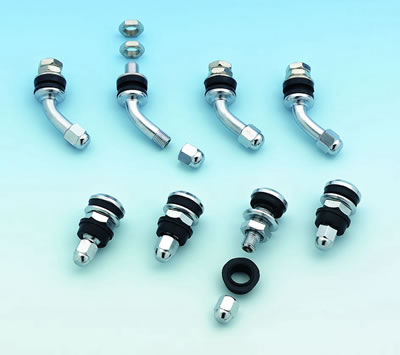
some of the lower-end rubber ones do not use
nuts to screw on. They're just press fitted (pull through) into
the hole.
Valvestems usually leak from the seal that mates to the wheel's valvestem
opening.
one note to my post above.. im basing my info on valve stems that
use nuts to screw on like the below pict. if it's anything like the
lower valve stem, i guess you can try tightening the nut from the
outside to see if you can seal it better. just don't over torque it.
some of the lower-end rubber ones do not use
nuts to screw on. They're just press fitted (pull through) into
the hole.
4th Gear
Joined: Nov 2004
Posts: 393
Likes: 0
From: East Tennessee
Before I removed a wheel and dismounted a tire, I would definetly make sure that the valve stem core isn't leaking. It's a 3 minute $1.50 fix. The "low-end" vavle stems are less likely to fail or leak.

4th Gear
Joined: Oct 2005
Posts: 392
Likes: 1
From: San Antonio
Originally Posted by The MINITOR
Now I am really confused. I have an 03 MCS with Falken 215/35/19 tires. I searched NAM to try to figure out what tire pressure to fill with. I came up with many different answers, most falling between 35-40 PSI. I first did 35 all around, and then tried increasing the front a bit.
Here's where the confusion arises. I then asked my shop, who does mostly alfa romeos and vintage racing, and they reccommended a lower pressure, 30-32 PSI. So I decreased a bit. But then I went to Les Schwab and the tech reccommended and filled them to 45 PSI. I asked a different tech for a second opinion, and he said 45 was fine but reccommended 36-40 PSI. I told the first tech that, and he insisted that since they were so low profile that they should be pumped higher, as in 45, where he left them. I tried them out, and the ride was actually quite nice. But I am confused with all of the conflicting answers. I guess I am hoping that someone who really knows there stuff can give me a solid answer, maybe a Tire Rack guy? Thanks.
Here's where the confusion arises. I then asked my shop, who does mostly alfa romeos and vintage racing, and they reccommended a lower pressure, 30-32 PSI. So I decreased a bit. But then I went to Les Schwab and the tech reccommended and filled them to 45 PSI. I asked a different tech for a second opinion, and he said 45 was fine but reccommended 36-40 PSI. I told the first tech that, and he insisted that since they were so low profile that they should be pumped higher, as in 45, where he left them. I tried them out, and the ride was actually quite nice. But I am confused with all of the conflicting answers. I guess I am hoping that someone who really knows there stuff can give me a solid answer, maybe a Tire Rack guy? Thanks.

6th Gear
Joined: Jan 2003
Posts: 3,301
Likes: 1
Closer clarification; measure temps in three places, outside, middle and inside. The middle should be the average of the outside and inside. If it is not, the outside is more than likely too hot...unless you've cranked in lots of camber and toe...
I agree with 36-38 psi for daily aggressive driving...lower at a track event. 34 psi worked fine for me on a balmy 38 degree day. PSI climbed to 40, after each run on all four tires. The outside shoulder of the front tires were slighty chewed and the temps were a bit higher than they should have been. A camber kit would...could cure this.
If you really want to get your tires working at their optimum, you will need a pyrometer so that you can check the tire temps. The idea here is to shoot for even tire temps all the way across the tread. To get the temps even, you may have to mess with alignment as well as presure.
I agree with 36-38 psi for daily aggressive driving...lower at a track event. 34 psi worked fine for me on a balmy 38 degree day. PSI climbed to 40, after each run on all four tires. The outside shoulder of the front tires were slighty chewed and the temps were a bit higher than they should have been. A camber kit would...could cure this.
If you really want to get your tires working at their optimum, you will need a pyrometer so that you can check the tire temps. The idea here is to shoot for even tire temps all the way across the tread. To get the temps even, you may have to mess with alignment as well as presure.
4th Gear
Joined: Nov 2004
Posts: 393
Likes: 0
From: East Tennessee
Originally Posted by kenchan
wiggles, can you post a pict of what an unassembled core looks like? thanks.
The reason I would suggest going through the process of finding the presure that's correct for your tire is because tires are different. Different tires will have a max. presure of anywhere from 32 PSI to 50 PSI and some tires do much better on a "camber challenged" car like a MINI and will require less presure to keep from "rolling over."
Did you locate the leak?
Thread Starter
|
6th Gear
Joined: Jun 2005
Posts: 2,315
Likes: 0
From: Austin, TX
Not exactly, its definately coming from the stem because sometimes I can hear it leaking. But if I wiggle it around it stops. Since the Janauary 31 it has lost 1 psi. I have been to busy to do much about it so I have just been checking it every day and adding a pound when it needs it.
4th Gear
Joined: Nov 2004
Posts: 393
Likes: 0
From: East Tennessee
Originally Posted by The MINITOR
Not exactly, its definately coming from the stem because sometimes I can hear it leaking. But if I wiggle it around it stops. Since the Janauary 31 it has lost 1 psi. I have been to busy to do much about it so I have just been checking it every day and adding a pound when it needs it.

6th Gear
Joined: Dec 2004
Posts: 3,802
Likes: 0
From: SF Bay Area
Just fyi, I was told by a tire shop today - a good place that has been in business for ages - that the fronts should have a couple of more lbs then the rear to compensate for the weight distribution (the front being heavier due to the engine). He set the fronts at 36 and the rears at 34. These are 215/45/17 performance tires (not run flats).
Don't mean to confuse you more but this was the first time I'd heard this and it makes sense.... doesn't it?
Don't mean to confuse you more but this was the first time I'd heard this and it makes sense.... doesn't it?


