


Suspension M7 rear chassis brace


Thread Starter
|
6th Gear
Joined: Jul 2004
Posts: 2,664
Likes: 1
From: Orlando, FL
M7 rear chassis brace
Ok. I like the idea of adding the lower attachment points for added rigidity but whats the point of doing that if you don't have any triangulation? Those bolts take the entire moment of the car. Adding a couple cross beams (that could be easily removed for hauling long items) would make the thing a heck of a lot stronger. Any comments?


pug poo picker-upper
Joined: Jun 2002
Posts: 9,803
Likes: 30
From: California
[bad cop]
Please Read
After yesterday's mess, this thread is getting restarted from the beginning.
Those taking part in the flame battles and thread hijackings read this next part carefully: There is a familiar cast of characters that have routinely engaged in flame battles, fan boy behavior, baiting, and thread hijackings all to the detriment of actual discussion. Some of those engaged in this activity already have a strike against them. As reminder, from the Site Guidelines a second strike will result in removal of your posting privileges.
The Site Guidelines need to be adhered to at all times. If they are not, just click on the little triangle ( ) next to the post and fill out the report a post form.
I'll close with this:
If anyone has any questions about the above, drop any of the administrators (Mark, Edge, or myself) a PM. Any posts off the topic of the first post in this thread will be removed. [/bad cop]
Please Read
After yesterday's mess, this thread is getting restarted from the beginning.
Those taking part in the flame battles and thread hijackings read this next part carefully: There is a familiar cast of characters that have routinely engaged in flame battles, fan boy behavior, baiting, and thread hijackings all to the detriment of actual discussion. Some of those engaged in this activity already have a strike against them. As reminder, from the Site Guidelines a second strike will result in removal of your posting privileges.
The Site Guidelines need to be adhered to at all times. If they are not, just click on the little triangle (
) next to the post and fill out the report a post form.I'll close with this:
RESPECT
When posting, both members and vendors must ALWAYS be respectful of fellow members and vendors. Personal attacks and flames will not be tolerated. If you feel you are being attacked, report the post or private message rather than replying or flaming back.
When posting, both members and vendors must ALWAYS be respectful of fellow members and vendors. Personal attacks and flames will not be tolerated. If you feel you are being attacked, report the post or private message rather than replying or flaming back.

Banned
iTrader: (1)
Joined: Feb 2005
Posts: 4,054
Likes: 0
From: As far away from Florida as I can get.
So here are the questions I have:
1. As per OP, a diagonal brace would make sense. Why go with a rectangle, which is anything, but rigid?
2. This has been covered in many other threads about Rear Braces, but the mounting points are nowhere near the shock towers. If that is correct, than what is being braced and how is it supposed to improve the car's handling?
3. Looking at the picture it looks like the vertical bars are resting on the floor of the boot. It would seem that for it to be any sort of added benefit those pieces would need to somehow be attached to the car. By the lack of visible bolts, or bracket it does not seem to be the case. Can some one confirm, or deny that?
1. As per OP, a diagonal brace would make sense. Why go with a rectangle, which is anything, but rigid?
2. This has been covered in many other threads about Rear Braces, but the mounting points are nowhere near the shock towers. If that is correct, than what is being braced and how is it supposed to improve the car's handling?
3. Looking at the picture it looks like the vertical bars are resting on the floor of the boot. It would seem that for it to be any sort of added benefit those pieces would need to somehow be attached to the car. By the lack of visible bolts, or bracket it does not seem to be the case. Can some one confirm, or deny that?


5th Gear
Joined: Oct 2004
Posts: 855
Likes: 1
3. Looking at the picture it looks like the vertical bars are resting on the floor of the boot. It would seem that for it to be any sort of added benefit those pieces would need to somehow be attached to the car. By the lack of visible bolts, or bracket it does not seem to be the case. Can some one confirm, or deny that?
I take this to mean that the two vertical posts mount to the brackets in the floor below them - but I can't see it in the pic.

Moderator :: Performance Mods
Joined: Mar 2003
Posts: 5,427
Likes: 8
From: A Den in Maryland
I've been involved in a behind-the-scenes discussion/brainstorming/fartaround regarding these braces with a few people for a while. Given the construction of the car and the rear suspension design, there is essentially no way that tying the brace (any brace, not to pick on any one vendor) where most do will benefit the suspension directly in any way. The brace is located more than two feet away from any suspension items, which aside from the upper shock mounts all exist under the floor.
However, such bracing can still provide some benefit as a body brace. Since a hatchback is a two-box design with the end of the 'large' box open, a triangulated brace can help compensate for this. What benefits arise from this addition are (and have been) debatable, but there is some agreement that stabilizing the body structure can tighten it up in extreme lateral loading in turns, and helping to dampen any oscillations that occur when lateral shock loading occurs (skittering through a wide sweeping turn with choppy pavement as the car is trying to step out at the rear, for example).
Specific answers to gj above (my opinions only, take them as they are):
1: Triangulation is king, no doubt. There can be some benefits similar to triangulation using flat stock such as the M7 kit in a rectangular layout by letting the bolted lap joints take up the torsional movements en masse, but that would never approach what triangulated braces would achieve unless the brace itself was a large continuous panel.
2: See the first paragraph. The shock towers only ever see up and down stress of the weight carrying functions of the springs and damping effects of the shocks. There is no lateral loading at all, this is carried out through the three suspension arms on each side and relayed into the crossmember and unibody frame beneath the floor.
3: It appears to me by the picture that the bottom of the brace is ataching to the floor tie points and not just resting there. The tie points themselves are not very strong, but the mounting locations might or might not be, and can provide some of the triangulation strength. There is a substantial above-floor channel between the seatback/bottom and the trunk floor. This is where the tie points connect, and this area can be used to carry triangulating loads quite easily. The seatback latch mounts by themselves are not the strongest of mount points, the seatbelt anchors are a better choice. Bracketing can be made to pick up all these areas for a stronger upper tie point.
The M7 piece could easily be fitted with a removable triangulating V- or X-brace to make it even stronger.
Remember here, just my $0.02 worth, no more, no less. Even adjusting for inflation and COL.
However, such bracing can still provide some benefit as a body brace. Since a hatchback is a two-box design with the end of the 'large' box open, a triangulated brace can help compensate for this. What benefits arise from this addition are (and have been) debatable, but there is some agreement that stabilizing the body structure can tighten it up in extreme lateral loading in turns, and helping to dampen any oscillations that occur when lateral shock loading occurs (skittering through a wide sweeping turn with choppy pavement as the car is trying to step out at the rear, for example).
Specific answers to gj above (my opinions only, take them as they are):
1: Triangulation is king, no doubt. There can be some benefits similar to triangulation using flat stock such as the M7 kit in a rectangular layout by letting the bolted lap joints take up the torsional movements en masse, but that would never approach what triangulated braces would achieve unless the brace itself was a large continuous panel.
2: See the first paragraph. The shock towers only ever see up and down stress of the weight carrying functions of the springs and damping effects of the shocks. There is no lateral loading at all, this is carried out through the three suspension arms on each side and relayed into the crossmember and unibody frame beneath the floor.
3: It appears to me by the picture that the bottom of the brace is ataching to the floor tie points and not just resting there. The tie points themselves are not very strong, but the mounting locations might or might not be, and can provide some of the triangulation strength. There is a substantial above-floor channel between the seatback/bottom and the trunk floor. This is where the tie points connect, and this area can be used to carry triangulating loads quite easily. The seatback latch mounts by themselves are not the strongest of mount points, the seatbelt anchors are a better choice. Bracketing can be made to pick up all these areas for a stronger upper tie point.
The M7 piece could easily be fitted with a removable triangulating V- or X-brace to make it even stronger.
Remember here, just my $0.02 worth, no more, no less. Even adjusting for inflation and COL.

I wonder if someone considering a roll cage should look at this item.
As one that is installing a roll bar I was advised by M7 that a purchase of this item would be a waste of funds.
Additionaly, one could add some hooks to the top of the brace and use it to hang grocery bags for that spririted drive home with fear of breaking the eggs.

Trending Topics

Banned
Joined: Aug 2004
Posts: 1,328
Likes: 0
I've been involved in a behind-the-scenes discussion/brainstorming/fartaround regarding these braces with a few people for a while. Given the construction of the car and the rear suspension design, there is essentially no way that tying the brace (any brace, not to pick on any one vendor) where most do will benefit the suspension directly in any way. The brace is located more than two feet away from any suspension items, which aside from the upper shock mounts all exist under the floor.
However, such bracing can still provide some benefit as a body brace. Since a hatchback is a two-box design with the end of the 'large' box open, a triangulated brace can help compensate for this. What benefits arise from this addition are (and have been) debatable, but there is some agreement that stabilizing the body structure can tighten it up in extreme lateral loading in turns, and helping to dampen any oscillations that occur when lateral shock loading occurs (skittering through a wide sweeping turn with choppy pavement as the car is trying to step out at the rear, for example).
Specific answers to gj above (my opinions only, take them as they are):
1: Triangulation is king, no doubt. There can be some benefits similar to triangulation using flat stock such as the M7 kit in a rectangular layout by letting the bolted lap joints take up the torsional movements en masse, but that would never approach what triangulated braces would achieve unless the brace itself was a large continuous panel.
2: See the first paragraph. The shock towers only ever see up and down stress of the weight carrying functions of the springs and damping effects of the shocks. There is no lateral loading at all, this is carried out through the three suspension arms on each side and relayed into the crossmember and unibody frame beneath the floor.
3: It appears to me by the picture that the bottom of the brace is ataching to the floor tie points and not just resting there. The tie points themselves are not very strong, but the mounting locations might or might not be, and can provide some of the triangulation strength. There is a substantial above-floor channel between the seatback/bottom and the trunk floor. This is where the tie points connect, and this area can be used to carry triangulating loads quite easily. The seatback latch mounts by themselves are not the strongest of mount points, the seatbelt anchors are a better choice. Bracketing can be made to pick up all these areas for a stronger upper tie point.
The M7 piece could easily be fitted with a removable triangulating V- or X-brace to make it even stronger.
Remember here, just my $0.02 worth, no more, no less. Even adjusting for inflation and COL.
However, such bracing can still provide some benefit as a body brace. Since a hatchback is a two-box design with the end of the 'large' box open, a triangulated brace can help compensate for this. What benefits arise from this addition are (and have been) debatable, but there is some agreement that stabilizing the body structure can tighten it up in extreme lateral loading in turns, and helping to dampen any oscillations that occur when lateral shock loading occurs (skittering through a wide sweeping turn with choppy pavement as the car is trying to step out at the rear, for example).
Specific answers to gj above (my opinions only, take them as they are):
1: Triangulation is king, no doubt. There can be some benefits similar to triangulation using flat stock such as the M7 kit in a rectangular layout by letting the bolted lap joints take up the torsional movements en masse, but that would never approach what triangulated braces would achieve unless the brace itself was a large continuous panel.
2: See the first paragraph. The shock towers only ever see up and down stress of the weight carrying functions of the springs and damping effects of the shocks. There is no lateral loading at all, this is carried out through the three suspension arms on each side and relayed into the crossmember and unibody frame beneath the floor.
3: It appears to me by the picture that the bottom of the brace is ataching to the floor tie points and not just resting there. The tie points themselves are not very strong, but the mounting locations might or might not be, and can provide some of the triangulation strength. There is a substantial above-floor channel between the seatback/bottom and the trunk floor. This is where the tie points connect, and this area can be used to carry triangulating loads quite easily. The seatback latch mounts by themselves are not the strongest of mount points, the seatbelt anchors are a better choice. Bracketing can be made to pick up all these areas for a stronger upper tie point.
The M7 piece could easily be fitted with a removable triangulating V- or X-brace to make it even stronger.
Remember here, just my $0.02 worth, no more, no less. Even adjusting for inflation and COL.
What's the best way to measure any benefits such a configuration may have?
The effectiveness of RSBs has always been debated. While a FSB will see lateral compression and tension, a rear bar theoretically shouldn't.
Before the thread got locked and edited, I had asked if you compare skidpad numbers, lap times, torsional rigidity, etc. How would you verify the effectiveness of any RSB design?
Skip

Moderator :: Performance Mods
Joined: Mar 2003
Posts: 5,427
Likes: 8
From: A Den in Maryland
Phil:
What's the best way to measure any benefits such a configuration may have?
The effectiveness of RSBs has always been debated. While a FSB will see lateral compression and tension, a rear bar theoretically shouldn't.
Before the thread got locked and edited, I had asked if you compare skidpad numbers, lap times, torsional rigidity, etc. How would you verify the effectiveness of any RSB design?
Skip
What's the best way to measure any benefits such a configuration may have?
The effectiveness of RSBs has always been debated. While a FSB will see lateral compression and tension, a rear bar theoretically shouldn't.
Before the thread got locked and edited, I had asked if you compare skidpad numbers, lap times, torsional rigidity, etc. How would you verify the effectiveness of any RSB design?
Skip
Another testing situation would be tight slalom track work like autocrossing to test how well the brace works in a transitioning lateral loading condition. Here again, comparing runs on the track with and without the brace would speak of it's effectiveness. If one wanted to really get technical, adding strain gauges to a triangulated brace to measure actual loading on the brace members would prove that there are forces involved. Now whether or not the presence of these forces can translate into real-world performance increases
can only be done by testing conditions outlined above.
Now, all testing is moot and unnecessary if one want to add a brace simply for cosmetic reasons. The big number here that comes into play is the Cool Factor.
Some racers who have full, triangulated roll cages fitted to their cars for rules/safety reasons will sometimes tie the upper parts of the roof hoops to the roof structures of the car where allowed to help the bar contribute to the overall body shell stiffness. This is probably the ultimate in rigidity enhancing mods save for tube framing the entire car.
Moderator :: Performance Mods
Joined: Mar 2003
Posts: 5,427
Likes: 8
From: A Den in Maryland


Coordinator::Asia
Joined: Oct 2002
Posts: 845
Likes: 2
My 2 cents.
Let M7/Peter chime in and tell us the functionality of the design and some of the findings during the testing of the product.
Seems to me that I remember the debates concerning previous M7 products......mainly the Under Strut System and the Strut Tower Plates. Now...how many of you are now using these items?
Give M7 a break and let them respond before you start bashing. I bet a lot of you will probably end up running the RCB too in the long run.
New and innovative products for the MINI are always a good thing in my opinion.
I look forward to the response from M7.
Let M7/Peter chime in and tell us the functionality of the design and some of the findings during the testing of the product.
Seems to me that I remember the debates concerning previous M7 products......mainly the Under Strut System and the Strut Tower Plates. Now...how many of you are now using these items?
Give M7 a break and let them respond before you start bashing. I bet a lot of you will probably end up running the RCB too in the long run.
New and innovative products for the MINI are always a good thing in my opinion.
I look forward to the response from M7.
Moderator :: Performance Mods
Joined: Mar 2003
Posts: 5,427
Likes: 8
From: A Den in Maryland
For the record, I have a M7 strut tower brace on my car. The benefits of the mounting system seem to have been proven as a deterrent to tower mushrooming, as M7 sells a variant of these sans bar for that purpose alone. As far as the bar adding structural stiffness? I know it's not taking any away, so any additional stiffness is welcome. It's also very well made IMO. 
Banned
Joined: Aug 2004
Posts: 1,328
Likes: 0

Who's bashing?
Seriously, we can't discuss the design? How does any of this constitute bashing?
FTR: I also look forward to hearing from M7 on the merits of the design and the testing data that contributed to it.

Former Vendor
Joined: Jul 2003
Posts: 1,594
Likes: 2
From: los angeles
Hi everyone...
Looks like I missed some intentional fireworks last night..
Many considerations went in to making the M7 RCB as you can imagine,
here are some:
1. Structural stiffness/Performance
2. Proper packaging to allow use of trunk area
3. Safety (as any fore/aft parts could possibly hurt rear seat occupants)
4. Parts need to be shipped in as small of a package as possible.
5. Aesthetics to match our STB and USS
6. Corrosion resistant anodizing
7. Utilization of available mounting points. (so no drilling is required)
8. Easy and fast installation by anyone.
9. Priced appropriately
As you can see, a lot of thought and planning went into the design and production of the M7 RCB.
After the first Beta part got installed and tested, it was clear to everyone that the RCB would be a very successfull part adding another layer of stiffness and dampening to the chassis.
The car feels, as someone said, "heavier" in the rear giving the car a more settled demeanor. At the track you will find mid-turn correction and rotation is more controlable.
The RCB is intended to be part of the M7 Handling Solutions system with the Strut Tower Brace, Under Strut System and our new M7 Coilovers all working together to give you the best control over your MINI's handling.
For the crowd that needs triangulation (and no trunk space) we will have a
very attractive solution available as an option shortly.
I hope that answered some of the burning questions you might have, if not
let me know. And remember you can always call and talk to me directly
at the office.
Yours truly
Peter
M7 Tuning
562-608-8123
Our New MC2 Ad

Looks like I missed some intentional fireworks last night..
Many considerations went in to making the M7 RCB as you can imagine,
here are some:
1. Structural stiffness/Performance
2. Proper packaging to allow use of trunk area
3. Safety (as any fore/aft parts could possibly hurt rear seat occupants)
4. Parts need to be shipped in as small of a package as possible.
5. Aesthetics to match our STB and USS
6. Corrosion resistant anodizing
7. Utilization of available mounting points. (so no drilling is required)
8. Easy and fast installation by anyone.
9. Priced appropriately
As you can see, a lot of thought and planning went into the design and production of the M7 RCB.
After the first Beta part got installed and tested, it was clear to everyone that the RCB would be a very successfull part adding another layer of stiffness and dampening to the chassis.
The car feels, as someone said, "heavier" in the rear giving the car a more settled demeanor. At the track you will find mid-turn correction and rotation is more controlable.
The RCB is intended to be part of the M7 Handling Solutions system with the Strut Tower Brace, Under Strut System and our new M7 Coilovers all working together to give you the best control over your MINI's handling.
For the crowd that needs triangulation (and no trunk space) we will have a
very attractive solution available as an option shortly.
I hope that answered some of the burning questions you might have, if not
let me know. And remember you can always call and talk to me directly
at the office.
Yours truly
Peter
M7 Tuning
562-608-8123
Our New MC2 Ad
Banned
iTrader: (1)
Joined: Feb 2005
Posts: 4,054
Likes: 0
From: As far away from Florida as I can get.
I was just thinking about this brace as the otherwise nearly a parallelogram linkage continued to bother me. I just couldn't see how two little bolts at the corners could provide the stiffness that is being implied with this product.
Doing some quick digging it occurred to me that a corner gusset would have been a much better solution. Here is an idea of what I am talking about:


Or some variation of the above. I think it would have met the stated design goals with much greater success. Anyone got any thoughts?
Edit: Pardon the pics, but that is the best I could do on short notice.
Doing some quick digging it occurred to me that a corner gusset would have been a much better solution. Here is an idea of what I am talking about:
Or some variation of the above. I think it would have met the stated design goals with much greater success. Anyone got any thoughts?
Edit: Pardon the pics, but that is the best I could do on short notice.
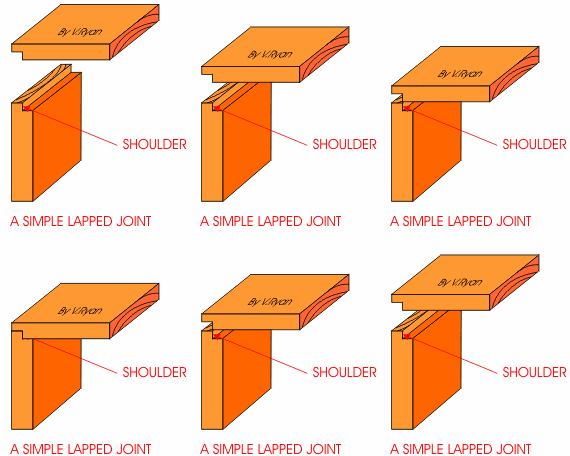

Ahh, did not see that angle. I would think using a lapped joint would have been preferable but as I have no idea of the cost I cannot really comment if it possible at the price point these were designed to meet.

Thread
Thread Starter
Forum
Replies
Last Post
ebowling
R50/R53 :: Hatch Talk (2002-2006)
90
Aug 4, 2019 09:15 AM
JaysinStrife
Suspension
7
Sep 7, 2015 12:52 PM