


Suspension rotors


Banned
Joined: Oct 2006
Posts: 1,299
Likes: 0
From: Tejas
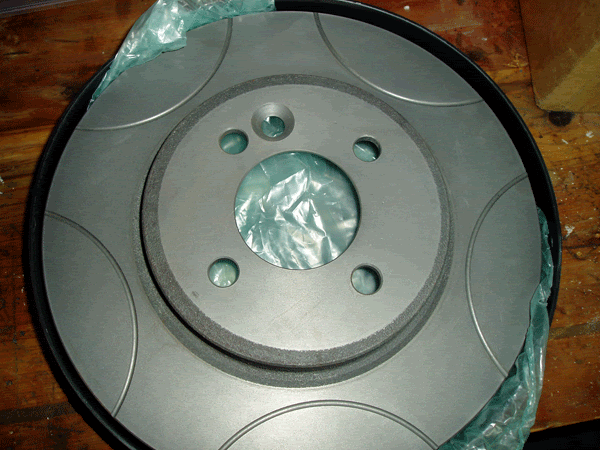
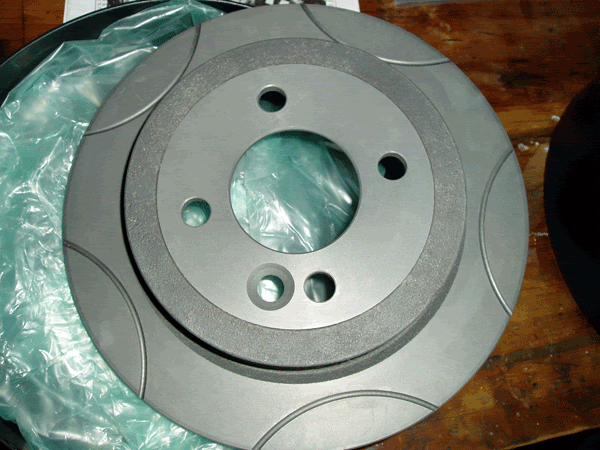
Our slotted rotors are on the way to us, ETA is 2-3 weeks before we'll have them in our hands, though... We'll be offering fronts for $199 for a full set of front and rear ($119 for front sets, $109 for rear sets).
Front:
Rear:
Front:
Rear:

 sold.
sold.

Banned
Joined: Feb 2007
Posts: 119
Likes: 0
From: Tehachapi, CA

Trending Topics


4th Gear
Joined: Mar 2005
Posts: 414
Likes: 0
Will the TSW rotors last longer than the stock units, i.e., are they harder? It seems like the stock ones wear out quickly compared to the rotors on other cars I've had - though admittedly those other cars weren't as sporty as my MINI.
Banned
Joined: Oct 2006
Posts: 1,299
Likes: 0
From: Tejas
They are not harder - but they do have the highest carbon content of any rotor out there AND will outperform ANY OEM replacement rotor. Longevity will have a lot to do with what pad compound you select and what you put them through!
And yes, $199 is the price for a full set...
And yes, $199 is the price for a full set...

Banned
Joined: Feb 2007
Posts: 119
Likes: 0
From: Tehachapi, CA
Strictly speaking, the slots add surface area - but I know what you're really asking. The amount of planar surface area does go down a bit, but as it turns out, this is a very weak parameter of performance. The swept area of the pad on the rotor is a much stronger parameter, and of course this doesn't change. The benefits of the slots during repeated cycles of threshold breaking greatly outweigh the costs.
Banned
Joined: Oct 2006
Posts: 1,299
Likes: 0
From: Tejas
Dr. Mike answered the question about surface area... The fronts are not directional, and retain the same straight vanes as OEM.
4th Gear
Joined: Mar 2005
Posts: 414
Likes: 0
Texas Speedwerks - are you going to also have have better-than-OEM pads to go with these rotors?
If not, whose pads would you recommend that would match up well with your rotors for a street machine that may see one performance event a year?
If not, whose pads would you recommend that would match up well with your rotors for a street machine that may see one performance event a year?

6th Gear
Joined: Mar 2006
Posts: 6,056
Likes: 0
From: Sacramento, CA
???? Edjamucate me. What's the problem with drilled rotors? I've heard that they aren't as effective as slotted, but are there other issues?
Banned
Joined: Feb 2007
Posts: 119
Likes: 0
From: Tehachapi, CA
Drilled holes in a rotor present stress concentrations. When a drilled rotor is subjected to cyclic, intense frictional heat, the surface experiences stresses which go beyond the yield stress of the metal (especially considering the strength at hot temperature). This results in compressive failures on the surface of the rotor (visible as heat checking after the rotor cools). Holes in the rotor tend to concentrate this stress by up to a factor of three, guaranteeing that a small crack will begin at the edge of a hole.
For racing rotors, this is sometimes acceptable, usually because the rotors are used up faster than the cracks grow, and because the holes are provided with generous fillets which are not cut away completely before the rotor is lifed out. In addition, proper rotor holes are cast, rather than drilled.
Street rotors, however, are hardly ever inspected unless they make noise or cause the brake pedal to pulse. This means that a crack in the rotor surface is likely to grow, which could lead to a nasty rotor failure.
Personally, I have run drilled rotors on some of my cars, but these were checked regularly for cracks (albeit with a visual inspection, not a proper dye-penetration or Magnaflux). I would not be comfortable, however, selling drilled rotors.
6th Gear
Joined: Mar 2006
Posts: 6,056
Likes: 0
From: Sacramento, CA
The biggest problem relates to weakening of the rotor by drilling it. This is a hotly debated subject, mind you, so I'm presenting my opinion only, not a general consensus.
Drilled holes in a rotor present stress concentrations. When a drilled rotor is subjected to cyclic, intense frictional heat, the surface experiences stresses which go beyond the yield stress of the metal (especially considering the strength at hot temperature). This results in compressive failures on the surface of the rotor (visible as heat checking after the rotor cools). Holes in the rotor tend to concentrate this stress by up to a factor of three, guaranteeing that a small crack will begin at the edge of a hole.
For racing rotors, this is sometimes acceptable, usually because the rotors are used up faster than the cracks grow, and because the holes are provided with generous fillets which are not cut away completely before the rotor is lifed out. In addition, proper rotor holes are cast, rather than drilled.
Street rotors, however, are hardly ever inspected unless they make noise or cause the brake pedal to pulse. This means that a crack in the rotor surface is likely to grow, which could lead to a nasty rotor failure.
Personally, I have run drilled rotors on some of my cars, but these were checked regularly for cracks (albeit with a visual inspection, not a proper dye-penetration or Magnaflux). I would not be comfortable, however, selling drilled rotors.
Drilled holes in a rotor present stress concentrations. When a drilled rotor is subjected to cyclic, intense frictional heat, the surface experiences stresses which go beyond the yield stress of the metal (especially considering the strength at hot temperature). This results in compressive failures on the surface of the rotor (visible as heat checking after the rotor cools). Holes in the rotor tend to concentrate this stress by up to a factor of three, guaranteeing that a small crack will begin at the edge of a hole.
For racing rotors, this is sometimes acceptable, usually because the rotors are used up faster than the cracks grow, and because the holes are provided with generous fillets which are not cut away completely before the rotor is lifed out. In addition, proper rotor holes are cast, rather than drilled.
Street rotors, however, are hardly ever inspected unless they make noise or cause the brake pedal to pulse. This means that a crack in the rotor surface is likely to grow, which could lead to a nasty rotor failure.
Personally, I have run drilled rotors on some of my cars, but these were checked regularly for cracks (albeit with a visual inspection, not a proper dye-penetration or Magnaflux). I would not be comfortable, however, selling drilled rotors.
Banned
Joined: Oct 2006
Posts: 1,299
Likes: 0
From: Tejas
HOWEVER, I would strongly suggest running pads that you are either already familiar with (and like) or those that suit your tastes. Personally, we know that the Porterfield R4's are majorly awesome for track work, AX, and the street but are a bit noisy and dusty... R4-S pads are great street pads and work well for AX, are very low dust and quiet, but aren't really well suited for the track.
There are no one solution fits all in the world of brake pads...


Thread
Thread Starter
Forum
Replies
Last Post
FatherG
R50/R53 :: Hatch Talk (2002-2006)
7
Oct 3, 2015 05:06 PM
Mini Mania
Tires, Wheels & Brakes
0
Oct 1, 2015 02:22 PM
Mini Mania
Tires, Wheels & Brakes
0
Oct 1, 2015 12:18 PM
Mini Mania
Tires, Wheels & Brakes
0
Oct 1, 2015 10:38 AM
Mini Mania
Tires, Wheels & Brakes
0
Oct 1, 2015 10:17 AM