


Suspension OK... What exactly are coilovers?


Joined: Jun 2007
Posts: 1,517
Likes: 3
From: Portlandia North, WA
OK... What exactly are coilovers?
 I'm sorry to express my studpidity, but what are coilovers? It's got to have something to do with the springs..... and they seem to go well with the sports suspension.

6th Gear
Joined: Mar 2006
Posts: 6,056
Likes: 0
From: Sacramento, CA
Everyone's gotta learn stuff sometime. 
Coilovers are integrated coil spring/damper assemblies that are matched to work optimally together.
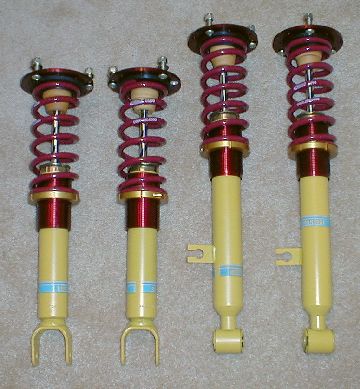
They are also usually adjustable for compression and/or rebound damping stiffness, and ride height.
I tried to get a picture of Texas Speedwerks' gorgeous new coilovers, but the site wouldn't come up. Check this link: https://www.northamericanmotoring.co...ad.php?t=97143
Coilovers are integrated coil spring/damper assemblies that are matched to work optimally together.
They are also usually adjustable for compression and/or rebound damping stiffness, and ride height.
I tried to get a picture of Texas Speedwerks' gorgeous new coilovers, but the site wouldn't come up. Check this link: https://www.northamericanmotoring.co...ad.php?t=97143
Last edited by 70spop; Jun 28, 2007 at 09:10 PM.
5th Gear
Joined: May 2006
Posts: 847
Likes: 0
From: Kennewick, WA
While "coilovers" has become the name people use to describe an aftermarket adjustable spring/shock combination (as 70sPop describes), all Mini Cooper models come with coilovers from the factory. The big difference is that the stock shock/spring combo (coilover) isn't adjustable. The springs are also much larger in diameter which can reduce the amount of space for larger wheels/tires.
Coilover simply means that the coil springs are "over" the shock. In otherwords, instead of a seperate spring and shock like on a Mustang, Covette, etc....the spring and shock are together as one unit.
Coilover simply means that the coil springs are "over" the shock. In otherwords, instead of a seperate spring and shock like on a Mustang, Covette, etc....the spring and shock are together as one unit.


3rd Gear
Joined: Jun 2007
Posts: 227
Likes: 0
The term "Coilovers" has been very overused lately to mean several different things. The literal meaning is that the 'Coil' spring is placed 'over' the shock, which is how most late model cars are set up from the factory.
A true "Adjustible coilover" involves a shock that's threaded on the outside which allows you to adjust the height of the spring on the shock, which in turn changes the ride height of the vehicle. Many racecars use these to fine-tune the suspension to the track they're racing at.
A "coilover sleave" (which is what the aftermarket seems to be terming "coilover" lately) is a threaded adaptor that fits onto your existing shock which then allows for similar height adjustments as the adjustable coilover above. This is basically a lower cost way to get an adjustable ride because you can keep your origional shocks.
The only advantage to running adjustable coilovers to the average street driver is the ability to "slam their ride" in the summer when the roads are nice, then jack it back up again in the winter so their car doesn't become a snow-plow. Another advantage would be the ability to change the height slightly if you decide down the road to put different size tires on the car and want to keep the same fender gap.
A good quality set of performance springs and shocks will give just as good if not better performance to the person who doesn't want to spend the time tweeking his suspension and just wants good solid performance that's allready been tried and tested.
A true "Adjustible coilover" involves a shock that's threaded on the outside which allows you to adjust the height of the spring on the shock, which in turn changes the ride height of the vehicle. Many racecars use these to fine-tune the suspension to the track they're racing at.
A "coilover sleave" (which is what the aftermarket seems to be terming "coilover" lately) is a threaded adaptor that fits onto your existing shock which then allows for similar height adjustments as the adjustable coilover above. This is basically a lower cost way to get an adjustable ride because you can keep your origional shocks.
The only advantage to running adjustable coilovers to the average street driver is the ability to "slam their ride" in the summer when the roads are nice, then jack it back up again in the winter so their car doesn't become a snow-plow. Another advantage would be the ability to change the height slightly if you decide down the road to put different size tires on the car and want to keep the same fender gap.
A good quality set of performance springs and shocks will give just as good if not better performance to the person who doesn't want to spend the time tweeking his suspension and just wants good solid performance that's allready been tried and tested.
3rd Gear
Joined: Jun 2007
Posts: 227
Likes: 0
Trending Topics

OVERDRIVE
Joined: Mar 2007
Posts: 5,602
Likes: 107
From: Arizona
A "coilover sleave" (which is what the aftermarket seems to be terming "coilover" lately) is a threaded adaptor that fits onto your existing shock which then allows for similar height adjustments as the adjustable coilover above. This is basically a lower cost way to get an adjustable ride because you can keep your origional shocks.
3rd Gear
Joined: Jun 2007
Posts: 227
Likes: 0
I can't answer the first half of your question but I can the second half...
I guess I didn't make it very clear on my first post but the coilover sleave still requires different springs to be used (usually much shorter than stock and even shorter than a regular lowering spring) in order to work properly. If you used it with the stock spring you would be at stock height on it's lowest setting and then jack the car up in the air as you raise it up.
I guess I didn't make it very clear on my first post but the coilover sleave still requires different springs to be used (usually much shorter than stock and even shorter than a regular lowering spring) in order to work properly. If you used it with the stock spring you would be at stock height on it's lowest setting and then jack the car up in the air as you raise it up.
Joined: Jun 2007
Posts: 1,517
Likes: 3
From: Portlandia North, WA


2nd Gear
Joined: Mar 2005
Posts: 51
Likes: 0
When it comes to height adjustable coilovers there are some things you need to keep in mind. While they can, and quite often, are used to "slam" the car this misses a very important part of the function of them.
The height adjustability is supposed to be used not only to set a proper ride height (as opposed to just slamming the car), but also to set the weight balance of the car to affect the handling characteristics. What the ideal balance and heights are for this car is a very long discussion worthy of it's own thread.
To touch upon each lightly I offer up this:
First to address the balance. You are looking at cross chassis "weighting" from corner to corner. This can vary based upon the track (for example, circle track as opposed to a road race style track). By putting scales under each tire you can adjust the amount of loading diagonally from corner to corner. This in turn will let you fine tune some of the characteristics of the car for understeer, neutrality, or oversteer.
Second up is height. Drop the car's height, and you lower the center of gravity. I believe everyone will agree with me that a lower CoG is a good thing when it comes to handling, BUT there are some other things that need to be considered. Here's a list of things to consider:
- First off is bump travel. Lower too much and you lose all or most of your bump travel. Spring travel not so much due to the adjustable nature of the spring perches that make height adjustable coilovers height adjustable. We're talking strut travel in this case. Sure you could cut or remove the bumpstops (something I would never recommend), but you are taking the struts out of the happy area where they like to work, and pushing them to the extreme of their travel. Net result will be a damper that wears more quickly than if a proper amount of travel is available. One of the things that you will find is that most height adjustable coilovers have a shorter damper body than the stock strut. This is the reason.
- Second up is roll center. You have two centers. Center of gravity, and roll center. Roll center is the axis of rotation or the point at which things pitch and roll. We'll use the front suspension in these examples to give you an idea of what is going on. Given the MacPherson front setup on these cars the RC will drop MUCH faster than the CoG. I don't have exact numbers as we have not modeled it yet, but to give you an example RC drops 2.5 times that of CoG on Subarus. This means that if you drop CoG 1" by using springs or height adjustable coilovers RC will drop 2.5" (keep in mind that you can lower CoG by using a tire with a lower profile). While this may not seem like a big deal it actually can be. The reason is this. The distance from the RC to the CoG is a lever arm. A lever arm that affects body roll. The longer the distance the longer the arm, and the more roll you can get. This is a bad thing because it affects point #3.
- Third is overall foibles of the MacP suspension setup. When it comes time to choosing a suspension setup by manufacturers there are only a few basic choices really. Each has strong and weak points. In the case of the MacP setup the strong points are this - lighter weight, ease of assembly, ease of packaging, ease of modeling, ease of working on in the future. It's really not a complicated setup, which can be really nice not just for the guys designing it or the guys building it, but also for the guys working on improving it in their own garage. The thing is all this ease does have its downsides (remember everything has tradeoffs). The biggest downside that you need to concern yourself with at this point is the camber curve. See, the camber curve of the MacP setup sucks. Plain and simple. As the lower control arms approach parallel to the ground the front wheel has a nasty habit of rolling over toward positive camber. This reduces contact patch available for grip up front. To combat this you can try a few things. First more static negative camber, second a bigger front anti-roll bar, and third, not as much of a drop.
More static negative camber is a good place to start as it lets you "bank" some negative camber so you have more contact patch on the ground when in a turn with a loaded tire. The problem is that if you go too much you really start to affect the grip available for straight line acceleration and braking.
A larger anti-roll bar can help with the compression problem and body roll problem. Thing is if you've lowered the car (this is where the roll center stuff comes in) you can cause more roll than with the car at stock height (remember the lever arm thing). So an easy fix would seem to be to correct it with a larger front bar. It'll help resist compression of the loaded tire, thus fighting to keep the dynamic camber close to static camber, and it will help resist the body roll. The problem here is that the car is front wheel drive. By tying the front together with a bar across it you really start to limit the suspension independence which on a FWD car is really going to hurt the front end grip. The thing to keep in mind is that you are already demanding quite a bit from the tires just in asking for grip during turns. Asking them to brake or accelerate at the same time can really start to overtax them. This is where understanding, mapping, and working within the confines of your traction circle can become important. This is also the reason why you see some folks ditch the front bar completely, and go with really stiff front springs. Springs will also resist body roll, helping to keep the camber curve in check while at the same time allowing the independence to remain, well, independent. The thing to this is you HAVE to properly match the damper rate to the spring, and even then this will affect your ride quality. That in and of itself is yet another essay.
Last is the amount of drop. There is out there a magic number for ride height that will give you a good compromise between all these factors. I do not yet know what it is, but it is out there. BUT there is something about that number that makes it complicated. It's not the same for all conditions, and can vary from track to track, road to road, and driving style to driving style. What the number is will first take quite a bit of modeling, and second take quite a bit of seat time. To take it full circle, height adjustable coilovers allow you to start somewhere, and work from there to find what works best for you.
In the end height adjustable coilovers will let you do one of two things. It will either let you slam your car for that "mad tyte look, yo" or take a more proper approach to handling and vehicle dynamics by letting you tune parts of your suspension to acheive the best handling for the given conditions.
Now, if you fall into the second camp with concerns on performance then this can be a long, and quite honestly, never ending process. One thing you will also need to keep in mind in all of this is alignment. Changing heights and messing about with camber settings will throw off your toe in your alignment. It certainly helps if you can set your own alignments or things will really start to get expensive. If you have access to a rack that's great, but don't forget that many many people do just fine with the old technique of a string alignment. As for what alignment settings to run - well, that's yet ANOTHER discussion.
As for coilovers themselves let me say this - you get what you pay for, and good ones are not cheap. If you fall into the "mad tyte, yo" camp then $800 height adjustable, 32 clicks of damping or rebound may just be fine. In my opinion your money in that case is better spent on quality lowering springs, and good bumpstops. If you fall into the camp of looking for performance then you are going to spend more. Much more. That's just the way it is. Do keep in mind though that height adjustable coilovers may still not be right for you. If you never track your car, if you don't have the budget, or if you don't have the time to work with and maintain them then go with springs, and be happy. Remember, for all they give you they are still not the right solution to all situations.
Today's message brought to you by the letter F, and the number 42.
The height adjustability is supposed to be used not only to set a proper ride height (as opposed to just slamming the car), but also to set the weight balance of the car to affect the handling characteristics. What the ideal balance and heights are for this car is a very long discussion worthy of it's own thread.
To touch upon each lightly I offer up this:
First to address the balance. You are looking at cross chassis "weighting" from corner to corner. This can vary based upon the track (for example, circle track as opposed to a road race style track). By putting scales under each tire you can adjust the amount of loading diagonally from corner to corner. This in turn will let you fine tune some of the characteristics of the car for understeer, neutrality, or oversteer.
Second up is height. Drop the car's height, and you lower the center of gravity. I believe everyone will agree with me that a lower CoG is a good thing when it comes to handling, BUT there are some other things that need to be considered. Here's a list of things to consider:
- First off is bump travel. Lower too much and you lose all or most of your bump travel. Spring travel not so much due to the adjustable nature of the spring perches that make height adjustable coilovers height adjustable. We're talking strut travel in this case. Sure you could cut or remove the bumpstops (something I would never recommend), but you are taking the struts out of the happy area where they like to work, and pushing them to the extreme of their travel. Net result will be a damper that wears more quickly than if a proper amount of travel is available. One of the things that you will find is that most height adjustable coilovers have a shorter damper body than the stock strut. This is the reason.
- Second up is roll center. You have two centers. Center of gravity, and roll center. Roll center is the axis of rotation or the point at which things pitch and roll. We'll use the front suspension in these examples to give you an idea of what is going on. Given the MacPherson front setup on these cars the RC will drop MUCH faster than the CoG. I don't have exact numbers as we have not modeled it yet, but to give you an example RC drops 2.5 times that of CoG on Subarus. This means that if you drop CoG 1" by using springs or height adjustable coilovers RC will drop 2.5" (keep in mind that you can lower CoG by using a tire with a lower profile). While this may not seem like a big deal it actually can be. The reason is this. The distance from the RC to the CoG is a lever arm. A lever arm that affects body roll. The longer the distance the longer the arm, and the more roll you can get. This is a bad thing because it affects point #3.
- Third is overall foibles of the MacP suspension setup. When it comes time to choosing a suspension setup by manufacturers there are only a few basic choices really. Each has strong and weak points. In the case of the MacP setup the strong points are this - lighter weight, ease of assembly, ease of packaging, ease of modeling, ease of working on in the future. It's really not a complicated setup, which can be really nice not just for the guys designing it or the guys building it, but also for the guys working on improving it in their own garage. The thing is all this ease does have its downsides (remember everything has tradeoffs). The biggest downside that you need to concern yourself with at this point is the camber curve. See, the camber curve of the MacP setup sucks. Plain and simple. As the lower control arms approach parallel to the ground the front wheel has a nasty habit of rolling over toward positive camber. This reduces contact patch available for grip up front. To combat this you can try a few things. First more static negative camber, second a bigger front anti-roll bar, and third, not as much of a drop.
More static negative camber is a good place to start as it lets you "bank" some negative camber so you have more contact patch on the ground when in a turn with a loaded tire. The problem is that if you go too much you really start to affect the grip available for straight line acceleration and braking.
A larger anti-roll bar can help with the compression problem and body roll problem. Thing is if you've lowered the car (this is where the roll center stuff comes in) you can cause more roll than with the car at stock height (remember the lever arm thing). So an easy fix would seem to be to correct it with a larger front bar. It'll help resist compression of the loaded tire, thus fighting to keep the dynamic camber close to static camber, and it will help resist the body roll. The problem here is that the car is front wheel drive. By tying the front together with a bar across it you really start to limit the suspension independence which on a FWD car is really going to hurt the front end grip. The thing to keep in mind is that you are already demanding quite a bit from the tires just in asking for grip during turns. Asking them to brake or accelerate at the same time can really start to overtax them. This is where understanding, mapping, and working within the confines of your traction circle can become important. This is also the reason why you see some folks ditch the front bar completely, and go with really stiff front springs. Springs will also resist body roll, helping to keep the camber curve in check while at the same time allowing the independence to remain, well, independent. The thing to this is you HAVE to properly match the damper rate to the spring, and even then this will affect your ride quality. That in and of itself is yet another essay.
Last is the amount of drop. There is out there a magic number for ride height that will give you a good compromise between all these factors. I do not yet know what it is, but it is out there. BUT there is something about that number that makes it complicated. It's not the same for all conditions, and can vary from track to track, road to road, and driving style to driving style. What the number is will first take quite a bit of modeling, and second take quite a bit of seat time. To take it full circle, height adjustable coilovers allow you to start somewhere, and work from there to find what works best for you.
In the end height adjustable coilovers will let you do one of two things. It will either let you slam your car for that "mad tyte look, yo" or take a more proper approach to handling and vehicle dynamics by letting you tune parts of your suspension to acheive the best handling for the given conditions.
Now, if you fall into the second camp with concerns on performance then this can be a long, and quite honestly, never ending process. One thing you will also need to keep in mind in all of this is alignment. Changing heights and messing about with camber settings will throw off your toe in your alignment. It certainly helps if you can set your own alignments or things will really start to get expensive. If you have access to a rack that's great, but don't forget that many many people do just fine with the old technique of a string alignment. As for what alignment settings to run - well, that's yet ANOTHER discussion.
As for coilovers themselves let me say this - you get what you pay for, and good ones are not cheap. If you fall into the "mad tyte, yo" camp then $800 height adjustable, 32 clicks of damping or rebound may just be fine. In my opinion your money in that case is better spent on quality lowering springs, and good bumpstops. If you fall into the camp of looking for performance then you are going to spend more. Much more. That's just the way it is. Do keep in mind though that height adjustable coilovers may still not be right for you. If you never track your car, if you don't have the budget, or if you don't have the time to work with and maintain them then go with springs, and be happy. Remember, for all they give you they are still not the right solution to all situations.
Today's message brought to you by the letter F, and the number 42.
Last edited by cboggess; Jul 2, 2007 at 08:42 AM.


Sleeves are sometimes available for aftermarket shocks, but rarely (if ever?) for OEM. I haven't looked into shocks for the MINI, but Koni makes a yellow shock for the Miata which has adjustable perch rings (really just circumferential grooves in the shock body - the perch is supported by circlips that fit into the grooves.)
3rd Gear
Joined: Jun 2007
Posts: 227
Likes: 0
NO.
Sleeves are sometimes available for aftermarket shocks, but rarely (if ever?) for OEM. I haven't looked into shocks for the MINI, but Koni makes a yellow shock for the Miata which has adjustable perch rings (really just circumferential grooves in the shock body - the perch is supported by circlips that fit into the grooves.)
Sleeves are sometimes available for aftermarket shocks, but rarely (if ever?) for OEM. I haven't looked into shocks for the MINI, but Koni makes a yellow shock for the Miata which has adjustable perch rings (really just circumferential grooves in the shock body - the perch is supported by circlips that fit into the grooves.)
I can't speak for MINI specifically, because I don't own one yet, but the Ground control (as well as most other brands) sleaves for Hondas most definately will fit factory shocks. I've done it.
And I was going to ask if Koni's for the MINI had the adjustable perch or not. They do that for Honda as well.

Thread
Thread Starter
Forum
Replies
Last Post
sssevita
MINI Parts for Sale
4
Mar 20, 2016 06:24 AM