


Drivetrain If I were the tuner. Part 2: Turbos and Intercoolers


Thread Starter
|
4th Gear

Joined: Jan 2012
Posts: 485
Likes: 18
From: DC Metro
If I were the tuner. Part 2: Turbos and Intercoolers
There wasn't a lot of response to my previous thread but I said I'd come back with more so here goes.
Picking the right turbo for your street car
I say street car because most people aren't putting their Countryman on a track. Some might do some rallycross but I'm going to leave that to someone else. There are a lot of variations in motorsports that may dictate a totally different setup than you'd want on the street.
My personal preference for a street turbo car is a nice compromise of economy, power, and ridiculousness.
Tuning companies usually have their own goals as to what they think their customers will want. Some opt for flat torque curves and "big motor" feel and some opt for peak power at the expense of low end. And everything in between.
I tend to prefer a bit more peak power and "turbo feel" at the expense of a little bit of spool and low end power. I'm not talking dyno queen power curves, but rather a turbo big enough that it doesn't spool too fast when you drive gently.
For a Countryman S, I'm going to speculate that a Garrett GT2560 sized turbo would be pretty a good start for an all-around street car that was fairly civil. I'm guessing peak power would be in the mid 200s at the wheels with solid torque from 2500 rpm. Definitely I would put more time in with the compressor maps (and turbine maps if they are available) to properly match the turbo and then do some real-world driving testing.
If you've got an "S" Cooper, you know that the dinky turbocharger gets into boost the second you touch the gas pedal. The drive-by-wire system slows that reaction down somewhat to improve gas mileage (less so in Sport mode probably) but you get a similar effect with a larger turbo. Since the spool takes a bit more time, you use less gas to make throttle adjustments at lower throttle values. And of course if you need to go faster, you just push the pedal further and/or downshift.
Bigger Turbos, more power!
If you aren't satisfied with 250 wheel hp, a bigger turbo might be necessary. The 2560 I mentioned above isn't going to do much more on a 1.6L. Something like a GT2871 would be better suited for more higher revving power. You'll sacrifice power below 3500 but open up the possibility of reaching closer to 300 whp. IF the fuel system can keep up.
Going beyond the T28 sized exhaust housing on a 1.6 is going to have diminishing returns on a smaller motor. There just isn't enough volumetric flow rate to spin a bigger turbine and provide boost. I suspect anyone looking for more than 300 wheel hp in a Countryman are going to have to increase the displacement of the motor or give up power below 4000 rpm. Most people driving on the street don't get above 4000 rpm most days.
Cooling the intake charge.
Whether you upgrade your turbo or not, the cooler the air entering the engine is, the more dense it is. Higher density air means more oxygen molecules per unit volume. And that means more power per unit volume of air entering the motor. That's why you might notice some turbo cars feel faster on cold winter days than they do on hot summer days.
The best way to cool that intake charge is an intercooler. The Countryman comes with one from the factory. It looks to be about 3 or 4 inches square (I haven't shoved a ruler into my grille yet). Forge has a great picture of one:

The stock intercooler is bar and plate (like the Forge above it). The alternative is a tube and fin intercooler. The latter is lighter and has better flow through the exterior but consequently they are more fragile (rock damage) and the tubes tend to be worse internally for flow since they stick slightly into the end tanks and cause turbulence more than a flush entry would. The following picture sort of shows the difference. The blue lines would be charge air. Bar and plate is on top, tube and fin on the bottom.
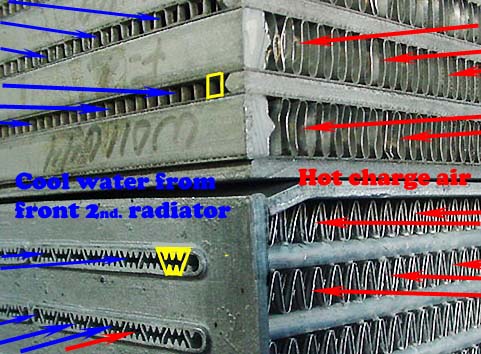
Sizewise, my short opinion is that "bigger is better" generally. I mean "generally" in the sense that usually the primary consideration for intercooler installations is how you fit it in front of the radiator followed closely by cost.
In my experience, I've found very little tradeoff in performance (spool, throttle response) from the increase in charge air volume between the turbo and the throttle body. There are plenty of threads on forums that discuss how long it takes to fill the large volume of air but I'm going to dismiss those as not an issue. Practically speaking the slowdown of the charge air from hitting ANY size intercooler is going to massively outweigh any perceivable delay from adding a couple more liters of air to the system. Remember, about half of the surface the charge air hits when it gets to the intercooler is solid aluminum. If anything increasing the flow area through the intercooler may offset the change in volume anyway.
So to sum up, I'd go for the biggest bar and plate intercooler that fits your car and fits your budget.
As for charge pipe sizes, you ideally want to keep the diameter consistent to eliminate flow restrictions from abrupt diameter changes. Changing the diameter up or down can slow down flow. For example: if your turbo has a 2 inch outlet and your throttle body is 2.5 inches, the best place to make that change is at the big fat bar and plate intercooler restriction. You've already sent the charge air into an end tank and confused it by sending it through a bunch of tiny air passages. It'll never even notice you bumped up the pipe diameter.
I like aluminum pipes. They're easy to bead, polish well, and will radiate heat.
I should mention something very important here about heat transfer:
Go ahead and paint your intercooler black. A thin coat will have almost no effect on cooling efficiency. Also important: intercoolers work primarily by convection, not by radiation. Just like your radiator. The name is a misnomer to a degree. Convection is heat exchange between a surface and a moving fluid (air, water, freon, gin & tonic, etc.) and that's why you have a big fan on your radiator. Of course any hot surface near a cool surface can radiate heat so it can't be neglected, it's just not the primary method.
If you want to get super fancy, know this: a gold mirror finish is the best insulator against radiation heat transfer. If you run an intercooler pipe near an exhaust manifold, make them both shiny and, if you can, gold. Don't believe me? Go look at spacecraft and multi-million dollar race cars.
Conversely, if you want to get the heat to transfer out of (or into) something, black matte finish is the way to go. So you could theoretically paint the turbo-side piping black and polish the throttle-body side piping to squeeze out the maximum heat transfer.
Similarly, if you need heat shielding, there's not much better than shiny foil backed with fiberglass. The foil will reject most of the radiant heat and the fiberglass will provide a barrier for any that gets through. Shiny makes sense for rejecting heat if you think about it. Heat is infrared. Infrared is just redder than the visible spectrum. What reflects the visible spectrum really well? A mirror. Why shouldn't a mirror work outside the visible spectrum too?
That's all for today. Thanks for reading.
Picking the right turbo for your street car
I say street car because most people aren't putting their Countryman on a track. Some might do some rallycross but I'm going to leave that to someone else. There are a lot of variations in motorsports that may dictate a totally different setup than you'd want on the street.
My personal preference for a street turbo car is a nice compromise of economy, power, and ridiculousness.
Tuning companies usually have their own goals as to what they think their customers will want. Some opt for flat torque curves and "big motor" feel and some opt for peak power at the expense of low end. And everything in between.
I tend to prefer a bit more peak power and "turbo feel" at the expense of a little bit of spool and low end power. I'm not talking dyno queen power curves, but rather a turbo big enough that it doesn't spool too fast when you drive gently.
For a Countryman S, I'm going to speculate that a Garrett GT2560 sized turbo would be pretty a good start for an all-around street car that was fairly civil. I'm guessing peak power would be in the mid 200s at the wheels with solid torque from 2500 rpm. Definitely I would put more time in with the compressor maps (and turbine maps if they are available) to properly match the turbo and then do some real-world driving testing.
If you've got an "S" Cooper, you know that the dinky turbocharger gets into boost the second you touch the gas pedal. The drive-by-wire system slows that reaction down somewhat to improve gas mileage (less so in Sport mode probably) but you get a similar effect with a larger turbo. Since the spool takes a bit more time, you use less gas to make throttle adjustments at lower throttle values. And of course if you need to go faster, you just push the pedal further and/or downshift.
Bigger Turbos, more power!
If you aren't satisfied with 250 wheel hp, a bigger turbo might be necessary. The 2560 I mentioned above isn't going to do much more on a 1.6L. Something like a GT2871 would be better suited for more higher revving power. You'll sacrifice power below 3500 but open up the possibility of reaching closer to 300 whp. IF the fuel system can keep up.
Going beyond the T28 sized exhaust housing on a 1.6 is going to have diminishing returns on a smaller motor. There just isn't enough volumetric flow rate to spin a bigger turbine and provide boost. I suspect anyone looking for more than 300 wheel hp in a Countryman are going to have to increase the displacement of the motor or give up power below 4000 rpm. Most people driving on the street don't get above 4000 rpm most days.
Cooling the intake charge.
Whether you upgrade your turbo or not, the cooler the air entering the engine is, the more dense it is. Higher density air means more oxygen molecules per unit volume. And that means more power per unit volume of air entering the motor. That's why you might notice some turbo cars feel faster on cold winter days than they do on hot summer days.
The best way to cool that intake charge is an intercooler. The Countryman comes with one from the factory. It looks to be about 3 or 4 inches square (I haven't shoved a ruler into my grille yet). Forge has a great picture of one:
The stock intercooler is bar and plate (like the Forge above it). The alternative is a tube and fin intercooler. The latter is lighter and has better flow through the exterior but consequently they are more fragile (rock damage) and the tubes tend to be worse internally for flow since they stick slightly into the end tanks and cause turbulence more than a flush entry would. The following picture sort of shows the difference. The blue lines would be charge air. Bar and plate is on top, tube and fin on the bottom.
Sizewise, my short opinion is that "bigger is better" generally. I mean "generally" in the sense that usually the primary consideration for intercooler installations is how you fit it in front of the radiator followed closely by cost.
In my experience, I've found very little tradeoff in performance (spool, throttle response) from the increase in charge air volume between the turbo and the throttle body. There are plenty of threads on forums that discuss how long it takes to fill the large volume of air but I'm going to dismiss those as not an issue. Practically speaking the slowdown of the charge air from hitting ANY size intercooler is going to massively outweigh any perceivable delay from adding a couple more liters of air to the system. Remember, about half of the surface the charge air hits when it gets to the intercooler is solid aluminum. If anything increasing the flow area through the intercooler may offset the change in volume anyway.
So to sum up, I'd go for the biggest bar and plate intercooler that fits your car and fits your budget.
As for charge pipe sizes, you ideally want to keep the diameter consistent to eliminate flow restrictions from abrupt diameter changes. Changing the diameter up or down can slow down flow. For example: if your turbo has a 2 inch outlet and your throttle body is 2.5 inches, the best place to make that change is at the big fat bar and plate intercooler restriction. You've already sent the charge air into an end tank and confused it by sending it through a bunch of tiny air passages. It'll never even notice you bumped up the pipe diameter.
I like aluminum pipes. They're easy to bead, polish well, and will radiate heat.
I should mention something very important here about heat transfer:
Go ahead and paint your intercooler black. A thin coat will have almost no effect on cooling efficiency. Also important: intercoolers work primarily by convection, not by radiation. Just like your radiator. The name is a misnomer to a degree. Convection is heat exchange between a surface and a moving fluid (air, water, freon, gin & tonic, etc.) and that's why you have a big fan on your radiator. Of course any hot surface near a cool surface can radiate heat so it can't be neglected, it's just not the primary method.
If you want to get super fancy, know this: a gold mirror finish is the best insulator against radiation heat transfer. If you run an intercooler pipe near an exhaust manifold, make them both shiny and, if you can, gold. Don't believe me? Go look at spacecraft and multi-million dollar race cars.
Conversely, if you want to get the heat to transfer out of (or into) something, black matte finish is the way to go. So you could theoretically paint the turbo-side piping black and polish the throttle-body side piping to squeeze out the maximum heat transfer.
Similarly, if you need heat shielding, there's not much better than shiny foil backed with fiberglass. The foil will reject most of the radiant heat and the fiberglass will provide a barrier for any that gets through. Shiny makes sense for rejecting heat if you think about it. Heat is infrared. Infrared is just redder than the visible spectrum. What reflects the visible spectrum really well? A mirror. Why shouldn't a mirror work outside the visible spectrum too?
That's all for today. Thanks for reading.

2nd Gear
Joined: Jan 2012
Posts: 131
Likes: 0
From: El Paso, TX
I like it, both this post and your previous, thank you.
I'm toying with the idea of the way motor works shiny backed fiberglass turbo heat shield for the hot side. I like it, but i don't know if i $175 like it..
I'm toying with the idea of the way motor works shiny backed fiberglass turbo heat shield for the hot side. I like it, but i don't know if i $175 like it..


I enjoy reading your posts. Pretty interesting stuff. I probably speak for many when I say we would appreciate your real-world suggestions regarding the parts/manufacturers that best match your theoretical ideals.
I'd love to get my Countryman S to at least 250 HP. I am essentially looking at doing it with four or five mods: An intake, exhaust, intercooler, an ECU tune, and maybe a different turbo. (Listed in order of impact on HP.)
Regarding turbos, you mention the Garrett GT2560, but this one from Alta looks like it might give the best of both worlds regarding low-end power, yet still capable of producing high total HP:
http://www.altaperformance.com/count...illet-56-turbo
http://blog.perrinperformance.com/al...turbo-upgrade/
I'd love to get my Countryman S to at least 250 HP. I am essentially looking at doing it with four or five mods: An intake, exhaust, intercooler, an ECU tune, and maybe a different turbo. (Listed in order of impact on HP.)
Regarding turbos, you mention the Garrett GT2560, but this one from Alta looks like it might give the best of both worlds regarding low-end power, yet still capable of producing high total HP:
http://www.altaperformance.com/count...illet-56-turbo
http://blog.perrinperformance.com/al...turbo-upgrade/
Thread Starter
|
4th Gear
Joined: Jan 2012
Posts: 485
Likes: 18
From: DC Metro
Since I'm relatively new to the MINI marque, I hadn't seen much of the tuner stuff. Thanks for the links. Looks like ALTA has been doing lots of good work on turbo selection and design. I gotta say I'm a little surprised how late the 2560 spools though. I run a relatively monstrous 2876 on my 1.8L miata and see 9 psi by about 3700 RPM. May be the smaller engine displacement...
The charts they show in the blog are pretty impressive. Now about that accessport...
To answer your question about real-world suggestions, I can try but often the answer is "let the car tell you".
Think of the car as a chain--only as powerful as the weakest link. Any time you replace a part with something to make it faster, you change what that weak link is. And that link may be a limiting factor for power OR it may be a breaking point. In the miata world, most people discover that the intake manifold is holding back peak power and the transmission breaks first. I doubt there is significant data available for the Countryman to tell you those points, though some tuner shops may have found the power limiters already.
On the CM, I'd probably start with exhaust and intercooler, assuming the stock intake isn't terribly restrictive. Then I'd move on to ECU tune and probably turbo.
I'm not sure how sensitive the stock ECU is to changes, but there is almost zero chance it would notice an intercooler. It might notice an exhaust (changes in boost pressure are easy for the ECU to measure). It would very maybe notice a new turbo, but who knows. ALTA says the billet 56 requires no tuning which is pretty cool.
And if you notice a lack of power or slow spool, come back and address the intake ahead of the turbo.
The charts they show in the blog are pretty impressive. Now about that accessport...
To answer your question about real-world suggestions, I can try but often the answer is "let the car tell you".
Think of the car as a chain--only as powerful as the weakest link. Any time you replace a part with something to make it faster, you change what that weak link is. And that link may be a limiting factor for power OR it may be a breaking point. In the miata world, most people discover that the intake manifold is holding back peak power and the transmission breaks first. I doubt there is significant data available for the Countryman to tell you those points, though some tuner shops may have found the power limiters already.
On the CM, I'd probably start with exhaust and intercooler, assuming the stock intake isn't terribly restrictive. Then I'd move on to ECU tune and probably turbo.
I'm not sure how sensitive the stock ECU is to changes, but there is almost zero chance it would notice an intercooler. It might notice an exhaust (changes in boost pressure are easy for the ECU to measure). It would very maybe notice a new turbo, but who knows. ALTA says the billet 56 requires no tuning which is pretty cool.
And if you notice a lack of power or slow spool, come back and address the intake ahead of the turbo.
Since I'm relatively new to the MINI marque, I hadn't seen much of the tuner stuff. Thanks for the links. Looks like ALTA has been doing lots of good work on turbo selection and design. I gotta say I'm a little surprised how late the 2560 spools though. I run a relatively monstrous 2876 on my 1.8L miata and see 9 psi by about 3700 RPM. May be the smaller engine displacement...
The charts they show in the blog are pretty impressive. Now about that accessport...
To answer your question about real-world suggestions, I can try but often the answer is "let the car tell you".
Think of the car as a chain--only as powerful as the weakest link. Any time you replace a part with something to make it faster, you change what that weak link is. And that link may be a limiting factor for power OR it may be a breaking point. In the miata world, most people discover that the intake manifold is holding back peak power and the transmission breaks first. I doubt there is significant data available for the Countryman to tell you those points, though some tuner shops may have found the power limiters already.
On the CM, I'd probably start with exhaust and intercooler, assuming the stock intake isn't terribly restrictive. Then I'd move on to ECU tune and probably turbo.
I'm not sure how sensitive the stock ECU is to changes, but there is almost zero chance it would notice an intercooler. It might notice an exhaust (changes in boost pressure are easy for the ECU to measure). It would very maybe notice a new turbo, but who knows. ALTA says the billet 56 requires no tuning which is pretty cool.
And if you notice a lack of power or slow spool, come back and address the intake ahead of the turbo.
The charts they show in the blog are pretty impressive. Now about that accessport...
To answer your question about real-world suggestions, I can try but often the answer is "let the car tell you".
Think of the car as a chain--only as powerful as the weakest link. Any time you replace a part with something to make it faster, you change what that weak link is. And that link may be a limiting factor for power OR it may be a breaking point. In the miata world, most people discover that the intake manifold is holding back peak power and the transmission breaks first. I doubt there is significant data available for the Countryman to tell you those points, though some tuner shops may have found the power limiters already.
On the CM, I'd probably start with exhaust and intercooler, assuming the stock intake isn't terribly restrictive. Then I'd move on to ECU tune and probably turbo.
I'm not sure how sensitive the stock ECU is to changes, but there is almost zero chance it would notice an intercooler. It might notice an exhaust (changes in boost pressure are easy for the ECU to measure). It would very maybe notice a new turbo, but who knows. ALTA says the billet 56 requires no tuning which is pretty cool.
And if you notice a lack of power or slow spool, come back and address the intake ahead of the turbo.
Sounds like our thoughts are similar. My "big three" are an exhaust, intercooler, and ECU tune. If I do a turbo, it will be down the line.
Regarding intakes, what is your sense of how much real-world gain there is by going with a "true" CAI like the Defender of Speed version (http://www.defendersofspeed.com/cold...-turbocharged/) as opposed to a more conventional design?
Maybe I'm showing my ignorance here, but I just feel like the cooling effect of a true CAI over a conventional intake pales in comparison to the cooling effect of a big intercooler over a stock one.
Last question: Regarding exhausts, what's your take on the VIP full-exhaust option as a quality performance exhaust? (See http://www.vipcustomparts.com/R60%20parts%20page.htm; scroll down to VPN 407 DP ("DP Series").)
It is a 2.5" exhaust from the downpipe back. I know you advocated a 3" exhaust, but I am not sure any are commercially available. One concern is that I'm not sure how restrictive the stock downpipe is. As you say, the whole thing is only as strong as its weakest part and it would be a shame to limit an otherwise legitimate exhaust due to a restrictive downpipe.
Trending Topics
Thread Starter
|
4th Gear
Joined: Jan 2012
Posts: 485
Likes: 18
From: DC Metro
the difference in the CAI (or "CAI" in quotes for the ones that aren't isolated from engine bay heat) is going to be primarily in the filter layout and media.
for the same size filter element though, more flow often means worse filtration. Personally I'm not willing to put a poor filter on a street car just for a few hp. If good filtration means too much restriction, run a larger filter.
I'm not convinced that the temperature of the air reaching any of the available aftermarket intakes is any cooler than stock. I'm open minded if there's data, but based on the designs, at best with the DoS you will see the same air temps.
The VIP exhaust looks pretty good. I tend to build my own but right now without a garage...
The downpipe probably has a catalytic converter in it. Not much you can do about that.
for the same size filter element though, more flow often means worse filtration. Personally I'm not willing to put a poor filter on a street car just for a few hp. If good filtration means too much restriction, run a larger filter.
I'm not convinced that the temperature of the air reaching any of the available aftermarket intakes is any cooler than stock. I'm open minded if there's data, but based on the designs, at best with the DoS you will see the same air temps.
The VIP exhaust looks pretty good. I tend to build my own but right now without a garage...
The downpipe probably has a catalytic converter in it. Not much you can do about that.

6th Gear
Joined: May 2010
Posts: 3,260
Likes: 87
From: Pacific NW
6th Gear
Joined: May 2010
Posts: 3,260
Likes: 87
From: Pacific NW
2nd Gear
Joined: Jan 2012
Posts: 131
Likes: 0
From: El Paso, TX
 I'd be game for welding an exhaust myself, but I've never done stainless..
One thing that bugs me is the use of K&N filters... Any car with a MAF will have to clean it eventually because the oil from the filter element will eventually coat the thin wires of the sensor which results in poor gas mileage and performance. Had it happen on two vehicles with K&N. Switched to Amsoil EA filters and no more problems.
Another thought for a project: custom charge piping. Not sure what all the different inlet/outlet sizes are on everything, but surely you could get some performance out of replacing all the factory plastic and silicone piping with a nice welded metal setup...
I noticed that yesterday as well, very cool! The VIP exhaust ditches the second cat, however having a high flow one welded in would be pretty nice and then it'd be totally legal. Same goes for the downpipe; just have a high flow cat installed. VIP exhaust is the one I want, you just cant beat full stainless I'd be game for welding an exhaust myself, but I've never done stainless..
One thing that bugs me is the use of K&N filters... Any car with a MAF will have to clean it eventually because the oil from the filter element will eventually coat the thin wires of the sensor which results in poor gas mileage and performance. Had it happen on two vehicles with K&N. Switched to Amsoil EA filters and no more problems.
Another thought for a project: custom charge piping. Not sure what all the different inlet/outlet sizes are on everything, but surely you could get some performance out of replacing all the factory plastic and silicone piping with a nice welded metal setup...
I'd be game for welding an exhaust myself, but I've never done stainless..One thing that bugs me is the use of K&N filters... Any car with a MAF will have to clean it eventually because the oil from the filter element will eventually coat the thin wires of the sensor which results in poor gas mileage and performance. Had it happen on two vehicles with K&N. Switched to Amsoil EA filters and no more problems.
Another thought for a project: custom charge piping. Not sure what all the different inlet/outlet sizes are on everything, but surely you could get some performance out of replacing all the factory plastic and silicone piping with a nice welded metal setup...
Assuming one didn't want to use the K&N filter, but liked the design of the VIP intake, could that person swap out a different filter on the VIP intake?
Regarding the exhaust, I am planning on taking my chances with the downpipe-back exhaust without replacing the second cat with anything. (Fingers crossed.) It'd be sweet to replace the downpipe with a Akrapovic downpipe to get max flow with at least a hat tip to the environment.
Back to intercoolers: Forge or Alta FMIC for the R60 in your opinion, y8s (and/or inh)? They seem pretty similar to me.
2nd Gear
Joined: Jan 2012
Posts: 131
Likes: 0
From: El Paso, TX
About this filters, the k&n most all CAIs come with is just a universal size one and chances are companies that make universal filters will have one that matches it. I got a universal filter from Amsoil that fit right on a k&n intake I had on another vehicle.
As far as oil, you might be right in that it was user error in over filing but to the best of my knowledge the filter on the vehicle I was having issues with had never been re-oiled.
2nd Gear
Joined: Jan 2012
Posts: 131
Likes: 0
From: El Paso, TX
You SHOULD fail for having less than the factory number of cats installed, however it's anyone's guess if they would check/notice. You probably wouldn't pass the emissions tests anyways though due to having less cats and the fact that the one cat you do have is much less restrictive than the original.
However, it's not unheard of to get your car a special tune to pass the emissions test with...
However, it's not unheard of to get your car a special tune to pass the emissions test with...
You SHOULD fail for having less than the factory number of cats installed, however it's anyone's guess if they would check/notice. You probably wouldn't pass the emissions tests anyways though due to having less cats and the fact that the one cat you do have is much less restrictive than the original.
However, it's not unheard of to get your car a special tune to pass the emissions test with...
However, it's not unheard of to get your car a special tune to pass the emissions test with...
What are the realistic gains (HP, torque, mileage) one could expect from a relatively free-flowing, 2.5" exhaust (i.e., Akrapovic and VIP full exhaust) versus the stock setup (assuming the car was tuned to take advantage of the exhaust)?
Thread Starter
|
4th Gear
Joined: Jan 2012
Posts: 485
Likes: 18
From: DC Metro
Keep in mind not all OBDII cars come with more than one cat. My 01 miata has just one and my local inspection never goes near the exhaust pipe. They plug into the OBDII port, check for codes, and that's it. Oh and I think they stick a probe in the fuel filler.
The high flow cats may still allow you to pass if you only get a plug-in test. The car's ECU may only check cat functionality at light load where flow volumes are low enough that it can do its job.
Anyway, that's the point of OBDII--to self test the car. If the aftermarket exhaust is working within the tolerances the system is designed for, it wont throw a code. If you don't have visual tests, then you might be ok.
I'd call up the vendor of the exhaust you want and ask if it'll make the car throw codes.
As for power increase, ask them that too. I'm not sure how the stock ECU handles the change.
The high flow cats may still allow you to pass if you only get a plug-in test. The car's ECU may only check cat functionality at light load where flow volumes are low enough that it can do its job.
Anyway, that's the point of OBDII--to self test the car. If the aftermarket exhaust is working within the tolerances the system is designed for, it wont throw a code. If you don't have visual tests, then you might be ok.
I'd call up the vendor of the exhaust you want and ask if it'll make the car throw codes.
As for power increase, ask them that too. I'm not sure how the stock ECU handles the change.
2nd Gear
Joined: Jan 2012
Posts: 131
Likes: 0
From: El Paso, TX
Yeah, I'm less concerned about the visual inspection and more concerned about emissions testing.
What are the realistic gains (HP, torque, mileage) one could expect from a relatively free-flowing, 2.5" exhaust (i.e., Akrapovic and VIP full exhaust) versus the stock setup (assuming the car was tuned to take advantage of the exhaust)?
What are the realistic gains (HP, torque, mileage) one could expect from a relatively free-flowing, 2.5" exhaust (i.e., Akrapovic and VIP full exhaust) versus the stock setup (assuming the car was tuned to take advantage of the exhaust)?
I don't know, but maybe someone does
Since you get pretty decent gains just from a basic bench tune (NM, Jan, etc) maybe another 10% on top of that?
6th Gear
Joined: May 2010
Posts: 3,260
Likes: 87
From: Pacific NW
Jeeze, I glad I don't live where I'd have to get my MINI inspected!
There are two different MINI exhausts, one has the second cat integrated with the muffler, the other has them separate.
If your MINI doesn't throw a code, with your mods, you shouldn't have a problem getting probed, the MINI's ECU is very sensitive!
Dave
There are two different MINI exhausts, one has the second cat integrated with the muffler, the other has them separate.
If your MINI doesn't throw a code, with your mods, you shouldn't have a problem getting probed, the MINI's ECU is very sensitive!
Dave
Keep in mind not all OBDII cars come with more than one cat. My 01 miata has just one and my local inspection never goes near the exhaust pipe. They plug into the OBDII port, check for codes, and that's it. Oh and I think they stick a probe in the fuel filler.
The high flow cats may still allow you to pass if you only get a plug-in test. The car's ECU may only check cat functionality at light load where flow volumes are low enough that it can do its job.
Anyway, that's the point of OBDII--to self test the car. If the aftermarket exhaust is working within the tolerances the system is designed for, it wont throw a code. If you don't have visual tests, then you might be ok.
I'd call up the vendor of the exhaust you want and ask if it'll make the car throw codes.
The high flow cats may still allow you to pass if you only get a plug-in test. The car's ECU may only check cat functionality at light load where flow volumes are low enough that it can do its job.
Anyway, that's the point of OBDII--to self test the car. If the aftermarket exhaust is working within the tolerances the system is designed for, it wont throw a code. If you don't have visual tests, then you might be ok.
I'd call up the vendor of the exhaust you want and ask if it'll make the car throw codes.
Like I said, the visual inspection doesn't scare me much. I'm told many don't go out of their way to really shake you down from an inspection standpoint. And even if they did, I doubt that most technicians even know what is or is not stock on a MINI Countryman S.
I talked to Van at VIP and he said the exhaust should not cause any CELs. (He said the intake might, but I am thinking of refraining from the intake anyway.) I have heard that the Akrapovic will cause a CEL unless some precautions are taken. I think another poster, "kconner," had one installed but avoided a CEL by putting in a spark plug spacer.
I would be ecstatic if I could pass a smog test with a VIP full exhaust and Akrapovic DP.
As for power increase, ask them that too. I'm not sure how the stock ECU handles the change.
Thanks for the insight. Really appreciate you taking the time to answer my questions.
Something I've always wondered is whether mods are additive or synergistic. For example, from the data I've seen, a tune seems to net ~30 hp. And an intercooler ~10 hp. And a full exhaust ~15 hp. If you added that up, it's 55 hp. But if they are synergistic, maybe putting them all together would equal 65 hp. In other words, their synergy makes it more powerful than the sum of its parts.
Not sure if that makes sense, but the concept of synergy seems to lie at the heart of the advice to do your bolt ons before tuning rather than the other way around.
From everything I've seen and from the comments you guys have posted, it seems like appreciable gains are really a function of just four things:
- Free-flowing exhaust (~$1,500)
- Big plate-and bar-intercooler (~$700)
- ECU tune (~$500)
- A bigger turbo ($2,000)
Everything else seems like window dressing