


Drivetrain If I were the tuner.


Thread Starter
|
4th Gear

Joined: Jan 2012
Posts: 485
Likes: 18
From: DC Metro
If I were the tuner.
I know I'm relatively new and I can be pretty unapolagetic when it comes to giving my opinion about power mods so I thought I'd provide my perspective on where I would take a Countryman S.
I've spent years learning about modifying turbo cars on various forums (primarily miataturbo.net). I've talked turbos with experts in the field and feel I have a strong grasp on the basics. Miataturbo has a Garrett engineer and Corky Bell as sporadically active users who are always willing to answer questions too.
So here is what I would do, take it or leave it or debate it:
1. A big fat open exhaust.
Our turbos are microscopic so size isn't as critical but generally speaking, a turbo needs the most free-flowing exhaust outlet it can get. On my 1.8L miata, that happens to be 3" diameter tubing. On the MINI 2.5" is probably adequate for the turbo from the factory. I'd probably just go straight to 3".
An idealized exhaust (non street) would come straight out of the turbine at the turbine outlet diameter and taper about 10-15 degrees until the final exhaust size. Practically speaking, this could happen anywhere in the downpipe. And it would have just open pipe from the turbo to the rear bumper.
Realistically, we need catalytic converters and mufflers and maybe resonators. I'm "old" and a "tree hugger" so I know I would put them on. I'd start with either the stock close-coupled cat in the downpipe (I assume there is one?) to maintain federal compliance and throw in a high flow spun metal core cat for the secondary. After that I'd use a perforated core resonator (bullet race muffler--NOT louvered, just holes) and finally a huge straight through perf core muffler or two, depending on size. I'd have to check space back there but maybe two small mufflers in line with the tailpipes would fit. The larger the muffler volume, the quieter the highway drive.
Ultimately, except for the catalytic converters, a baseball should be able to roll from one end of the exhaust to the exit. Free flowing. I'd hold it all together with V-bands because they are so much easier to align and assemble than two- or three-bolt flanges. Material would be stainless from the turbo back. This isn't a race car and it doesn't need inconel or anything exotic.
Theoretical cost?
Home built for myself: $400-700
Commercially available: triple that.
Theoretical improvements?
Quicker spool? Maybe. The turbo's already so small it spools yesterday.
Better MPG? probably since the engine has less work to do to expel exhaust
More top end power? probably, same reason.
Noise? based on my miata experience, only a little louder around town but deep and throaty when you floor it.
I've spent years learning about modifying turbo cars on various forums (primarily miataturbo.net). I've talked turbos with experts in the field and feel I have a strong grasp on the basics. Miataturbo has a Garrett engineer and Corky Bell as sporadically active users who are always willing to answer questions too.
So here is what I would do, take it or leave it or debate it:
1. A big fat open exhaust.
Our turbos are microscopic so size isn't as critical but generally speaking, a turbo needs the most free-flowing exhaust outlet it can get. On my 1.8L miata, that happens to be 3" diameter tubing. On the MINI 2.5" is probably adequate for the turbo from the factory. I'd probably just go straight to 3".
An idealized exhaust (non street) would come straight out of the turbine at the turbine outlet diameter and taper about 10-15 degrees until the final exhaust size. Practically speaking, this could happen anywhere in the downpipe. And it would have just open pipe from the turbo to the rear bumper.
Realistically, we need catalytic converters and mufflers and maybe resonators. I'm "old" and a "tree hugger" so I know I would put them on. I'd start with either the stock close-coupled cat in the downpipe (I assume there is one?) to maintain federal compliance and throw in a high flow spun metal core cat for the secondary. After that I'd use a perforated core resonator (bullet race muffler--NOT louvered, just holes) and finally a huge straight through perf core muffler or two, depending on size. I'd have to check space back there but maybe two small mufflers in line with the tailpipes would fit. The larger the muffler volume, the quieter the highway drive.
Ultimately, except for the catalytic converters, a baseball should be able to roll from one end of the exhaust to the exit. Free flowing. I'd hold it all together with V-bands because they are so much easier to align and assemble than two- or three-bolt flanges. Material would be stainless from the turbo back. This isn't a race car and it doesn't need inconel or anything exotic.
Theoretical cost?
Home built for myself: $400-700
Commercially available: triple that.
Theoretical improvements?
Quicker spool? Maybe. The turbo's already so small it spools yesterday.
Better MPG? probably since the engine has less work to do to expel exhaust
More top end power? probably, same reason.
Noise? based on my miata experience, only a little louder around town but deep and throaty when you floor it.
Thread Starter
|
4th Gear
Joined: Jan 2012
Posts: 485
Likes: 18
From: DC Metro
I know you'll all think I'm reinventing the wheel since there are a couple CAI options out there but I'm going to type this out anyway.
2. The perfect bolt-on intake system.
This intake ends at the turbo's compressor inlet.
Intakes break down into a few major things:
Intake air temperature
flow restriction
Resonance
Air temperature (and pressure)
Cold, dense air provides more oxygen per unit volume and therefore more power per unit pressure from your turbo. You can feel this in cold weather. In my miata in winter, my turbo spools much faster and at the same boost level the car feels much stronger. I can spin the tires (which are also cold...) in 3rd gear from a roll instead of just 2nd.
Colder intake air also resists detonation which means your motor lasts longer.
That means getting air from regions of the engine bay that are lower than typical underhood temps. Bonus points for regions where aerodynamic pressure is high. The stock location is not bad because it's in the front of the grille. Temperature testing would show more regions of cool air (both at idle when heatsoak is bad and at speed) that could be used but my gut says the stock location aint bad.
As far as aero pressure, a differential pressure gauge used like the temp sensor would indicate where static and dynamic pressures on the vehicle's body form are increasing or decreasing. Some of you may have seen rainbow-colored graphics like the following that show high/low pressure gradients:
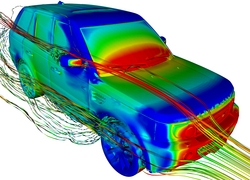
You can gather the same data with a differential pressure gauge and a ton of highway testing. Red means high pressure and blue is low. Putting the intake at a red region gives you a ram-air effect. Putting it in a blue region gives up that effect or if the pressure is low enough, works against you.
Flow Restriction
This one is easy. The less the engine has to work to get air into the intake, the more net power you get.
The simplest type of intake for a turbo is one that provides direct access to air with minimal velocity effects. You've probably seen the solution on turbo drag cars.
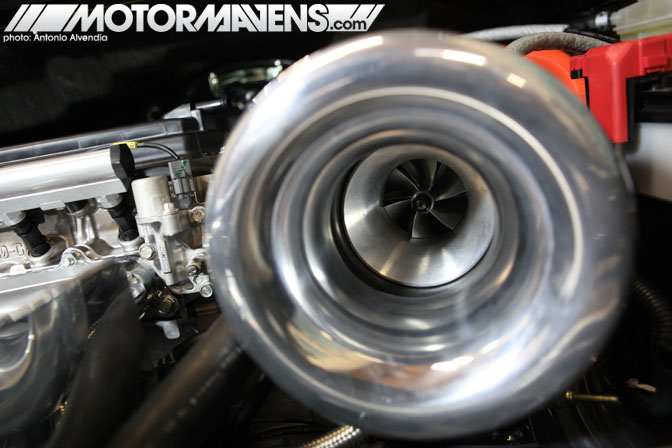
The flared horn.
The idea here is that the horn eliminates head pressure effects from tubing. When fluids (air is a fluid) flows through a pipe, there are friction effects that slow down the fluid. When fluids turn corners, same thing. When pipe diameters change too quickly you slow down the flow.
The reason for the curve is fairly simple. Fast-moving air doesn't like to make sharp turns. That's why air planes are smooth shapes. When air makes a sharp turn, it gets turbulent and stagnation points and eddies form. These will, in some cases, stop airflow dead. Think of sitting in a canoe on a river behind a rock. The water behind the rock is still because of the turbulence rolling back around the rock. You can sit there all day without the river taking you downstream.
The horn shape effectively turns a straight pipe into a pipe that has a slowly increasing inside diameter--ultimately ending in an infinite (ok not really) diameter. Airflow in a pipe generally decreases with an increase in diameter for a fixed volume flow rate so as the pipe expands, the velocity drops. You get the same quantity of air in, but the edge conditions where the pipe diameter approaches infinity mean that your flow velocity approaches zero! Slow moving air moving around smooth surfaces is pretty easy to suck in.
The velocity only increases as the throat tightens down to the compressor inlet diameter.
Resonance
This is a hard one and without testing will be harder still to address. Tuners are very familiar with long tube versus short tube and big volume versus short volume in terms of where your power band ends up. Generally speaking, any volume of air will have a natural resonance (ever blow across a beer bottle to make that HOOOOOO noise? Notice it always sounds about the same no matter what shape of empty 12 oz bottle you use?)
When that air resonance compliments the speed of the intake events in the motor, it can actually push the air/fuel mix into the engine. When it's out of sync it can actually pull it back out! The latter is called reversion and it can happen on the intake side (AND the exhaust side of the cylinder). Generally you don't want it. Unless you're doing something complicated involving re-burning exhaust gas--you aren't.
The whole package
Give the above, here's what I'd build for the pre-turbo intake:
Once a suitable cold / high pressure spot was found, I'd put a big bell-horn shaped inlet there to reduce pipe edge effects and eliminate the sharp corners leading into the inlet. Most OEMs probably do this.
Then I'd run a large, smooth pipe (at least 3" diameter) from there to an enclosed air box that slowly tapered up from the 3" pipe to the size of the air filter. A panel filter will work fine. The more surface area the better--that way you don't increase flow restriction and you don't reduce filtration level.
After the filter, I'd taper slowly back down to the diameter of the turbine inlet, again using pipe with a smooth interior. I'll note here that the orientation of the outlet probably doesn't matter because the amount of restriction and turbulence from the filter has turned the air box into, essentially, a plenum (or "tank" if you like) and whatever is coming out of it is pulling from a large volume of slow moving air. We could theoretically include another intake bell inside the plenum to eliminate velocity effects. The bell would need be offset from the wall to avoid wall boundary effects but it probably isn't necessary for anything short of F1. But who knows? People do this with intake manifold plenums too.

The whole thing will have to have bends to fit in the car but I'd make sure those are as large as possible. Something around 2x the diameter to start should be practical.
So in short: bell to pipe to filter plenum (with bell) to compressor inlet.
Theoretical cost? A lot. This would require the fabricated plenum plus all the piping and bell. And you'd all want carbon fiber.
Theoretical Improvements?
I'd imagine similar performance improvements as mentioned above. The easier the turbo can breathe, the more net power you get at all RPM. Resonance tuning would determine a little of the shape of the power curve but without experimentation, it's hard to say how I'd want to change it.
And probably minimal change in sound. If anything, the bell-shaped inlets would be fairly quiet. The loud sucking noise you hear on some turbo cars is turbulence and it's not always a good thing.
------
Later I'll think about turbos and intercoolers and some of the other "little things".
2. The perfect bolt-on intake system.
This intake ends at the turbo's compressor inlet.
Intakes break down into a few major things:
Intake air temperature
flow restriction
Resonance
Air temperature (and pressure)
Cold, dense air provides more oxygen per unit volume and therefore more power per unit pressure from your turbo. You can feel this in cold weather. In my miata in winter, my turbo spools much faster and at the same boost level the car feels much stronger. I can spin the tires (which are also cold...) in 3rd gear from a roll instead of just 2nd.
Colder intake air also resists detonation which means your motor lasts longer.
That means getting air from regions of the engine bay that are lower than typical underhood temps. Bonus points for regions where aerodynamic pressure is high. The stock location is not bad because it's in the front of the grille. Temperature testing would show more regions of cool air (both at idle when heatsoak is bad and at speed) that could be used but my gut says the stock location aint bad.
As far as aero pressure, a differential pressure gauge used like the temp sensor would indicate where static and dynamic pressures on the vehicle's body form are increasing or decreasing. Some of you may have seen rainbow-colored graphics like the following that show high/low pressure gradients:
You can gather the same data with a differential pressure gauge and a ton of highway testing. Red means high pressure and blue is low. Putting the intake at a red region gives you a ram-air effect. Putting it in a blue region gives up that effect or if the pressure is low enough, works against you.
Flow Restriction
This one is easy. The less the engine has to work to get air into the intake, the more net power you get.
The simplest type of intake for a turbo is one that provides direct access to air with minimal velocity effects. You've probably seen the solution on turbo drag cars.
The flared horn.
The idea here is that the horn eliminates head pressure effects from tubing. When fluids (air is a fluid) flows through a pipe, there are friction effects that slow down the fluid. When fluids turn corners, same thing. When pipe diameters change too quickly you slow down the flow.
The reason for the curve is fairly simple. Fast-moving air doesn't like to make sharp turns. That's why air planes are smooth shapes. When air makes a sharp turn, it gets turbulent and stagnation points and eddies form. These will, in some cases, stop airflow dead. Think of sitting in a canoe on a river behind a rock. The water behind the rock is still because of the turbulence rolling back around the rock. You can sit there all day without the river taking you downstream.
The horn shape effectively turns a straight pipe into a pipe that has a slowly increasing inside diameter--ultimately ending in an infinite (ok not really) diameter. Airflow in a pipe generally decreases with an increase in diameter for a fixed volume flow rate so as the pipe expands, the velocity drops. You get the same quantity of air in, but the edge conditions where the pipe diameter approaches infinity mean that your flow velocity approaches zero! Slow moving air moving around smooth surfaces is pretty easy to suck in.
The velocity only increases as the throat tightens down to the compressor inlet diameter.
Resonance
This is a hard one and without testing will be harder still to address. Tuners are very familiar with long tube versus short tube and big volume versus short volume in terms of where your power band ends up. Generally speaking, any volume of air will have a natural resonance (ever blow across a beer bottle to make that HOOOOOO noise? Notice it always sounds about the same no matter what shape of empty 12 oz bottle you use?)
When that air resonance compliments the speed of the intake events in the motor, it can actually push the air/fuel mix into the engine. When it's out of sync it can actually pull it back out! The latter is called reversion and it can happen on the intake side (AND the exhaust side of the cylinder). Generally you don't want it. Unless you're doing something complicated involving re-burning exhaust gas--you aren't.
The whole package
Give the above, here's what I'd build for the pre-turbo intake:
Once a suitable cold / high pressure spot was found, I'd put a big bell-horn shaped inlet there to reduce pipe edge effects and eliminate the sharp corners leading into the inlet. Most OEMs probably do this.
Then I'd run a large, smooth pipe (at least 3" diameter) from there to an enclosed air box that slowly tapered up from the 3" pipe to the size of the air filter. A panel filter will work fine. The more surface area the better--that way you don't increase flow restriction and you don't reduce filtration level.
After the filter, I'd taper slowly back down to the diameter of the turbine inlet, again using pipe with a smooth interior. I'll note here that the orientation of the outlet probably doesn't matter because the amount of restriction and turbulence from the filter has turned the air box into, essentially, a plenum (or "tank" if you like) and whatever is coming out of it is pulling from a large volume of slow moving air. We could theoretically include another intake bell inside the plenum to eliminate velocity effects. The bell would need be offset from the wall to avoid wall boundary effects but it probably isn't necessary for anything short of F1. But who knows? People do this with intake manifold plenums too.
The whole thing will have to have bends to fit in the car but I'd make sure those are as large as possible. Something around 2x the diameter to start should be practical.
So in short: bell to pipe to filter plenum (with bell) to compressor inlet.
Theoretical cost? A lot. This would require the fabricated plenum plus all the piping and bell. And you'd all want carbon fiber.
Theoretical Improvements?
I'd imagine similar performance improvements as mentioned above. The easier the turbo can breathe, the more net power you get at all RPM. Resonance tuning would determine a little of the shape of the power curve but without experimentation, it's hard to say how I'd want to change it.
And probably minimal change in sound. If anything, the bell-shaped inlets would be fairly quiet. The loud sucking noise you hear on some turbo cars is turbulence and it's not always a good thing.
------
Later I'll think about turbos and intercoolers and some of the other "little things".


y8s, very interesting post!
The fly-by-night vendors not withstanding, can we assume that some of the major turbo performance part suppliers (e.g. Cobb, AWE, et cetera) do more comprehensive testing than others? In other words, you'll get more effective results from some designs more than others? Obviously I'm looking for the most bang for my buck.
The fly-by-night vendors not withstanding, can we assume that some of the major turbo performance part suppliers (e.g. Cobb, AWE, et cetera) do more comprehensive testing than others? In other words, you'll get more effective results from some designs more than others? Obviously I'm looking for the most bang for my buck.


Thought I would bring my questions about exhausts to this thread instead of the thread that was supposed to be about turbos and intercoolers.
In the turbo thread, I asked how to keep the catted downpipe from dragging down an otherwise cat-less, free-flowing exhaust (e.g., the VIP with 2.5" pipe that removes the second cat).
The question I have now is how much of a difference a free-flowing (i.e., Akrapovic) downpipe would make (if any) on a mostly stock exhaust with the second cat in place? You hear a lot about how a higher flow downpipe can unlock some gains, but does that only hold true for aftermarket, cat-less exhausts, or is that true across the board?
Logic suggests that if the remainder of the exhaust is still mostly stock and has the second cat, then replacing the stock downpipe with a higher flowing one like the Akrapovic will only delay the inevitable: Instead of the bottleneck occurring at the downpipe, it will simply occur further down stream.
Am I right in that assessment or is their something unique about the downpipe such that putting in a free-flowing pipe can significantly improve performance even on a mostly stock exhaust?
In the turbo thread, I asked how to keep the catted downpipe from dragging down an otherwise cat-less, free-flowing exhaust (e.g., the VIP with 2.5" pipe that removes the second cat).
The question I have now is how much of a difference a free-flowing (i.e., Akrapovic) downpipe would make (if any) on a mostly stock exhaust with the second cat in place? You hear a lot about how a higher flow downpipe can unlock some gains, but does that only hold true for aftermarket, cat-less exhausts, or is that true across the board?
Logic suggests that if the remainder of the exhaust is still mostly stock and has the second cat, then replacing the stock downpipe with a higher flowing one like the Akrapovic will only delay the inevitable: Instead of the bottleneck occurring at the downpipe, it will simply occur further down stream.
Am I right in that assessment or is their something unique about the downpipe such that putting in a free-flowing pipe can significantly improve performance even on a mostly stock exhaust?
Thread Starter
|
4th Gear
Joined: Jan 2012
Posts: 485
Likes: 18
From: DC Metro
Technical answer:
The turbo generates shaft power to spin the compressor when there is an enthalpy difference across the turbine. Enthalpy is basically temperature, pressure, and dynamic flow all combined. Moving the downpipe cat would increase the volume available for expanding gases to exit the turbine before they hit an obstruction. It will also remove some of the exhaust restriction (two cats are more restrictive than one, yes?).
Since the exhaust gas is compressible, it's going to retain its exit velocity at the turbine slightly longer than it would if there was a cat there.
So I'd imagine you get better spool and slightly better top end but obviously not as much as if both cats were gone.
The turbo generates shaft power to spin the compressor when there is an enthalpy difference across the turbine. Enthalpy is basically temperature, pressure, and dynamic flow all combined. Moving the downpipe cat would increase the volume available for expanding gases to exit the turbine before they hit an obstruction. It will also remove some of the exhaust restriction (two cats are more restrictive than one, yes?).
Since the exhaust gas is compressible, it's going to retain its exit velocity at the turbine slightly longer than it would if there was a cat there.
So I'd imagine you get better spool and slightly better top end but obviously not as much as if both cats were gone.
Trending Topics
Technical answer:
The turbo generates shaft power to spin the compressor when there is an enthalpy difference across the turbine. Enthalpy is basically temperature, pressure, and dynamic flow all combined. Moving the downpipe cat would increase the volume available for expanding gases to exit the turbine before they hit an obstruction. It will also remove some of the exhaust restriction (two cats are more restrictive than one, yes?).
Since the exhaust gas is compressible, it's going to retain its exit velocity at the turbine slightly longer than it would if there was a cat there.
So I'd imagine you get better spool and slightly better top end but obviously not as much as if both cats were gone.
The turbo generates shaft power to spin the compressor when there is an enthalpy difference across the turbine. Enthalpy is basically temperature, pressure, and dynamic flow all combined. Moving the downpipe cat would increase the volume available for expanding gases to exit the turbine before they hit an obstruction. It will also remove some of the exhaust restriction (two cats are more restrictive than one, yes?).
Since the exhaust gas is compressible, it's going to retain its exit velocity at the turbine slightly longer than it would if there was a cat there.
So I'd imagine you get better spool and slightly better top end but obviously not as much as if both cats were gone.
I am reluctant to remove a cat for fear of making my car not "street legal" which might have negative implications for insurance purposes. It would be a disaster to get into an accident and find my insurance voided because I removed a cat on my vehicle for 10 more horsepower.

It wouldn't surprise me if the coverage was void in the event the car is rendered "street illegal" by virtue of an illegal modification, even one that does not pertain to safety (i.e., removing a cat).
Not saying this is definitely true, but it is a risk.
Speaking of downpipes, does anyone happen to know if this will fit the Countryman?
http://www.exhaustdepot.net/exder56do.html
I suppose it depends on whether the downpipes in the R56 and R60 are the same. I'm guessing yes, but it would be nice to confirm.
This might be a nice alternative to the Akrapovic insofar as it won't throw a CEL.
http://www.exhaustdepot.net/exder56do.html
I suppose it depends on whether the downpipes in the R56 and R60 are the same. I'm guessing yes, but it would be nice to confirm.
This might be a nice alternative to the Akrapovic insofar as it won't throw a CEL.
Realistically, we need catalytic converters and mufflers and maybe resonators. I'm "old" and a "tree hugger" so I know I would put them on. I'd start with either the stock close-coupled cat in the downpipe (I assume there is one?) to maintain federal compliance and throw in a high flow spun metal core cat for the secondary. After that I'd use a perforated core resonator (bullet race muffler--NOT louvered, just holes) and finally a huge straight through perf core muffler or two, depending on size. I'd have to check space back there but maybe two small mufflers in line with the tailpipes would fit. The larger the muffler volume, the quieter the highway drive.
1) Where can one find a "high-flow spun metal core cat" as alluded to above? I've seen that Magnaflow makes high-flow, metal core cats. Is that an example?
2) Is it feasible to weld a cat into straight pipe like the VIP setup?
3) What are the odds such a setup would pass the emissions tests? I'm thinking the stock setup is probably very low emissions and would pass a smog test with flying colors such that two high-flow cats would still probably pass. Anyone with experience in that regard?

2nd Gear
Joined: Feb 2013
Posts: 92
Likes: 0
Thinking of doing sort of a custom exhaust with the VIP turbo-back, Akrapovic down pipe, and adding in an aftermarket, 2.5" high-flow secondary cat to maintain legality and increase the odds I'll pass emissions. Questions:
1) Where can one find a "high-flow spun metal core cat" as alluded to above? I've seen that Magnaflow makes high-flow, metal core cats. Is that an example?
2) Is it feasible to weld a cat into straight pipe like the VIP setup?
3) What are the odds such a setup would pass the emissions tests? I'm thinking the stock setup is probably very low emissions and would pass a smog test with flying colors such that two high-flow cats would still probably pass. Anyone with experience in that regard?
1) Where can one find a "high-flow spun metal core cat" as alluded to above? I've seen that Magnaflow makes high-flow, metal core cats. Is that an example?
2) Is it feasible to weld a cat into straight pipe like the VIP setup?
3) What are the odds such a setup would pass the emissions tests? I'm thinking the stock setup is probably very low emissions and would pass a smog test with flying colors such that two high-flow cats would still probably pass. Anyone with experience in that regard?
First, there are (or were), three components to a CA smog test:
- A visual inspection (looking for cats)
- A tailpipe-emissions test (i.e., "sniffer" test)
- An OBDII readiness test
I believe (you should confirm), that as of January 2013, California is moving away from tailpipe emissions testing and relying exclusively on a visual inspection and OBDII readiness test.
Second, I believe an R60 would pass a tailpipe-emissions test (and probably a visual inspection) if you fit a higher flow secondary cat in addition to an Akrapovic. I say this because it is clear from the way the car is designed that the monitored cat in the OEM downpipe is all that is needed to keep emissions in check. (Otherwise, the car would monitor the secondary cat with o2 sensors, but it doesn't.) The cat in the OEM downpipe is ~400 cpsi. The Akrapovic is 100 cpsi. Add a 200-300 cpsi high flow secondary cat and you'd be right there.
But the biggest issue would be OBDII readiness. As it currently stands, very few with Akrapovic downpipes have succeeded in eliminating the P0420 (cat inefficiency) CEL with mechanical means (i.e., spacers). Instead, they rely on either a tune to turn off the rear o2 sensor or a device like the Akrapovic Delete-R to repeatedly clear the code so it doesn't appear.
The problem is that non-mechanical means of turning off the CEL and P0420 code will do nothing to prevent a latent "not ready" code. This jeopardizes your ability to pass the OBDII readiness portion of the test.
As for me, I ultimately went with an Akrapovic DP mated to the VIP DP-back exhaust. Since I won't have to smog the car for another 5 years, I have 60 months to come up with a mechanical means to keep the o2 off or find some other way to maintain compliance.
Thread Starter
|
4th Gear
Joined: Jan 2012
Posts: 485
Likes: 18
From: DC Metro
OK fine I'll answer now that it's 11 months later.
Magnaflow makes spun metal cats. You'll have to strike a balance between cell count and flow. Higher cell count means worse flow and lower emissions.
You can absolutely weld one into your exhaust anywhere or to a straight pipe. They're stainless steel and with the right welding wire (309L I believe) you can even weld it to aluminized steel.
With respect to passing emissions, it's hard to say. I've passed with a single high flow cat in my turbocharged miata. That was a 3 inch exhaust. It also depends on your state's test method and requirements. If it's just an idle and OBDII check, likely it will pass fine.
Adding a second one may not do anything for you since it might not heat up properly, but you could try. Just get them as close to the turbo as possible for the best chance at lighting them off early.
Here's the thing though: usually the close-coupled cat is primarily for cold start. get it hot and fast to reduce startup emissions. in many modern cars, there is a larger second cat that handles the bulk of the emissions reduction. So you COULD still pass even with just the second one and not the first... especially if you can't fit something in the downpipe.
Magnaflow makes spun metal cats. You'll have to strike a balance between cell count and flow. Higher cell count means worse flow and lower emissions.
You can absolutely weld one into your exhaust anywhere or to a straight pipe. They're stainless steel and with the right welding wire (309L I believe) you can even weld it to aluminized steel.
With respect to passing emissions, it's hard to say. I've passed with a single high flow cat in my turbocharged miata. That was a 3 inch exhaust. It also depends on your state's test method and requirements. If it's just an idle and OBDII check, likely it will pass fine.
Adding a second one may not do anything for you since it might not heat up properly, but you could try. Just get them as close to the turbo as possible for the best chance at lighting them off early.
Here's the thing though: usually the close-coupled cat is primarily for cold start. get it hot and fast to reduce startup emissions. in many modern cars, there is a larger second cat that handles the bulk of the emissions reduction. So you COULD still pass even with just the second one and not the first... especially if you can't fit something in the downpipe.


Thread
Thread Starter
Forum
Replies
Last Post
Navigation & Audio HD Radio IBOC Retrofit Success
strobeyprobey
Navigation & Audio
14
Jul 9, 2016 03:49 PM
FastMiniS
F55/F56 :: Hatch Talk (2014+)
39
Jun 10, 2015 11:58 AM
SDMike
All other MINI parts and items for Sale (archive)
3
Sep 28, 2007 08:52 AM