


R56 Consensus on Oil Catch Can?


Consensus on Oil Catch Can?
Hey Folks,
I've done lots of reading on the forum before and after buying my 2009 MCS. I know that carbon fouling is a problem on DI engines.
I know a lot of people have oil catch cans on their MCS's but it doesn't seem clear if this stops the carbon sludge on the inlet valve problem.
Is it certain to help? my car has 13k miles on the clock so is probably fairly ok for now, but if an oil catch can will stop the carbon sludge then I'll buy and fit one.
If so what is a good brand as far as good fit etc.
Thanks!
chris
I've done lots of reading on the forum before and after buying my 2009 MCS. I know that carbon fouling is a problem on DI engines.
I know a lot of people have oil catch cans on their MCS's but it doesn't seem clear if this stops the carbon sludge on the inlet valve problem.
Is it certain to help? my car has 13k miles on the clock so is probably fairly ok for now, but if an oil catch can will stop the carbon sludge then I'll buy and fit one.
If so what is a good brand as far as good fit etc.
Thanks!
chris

Banned
Joined: Apr 2012
Posts: 116
Likes: 0
From: San Francisco
BSH is what's widely regarded as the best bc of the internal baffle, but now there's speculation as to whether or not some of them even have it as some people have come forward with either not having it in there or having it but it being loose.
But from what I've heard and read, the OCC will help in slowing down the carbon deposit, but it won't stop it. Only a water/meth injection system will eliminate the carbon buildup.
But from what I've heard and read, the OCC will help in slowing down the carbon deposit, but it won't stop it. Only a water/meth injection system will eliminate the carbon buildup.


4th Gear
Joined: Aug 2008
Posts: 470
Likes: 1
From: Harleysville PA
Well, I've had my Mini for almost four years and fifty thousand miles. I installed the BSH catch can along with the block off & plug at about eighteen thousand miles. Now that said, all I usually get out of the catch can is water(condensation) with very little oil. Has it helped, I really don't know. I haven't had engine trouble, so that's good.
I have also given it a Seafoam treatment a few times. That has yielded significant improvement in my Mini's performance.
Sorry I can't give you a definitive answer.
I have also given it a Seafoam treatment a few times. That has yielded significant improvement in my Mini's performance.
Sorry I can't give you a definitive answer.
I've been looking into this more. Seems a similar problem exists in vacuum pumps on the exhaust, they create a fine mist of oil particles in the micron range which must be captured. The pumps use filters which need to be replaced.
I'm a professional design engineer and I'm toying with the idea of creating my own catch can, something more efficient than a simple volume with a port on the bottom which most of them seem to be.
I'm a professional design engineer and I'm toying with the idea of creating my own catch can, something more efficient than a simple volume with a port on the bottom which most of them seem to be.
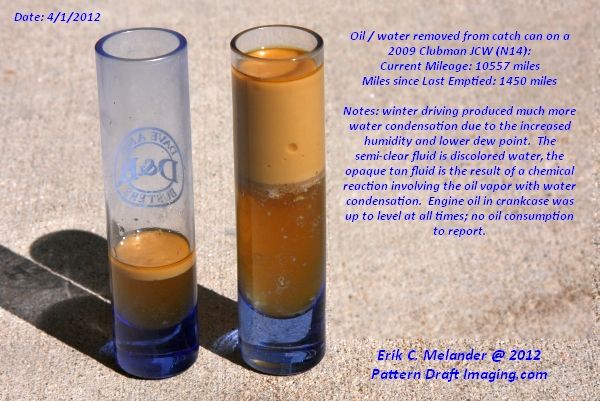
I've had great results with the BSH Speed Shop oil catch can and block-off plug (for passenger side PCV port).
It's proven to me that it removes oil film and collects water condensation during the winter or high-humidity months.
Examples:
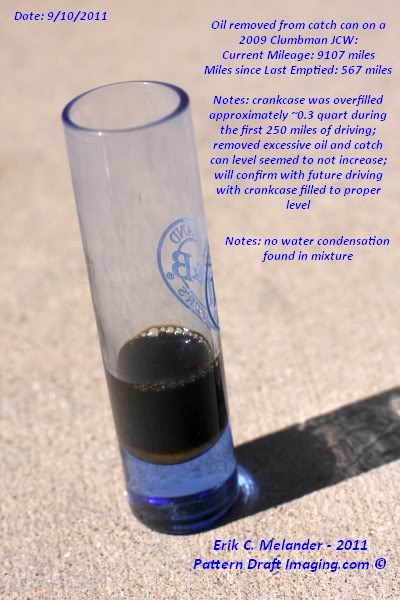

- Erik
It's proven to me that it removes oil film and collects water condensation during the winter or high-humidity months.
Examples:
- Erik
Trending Topics

3rd Gear
Joined: Apr 2008
Posts: 262
Likes: 0
Well, I've had my Mini for almost four years and fifty thousand miles. I installed the BSH catch can along with the block off & plug at about eighteen thousand miles. Now that said, all I usually get out of the catch can is water(condensation) with very little oil. Has it helped, I really don't know. I haven't had engine trouble, so that's good.
I have also given it a Seafoam treatment a few times. That has yielded significant improvement in my Mini's performance.
Sorry I can't give you a definitive answer.
I have also given it a Seafoam treatment a few times. That has yielded significant improvement in my Mini's performance.
Sorry I can't give you a definitive answer.
Can you say how you used teh Seafoam? In oil or tank? or both
4th Gear
Joined: Aug 2008
Posts: 470
Likes: 1
From: Harleysville PA
Here's a link to instructions: https://www.northamericanmotoring.co...t-r55-r56.html
I find a great improvement once the procedure is completed.

Wow, interesting to see. I'm toying with some ideas for my own catch can, if it proves to be more effective than the normal ones I might start selling them although it will be more expensive than the ones on the market currently.


2nd Gear
Joined: Jul 2008
Posts: 56
Likes: 0
From: Kansas
GREGSMINI, can you please explain what wasn't quite right with your car before the Seafoam? You say you noticed a great improvement - what exactly changed? My MCS has 32k and the only issue I notice is that it does not accelerate smoothly when cold. Once its warmed up it is pretty smooth but not perfect. Are these symptoms that Seafoam might address? Thanks

Former Vendor
Joined: Mar 2011
Posts: 435
Likes: 4
From: Baltimore MD Area
Black Magic, it may or may not be carbon but for how cheap and easy the SeaFoam is, its cheap insurance against a $600 walnut media blast bill. I just installed my OCC and PCV block and its somewhat late for me (73K) but I did SeaFoam and will again so it shouldnt be closing the barn door after the horses escaped. First SeaFoam at about 55K. I would not add it to the oil, Marvel Mystery Oil is safe for that application in small amounts.
Chris, Id be very curious to see what you are thinking. The only issue here is to force the air to change direction and drop the entrained liquids it is carrying, an inlet tube that is horizontally offset from the outlet port is basically all that is required, perhaps with the outlet higher as well but that introduces other packaging issues in an already very tight engine bay. You want the gas stream to impact the container wall and drop its cargo of entrained crap before turning around and exiting.
Chris, Id be very curious to see what you are thinking. The only issue here is to force the air to change direction and drop the entrained liquids it is carrying, an inlet tube that is horizontally offset from the outlet port is basically all that is required, perhaps with the outlet higher as well but that introduces other packaging issues in an already very tight engine bay. You want the gas stream to impact the container wall and drop its cargo of entrained crap before turning around and exiting.
4th Gear
Joined: Aug 2008
Posts: 470
Likes: 1
From: Harleysville PA
GREGSMINI, can you please explain what wasn't quite right with your car before the Seafoam? You say you noticed a great improvement - what exactly changed? My MCS has 32k and the only issue I notice is that it does not accelerate smoothly when cold. Once its warmed up it is pretty smooth but not perfect. Are these symptoms that Seafoam might address? Thanks
I didn't realize how much quick pickup I had lost. It was like a different car, I found lost power, I put my foot down and now it flies, much better than before the Seafoam treatment.
I do get some stumbling when it's cold. I think I'm going to do a Seafoam treatment after 3K miles and see if that clears that up. If not, I might change the spark plugs.
Sorry about the hijack, back to your regular programming.
Black Magic, it may or may not be carbon but for how cheap and easy the SeaFoam is, its cheap insurance against a $600 walnut media blast bill. I just installed my OCC and PCV block and its somewhat late for me (73K) but I did SeaFoam and will again so it shouldnt be closing the barn door after the horses escaped. First SeaFoam at about 55K. I would not add it to the oil, Marvel Mystery Oil is safe for that application in small amounts.
Chris, Id be very curious to see what you are thinking. The only issue here is to force the air to change direction and drop the entrained liquids it is carrying, an inlet tube that is horizontally offset from the outlet port is basically all that is required, perhaps with the outlet higher as well but that introduces other packaging issues in an already very tight engine bay. You want the gas stream to impact the container wall and drop its cargo of entrained crap before turning around and exiting.
Chris, Id be very curious to see what you are thinking. The only issue here is to force the air to change direction and drop the entrained liquids it is carrying, an inlet tube that is horizontally offset from the outlet port is basically all that is required, perhaps with the outlet higher as well but that introduces other packaging issues in an already very tight engine bay. You want the gas stream to impact the container wall and drop its cargo of entrained crap before turning around and exiting.
I'm also figuring out how to evaluate the effectiveness of the design so I have some real data on how effective it is.
I used to own a Porsche 911 and I developed a kit for those and had my own small company for a while, it was a tiny niche market though which limited sales. I did sell worldwide though and was features in a mainstream Porsche magazine, they gave my kit a great review.
I do engineering design for a living so this kind of stuff comes naturally to me.
If I can design a generic oil catch device that can be fitted to virtually any DI engine car then it opens up a large market.

4th Gear
Joined: Apr 2009
Posts: 506
Likes: 30
From: UK
I have a few ideas, I'm doing some testing at home. When I have something complete I'll try it on my car and post some photos.
I'm also figuring out how to evaluate the effectiveness of the design so I have some real data on how effective it is.
I used to own a Porsche 911 and I developed a kit for those and had my own small company for a while, it was a tiny niche market though which limited sales. I did sell worldwide though and was features in a mainstream Porsche magazine, they gave my kit a great review.
I do engineering design for a living so this kind of stuff comes naturally to me.
If I can design a generic oil catch device that can be fitted to virtually any DI engine car then it opens up a large market.
I'm also figuring out how to evaluate the effectiveness of the design so I have some real data on how effective it is.
I used to own a Porsche 911 and I developed a kit for those and had my own small company for a while, it was a tiny niche market though which limited sales. I did sell worldwide though and was features in a mainstream Porsche magazine, they gave my kit a great review.
I do engineering design for a living so this kind of stuff comes naturally to me.
If I can design a generic oil catch device that can be fitted to virtually any DI engine car then it opens up a large market.
What about the differences between the various engines, bleed down pumping losses, windage pressure/volume, oil control including feed, pressure entrapment and return, oil/engine temperature cam cover PCV control and efficiency and most importantly flow volume ?

- Erik
Former Vendor
Joined: Mar 2011
Posts: 435
Likes: 4
From: Baltimore MD Area
Sri, any oil passing through the turbo will not damage it. Where the damage actually ends up is the coking of the intake valves with all the crap that the PCV system exhales and any oil that seeps past the turbo bearing seal on the intake side. The OCC and PCV block/delete are a good investment, total cost, around $100 to 250, depending on whose parts you select.

3rd Gear
Joined: Jan 2011
Posts: 172
Likes: 1
Wait...
250 bucks (R56 2011+ fit) for a product with lackluster quality control,
and even if I'm lucky to get a good one I still have to Sea Foam because it only "slows" down carbon build up? 
No, thanks! I'll stick to 7.5k oil change and periodic Sea Foam treatment.
250 bucks (R56 2011+ fit) for a product with lackluster quality control,
there's speculation as to whether or not some of them even have it as some people have come forward with either not having it in there or having it but it being loose.
But from what I've heard and read, the OCC will help in slowing down the carbon deposit, but it won't stop it. Only a water/meth injection system will eliminate the carbon buildup.
But from what I've heard and read, the OCC will help in slowing down the carbon deposit, but it won't stop it. Only a water/meth injection system will eliminate the carbon buildup.
No, thanks! I'll stick to 7.5k oil change and periodic Sea Foam treatment.


Up here in Buffalo, NY, I drive about 40 miles per day. Every week this translates into 6-8 oz of water (95%) and oil during the winter (almost filled a gallon can since fall). During summer I would get about 3-4 oz of water (50%) and oil every month. On my car, the OCC catches things. I did seafoam with no changes (via my butt dyno), but changing the plugs at 55k did feel better. There are some good threads about seafoam, if you want to do more reading.
Whatever you choose, feel good about it. For me, $250 for an OCC made sense. The amount of stuff that I remove gives me some peace of mind.
Have fun,
Mike
Whatever you choose, feel good about it. For me, $250 for an OCC made sense. The amount of stuff that I remove gives me some peace of mind.
Have fun,
Mike

2nd Gear
Joined: Oct 2012
Posts: 61
Likes: 0
From: Hartford
With the 8-12 oz of effluent I suck out of that can every other week (so far in cold weather) I don't know how much it delays the inevitable carbon blast but I sleep better knowing that MOST of the crap wafting about the PCV system is not finding a new home on my valves & port walls.
https://www.northamericanmotoring.co...-believer.html
I will submit, hopefully without stepping on toes that seafoam is useless for fighting this buildup. I dealt with this problem in BMW's in the 80's & that gunk is not coming off with an over the counter chemical blowing past it. Meth injection would be the only preventive medicine if installed after starting w/ clean valves & ports. For these reasons I have purchased the blast snorkel & wand for what looks like my yearly do it yourself carbon blast. Once the weather warms up I will see what is there after 30k+ prior to the OCC install & compare it in the coming years. Only then will I be able to gauge the effectiveness of the catch can.
https://www.northamericanmotoring.co...-believer.html
I will submit, hopefully without stepping on toes that seafoam is useless for fighting this buildup. I dealt with this problem in BMW's in the 80's & that gunk is not coming off with an over the counter chemical blowing past it. Meth injection would be the only preventive medicine if installed after starting w/ clean valves & ports. For these reasons I have purchased the blast snorkel & wand for what looks like my yearly do it yourself carbon blast. Once the weather warms up I will see what is there after 30k+ prior to the OCC install & compare it in the coming years. Only then will I be able to gauge the effectiveness of the catch can.

3rd Gear
Joined: Jan 2012
Posts: 194
Likes: 2
From: Simi Valley, CA
Have mine installed for nearly 6 months now and went from using a quart of oil every 2-3K miles to zero usage.....so it's doing something....did the media blast the same time I installed the OCC and PCV block.
