


R50/53 Oxygen Sensor Replacement?


So i am now really confused, I thought i fixed my problem with my 02 sensor with the ntk oe replacement but I am now getting another "sns" light with a p0136 bank1 sensor 2 error. i am not sure what to do, my mechanic says i should put some cat cleaner in it but other than the front 02 sensor which sets up the second 02 sensor i don't have any idea what the problem is... any help
Here's the good news - you should be able to get this covered by the dealer for free, whatever the problem is. The emissions warranty on '04-'06 MINIs is 10 years/100k miles. See this thread:
https://www.northamericanmotoring.co...006-minis.html
6th Gear
Joined: Apr 2009
Posts: 1,361
Likes: 4
From: Yorktown, VA
I'm surprised you are having an issue with the NTK O2 sensor. I know the post-cat O2 sensor gets less carbon buildup. Maybe try swapping them around to see if that fixes the issue. Also look for cracked or frayed wiring.

If it's the one before the catalytic converter, you might get poor gas mileage and I guess it might run a little "shaky." The reason is that one determines the proper fuel-air ratio, so if it's not getting a correct measurement, the fuel-air mixture will be off.


4th Gear
Joined: Jan 2011
Posts: 478
Likes: 1
Comments from a former Bosch O2 sensor development engineer...
I just love these threads. O2 sensors are complicated little things and I spent 10 years of my career working on them both in the US and in Germany. I have a few patents related to their design and supported BMW, Ford and PSA (Peugeot, etc). I am probably in a position to clear up some confusion
The 10 year, 100,000 mile warranty is a federal law that applies to emissions equipment. If your vehicle is throwing codes the manufacturer is obligated to provide replacements. They may not know this and you may have to force the issue on up the chain but the federal law is what it is. That being said, we produced both a 100k sensor and a 150k sensor. The difference between the two was that we tested the 150k sensor 50k longer.
The post cat sensor has no function other than to tell you your catalyst is starting to fail. It is a federal OBD requirement.
Some Bosch aftermarket sensors might be good depending on whether or not they were original equipment. I knew the guy who does/did the competitor testing and part number consolidation for the aftermarket. He never worked on OE applications and never really designed or did anything of value as far as the actual part goes. He is a giant idiot and has likely cost many consumers hundreds of thousands in parts that do not match the application correctly because he bent over for marketing rather than acting like a responsible engineer. When Bosch entered the aftermarket for sensors, the manufacturing scrap rate went down because the tolerances were opened up for the aftermarket. This is also where we sent parts from manufacturing trials. You might get a really good one, you might get a really bad one.
The universal sensors are a compromise and I would never put one in my own vehicle. Switching sensors, which are just on or off, not a range of values, are sensitive to the vehicles operating temperature, the shape and number of holes in the protection tube covering the sensor, and even the length of wire used in the sensor wire harness. All of this is taken into account when the fuel map is design and, contrary to popular belief, a great deal of effort goes into getting it correct to meet emmisions standards. You might get a sensor that switches leaner than OE spec and gives your better gas mileage (and possibly burned pistons) or you might get one that runs a little richer (and fills your exhaust system with soot).
O2 sensors only fail for a few reasons outside of manufacturing defects:
You have a lot of soot build up due to some other problem and it covers the sensor element.
Repeated thermal shock from a bad mounting location(the Mini is excellent) or poor cold start strategy (like an aftermarket ECU).
You like to run leaded race gas, which will poison the sensor and the catalyst in about 15,000 miles.
Somehow you got silicone in the exhaust stream (sometimes gas is contaminated) and it poisoned the sensor.
You spliced the wires incorrectly and either sealed them (an O2 sensor replaces it's reference side air through the wire harness) or left them open to atmosphere (where humidity contaminates the reference side of the sensor and it provides false readings).
I would likely use an aftermarket sensor if it were application specific and I could match the Bosch part number to the one on the OE sensor. All Bosch part numbers are 10 digits and for sensor (if I'm remembering correctly) start with either 0 258... or 0 280... Other than that, I'd stick with the obscenely over priced dealer part.
The 10 year, 100,000 mile warranty is a federal law that applies to emissions equipment. If your vehicle is throwing codes the manufacturer is obligated to provide replacements. They may not know this and you may have to force the issue on up the chain but the federal law is what it is. That being said, we produced both a 100k sensor and a 150k sensor. The difference between the two was that we tested the 150k sensor 50k longer.
The post cat sensor has no function other than to tell you your catalyst is starting to fail. It is a federal OBD requirement.
Some Bosch aftermarket sensors might be good depending on whether or not they were original equipment. I knew the guy who does/did the competitor testing and part number consolidation for the aftermarket. He never worked on OE applications and never really designed or did anything of value as far as the actual part goes. He is a giant idiot and has likely cost many consumers hundreds of thousands in parts that do not match the application correctly because he bent over for marketing rather than acting like a responsible engineer. When Bosch entered the aftermarket for sensors, the manufacturing scrap rate went down because the tolerances were opened up for the aftermarket. This is also where we sent parts from manufacturing trials. You might get a really good one, you might get a really bad one.
The universal sensors are a compromise and I would never put one in my own vehicle. Switching sensors, which are just on or off, not a range of values, are sensitive to the vehicles operating temperature, the shape and number of holes in the protection tube covering the sensor, and even the length of wire used in the sensor wire harness. All of this is taken into account when the fuel map is design and, contrary to popular belief, a great deal of effort goes into getting it correct to meet emmisions standards. You might get a sensor that switches leaner than OE spec and gives your better gas mileage (and possibly burned pistons) or you might get one that runs a little richer (and fills your exhaust system with soot).
O2 sensors only fail for a few reasons outside of manufacturing defects:
You have a lot of soot build up due to some other problem and it covers the sensor element.
Repeated thermal shock from a bad mounting location(the Mini is excellent) or poor cold start strategy (like an aftermarket ECU).
You like to run leaded race gas, which will poison the sensor and the catalyst in about 15,000 miles.
Somehow you got silicone in the exhaust stream (sometimes gas is contaminated) and it poisoned the sensor.
You spliced the wires incorrectly and either sealed them (an O2 sensor replaces it's reference side air through the wire harness) or left them open to atmosphere (where humidity contaminates the reference side of the sensor and it provides false readings).
I would likely use an aftermarket sensor if it were application specific and I could match the Bosch part number to the one on the OE sensor. All Bosch part numbers are 10 digits and for sensor (if I'm remembering correctly) start with either 0 258... or 0 280... Other than that, I'd stick with the obscenely over priced dealer part.
Last edited by ignitionmodule; Nov 14, 2012 at 05:36 AM.


Not very. I wouldn't replace it until it gives you codes. It is only making sure the cat is doing it's job. The pre cat sensor is helping to calculate the fuel-air mixture, so that's the important one.
4th Gear
Joined: Jan 2011
Posts: 478
Likes: 1
One thing you can try to clean up the sensor (since its bad anyway), is to remove it and heat the protection tube with a propane torch until it just turns red then hold it there for a few minutes.
An O2 sensor can last up to 150k miles and failure before that is typically contaminants in your gas or soot build up, which slows response time. If it is soot, what your torch is doing is burning it off. Technically, I'd say heat the tip to 850C for 15 minutes, but that's pretty hard if you don't already have a test stand for doing that.
An O2 sensor can last up to 150k miles and failure before that is typically contaminants in your gas or soot build up, which slows response time. If it is soot, what your torch is doing is burning it off. Technically, I'd say heat the tip to 850C for 15 minutes, but that's pretty hard if you don't already have a test stand for doing that.
Check this thread out.

"The emissions warranty extension for this component applies to your vehicle and is transferable to any subsequent purchaser of your car."
As long as your MINI is an '04-'06 and under 100k miles, you're covered.

Neutral
Joined: Aug 2004
Posts: 10
Likes: 0
Bosch 13878 Oxygen Sensor Not a Good Replacement
Here is the short of it... The check engine light on my 2004 MINI Cooper S came on and the mechanic told me that it was the Pre-cat O2 sensor that was malfunctioning. The head of the shop told me as well that even though the pre-Cat was bad that I should replace both. I bought two Bosch 13878 O2 sensors for $90 instead of paying the $200+ for the OEM part, NTK 11 78 0 872 674 to save money and did the job myself. The check engine light was cleared by the mechanic and a short time later the light came back on. The light remained on and was in and out of the shop multiple times for two months for the tune of $160.00 and still no O2 leak was found. Obviously, the mechanic checked the the Bosch part, and according to the mechanic, it read as though it was electronically working properly. "Electronically working" and whether the part is actually engineered to "read what the MINI computer says is permissible" - especially the pre-Cat O2" might be two completely different things...
I started to do my own research out of frustration and on one forum I found another individual with the same problem... Check engine light on with a Bosch O2 part, pulled the Bosch and put in the NTK part and PRESTO - the light turned off and continued to stay off!
Amazon was kind enough to return my money for the pre-cat O2 Bosch sensor and I ended up buying a NTK O2 for just over $200... After just minutes of running time with the new NTK part that the check engine light...WHOOSH..turned off! I had the mechanic clear the code and I have been driving check engine light free for months!
My advise on this one and I know only from research and personal experience:
1) If are going to do the work yourself - find out what O2 sensor is out and replace just one of them rather than both.
2) Replace, especially the pre-cat(!!!) with only an OEM, NTK part and forget about saving any money that you might for the Bosch part.
3) If it is the post-Cat that goes out maybe the Bosch part would work fine (as mine is now) and you could save $110 therein...
Quite frankly after talking with a Bosch Rep and not being able to track the returned O2 sensor once it was returned to Amazon and then off to Bosch for examination I just don't know if that particular O2 was bad OR it was not engineered - pre-Cat - as it might have been (?).
I started to do my own research out of frustration and on one forum I found another individual with the same problem... Check engine light on with a Bosch O2 part, pulled the Bosch and put in the NTK part and PRESTO - the light turned off and continued to stay off!
Amazon was kind enough to return my money for the pre-cat O2 Bosch sensor and I ended up buying a NTK O2 for just over $200... After just minutes of running time with the new NTK part that the check engine light...WHOOSH..turned off! I had the mechanic clear the code and I have been driving check engine light free for months!
My advise on this one and I know only from research and personal experience:
1) If are going to do the work yourself - find out what O2 sensor is out and replace just one of them rather than both.
2) Replace, especially the pre-cat(!!!) with only an OEM, NTK part and forget about saving any money that you might for the Bosch part.
3) If it is the post-Cat that goes out maybe the Bosch part would work fine (as mine is now) and you could save $110 therein...
Quite frankly after talking with a Bosch Rep and not being able to track the returned O2 sensor once it was returned to Amazon and then off to Bosch for examination I just don't know if that particular O2 was bad OR it was not engineered - pre-Cat - as it might have been (?).
This is almost identical to what happened to me a few years ago - lots of running around, trying different sensors, etc. The long and short of it - the Bosch sensors in the pre-cat position just don't work with the MINI engine management system. All of the Bosch sensors are that way in these MINIs - yours wasn't just a bad sensor.
I've had an ACDelco sensor in the post-cat position for a few years with no problems though...but, in the pre-cat position, that sensor triggered the check engine light intermittently at first and eventually constantly.
I've had an ACDelco sensor in the post-cat position for a few years with no problems though...but, in the pre-cat position, that sensor triggered the check engine light intermittently at first and eventually constantly.
Neutral
Joined: Aug 2004
Posts: 10
Likes: 0
Bosch 13878 Oxygen Sensor Not a Good Replacement
Thanks for the confirmation, Geoff! Good to hear, again, that others are dealing with the same issues as well. I just wish someone would have spelled this out more clearly so I did not end up going on for months with no solution after needlessly paying mechanic fees that dead-ended as I, the consumer, actually believed that a replacement part with a company as well established as Bosch, might do the job it was being sold to do?!
Neutral
Joined: Aug 2004
Posts: 10
Likes: 0
Bosch 13878 Oxygen Sensor Not a Good Replacement
Looked it up on the Internet and it looks like it is in fact a cross match - good to hear the application worked for you. After my failed attempt with the Bosch pre-Cat I just went to what I initially knew was the OEM part and didn't look any further. Good to here it is working for you and you saved 1/2 of what I paid for the NTK 11 78 0 872 674.

3rd Gear
Joined: Aug 2009
Posts: 152
Likes: 4
2 - one before the catalytic converter (monitors oxygen content of exhaust to get the fuel to air ratio correct) and one after the catalytic converter (makes sure the catalytic converter is doing its job).
The one before the catalytic converter is the more important one in terms engine efficiency. Here's a diagram:
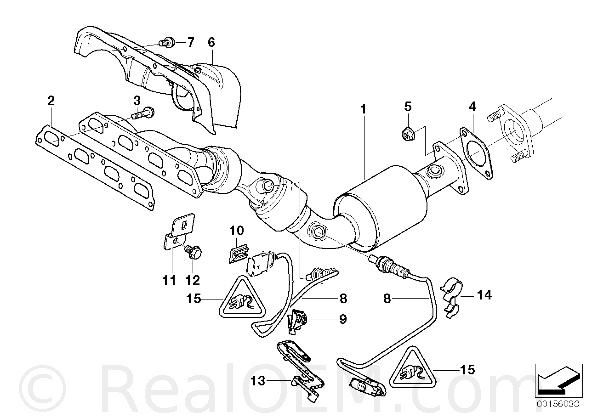
The one before the catalytic converter is the more important one in terms engine efficiency. Here's a diagram:
 , AL.
, AL.
Neutral
Joined: Aug 2004
Posts: 10
Likes: 0
Don't know where you pulled that diagram (?). Please note #6 on the diagram which shows the two O2 sensor locations. I pulled this from the Bentley Service Manual for MINI Cooper & MINI Cooper S's: 2002, 2003, 2004.
Last edited by alivenkickn; Feb 7, 2015 at 05:47 PM. Reason: Attachment needed
3rd Gear
Joined: Aug 2009
Posts: 152
Likes: 4
I have a question, I have replaced my pre-cat o2 sensor twice and getting a code for a bad pre-cat sensor, some one said I may have a bad cat, wouldn't that set a car code?
3rd Gear
Joined: Aug 2009
Posts: 152
Likes: 4
O2 Sensor Problems
I have a question, I have replaced my pre-cat o2 sensor twice and getting a code for a bad pre-cat sensor, some one said I may have a bad cat, wouldn't that set a car code?

Thread
Thread Starter
Forum
Replies
Last Post
Drivetrain Help on MAF Sensor Clip - Cannot Remove
Motown
Drivetrain (Cooper S)
4
Apr 20, 2018 09:31 AM
silence2-38554
R50/R53 :: Hatch Talk (2002-2006)
98
Sep 21, 2016 02:52 PM
squawSkiBum
MINI Parts for Sale
15
Oct 2, 2015 09:21 AM
JPMontes3
R50/R53 :: Hatch Talk (2002-2006)
3
Aug 23, 2015 01:26 AM
PSIChocolate
Stock Problems/Issues
1
Aug 13, 2015 12:46 PM