


R50/53 Who's got the cross drilled rotors?


6th Gear
Joined: Aug 2005
Posts: 3,902
Likes: 2
From: SoCaL (Agoura Hills)
They don't do anything... Buy regular rotors and spend the extra money on better brake pads.

But to be fair it's a huge topic that would best be answered by reading a bit about brakes and how they function. From there you can determine if your requirements are such that a bbk is necessary. Chances are they are not.
p.s. unless they are insane carbon ceramic or oem porsche brakes... they are going to crack at the drilled holes.
this generalization is bs and leaves so much left to be desired it's not funny.
But to be fair it's a huge topic that would best be answered by reading a bit about brakes and how they function. From there you can determine if your requirements are such that a bbk is necessary. Chances are they are not.
p.s. unless they are insane carbon ceramic or oem porsche brakes... they are going to crack at the drilled holes.
But to be fair it's a huge topic that would best be answered by reading a bit about brakes and how they function. From there you can determine if your requirements are such that a bbk is necessary. Chances are they are not.
p.s. unless they are insane carbon ceramic or oem porsche brakes... they are going to crack at the drilled holes.

6th Gear
Joined: Aug 2007
Posts: 1,798
Likes: 11
From: CT
Just to help clear up potential misinterpretation... I think Rusty was saying taht Cross drilled rotors dont do anything, not BBK's which have been proven over and over as being useful in certain situations.


6th Gear
Joined: Aug 2005
Posts: 3,902
Likes: 2
From: SoCaL (Agoura Hills)
this generalization is bs and leaves so much left to be desired it's not funny.
But to be fair it's a huge topic that would best be answered by reading a bit about brakes and how they function. From there you can determine if your requirements are such that a bbk is necessary. Chances are they are not.
p.s. unless they are insane carbon ceramic or oem porsche brakes... they are going to crack at the drilled holes.
But to be fair it's a huge topic that would best be answered by reading a bit about brakes and how they function. From there you can determine if your requirements are such that a bbk is necessary. Chances are they are not.
p.s. unless they are insane carbon ceramic or oem porsche brakes... they are going to crack at the drilled holes.
As far as a BBK goes, 99% of drivers on the street don't need one. Hell, the majority of drivers on the track don't either (Pad and fluid upgrade works fine). I had an opportunity to get one for about what it would have cost to buy new pads and rotors, so I jumped at it.
Trending Topics
6th Gear
Joined: Aug 2005
Posts: 3,902
Likes: 2
From: SoCaL (Agoura Hills)
I think most brake experts have already ruled that x-drilled rotors are standard on porsches for much the same reason they are on most sports cars. It's come to be expected by the buying public, and it's more to add to their marketing BS. My statement was plenty valid, I've tested them on the track, the car doesn't fade any less with x-drilled rotors.
Slotting helped a bit with initial bite, but other than that, the fade characteristics were the same. Unless you have some actual data instead of marketing BS from Porsche about how awesome drilling holes in a rotor (How does removing 25% of the thermal mass of an object increase it's heat absorption characteristics?), don't bother.
Still don't believe me? Here's some info from people who PROBABLY know a thing or two about brakes...
From Stoptech:
From Wilwood:
From Baer:
Then from Grassroots Motorsports:
I have a friend with a 997 turbo with the 16k dollar carbon ceramic brake upgrade. Guess what, My car stops faster on R-Compounds! (More aggressive pads and stickier tires). They do look great though, and I'm sure they really shine on the track when you're doing endurance racing.
Here's a better picture by the way...

Slotting helped a bit with initial bite, but other than that, the fade characteristics were the same. Unless you have some actual data instead of marketing BS from Porsche about how awesome drilling holes in a rotor (How does removing 25% of the thermal mass of an object increase it's heat absorption characteristics?), don't bother.
Still don't believe me? Here's some info from people who PROBABLY know a thing or two about brakes...
From Stoptech:
Which is better, slotted or drilled rotors?
StopTech provides rotors slotted, drilled or plain. For most performance applications slotted is the preferred choice. Slotting helps wipe away debris from between the pad and rotor as well as increasing the "bite" characteristics of the pad. A drilled rotor provides the same type of benefit, but is more susceptible to cracking under severe usage. Many customers prefer the look of a drilled rotor and for street and occasional light duty track use they will work fine. For more severe applications, we recommend slotted rotors.
StopTech provides rotors slotted, drilled or plain. For most performance applications slotted is the preferred choice. Slotting helps wipe away debris from between the pad and rotor as well as increasing the "bite" characteristics of the pad. A drilled rotor provides the same type of benefit, but is more susceptible to cracking under severe usage. Many customers prefer the look of a drilled rotor and for street and occasional light duty track use they will work fine. For more severe applications, we recommend slotted rotors.
Q: Why are some rotors drilled or slotted?
A: Rotors are drilled to reduce rotating weight, an issue near and dear to racers searching for ways to minimize unsprung weight. Drilling diminishes a rotor's durability and cooling capacity.
A: Rotors are drilled to reduce rotating weight, an issue near and dear to racers searching for ways to minimize unsprung weight. Drilling diminishes a rotor's durability and cooling capacity.
What are the benefits to Crossdrilling, Slotting, and Zinc-Washing my rotors?
In years past, crossdrilling and/or Slotting the rotor for racing purposes was beneficial by providing a way to expel the gasses created when the bonding agents employed to manufacture the pads...However, with today’s race pad technology, ‘outgassing’ is no longer much of a concern...Slotted surfaces are what Baer recommends for track only use. Slotted only rotors are offered as an option for any of Baer’s offerings.
In years past, crossdrilling and/or Slotting the rotor for racing purposes was beneficial by providing a way to expel the gasses created when the bonding agents employed to manufacture the pads...However, with today’s race pad technology, ‘outgassing’ is no longer much of a concern...Slotted surfaces are what Baer recommends for track only use. Slotted only rotors are offered as an option for any of Baer’s offerings.
Crossdrilling your rotors might look neat, but what is it really doing for you? Well, unless your car is using brake pads from the '40s and 50s, not a whole lot. Rotors were first drilled because early brake pad materials gave off gasses when heated to racing temperatures, a process known as "gassing out." It was an effective solution, but today's friction materials do not exhibit the some gassing out phenomenon as the early pads.
Contrary to popular belief, they don't lower temperatures. (In fact, by removing weight from the rotor, they can actually cause temperatures to increase a little.) These holes create stress risers that allow the rotor to crack sooner, and make a mess of brake pads--sort of like a cheese grater rubbing against them at every stop. Want more evidence? Look at NASCAR or F1. You would think that if drilling holes in the rotor was the hot ticket, these teams would be doing it...Slotting rotors, on the other hand, might be a consideration if your sanctioning body allows for it.
Cutting thin slots across the face of the rotor can actually help to clean the face of the brake pads over time, helping to reduce the glazing often found during high-speed use which can lower the coefficient of friction. While there may still be a small concern over creating stress risers in the face of the rotor, if the slots are shallow and cut properly, the trade-off appears to be worth the risk. (Have you looked at a NASCAR rotor lately?)
Contrary to popular belief, they don't lower temperatures. (In fact, by removing weight from the rotor, they can actually cause temperatures to increase a little.) These holes create stress risers that allow the rotor to crack sooner, and make a mess of brake pads--sort of like a cheese grater rubbing against them at every stop. Want more evidence? Look at NASCAR or F1. You would think that if drilling holes in the rotor was the hot ticket, these teams would be doing it...Slotting rotors, on the other hand, might be a consideration if your sanctioning body allows for it.
Cutting thin slots across the face of the rotor can actually help to clean the face of the brake pads over time, helping to reduce the glazing often found during high-speed use which can lower the coefficient of friction. While there may still be a small concern over creating stress risers in the face of the rotor, if the slots are shallow and cut properly, the trade-off appears to be worth the risk. (Have you looked at a NASCAR rotor lately?)
Here's a better picture by the way...
Last edited by Guest; Jun 5, 2008 at 10:50 PM.

I have disagree. Better brakes will make a difference. When my 348 Challenge car's brakes were changed to an F40/F50 set up, I quickly found that I could outbrake virtually anything short of a purpose built race car, at the track. And on the street, there is nothing like having the confidence of great stoppers.
6th Gear
Joined: Aug 2005
Posts: 3,902
Likes: 2
From: SoCaL (Agoura Hills)
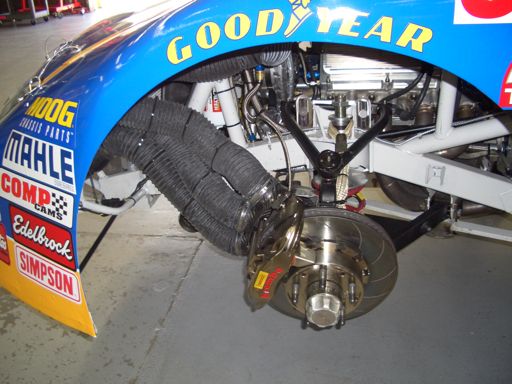
FYI, here are shots of Nascar and F1 brakes
Nascar:


Good friend of mine (Same one with the Porsche) works for an Indy Race team. VP of Marketing and Sales. I'd be happy to have him explain why you don't need holes in your rotors to stop faster.
Nascar:
Good friend of mine (Same one with the Porsche) works for an Indy Race team. VP of Marketing and Sales. I'd be happy to have him explain why you don't need holes in your rotors to stop faster.
6th Gear
Joined: Aug 2005
Posts: 3,902
Likes: 2
From: SoCaL (Agoura Hills)
I have disagree. Better brakes will make a difference. When my 348 Challenge car's brakes were changed to an F40/F50 set up, I quickly found that I could outbrake virtually anything short of a purpose built race car, at the track. And on the street, there is nothing like having the confidence of great stoppers.
Upgrading rotors does nothing but increase thermal capacity. Upgrading pads increases the amount of brake torque your rotors can apply to the disk, basically, how hard it grabs onto them.
I ran race pads on the street as a precursor to a track day (wanted to bed them in). Aside from destroying my rotors (less than 300 miles and it actually ate THROUGH the machined slots in my rotors and wiped the rotor clean. Yes, that's right, my slotted rotors are now plain) there wasn't any decrease in stopping distances. All I did was activate ABS at every stop cause the wheels wanted to lock with almost no pedal input.
Yea, it was cool to rest my foot on the brake and slow from 60-30 in 2 seconds, but i'd rather not go through rotors every few months.
Last edited by Guest; Jun 5, 2008 at 11:22 PM.

Although Rusty backed up on his statements with his sources, I do think
"They don't do anything" comment is a bit too generalized.
I believe slots and drilled rotors WORK in certain situations and there are certainly benefits to them, but for how most people drive on streets and tracking occasionally, it is better to spend money, like Rusty said, on better pads or rotors.
"They don't do anything" comment is a bit too generalized.
I believe slots and drilled rotors WORK in certain situations and there are certainly benefits to them, but for how most people drive on streets and tracking occasionally, it is better to spend money, like Rusty said, on better pads or rotors.

3rd Gear
Joined: Mar 2007
Posts: 283
Likes: 1
guys, guys. There is little to no STOPPING benefit with slotted or drilled rotors (though there are limited benefits if the edges aren't beveled, because of the added "bite" into the pad by the sharp edge. The primary reason slots and drills are used is for cooling. Keeping the temperature uniformly down with brakes is an eternal problem, and this is a way to help it. However, when conditions are under very high stress, its sometimes not worth adding all of those little stress concentrations. The real benefit comes in the relationship that the rotor and pad have. The coefficient of friction between the pad and the rotor as well as the rubber and road is the driving force (no pun intended!) behind stopping performance as far as stopping power Sorry about the nerdiness, its the only way i can talk about it! 
That being said, i LOVE the look of slotted or drilled rotors, and since most of us are just street drivers, having the Thought of better performance is good enough to justify getting some sexy rotors
That being said, i LOVE the look of slotted or drilled rotors, and since most of us are just street drivers, having the Thought of better performance is good enough to justify getting some sexy rotors
3rd Gear
Joined: Mar 2007
Posts: 283
Likes: 1


5th Gear
Joined: May 2008
Posts: 855
Likes: 0
Doesn't really relate to the discussion of iron discs.
6th Gear
Joined: Aug 2005
Posts: 3,902
Likes: 2
From: SoCaL (Agoura Hills)
I'll see if he'd be willing to come on and explain, I asked him to snap a few pics of the rotors if he had a chance today, he's in TX right now for practice and qualifying.

Wish Roth Racing luck!
Last edited by Guest; Jun 6, 2008 at 11:58 AM.
6th Gear
Joined: Aug 2005
Posts: 3,902
Likes: 2
From: SoCaL (Agoura Hills)
guys, guys. There is little to no STOPPING benefit with slotted or drilled rotors (though there are limited benefits if the edges aren't beveled, because of the added "bite" into the pad by the sharp edge. The primary reason slots and drills are used is for cooling. Keeping the temperature uniformly down with brakes is an eternal problem, and this is a way to help it. However, when conditions are under very high stress, its sometimes not worth adding all of those little stress concentrations. The real benefit comes in the relationship that the rotor and pad have. The coefficient of friction between the pad and the rotor as well as the rubber and road is the driving force (no pun intended!) behind stopping performance as far as stopping power Sorry about the nerdiness, its the only way i can talk about it!
That being said, i LOVE the look of slotted or drilled rotors, and since most of us are just street drivers, having the Thought of better performance is good enough to justify getting some sexy rotors
That being said, i LOVE the look of slotted or drilled rotors, and since most of us are just street drivers, having the Thought of better performance is good enough to justify getting some sexy rotors
5th Gear
Joined: May 2008
Posts: 855
Likes: 0
True, but even still, Indy hasn't used drilled rotors since outgassing stopped being an issue (Even before Carbon Ceramic brakes).
I'll see if he'd be willing to come on and explain, I asked him to snap a few pics of the rotors if he had a chance today, he's in TX right now for practice and qualifying.
I'll see if he'd be willing to come on and explain, I asked him to snap a few pics of the rotors if he had a chance today, he's in TX right now for practice and qualifying.
Like I said, I agree with you, the carbon disc just made me laugh.
I have to admit, I have drilled rotors, but thats what comes with the AP kit(the price was too good to pass up) and the heavy cabrio will be lucky to see a track day. That's what the other money pit is for.



This discussion is way above my level....but the only thing that has been described as a positive for x-drilled/slotted is if you do a lot of stop/go city traffic and glaze over pads. The extra cheese grater effect helps keep the surfaces fresh, and extra pad replacement!
Otherwise I just upgraded the fluid, pads, SS-lines, bushings, and plain ole rotors. Need better tires.
x-drilled do look cool, gotta admit. bling!
Otherwise I just upgraded the fluid, pads, SS-lines, bushings, and plain ole rotors. Need better tires.
x-drilled do look cool, gotta admit. bling!

6th Gear
Joined: Aug 2005
Posts: 3,902
Likes: 2
From: SoCaL (Agoura Hills)
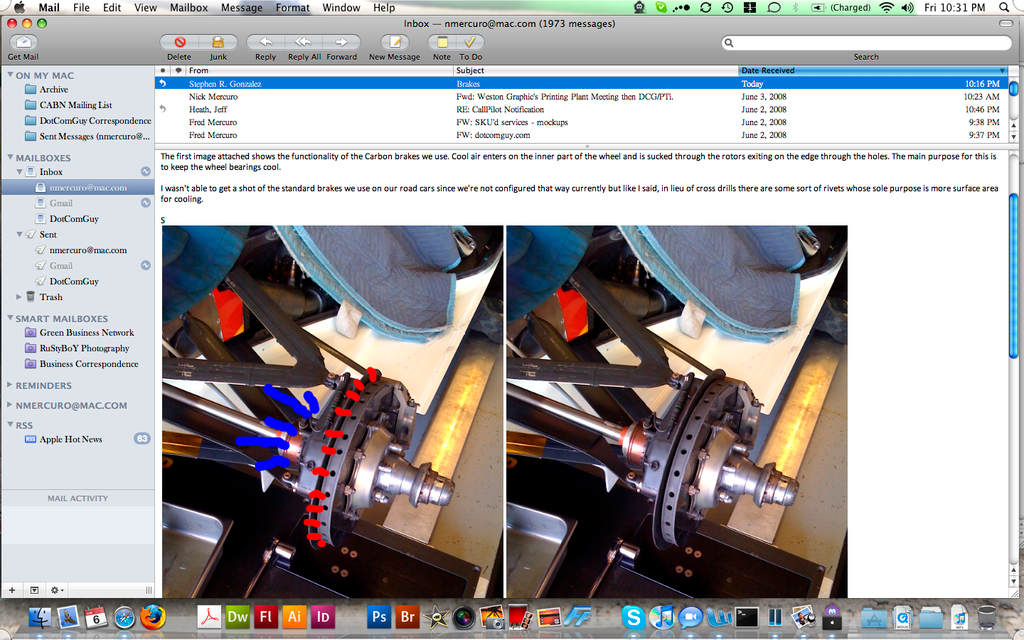
Well, here's the response I got back from my Indy buddy. He actually said they DO use plain iron rotors for road courses. They definitely don't use x-drilled though for anything (This is for IndyCar).

6th Gear
Joined: Aug 2005
Posts: 3,902
Likes: 2
From: SoCaL (Agoura Hills)
This discussion is way above my level....but the only thing that has been described as a positive for x-drilled/slotted is if you do a lot of stop/go city traffic and glaze over pads. The extra cheese grater effect helps keep the surfaces fresh, and extra pad replacement!
Otherwise I just upgraded the fluid, pads, SS-lines, bushings, and plain ole rotors. Need better tires.
x-drilled do look cool, gotta admit. bling!
Otherwise I just upgraded the fluid, pads, SS-lines, bushings, and plain ole rotors. Need better tires.
x-drilled do look cool, gotta admit. bling!

Thread
Thread Starter
Forum
Replies
Last Post
R50/53 Broken Strut Pinch Bolt
ericbryant24
R50/R53 :: Hatch Talk (2002-2006)
55
Sep 30, 2024 02:10 PM
Navigation & Audio HK Replacement With New Components
Filmy
Navigation & Audio
15
Jun 6, 2023 06:27 AM
R50/53 EBC vs. Akebono - EBC wins
David.R53
R50/R53 :: Hatch Talk (2002-2006)
9
Sep 13, 2015 03:44 PM
Mini Mania
Interior/Exterior Products
1
Sep 11, 2015 01:15 PM