


R50/53 100 Octane or CAM 2 Fuel


Thread Starter
|
5th Gear
Joined: Aug 2003
Posts: 785
Likes: 0
Anyone have any information about CAM 2 or 100 Octane fuel for use in a MCS?
The manual recommends using high octane around 93 or 94.
Is more better in this case like would 100 be better than 94? Or are there different types of CAM 2 fuels?
The manual recommends using high octane around 93 or 94.
Is more better in this case like would 100 be better than 94? Or are there different types of CAM 2 fuels?

1st Gear
Joined: Jan 2003
Posts: 50
Likes: 0
From: Austin
More octane is not better. All gasoline has the same energy, the octane rating is a measure of auto-ignition. Once you get to an octane point where the compression of the air/fuel does not ignite itself, there is nothing to be gained by a higher octane rating.
I run 89 or 93 (mostly 93), but I can't tell the difference and 89 does not seem to auto-ignite.
I run 89 or 93 (mostly 93), but I can't tell the difference and 89 does not seem to auto-ignite.

2nd Gear
Joined: Jul 2003
Posts: 135
Likes: 0
From: Lake Norman, NC
We own the northeastern distributorships for Sunoco Race Fuels and 76 Racing Gasoline. CAM2 is a Sunoco brand. The following street-legal fuels can be used in MINIs for street or track use:
Sunoco GT Unleaded (100 octane) CAM2 GT Unleaded (100)
76 Competition 100 (100) 76 Cool Blue 100 (100)
MINI Cooper:
While the engine computer will take advantage of the increased octane and adjust timing accordingly, I do NOT feel the increase would be worth the added cost.
MINI Cooper S:
Supercharged cars are more likely to see power gains from use of these higher octane fuels.
MINI Cooper S with "power pulleys" and other engine mods:
100 octane fuel should help prevent detonation from higher boost pressures, and should provide more power.
Note: You can blend any of these 100 octane fuels with pump gas... the resulting octane is a simple ratio of the amount blended. i.e. 1 gallon of 92 octane blended with 1 gallon of 100 octane yields 2 gallons of 96 octane. (100+92)/2.
These fuels are completely street-legal and will NOT harm the catalyst or sensors.
Both companies also make a 104 octane unleaded fuel. The 104 is NOT for street use, lacks stability if exposed to sunlight, etc..
Questions? email me.
Sunoco GT Unleaded (100 octane) CAM2 GT Unleaded (100)
76 Competition 100 (100) 76 Cool Blue 100 (100)
MINI Cooper:
While the engine computer will take advantage of the increased octane and adjust timing accordingly, I do NOT feel the increase would be worth the added cost.
MINI Cooper S:
Supercharged cars are more likely to see power gains from use of these higher octane fuels.
MINI Cooper S with "power pulleys" and other engine mods:
100 octane fuel should help prevent detonation from higher boost pressures, and should provide more power.
Note: You can blend any of these 100 octane fuels with pump gas... the resulting octane is a simple ratio of the amount blended. i.e. 1 gallon of 92 octane blended with 1 gallon of 100 octane yields 2 gallons of 96 octane. (100+92)/2.
These fuels are completely street-legal and will NOT harm the catalyst or sensors.
Both companies also make a 104 octane unleaded fuel. The 104 is NOT for street use, lacks stability if exposed to sunlight, etc..
Questions? email me.

4th Gear
Joined: Jul 2003
Posts: 318
Likes: 0
From: Eastern, PA
>>More octane is not better. All gasoline has the same energy, the octane rating is a measure of auto-ignition. Once you get to an octane point where the compression of the air/fuel does not ignite itself, there is nothing to be gained by a higher octane rating.
>>
Well said James...
However, I've got a couple of problems with the claims that 200mph is making (I didn't quote cause this post is long enough)...
Think of it this way... The higher the octane rating, the LESS likely the fuel is to pre-ignite. The reason for running higher octane in higher-compression motors (including Super/Turbo-charged engines) is to prevent the potentially damaging pre-ignition which is more likely to occur in high compression combustion chambers.
To SOME extent, older, higher mileage motors with lots of carbon deposits (which will reduce the overall VOLUME of the combustion chamber, thereby increasing compression ratio slightly) MAY (and I emphasize MAY) benefit from a higher octane fuel.
Now, it is my experience that the majority of computer controlled automotive fuel/ignition systems have no way to know what type of octane you are running, with one notable exception. Engines equipped with a knock sensor (and I haven't checked to see if the Mini motors have one or not yet) detect the presence of pre-ignition and alert the computer module when it occurs, which (in most cases) will respond by retarding timing (stealing a certain amount of power from the motor) in order to cease the knocking and protect the motor.
In this way the use of insufficient octane doesn't really hurt the motor (thanks to the ECU) but it DOES hurt the performance.
However, in the abscence of pre-ignition the ECU simply leaves fuel and ignition mapping alone. So the abscence of pre-ignition allows the motor to operate at maximum efficiency.
Note that I said the ECU/ECM has no way to know the octane rating. What I mean therefore is that once you add high enough octane to prevent pre-ignition you get the optimum mapping/timing. If that comes at 93/94 octane, then that's all you need to run. Adding 95, 96, 104 or whatever will do ABSOLUTELY NOTHING to increase power or performance. The ECU has no way to know that it's in the tank and does not further increase mapping/timing to compensate (which is the only way it could help).
It is quite likely that stock MC and MCS engines will run fine on a lower octane rating than 93, as that spec is a safety net provided by the manufacturer to prevent pre-ignition.
Also, if the JCW package does not require more than 93 octane, I cannot see how a similarly modified MCS (with pulley, intake, exhaust etc) could benefit from a higher octane (UNLESS the pistons/combustion chambers and/or the ECU programming has/have also been modified).
What I'm saying is, run the octane Mini has specified and don't waste your money on anything else.
I know there are more sophisticated tuners on this board, so please feel free to point out anything I've forgotten or mispoken. Otherwise, I hope this helps!
Kev
_________________
She let's me drive her MCS (which is good, cause I gave it to her as a wedding present)!!!
Our Baby? - she's an 03 Elect Blue (white roof/wheels) MCS, w/ all the toys (premium, cold, h/k, Nav, xenon, fogs etc) !
>>
Well said James...
However, I've got a couple of problems with the claims that 200mph is making (I didn't quote cause this post is long enough)...
Think of it this way... The higher the octane rating, the LESS likely the fuel is to pre-ignite. The reason for running higher octane in higher-compression motors (including Super/Turbo-charged engines) is to prevent the potentially damaging pre-ignition which is more likely to occur in high compression combustion chambers.
To SOME extent, older, higher mileage motors with lots of carbon deposits (which will reduce the overall VOLUME of the combustion chamber, thereby increasing compression ratio slightly) MAY (and I emphasize MAY) benefit from a higher octane fuel.
Now, it is my experience that the majority of computer controlled automotive fuel/ignition systems have no way to know what type of octane you are running, with one notable exception. Engines equipped with a knock sensor (and I haven't checked to see if the Mini motors have one or not yet) detect the presence of pre-ignition and alert the computer module when it occurs, which (in most cases) will respond by retarding timing (stealing a certain amount of power from the motor) in order to cease the knocking and protect the motor.
In this way the use of insufficient octane doesn't really hurt the motor (thanks to the ECU) but it DOES hurt the performance.
However, in the abscence of pre-ignition the ECU simply leaves fuel and ignition mapping alone. So the abscence of pre-ignition allows the motor to operate at maximum efficiency.
Note that I said the ECU/ECM has no way to know the octane rating. What I mean therefore is that once you add high enough octane to prevent pre-ignition you get the optimum mapping/timing. If that comes at 93/94 octane, then that's all you need to run. Adding 95, 96, 104 or whatever will do ABSOLUTELY NOTHING to increase power or performance. The ECU has no way to know that it's in the tank and does not further increase mapping/timing to compensate (which is the only way it could help).
It is quite likely that stock MC and MCS engines will run fine on a lower octane rating than 93, as that spec is a safety net provided by the manufacturer to prevent pre-ignition.
Also, if the JCW package does not require more than 93 octane, I cannot see how a similarly modified MCS (with pulley, intake, exhaust etc) could benefit from a higher octane (UNLESS the pistons/combustion chambers and/or the ECU programming has/have also been modified).
What I'm saying is, run the octane Mini has specified and don't waste your money on anything else.
I know there are more sophisticated tuners on this board, so please feel free to point out anything I've forgotten or mispoken. Otherwise, I hope this helps!
Kev
_________________
She let's me drive her MCS (which is good, cause I gave it to her as a wedding present)!!!
Our Baby? - she's an 03 Elect Blue (white roof/wheels) MCS, w/ all the toys (premium, cold, h/k, Nav, xenon, fogs etc) !
2nd Gear
Joined: Jul 2003
Posts: 135
Likes: 0
From: Lake Norman, NC
KevM,
You're right to a point. All US cars with computer-controlled ignition retard spark timing to prevent detonation, and the computer doesnt know (or care) what octane fuel is in the car. USA Today ran an article just last week saying premium fuel is a waste of money for most drivers, even if the manufacturer calls for it.
What you may not know, is that many new cars WILL also ADVANCE spark beyond "factory spec" to just below the point of detonation. This maximizes the burn so the engine runs as efficiently as possible, and also makes max power.
So even if the engine is "rated" by the factory using 93 octane, many cars will make more horsepower if their computer will adjust for a higher octane fuel... just as they will make slightly less power as the car compensates for 89 or 87 octane gas.
Adding octane does not make power. Rather, it permits the engine to be built (increased compression) or tuned (more spark advance) to make more power than when a lower octane fuel is used.
Your advice to consult a professional tuner or engine builder is wise.
You can also call 1-800-RACE-GAS with questions.
You're right to a point. All US cars with computer-controlled ignition retard spark timing to prevent detonation, and the computer doesnt know (or care) what octane fuel is in the car. USA Today ran an article just last week saying premium fuel is a waste of money for most drivers, even if the manufacturer calls for it.
What you may not know, is that many new cars WILL also ADVANCE spark beyond "factory spec" to just below the point of detonation. This maximizes the burn so the engine runs as efficiently as possible, and also makes max power.
So even if the engine is "rated" by the factory using 93 octane, many cars will make more horsepower if their computer will adjust for a higher octane fuel... just as they will make slightly less power as the car compensates for 89 or 87 octane gas.
Adding octane does not make power. Rather, it permits the engine to be built (increased compression) or tuned (more spark advance) to make more power than when a lower octane fuel is used.
Your advice to consult a professional tuner or engine builder is wise.
You can also call 1-800-RACE-GAS with questions.
4th Gear
Joined: Jul 2003
Posts: 318
Likes: 0
From: Eastern, PA
200, thanks for the reply...
I'm in a unique position, as my job has allowed me to study theory, operation and service of most automobiles in the US market for the past decade or two. Though, I must admit that professionally my focus changed from car engines to recreational engines about 2-3 years ago, so some of my information is starting to get out of date.
I've still got some questions regarding your reply:
>>What you may not know, is that many new cars WILL also ADVANCE spark beyond "factory spec" to just below the point of detonation. This maximizes the burn so the engine runs as efficiently as possible, and also makes max power.
>>
That's news to me. If true (and I'm skeptical, but willing to learn :smile: ), what you are claiming is that the published (when it is published these days) "factory timing specification" is for optimum operation with rated octane level fuel. And that the ECU in MANY new cars (I'd love to hear some examples) are designed to continue advancing timing beyond that spec, up to the point of detination (cause that's the only way they'd know when it occurs) and THEN lower it just below that point (almost in a cyclic feedback loop similar to the way that the O2 sensor causes fuel injector pulsing to cycle above and below the stochiometric 14:1 air/fuel ratio to achieve optimum combustion)
>>So even if the engine is "rated" by the factory using 93 octane, many cars will make more horsepower if their computer will adjust for a higher octane fuel... just as they will make slightly less power as the car compensates for 89 or 87 octane gas.>>
Well, the theory works, I'm ok with the theory. If the ECU is designed to map timing as you say, they will squeeze out a little more power at high rpm operation using more aggressively advanced timing.
>>Adding octane does not make power. Rather, it permits the engine to be built (increased compression) or tuned (more spark advance) to make more power than when a lower octane fuel is used.
>>
YUP, well summed up, that's exactly correct. Mgear or anyone reading this thread who is curious about higher octane fuels, that's why "Chipping" a computer normally requires a car which was originally spec'd for regular gasoline to be run on premium, because aftermarket chips or flash reprogramming usually allows for more agressive timing.
>>Your advice to consult a professional tuner or engine builder is wise.
>>You can also call 1-800-RACE-GAS with questions.
>>
Can't argue with that advice.
I'm in a unique position, as my job has allowed me to study theory, operation and service of most automobiles in the US market for the past decade or two. Though, I must admit that professionally my focus changed from car engines to recreational engines about 2-3 years ago, so some of my information is starting to get out of date.
I've still got some questions regarding your reply:
>>What you may not know, is that many new cars WILL also ADVANCE spark beyond "factory spec" to just below the point of detonation. This maximizes the burn so the engine runs as efficiently as possible, and also makes max power.
>>
That's news to me. If true (and I'm skeptical, but willing to learn :smile: ), what you are claiming is that the published (when it is published these days) "factory timing specification" is for optimum operation with rated octane level fuel. And that the ECU in MANY new cars (I'd love to hear some examples) are designed to continue advancing timing beyond that spec, up to the point of detination (cause that's the only way they'd know when it occurs) and THEN lower it just below that point (almost in a cyclic feedback loop similar to the way that the O2 sensor causes fuel injector pulsing to cycle above and below the stochiometric 14:1 air/fuel ratio to achieve optimum combustion)
>>So even if the engine is "rated" by the factory using 93 octane, many cars will make more horsepower if their computer will adjust for a higher octane fuel... just as they will make slightly less power as the car compensates for 89 or 87 octane gas.>>
Well, the theory works, I'm ok with the theory. If the ECU is designed to map timing as you say, they will squeeze out a little more power at high rpm operation using more aggressively advanced timing.
>>Adding octane does not make power. Rather, it permits the engine to be built (increased compression) or tuned (more spark advance) to make more power than when a lower octane fuel is used.
>>
YUP, well summed up, that's exactly correct. Mgear or anyone reading this thread who is curious about higher octane fuels, that's why "Chipping" a computer normally requires a car which was originally spec'd for regular gasoline to be run on premium, because aftermarket chips or flash reprogramming usually allows for more agressive timing.
>>Your advice to consult a professional tuner or engine builder is wise.
>>You can also call 1-800-RACE-GAS with questions.
>>
Can't argue with that advice.
2nd Gear
Joined: Jul 2003
Posts: 135
Likes: 0
From: Lake Norman, NC
Thanks, KevM,
Much of the octane confusion relates to manufacturer's published power and performance numbers.
A manufacturer may quote (say) 163hp and 120ftlbs, and 0-60 in 6.9sec. When they then say "93 octane required", it means that 93 octane is required to duplicate those numbers. 93 octane is NOT required for the car to run properly.
The car WILL run just fine on 87 octane, but it wont reach those performance and power numbers.
See USA Today, 7/31, pp 1B,2B for more on this.
Car & Driver did a sidebar on the computer issue, and while I dont have the issue at hand, I recall Porsches, BMW's and yes, the Ford Explorer as some listed examples of vehicles whose ECU could advance as well as retard timing from spec.
I only recommend premium fuel to (a)racers, and (b) people who drive with their right foot bricked to the floor much of the time... like many drivers of turbo and supercharged cars like the MCS.
Another advantage to our 100 octane is for people who store their cars. The additives in today's pump gas cause it to begin to break down in about 90 days. Sunoco or 76 racing gasolines have a shelf life of more than a year. Many well-known car collections use our fuel to prevent multi-carb rebuilds after periods of storage.
Much of the octane confusion relates to manufacturer's published power and performance numbers.
A manufacturer may quote (say) 163hp and 120ftlbs, and 0-60 in 6.9sec. When they then say "93 octane required", it means that 93 octane is required to duplicate those numbers. 93 octane is NOT required for the car to run properly.
The car WILL run just fine on 87 octane, but it wont reach those performance and power numbers.
See USA Today, 7/31, pp 1B,2B for more on this.
Car & Driver did a sidebar on the computer issue, and while I dont have the issue at hand, I recall Porsches, BMW's and yes, the Ford Explorer as some listed examples of vehicles whose ECU could advance as well as retard timing from spec.
I only recommend premium fuel to (a)racers, and (b) people who drive with their right foot bricked to the floor much of the time... like many drivers of turbo and supercharged cars like the MCS.
Another advantage to our 100 octane is for people who store their cars. The additives in today's pump gas cause it to begin to break down in about 90 days. Sunoco or 76 racing gasolines have a shelf life of more than a year. Many well-known car collections use our fuel to prevent multi-carb rebuilds after periods of storage.
Trending Topics

Banned
Joined: Mar 2003
Posts: 2,859
Likes: 0
From: Plymouth, MN
>>That's news to me. If true (and I'm skeptical, but willing to learn :smile: ), what you are claiming is that the published (when it is published these days) "factory timing specification" is for optimum operation with rated octane level fuel. And that the ECU in MANY new cars (I'd love to hear some examples) are designed to continue advancing timing beyond that spec, up to the point of detination (cause that's the only way they'd know when it occurs) and THEN lower it just below that point (almost in a cyclic feedback loop similar to the way that the O2 sensor causes fuel injector pulsing to cycle above and below the stochiometric 14:1 air/fuel ratio to achieve optimum combustion)
I don't know if this is true either, but here is the timing for my 02/02 build MINI Cooper 5-speed
as I go on and off the highway.
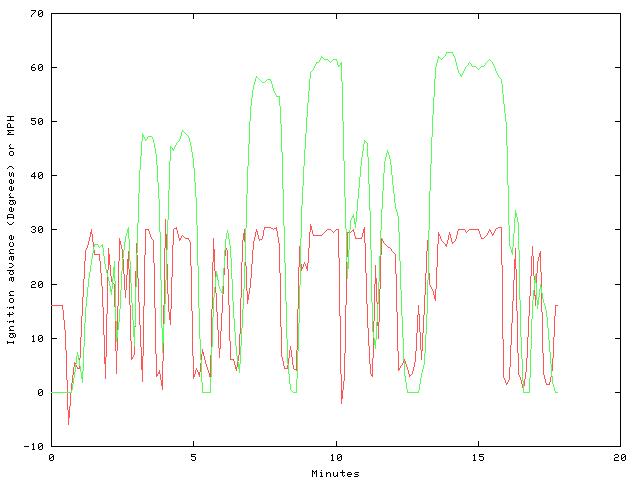
The red line is the ignition advance in degrees. The green line is speed in MPG on a common graph.
The left edge os before I started the car. Notice the ignition is retarded almost 5 degrees when I'm
cranking the engine to start it.
I suppose I could put in lower-octane gas and see if the timing changes.
I don't know if this is true either, but here is the timing for my 02/02 build MINI Cooper 5-speed
as I go on and off the highway.
The red line is the ignition advance in degrees. The green line is speed in MPG on a common graph.
The left edge os before I started the car. Notice the ignition is retarded almost 5 degrees when I'm
cranking the engine to start it.
I suppose I could put in lower-octane gas and see if the timing changes.
2nd Gear
Joined: Jul 2003
Posts: 135
Likes: 0
From: Lake Norman, NC
The best advice I ever got on octane came during the first gas crisis. My car was a Z/28 Camaro, and its 800cfm double-pumper Holley 4bbl carb thirsted for a gallon of Sunoco 260 or Amoco Premium every 11 miles or so.
A race mechanic and garage owner named Charlie Reynolds detuned my car by retarding the ignition timing, changing carburetor jetting and changing spark plugs so it would run on the crap regular gas that often was the only fuel available.
Charlie's axiom, which holds true to this day:
IF THE ENGINE ISN'T PINGING (detonating), YOU HAVE ENOUGH OCTANE.
BTW, the changes picked up the gas mileage to 14, (25%!!!) and I never really missed the "lost" performance.
Mike
A race mechanic and garage owner named Charlie Reynolds detuned my car by retarding the ignition timing, changing carburetor jetting and changing spark plugs so it would run on the crap regular gas that often was the only fuel available.
Charlie's axiom, which holds true to this day:
IF THE ENGINE ISN'T PINGING (detonating), YOU HAVE ENOUGH OCTANE.
BTW, the changes picked up the gas mileage to 14, (25%!!!) and I never really missed the "lost" performance.
Mike
4th Gear
Joined: Jul 2003
Posts: 318
Likes: 0
From: Eastern, PA
>>
>>I don't know if this is true either, but here is the timing for my 02/02 build MINI Cooper 5-speed
>>The red line is the ignition advance in degrees. The green line is speed in MPG on a common graph.
>>
>>The left edge os before I started the car. Notice the ignition is retarded almost 5 degrees when I'm
>>cranking the engine to start it.
>>
>>I suppose I could put in lower-octane gas and see if the timing changes.
OOOOOOHHH, or you could put some racing gas in a see if the MC increases advance any over these numbers. That would be an excellent test with no risk other than the cost of a tank of expensive gas....
If you do, please let us know how it turns out.
Hey, Mike, that was exactly my point....
If it is not pinging you've got the right octane!!!!!!!!!!!!
Thanks for the intellectual discourse.
>>I don't know if this is true either, but here is the timing for my 02/02 build MINI Cooper 5-speed
>>The red line is the ignition advance in degrees. The green line is speed in MPG on a common graph.
>>
>>The left edge os before I started the car. Notice the ignition is retarded almost 5 degrees when I'm
>>cranking the engine to start it.
>>
>>I suppose I could put in lower-octane gas and see if the timing changes.
OOOOOOHHH, or you could put some racing gas in a see if the MC increases advance any over these numbers. That would be an excellent test with no risk other than the cost of a tank of expensive gas....
If you do, please let us know how it turns out.
Hey, Mike, that was exactly my point....
If it is not pinging you've got the right octane!!!!!!!!!!!!
Thanks for the intellectual discourse.

Banned
Joined: Mar 2003
Posts: 2,859
Likes: 0
From: Plymouth, MN
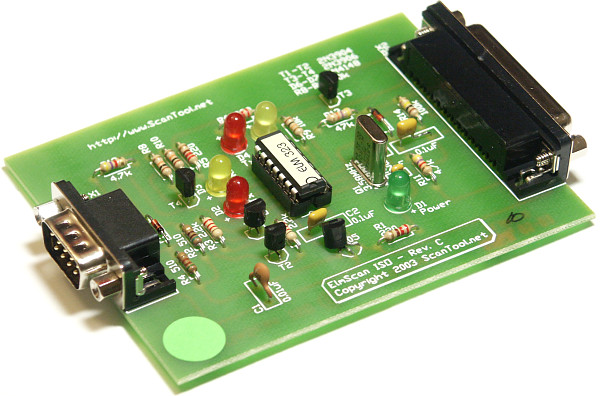
I use the ElmScan-ISO interface to a laptop.
From scantool ISO interface
It's only $85.00 and they have some free software, but I wrote my own Linux
software to do the data acquisition.
From scantool ISO interface
It's only $85.00 and they have some free software, but I wrote my own Linux
software to do the data acquisition.

Thread
Thread Starter
Forum
Replies
Last Post
patsum
R50/R53 :: Hatch Talk (2002-2006)
26
May 29, 2021 06:29 PM
Hippiehobbit267
MINI Parts for Sale
0
Sep 1, 2015 06:13 PM