


Suspension strange noise after install of Megan coilovers


Thread Starter
|
Neutral
Joined: Oct 2010
Posts: 6
Likes: 0
spring sound - creaking from Megan coilover install... PLEASE HELP
Greetings-
I am new to the mini scene... I just picked up some decent megan coilovers for my r53. A older guy just purchased a r53 and wanted to trade the "lowered" suspension for stock suspension, so I jumped all over it. They are older looking, with red coils in back and black on rear... front is adjustable (not sure what generation)
Anyways when we did the trade at a shop, I didnt check out the front sway bar endlinks... I left what was on his alone, and I have oem on mine.
I have turned the coil overs down quite a bit... I am familiar with coil overs and understand how they adjust... I like the slammed look, and I am now getting a funky ping noise from the front that almost sounds like something is hitting the coil when i hit a bump, its pretty loud and its for sure coming from the front. Please note, I have the coils turn down pretty drastically. (fender about 3/8" from 205/17 tires)
Do I need to order an adjustable endlink for the front sway bar???? I have seen them for sale and was curious... Is my oem too long or too short?
I have also notice that the front drivers corner will drop lower then the front passenger corner. Is the sway bar keeping it up? I have the coil nuts about 1/2" from the perch on the drivers and about 1" from the perch on the passengers to keep the front level...
Any help would be badass. Thanks
I am new to the mini scene... I just picked up some decent megan coilovers for my r53. A older guy just purchased a r53 and wanted to trade the "lowered" suspension for stock suspension, so I jumped all over it. They are older looking, with red coils in back and black on rear... front is adjustable (not sure what generation)
Anyways when we did the trade at a shop, I didnt check out the front sway bar endlinks... I left what was on his alone, and I have oem on mine.
I have turned the coil overs down quite a bit... I am familiar with coil overs and understand how they adjust... I like the slammed look, and I am now getting a funky ping noise from the front that almost sounds like something is hitting the coil when i hit a bump, its pretty loud and its for sure coming from the front. Please note, I have the coils turn down pretty drastically. (fender about 3/8" from 205/17 tires)
Do I need to order an adjustable endlink for the front sway bar???? I have seen them for sale and was curious... Is my oem too long or too short?
I have also notice that the front drivers corner will drop lower then the front passenger corner. Is the sway bar keeping it up? I have the coil nuts about 1/2" from the perch on the drivers and about 1" from the perch on the passengers to keep the front level...
Any help would be badass. Thanks
Last edited by coolethan; Oct 22, 2010 at 10:05 AM.
Thread Starter
|
Neutral
Joined: Oct 2010
Posts: 6
Likes: 0
UPDATE:
I looked at over everything twice... the coils clear the tower and everything is nice and tight. The noise only comes when I hit a small bump at slow speeds and turn the wheels in a parking lot. It almost sound like a spring noise (as if you were to flick or hit a spring)
Anyone????
I looked at over everything twice... the coils clear the tower and everything is nice and tight. The noise only comes when I hit a small bump at slow speeds and turn the wheels in a parking lot. It almost sound like a spring noise (as if you were to flick or hit a spring)
Anyone????
Last edited by coolethan; Oct 22, 2010 at 10:04 AM.

UPDATE:
I looked at over everything twice... the coils clear the tower and everything is nice and tight. The noise only comes when I hit a small bump at slow speeds and turn the wheels in a parking lot. It almost sound like a spring noise (as if you were to flick or hit a spring)
Anyone????
I looked at over everything twice... the coils clear the tower and everything is nice and tight. The noise only comes when I hit a small bump at slow speeds and turn the wheels in a parking lot. It almost sound like a spring noise (as if you were to flick or hit a spring)
Anyone????
Does it go click click click click in parking lots when doing a sharp turn? It may be a axle.

4th Gear
Joined: Dec 2008
Posts: 525
Likes: 1
coolethan, did you ever figure this out? I have the same ping in the right front. The spring looks like it is shifting around the axis of the shock as the wheel turns. It's like it gets stuck while turning, then flicks into position, causing the 'BOING' sound.

What is most likely happening is that something is keeping your springs from freely rotating with the strut. I don't know much about Megans, but I would first check to see if your top spring perches are up against the inside of the strut tower due to too much camber. Otherwise either the design, or the failing of a part is keeping the top perch from rotating with the strut. The ping you here is the spring finally breaking free from either the top or bottom perch due to being twisted so much.
4th Gear
Joined: Dec 2008
Posts: 525
Likes: 1
That makes sense and I'll check it out. The camber is only set at -1.5 front and rear with a 1" drop all the way around and I would hope such modest settings would not be causing the problem.
I'm headed to the garage now and I'll let you know what I find out.
Thanks for the reply!
I'm headed to the garage now and I'll let you know what I find out.
Thanks for the reply!
4th Gear
Joined: Dec 2008
Posts: 525
Likes: 1
DSC00108.jpg?t=1308357229
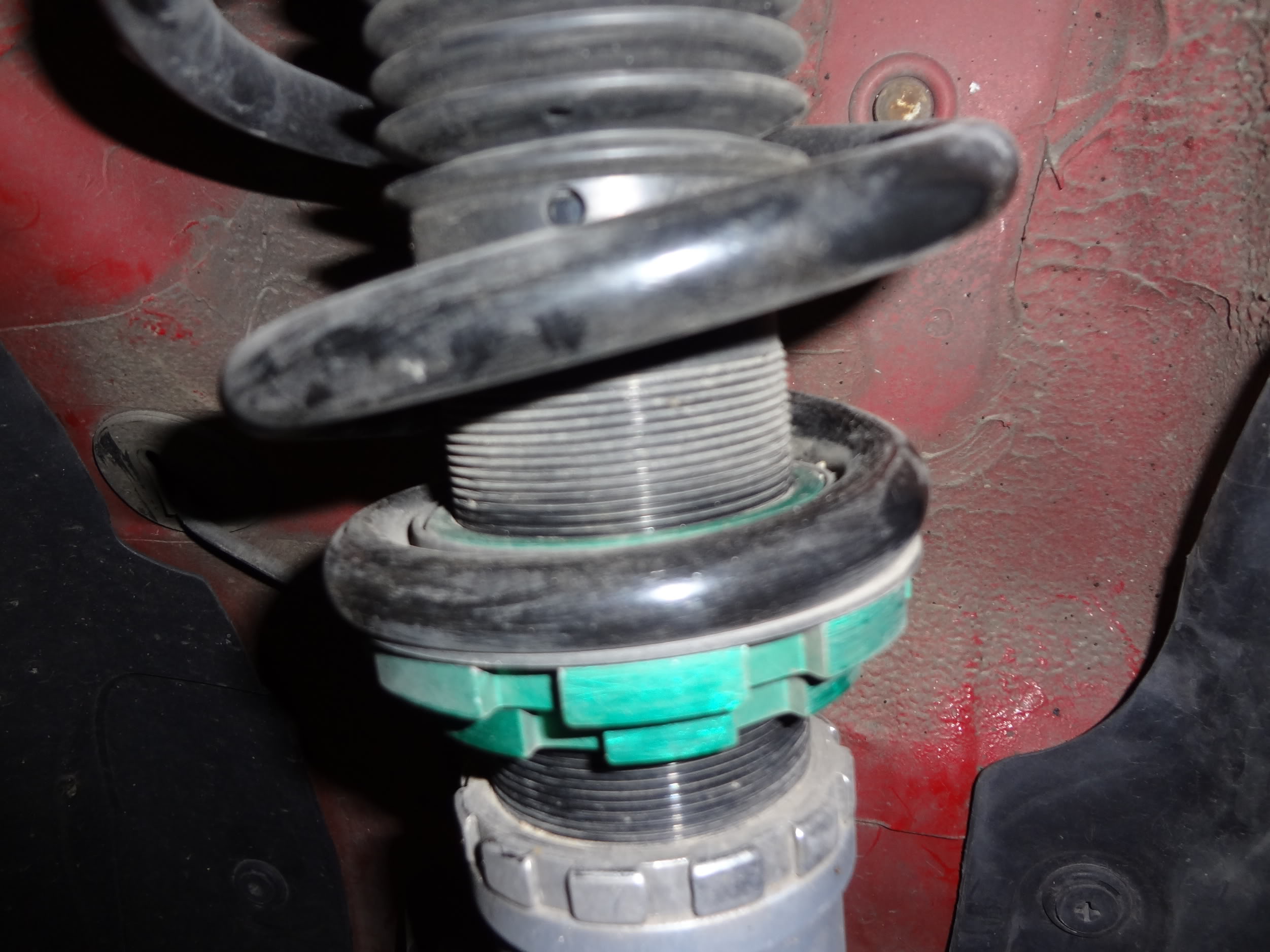


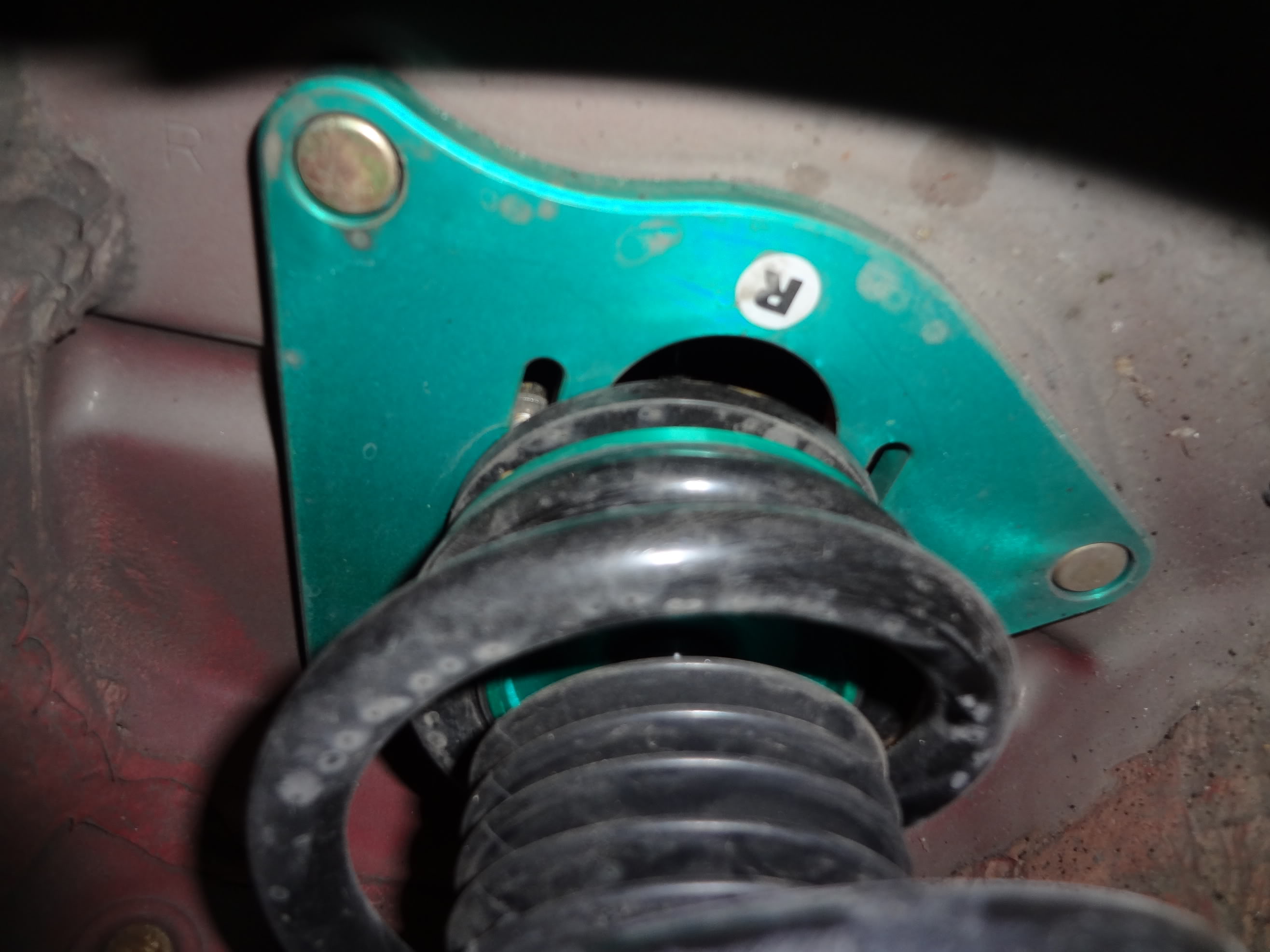
I'm not seeing an issue, but I took some pictures. Maybe a keen eye out there can notice something I can't.
I wish I had a lift so I could put it up, take off the rim, and turn the wheel left and right to inspect in full view.
I'm not seeing an issue, but I took some pictures. Maybe a keen eye out there can notice something I can't.
I wish I had a lift so I could put it up, take off the rim, and turn the wheel left and right to inspect in full view.
Trending Topics

6th Gear
Joined: Feb 2007
Posts: 1,521
Likes: 17
There are 2 possible fixes for this..
It is on the Megan site..
CDK: Why do I hear noise from coilovers?
[FONT=trebuchet ms,geneva]Megan Racing has designed a minimalist coil-over design that is easy to adjust and tighten, limiting the amount of hardware that may potentially become loose over time. With only a 17mm nut at the very top of the shock shaft to maintain its torque specification aside from the 3 locking spring perches in most applications, there is nothing difficult about diagnosing noise issues with the coil-overs. [/FONT]
[FONT=trebuchet ms,geneva]The noise that occurs from aftermarket coil-overs are more prevalent on McPherson strut suspension lay-outs since the entire strut assembly moves along with the hub/knuckle and the drive wheels, when the steering wheel is turned by the driver. All of the rotating forces that result from steering is transmitted through the coil-over assembly in a McPhersono strut lay-out, and when combined with the cornering loads on top of the rapid oscillation from bumps and dips in the road, there is no preventative maintenance to keep the shock body and spring perches from getting loose besides regular maintenance which is as simple as checking the coil-overs to make sure they are tight periodically. While it is good practice to do the same for double-wishbone suspension lay-outs, it is not necessary as double-wishbones do not turn the shock body when the steering wheel is turned.[/FONT]
[FONT=trebuchet ms,geneva]There are two typical noises that result from coil-overs:[/FONT]
[FONT=trebuchet ms,geneva]1) The first typical noises are commonly described as "rattling" and "clunking." [/FONT]
[FONT=trebuchet ms,geneva]2) The second typical noise from coil-over assemblies is "coil-bind."[/FONT]
[FONT=trebuchet ms,geneva]A) "RATTLING" AND "CLUNKING"[/FONT]
[FONT=trebuchet ms,geneva]The rattling and clunking usually sound like metal-to-metal contact and usually is a sharper, more direct noise. This first issue is caused by loose components of the coil-over assembly. The best way to diagnose this type of noise is to make sure all of the components of the coil-over assembly are tightened. [/FONT]
[FONT=trebuchet ms,geneva]1) First, you must understand that the entire "coil-over assembly" is built around the shock body-- the lower bracket is threaded onto the threaded shock body, and is locked in place by a single locking spring perch. On the piston shaft of the shock, there is a bumpstop and dust boot. The spring is held in place by two locking perches (locked against each other) on the shock body. Above the spring is the upper spring mount. On top of that is the pillow-ball upper mount, which has the lower and upper pillow-ball bearing surrounding it. The pillow-ball mount is usually incorporated into the top hat, which is what has the studs built in that bolts through the chassis holes. On McPerson strut applications, the pillow-ball mount is mounted onto the camber plate. [/FONT]
[FONT=trebuchet ms,geneva]2) Now that you are aware of the miscellaneous parts of a coil-over assembly, this first noise is usually caused by either the locking perches on the shock body being loose, or any of the components above the spring, which is all secured in place on the shock shaft by a single 17mm nut. To access the top 17mm nut, you must remove the damper adjustment **** which is simply threaded onto the very tip of the shock shaft.[/FONT]
[FONT=trebuchet ms,geneva]3) To tighten the 17mm nut, after the removal of the damper adjustment ****, the top of the shock shaft will be exposed. You will notice there is a 6-sided shape within the top of the piston shaft-- this is to be used for a hex tool of the appropriate size. All of our Megan Racing coil-over damper kits come with this hex tool for this very purpose (as well as to tighten the camber plate allen head bolts for strut applications). Using a closed-end wrench along with this hex tool, tighten the 17mm nut. The typical torque specification for an automotive 17mm bolt is about 40-60 lbs/in. This is a good baseline to aim for, but the critical part to take notice of is to make sure that as you are tightening the 17mm bolt, that the shock shaft is not rotating with the nut-- otherwise, the nut is not actually getting tightened. It is also a good safeguard to use an impact gun after the hex tool and wrench were used to assure that the assembly is tightened up to spec.[/FONT]
NOTE: Remember to torque the top 17mm nut at the top of all McPherson struts to 40-60ft/lbs with properly calibrated torque wrench. Improper torque specification can cause the assembly to come loose and cause symptomatic clunking noise, or may damage the threads on the shock shaft when overtorqued. The "crash bolts/eccentric bolts" holding the lower steel bracket onto the knuckle also needs specific torque specs. You will need to follow the OEM torque specifications for these bolts. Your local dealership should have these torque specifications for your particular vehicle. Torque specifications for these bolts are critical to the safe operation of your coil-overs on you vehicle. We recommend you double check these torque specs with the vehicle manufacturer. Please replace the bolts with brand new OEM hardware once torqued down to specification. Due to the nature of these bolts and the excessive loads it experiences, these bolts will stretch after repeated use, rendering the possibility of hardware failure. These are one-time-use only bolts. Failure to do so will void certain warranty applicability.
[FONT=trebuchet ms,geneva]B.) "COIL-BIND"[/FONT]
[FONT=trebuchet ms,geneva][/FONT]
[FONT=trebuchet ms,geneva]Coil-bind is only found on McPherson strut applications due to the nature of the strut design. Coil-bind is a "springy" noise that only occurs at low speeds while turning the wheel. Typically, coil-bind is usually experienced for example when maneuvering at slow speeds in a parking lot, where speeds are low and there are a lot of steering angle inputs. The "springy" noises is distinct from the sharper, more direct noises that occur when the assembly is loose and a component is rattling and clunking around from the miscellaneous loads stressed upon the coil-over assembly. [/FONT]
[FONT=trebuchet ms,geneva]Many times, coil-bind is difficult to diagnose and fix-- some vehicles experience this moreso than others, and it is not a brand-specific issue. What we have suggested as a coil-bind remedy is to apply grease to the upper and lower spring isolators, also referred to as noise prevention cushions. Grease should also be applied to the lower and upper pillow-ball bearing-- this step may require disassembly of the entire coil-over unit.[/FONT]
[FONT=trebuchet ms,geneva]The details of the coil-bind remedy are depicted in the following photo:[/FONT]
[FONT=trebuchet ms,geneva]CoilBindRemedy.jpg?t=1282084397[/FONT]
CDK: Why do I hear noise from coilovers?
[FONT=trebuchet ms,geneva]Megan Racing has designed a minimalist coil-over design that is easy to adjust and tighten, limiting the amount of hardware that may potentially become loose over time. With only a 17mm nut at the very top of the shock shaft to maintain its torque specification aside from the 3 locking spring perches in most applications, there is nothing difficult about diagnosing noise issues with the coil-overs. [/FONT]
[FONT=trebuchet ms,geneva]The noise that occurs from aftermarket coil-overs are more prevalent on McPherson strut suspension lay-outs since the entire strut assembly moves along with the hub/knuckle and the drive wheels, when the steering wheel is turned by the driver. All of the rotating forces that result from steering is transmitted through the coil-over assembly in a McPhersono strut lay-out, and when combined with the cornering loads on top of the rapid oscillation from bumps and dips in the road, there is no preventative maintenance to keep the shock body and spring perches from getting loose besides regular maintenance which is as simple as checking the coil-overs to make sure they are tight periodically. While it is good practice to do the same for double-wishbone suspension lay-outs, it is not necessary as double-wishbones do not turn the shock body when the steering wheel is turned.[/FONT]
[FONT=trebuchet ms,geneva]There are two typical noises that result from coil-overs:[/FONT]
[FONT=trebuchet ms,geneva]1) The first typical noises are commonly described as "rattling" and "clunking." [/FONT]
[FONT=trebuchet ms,geneva]2) The second typical noise from coil-over assemblies is "coil-bind."[/FONT]
[FONT=trebuchet ms,geneva]A) "RATTLING" AND "CLUNKING"[/FONT]
[FONT=trebuchet ms,geneva]The rattling and clunking usually sound like metal-to-metal contact and usually is a sharper, more direct noise. This first issue is caused by loose components of the coil-over assembly. The best way to diagnose this type of noise is to make sure all of the components of the coil-over assembly are tightened. [/FONT]
[FONT=trebuchet ms,geneva]1) First, you must understand that the entire "coil-over assembly" is built around the shock body-- the lower bracket is threaded onto the threaded shock body, and is locked in place by a single locking spring perch. On the piston shaft of the shock, there is a bumpstop and dust boot. The spring is held in place by two locking perches (locked against each other) on the shock body. Above the spring is the upper spring mount. On top of that is the pillow-ball upper mount, which has the lower and upper pillow-ball bearing surrounding it. The pillow-ball mount is usually incorporated into the top hat, which is what has the studs built in that bolts through the chassis holes. On McPerson strut applications, the pillow-ball mount is mounted onto the camber plate. [/FONT]
[FONT=trebuchet ms,geneva]2) Now that you are aware of the miscellaneous parts of a coil-over assembly, this first noise is usually caused by either the locking perches on the shock body being loose, or any of the components above the spring, which is all secured in place on the shock shaft by a single 17mm nut. To access the top 17mm nut, you must remove the damper adjustment **** which is simply threaded onto the very tip of the shock shaft.[/FONT]
[FONT=trebuchet ms,geneva]3) To tighten the 17mm nut, after the removal of the damper adjustment ****, the top of the shock shaft will be exposed. You will notice there is a 6-sided shape within the top of the piston shaft-- this is to be used for a hex tool of the appropriate size. All of our Megan Racing coil-over damper kits come with this hex tool for this very purpose (as well as to tighten the camber plate allen head bolts for strut applications). Using a closed-end wrench along with this hex tool, tighten the 17mm nut. The typical torque specification for an automotive 17mm bolt is about 40-60 lbs/in. This is a good baseline to aim for, but the critical part to take notice of is to make sure that as you are tightening the 17mm bolt, that the shock shaft is not rotating with the nut-- otherwise, the nut is not actually getting tightened. It is also a good safeguard to use an impact gun after the hex tool and wrench were used to assure that the assembly is tightened up to spec.[/FONT]
NOTE: Remember to torque the top 17mm nut at the top of all McPherson struts to 40-60ft/lbs with properly calibrated torque wrench. Improper torque specification can cause the assembly to come loose and cause symptomatic clunking noise, or may damage the threads on the shock shaft when overtorqued. The "crash bolts/eccentric bolts" holding the lower steel bracket onto the knuckle also needs specific torque specs. You will need to follow the OEM torque specifications for these bolts. Your local dealership should have these torque specifications for your particular vehicle. Torque specifications for these bolts are critical to the safe operation of your coil-overs on you vehicle. We recommend you double check these torque specs with the vehicle manufacturer. Please replace the bolts with brand new OEM hardware once torqued down to specification. Due to the nature of these bolts and the excessive loads it experiences, these bolts will stretch after repeated use, rendering the possibility of hardware failure. These are one-time-use only bolts. Failure to do so will void certain warranty applicability.
[FONT=trebuchet ms,geneva]B.) "COIL-BIND"[/FONT]
[FONT=trebuchet ms,geneva][/FONT]
[FONT=trebuchet ms,geneva]Coil-bind is only found on McPherson strut applications due to the nature of the strut design. Coil-bind is a "springy" noise that only occurs at low speeds while turning the wheel. Typically, coil-bind is usually experienced for example when maneuvering at slow speeds in a parking lot, where speeds are low and there are a lot of steering angle inputs. The "springy" noises is distinct from the sharper, more direct noises that occur when the assembly is loose and a component is rattling and clunking around from the miscellaneous loads stressed upon the coil-over assembly. [/FONT]
[FONT=trebuchet ms,geneva]Many times, coil-bind is difficult to diagnose and fix-- some vehicles experience this moreso than others, and it is not a brand-specific issue. What we have suggested as a coil-bind remedy is to apply grease to the upper and lower spring isolators, also referred to as noise prevention cushions. Grease should also be applied to the lower and upper pillow-ball bearing-- this step may require disassembly of the entire coil-over unit.[/FONT]
[FONT=trebuchet ms,geneva]The details of the coil-bind remedy are depicted in the following photo:[/FONT]
[FONT=trebuchet ms,geneva]CoilBindRemedy.jpg?t=1282084397[/FONT]
It is on the Megan site..
CDK: Why do I hear noise from coilovers?
[FONT=trebuchet ms,geneva]Megan Racing has designed a minimalist coil-over design that is easy to adjust and tighten, limiting the amount of hardware that may potentially become loose over time. With only a 17mm nut at the very top of the shock shaft to maintain its torque specification aside from the 3 locking spring perches in most applications, there is nothing difficult about diagnosing noise issues with the coil-overs. [/FONT]
[FONT=trebuchet ms,geneva]The noise that occurs from aftermarket coil-overs are more prevalent on McPherson strut suspension lay-outs since the entire strut assembly moves along with the hub/knuckle and the drive wheels, when the steering wheel is turned by the driver. All of the rotating forces that result from steering is transmitted through the coil-over assembly in a McPhersono strut lay-out, and when combined with the cornering loads on top of the rapid oscillation from bumps and dips in the road, there is no preventative maintenance to keep the shock body and spring perches from getting loose besides regular maintenance which is as simple as checking the coil-overs to make sure they are tight periodically. While it is good practice to do the same for double-wishbone suspension lay-outs, it is not necessary as double-wishbones do not turn the shock body when the steering wheel is turned.[/FONT]
[FONT=trebuchet ms,geneva]There are two typical noises that result from coil-overs:[/FONT]
[FONT=trebuchet ms,geneva]1) The first typical noises are commonly described as "rattling" and "clunking." [/FONT]
[FONT=trebuchet ms,geneva]2) The second typical noise from coil-over assemblies is "coil-bind."[/FONT]
[FONT=trebuchet ms,geneva]A) "RATTLING" AND "CLUNKING"[/FONT]
[FONT=trebuchet ms,geneva]The rattling and clunking usually sound like metal-to-metal contact and usually is a sharper, more direct noise. This first issue is caused by loose components of the coil-over assembly. The best way to diagnose this type of noise is to make sure all of the components of the coil-over assembly are tightened. [/FONT]
[FONT=trebuchet ms,geneva]1) First, you must understand that the entire "coil-over assembly" is built around the shock body-- the lower bracket is threaded onto the threaded shock body, and is locked in place by a single locking spring perch. On the piston shaft of the shock, there is a bumpstop and dust boot. The spring is held in place by two locking perches (locked against each other) on the shock body. Above the spring is the upper spring mount. On top of that is the pillow-ball upper mount, which has the lower and upper pillow-ball bearing surrounding it. The pillow-ball mount is usually incorporated into the top hat, which is what has the studs built in that bolts through the chassis holes. On McPerson strut applications, the pillow-ball mount is mounted onto the camber plate. [/FONT]
[FONT=trebuchet ms,geneva]2) Now that you are aware of the miscellaneous parts of a coil-over assembly, this first noise is usually caused by either the locking perches on the shock body being loose, or any of the components above the spring, which is all secured in place on the shock shaft by a single 17mm nut. To access the top 17mm nut, you must remove the damper adjustment **** which is simply threaded onto the very tip of the shock shaft.[/FONT]
[FONT=trebuchet ms,geneva]3) To tighten the 17mm nut, after the removal of the damper adjustment ****, the top of the shock shaft will be exposed. You will notice there is a 6-sided shape within the top of the piston shaft-- this is to be used for a hex tool of the appropriate size. All of our Megan Racing coil-over damper kits come with this hex tool for this very purpose (as well as to tighten the camber plate allen head bolts for strut applications). Using a closed-end wrench along with this hex tool, tighten the 17mm nut. The typical torque specification for an automotive 17mm bolt is about 40-60 lbs/in. This is a good baseline to aim for, but the critical part to take notice of is to make sure that as you are tightening the 17mm bolt, that the shock shaft is not rotating with the nut-- otherwise, the nut is not actually getting tightened. It is also a good safeguard to use an impact gun after the hex tool and wrench were used to assure that the assembly is tightened up to spec.[/FONT]
NOTE: Remember to torque the top 17mm nut at the top of all McPherson struts to 40-60ft/lbs with properly calibrated torque wrench. Improper torque specification can cause the assembly to come loose and cause symptomatic clunking noise, or may damage the threads on the shock shaft when overtorqued. The "crash bolts/eccentric bolts" holding the lower steel bracket onto the knuckle also needs specific torque specs. You will need to follow the OEM torque specifications for these bolts. Your local dealership should have these torque specifications for your particular vehicle. Torque specifications for these bolts are critical to the safe operation of your coil-overs on you vehicle. We recommend you double check these torque specs with the vehicle manufacturer. Please replace the bolts with brand new OEM hardware once torqued down to specification. Due to the nature of these bolts and the excessive loads it experiences, these bolts will stretch after repeated use, rendering the possibility of hardware failure. These are one-time-use only bolts. Failure to do so will void certain warranty applicability.
[FONT=trebuchet ms,geneva]B.) "COIL-BIND"[/FONT]
[FONT=trebuchet ms,geneva][/FONT]
[FONT=trebuchet ms,geneva]Coil-bind is only found on McPherson strut applications due to the nature of the strut design. Coil-bind is a "springy" noise that only occurs at low speeds while turning the wheel. Typically, coil-bind is usually experienced for example when maneuvering at slow speeds in a parking lot, where speeds are low and there are a lot of steering angle inputs. The "springy" noises is distinct from the sharper, more direct noises that occur when the assembly is loose and a component is rattling and clunking around from the miscellaneous loads stressed upon the coil-over assembly. [/FONT]
[FONT=trebuchet ms,geneva]Many times, coil-bind is difficult to diagnose and fix-- some vehicles experience this moreso than others, and it is not a brand-specific issue. What we have suggested as a coil-bind remedy is to apply grease to the upper and lower spring isolators, also referred to as noise prevention cushions. Grease should also be applied to the lower and upper pillow-ball bearing-- this step may require disassembly of the entire coil-over unit.[/FONT]
[FONT=trebuchet ms,geneva]The details of the coil-bind remedy are depicted in the following photo:[/FONT]
[FONT=trebuchet ms,geneva]CoilBindRemedy.jpg?t=1282084397[/FONT]
CDK: Why do I hear noise from coilovers?
[FONT=trebuchet ms,geneva]Megan Racing has designed a minimalist coil-over design that is easy to adjust and tighten, limiting the amount of hardware that may potentially become loose over time. With only a 17mm nut at the very top of the shock shaft to maintain its torque specification aside from the 3 locking spring perches in most applications, there is nothing difficult about diagnosing noise issues with the coil-overs. [/FONT]
[FONT=trebuchet ms,geneva]The noise that occurs from aftermarket coil-overs are more prevalent on McPherson strut suspension lay-outs since the entire strut assembly moves along with the hub/knuckle and the drive wheels, when the steering wheel is turned by the driver. All of the rotating forces that result from steering is transmitted through the coil-over assembly in a McPhersono strut lay-out, and when combined with the cornering loads on top of the rapid oscillation from bumps and dips in the road, there is no preventative maintenance to keep the shock body and spring perches from getting loose besides regular maintenance which is as simple as checking the coil-overs to make sure they are tight periodically. While it is good practice to do the same for double-wishbone suspension lay-outs, it is not necessary as double-wishbones do not turn the shock body when the steering wheel is turned.[/FONT]
[FONT=trebuchet ms,geneva]There are two typical noises that result from coil-overs:[/FONT]
[FONT=trebuchet ms,geneva]1) The first typical noises are commonly described as "rattling" and "clunking." [/FONT]
[FONT=trebuchet ms,geneva]2) The second typical noise from coil-over assemblies is "coil-bind."[/FONT]
[FONT=trebuchet ms,geneva]A) "RATTLING" AND "CLUNKING"[/FONT]
[FONT=trebuchet ms,geneva]The rattling and clunking usually sound like metal-to-metal contact and usually is a sharper, more direct noise. This first issue is caused by loose components of the coil-over assembly. The best way to diagnose this type of noise is to make sure all of the components of the coil-over assembly are tightened. [/FONT]
[FONT=trebuchet ms,geneva]1) First, you must understand that the entire "coil-over assembly" is built around the shock body-- the lower bracket is threaded onto the threaded shock body, and is locked in place by a single locking spring perch. On the piston shaft of the shock, there is a bumpstop and dust boot. The spring is held in place by two locking perches (locked against each other) on the shock body. Above the spring is the upper spring mount. On top of that is the pillow-ball upper mount, which has the lower and upper pillow-ball bearing surrounding it. The pillow-ball mount is usually incorporated into the top hat, which is what has the studs built in that bolts through the chassis holes. On McPerson strut applications, the pillow-ball mount is mounted onto the camber plate. [/FONT]
[FONT=trebuchet ms,geneva]2) Now that you are aware of the miscellaneous parts of a coil-over assembly, this first noise is usually caused by either the locking perches on the shock body being loose, or any of the components above the spring, which is all secured in place on the shock shaft by a single 17mm nut. To access the top 17mm nut, you must remove the damper adjustment **** which is simply threaded onto the very tip of the shock shaft.[/FONT]
[FONT=trebuchet ms,geneva]3) To tighten the 17mm nut, after the removal of the damper adjustment ****, the top of the shock shaft will be exposed. You will notice there is a 6-sided shape within the top of the piston shaft-- this is to be used for a hex tool of the appropriate size. All of our Megan Racing coil-over damper kits come with this hex tool for this very purpose (as well as to tighten the camber plate allen head bolts for strut applications). Using a closed-end wrench along with this hex tool, tighten the 17mm nut. The typical torque specification for an automotive 17mm bolt is about 40-60 lbs/in. This is a good baseline to aim for, but the critical part to take notice of is to make sure that as you are tightening the 17mm bolt, that the shock shaft is not rotating with the nut-- otherwise, the nut is not actually getting tightened. It is also a good safeguard to use an impact gun after the hex tool and wrench were used to assure that the assembly is tightened up to spec.[/FONT]
NOTE: Remember to torque the top 17mm nut at the top of all McPherson struts to 40-60ft/lbs with properly calibrated torque wrench. Improper torque specification can cause the assembly to come loose and cause symptomatic clunking noise, or may damage the threads on the shock shaft when overtorqued. The "crash bolts/eccentric bolts" holding the lower steel bracket onto the knuckle also needs specific torque specs. You will need to follow the OEM torque specifications for these bolts. Your local dealership should have these torque specifications for your particular vehicle. Torque specifications for these bolts are critical to the safe operation of your coil-overs on you vehicle. We recommend you double check these torque specs with the vehicle manufacturer. Please replace the bolts with brand new OEM hardware once torqued down to specification. Due to the nature of these bolts and the excessive loads it experiences, these bolts will stretch after repeated use, rendering the possibility of hardware failure. These are one-time-use only bolts. Failure to do so will void certain warranty applicability.
[FONT=trebuchet ms,geneva]B.) "COIL-BIND"[/FONT]
[FONT=trebuchet ms,geneva][/FONT]
[FONT=trebuchet ms,geneva]Coil-bind is only found on McPherson strut applications due to the nature of the strut design. Coil-bind is a "springy" noise that only occurs at low speeds while turning the wheel. Typically, coil-bind is usually experienced for example when maneuvering at slow speeds in a parking lot, where speeds are low and there are a lot of steering angle inputs. The "springy" noises is distinct from the sharper, more direct noises that occur when the assembly is loose and a component is rattling and clunking around from the miscellaneous loads stressed upon the coil-over assembly. [/FONT]
[FONT=trebuchet ms,geneva]Many times, coil-bind is difficult to diagnose and fix-- some vehicles experience this moreso than others, and it is not a brand-specific issue. What we have suggested as a coil-bind remedy is to apply grease to the upper and lower spring isolators, also referred to as noise prevention cushions. Grease should also be applied to the lower and upper pillow-ball bearing-- this step may require disassembly of the entire coil-over unit.[/FONT]
[FONT=trebuchet ms,geneva]The details of the coil-bind remedy are depicted in the following photo:[/FONT]
[FONT=trebuchet ms,geneva]CoilBindRemedy.jpg?t=1282084397[/FONT]
6th Gear
Joined: Feb 2007
Posts: 1,521
Likes: 17
In short spray the heck out of the perches top and bottom with some WD-40 for a quick fix test. The WD-40 won't last but so long, but you'll know if that fixes what you hear.
Tighten that top bolt they mention as well and you should be good to go..
Worked for me...
Tighten that top bolt they mention as well and you should be good to go..
Worked for me...

spring binding is common with some coilovers, some more expensive setups come with needle bearings to stop this from happening.
wd-40 wont keep noises from happening, maybe some heavier grease, bit wd-40 is for water displacement, not lubrication.
wd-40 wont keep noises from happening, maybe some heavier grease, bit wd-40 is for water displacement, not lubrication.
6th Gear
Joined: Feb 2007
Posts: 1,521
Likes: 17
As mentioned the WD-40 is just to figure out if that is part of his problem. It will work for a short period of time till he gets the better lubricate. Assuming that is the problem.. Everybody has a can of WD-40 around, and it is a type of lubricate as it stops squeaks on almost anything..


1st Gear
Joined: Aug 2011
Posts: 33
Likes: 1
Make sure that the springs are snug between the upper and lower perch while the suspension is at full droop.
The Megan perch is a pillow ball, right? If so there shouldn't be any binding whatsoever; the spring and damper spin in unison.
Also, make sure that the four allen screws/nuts are properly torqued...if you are okay with the camber setting use red locktite.
Do you have stock swaybar endlinks? Make sure these are in good shape. If either ball joint end on the endlink is worn you will hear odd noises...clicking/light clunking.
Make sure the ball joints are in good shape as well as the LCA bushings
Make sure the the pinch bolt in the knuckle is torqued properly as well.
The Megan perch is a pillow ball, right? If so there shouldn't be any binding whatsoever; the spring and damper spin in unison.
Also, make sure that the four allen screws/nuts are properly torqued...if you are okay with the camber setting use red locktite.
Do you have stock swaybar endlinks? Make sure these are in good shape. If either ball joint end on the endlink is worn you will hear odd noises...clicking/light clunking.
Make sure the ball joints are in good shape as well as the LCA bushings
Make sure the the pinch bolt in the knuckle is torqued properly as well.



Thread
Thread Starter
Forum
Replies
Last Post
squawSkiBum
MINI Parts for Sale
15
Oct 2, 2015 09:21 AM