


Drivetrain which intake?


Thread Starter
|
6th Gear
Joined: Sep 2004
Posts: 5,149
Likes: 0
which intake?
I have a Dinan CAI on my car and with the advent of the new M7AGS I have been re-thinking my choice. There is a hugs debate about the merits of the M7 but what I am looking for is which intake of all of them will give me the most performance with my list of mods?
Bob
Bob

3rd Gear
Joined: Apr 2003
Posts: 183
Likes: 0
From: greensboro, nc
you do bring up a good point. There are actually no proven dyno numbers for these intakes individually or with other mods. However, M7 is really the only company that gets slammed for not having dyno numbers for hp, though there was an independent test done on the system that showed a 20% increase in airflow.
I have an AGS, I also have 400cc injectors, 62mm throttlebody, 19% pulley, cat-back exhaust, and MTH software. Before the AGS I had a madness intake. The difference I notice is at the high end over the madness intake. In reality it may add only a couple more horses than a CAI. There is also a difference in sound because you can really hear the air being sucked in through the throttlebody and you can hear the SC spool up when you take off. I would recommend it because you could sell your dinan for a good price and that would bring the cost of the AGS down substantially. Hope that helps
I have an AGS, I also have 400cc injectors, 62mm throttlebody, 19% pulley, cat-back exhaust, and MTH software. Before the AGS I had a madness intake. The difference I notice is at the high end over the madness intake. In reality it may add only a couple more horses than a CAI. There is also a difference in sound because you can really hear the air being sucked in through the throttlebody and you can hear the SC spool up when you take off. I would recommend it because you could sell your dinan for a good price and that would bring the cost of the AGS down substantially. Hope that helps

6th Gear
Joined: Oct 2002
Posts: 3,652
Likes: 6
From: Lansdale, PA
Originally Posted by peterwhit
you do bring up a good point. There are actually no proven dyno numbers for these intakes individually or with other mods. However, M7 is really the only company that gets slammed for not having dyno numbers for hp, though there was an independent test done on the system that showed a 20% increase in airflow
M7 says the AGS outflows all other intakes on the market by a margin. If you believe that, despite the absence evidence to back that up, then buy the AGS by all means.


While the HP numbers are scarce, the flow numbers aren't.
The ags flows well. Search and there's a thread on that. It will outflow the JCW. I'd do an HAI or and AGS. But with the bigger TB etc, you're looking at a $350 delta to step up to the AGS (just my estimate, sell the JCW for $250....)
You could spend your $ on worse items......
Matt
You could spend your $ on worse items......
Matt


6th Gear
Joined: Mar 2004
Posts: 2,748
Likes: 0
From: Napa, CA
I just switched from a Dinan to an Alta and plan to go with the AGS soon. I like the quiteness of the Dinan but I also like the swoosh of the Alta at times. The Alta does seem to have a little more pickup and is slightly smoother than the Dinan but the Dinan is way better than stock. Can't speak for the AGS but Bill K. just switched from the Alta to the AGS and told me that it is like night and day.

6th Gear
Joined: Apr 2004
Posts: 1,179
Likes: 0
From: San Francisco Ca.
with your mods SpiderX, I'd say Alta or AGS. I think the AGS will bring out the most of your current mods. Alta looks cooler.
I can't wait to try one out, should be here next week.
Alta looks cooler. I can't wait to try one out, should be here next week.
Trending Topics
6th Gear
Joined: Apr 2004
Posts: 1,179
Likes: 0
From: San Francisco Ca.
Originally Posted by andy@ross-tech.com
Nope. There was a test done of ONE PART of the system. It is very likely that since the AGS has MUCH SMALLER FILTER AREA than the HAI, that the improvement in the one part is negated by losses in another part.
M7 says the AGS outflows all other intakes on the market by a margin. If you believe that, despite the absence evidence to back that up, then buy the AGS by all means.
M7 says the AGS outflows all other intakes on the market by a margin. If you believe that, despite the absence evidence to back that up, then buy the AGS by all means.
3rd Gear
Joined: Apr 2003
Posts: 183
Likes: 0
From: greensboro, nc
Andy,
could you please provide us with the numbers that show the AGS filter has a much smaller surface area than the HAI?
thanks.
could you please provide us with the numbers that show the AGS filter has a much smaller surface area than the HAI?
thanks.
Originally Posted by andy@ross-tech.com
Nope. There was a test done of ONE PART of the system. It is very likely that since the AGS has MUCH SMALLER FILTER AREA than the HAI, that the improvement in the one part is negated by losses in another part.
M7 says the AGS outflows all other intakes on the market by a margin. If you believe that, despite the absence evidence to back that up, then buy the AGS by all means.
M7 says the AGS outflows all other intakes on the market by a margin. If you believe that, despite the absence evidence to back that up, then buy the AGS by all means.

6th Gear
Joined: Mar 2004
Posts: 2,748
Likes: 0
From: Napa, CA
This argument over surface area is ridiculous. David Vizard - one of the most respected engine tuners in the world - did an airflow test on the same size filter for a Weber application and found that the air filter flowed several hundred times more than any four-cylinder engine could ever require. I will find the article, scan it, and post it here soon.
3rd Gear
Joined: Apr 2003
Posts: 183
Likes: 0
From: greensboro, nc
I think this post originally started out to help SpiderX decide on which air intake might be best for the maximum performance of his mini. Naturally, this would limit responses to people who have trid out one or more intake set-ups and their experiences with the set up. Those who feel the need to bash other products without numbers, personal experiences or other insight should probably save their comments for the threads that are appropriate. That being said:
- I felt an improvement in my engine's performance adding an AGS over a CAI
- danmcg really thinks the HAI was an improvement
- Rick-Anderson liked the alta over the dinan and is anticipating an AGS
other personal experiences with different intakes would really help out.
- I felt an improvement in my engine's performance adding an AGS over a CAI
- danmcg really thinks the HAI was an improvement
- Rick-Anderson liked the alta over the dinan and is anticipating an AGS
other personal experiences with different intakes would really help out.

i have the alta and love it if it helps
i'd wager that the ags will outflow everything else... im skeptical as to whether it'd make THAT much more power than any other system, but you put an alta in with hose, plus a tb and it'd be around the same cost as a ags... the question is sound really... that's how i look at it...
if i did the mini all over again and wanted the tb, i would've went with the ags, but since i have the alta and have no desire to change tb, im not swapping...
i'd wager that the ags will outflow everything else... im skeptical as to whether it'd make THAT much more power than any other system, but you put an alta in with hose, plus a tb and it'd be around the same cost as a ags... the question is sound really... that's how i look at it...
if i did the mini all over again and wanted the tb, i would've went with the ags, but since i have the alta and have no desire to change tb, im not swapping...

4th Gear
Joined: Mar 2005
Posts: 485
Likes: 0
The whole air flow argument seems somewhat silly in the absence of a statement of how much air the engine can usefully process per minute. Ever drink from a firehose? Darned great flow on those firehoses. :smile:
Of course, I say this with little background in engine and intake technology - my arguments are based wholly on simple minded understanding.
Of course, I say this with little background in engine and intake technology - my arguments are based wholly on simple minded understanding.

3rd Gear
Joined: Nov 2004
Posts: 171
Likes: 0
From: Hoboken, NJ
Originally Posted by neilgj
The whole air flow argument seems somewhat silly in the absence of a statement of how much air the engine can usefully process per minute. Ever drink from a firehose? Darned great flow on those firehoses. :smile:
Of course, I say this with little background in engine and intake technology - my arguments are based wholly on simple minded understanding.
Of course, I say this with little background in engine and intake technology - my arguments are based wholly on simple minded understanding.


Originally Posted by peterwhit
Andy,
could you please provide us with the numbers that show the AGS filter has a much smaller surface area than the HAI?
thanks.
could you please provide us with the numbers that show the AGS filter has a much smaller surface area than the HAI?
thanks.
HAI:
4x6.25x7 = filter area of 119 in^2
AGS filter:
11x5x3.25 = filter area of 90 in^2
Since each filter has rounded edges, I calculated areas based on the width of the filter being the diameter of the rounded edge. Looks like filter area of the HAI filter is about 32% larger than that of the AGS filter. Both are pleated, oiled-cotton filters between wire mesh, right?
Is the filter a bottleneck? Who knows?...
6th Gear
Joined: Oct 2002
Posts: 3,652
Likes: 6
From: Lansdale, PA
Originally Posted by neilgj
The whole air flow argument seems somewhat silly in the absence of a statement of how much air the engine can usefully process per minute. Ever drink from a firehose? Darned great flow on those firehoses. :smile:
Of course, I say this with little background in engine and intake technology - my arguments are based wholly on simple minded understanding.
Of course, I say this with little background in engine and intake technology - my arguments are based wholly on simple minded understanding.
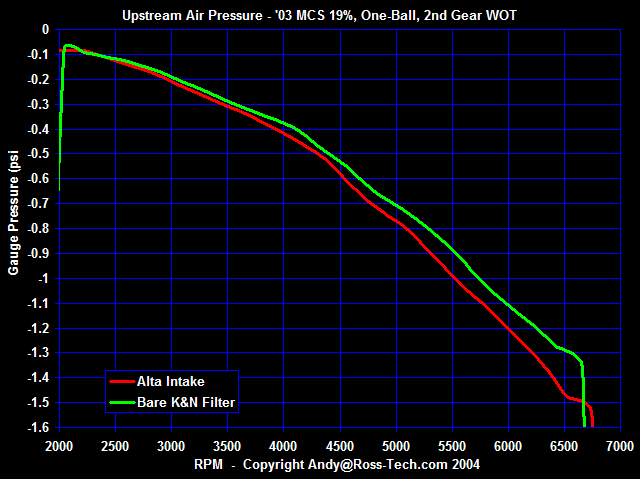
4th Gear
Joined: Mar 2005
Posts: 485
Likes: 0
Originally Posted by andy@ross-tech.com
Both the Alta intake and the HAI drink through firehoses.
This graph appears to show me that the difference in air flow (as measured by air pressure - upstream of what? by the way) between the Alta intake and a Bare K&N filter is pretty much insubstantial up to about 5000 RPM when it gets to about 10% - or - is this measuring how much air the engine is actually processing (sucking?) at these RPMs?
Does this graph somehow show that the engine cannot process or effectively utilize all the air supplied to it?
Dumb questions, I'm sure - please excuse me.
4th Gear
Joined: Mar 2005
Posts: 485
Likes: 0
Originally Posted by SpiderX
what is an HAI?
as opposed to
CAI = Cold Air Intake (Alta, Madness, the now notorious AGS, etc.)
Thread Starter
|
6th Gear
Joined: Sep 2004
Posts: 5,149
Likes: 0
Originally Posted by Rick-Anderson
I just switched from a Dinan to an Alta and plan to go with the AGS soon. I like the quiteness of the Dinan but I also like the swoosh of the Alta at times. The Alta does seem to have a little more pickup and is slightly smoother than the Dinan but the Dinan is way better than stock. Can't speak for the AGS but Bill K. just switched from the Alta to the AGS and told me that it is like night and day.
6th Gear
Joined: Mar 2004
Posts: 2,748
Likes: 0
From: Napa, CA
I believe the AGS system was designed to use with the stock or larger throttle body, so there should be no problems.
Yeah, where's the dyno number lynch mob on this one? 
What about the BMP? They claim 12 hp...........no one seems to talk about this one

6th Gear
Joined: Jan 2005
Posts: 1,719
Likes: 1
From: New Brunswick, NJ
I'd like to take the time to quote a guest lecturer I had in my Human Behavior class: (a student raises is hand, says his question may be stupid...) "[teacher's thick southern accent] Don't worry, there are no stupid questions." The student then asks his question....and the professor says, "[suprisingly even thicker accent] Son, I always say that there are no stupid questions, but that there may be the STUPIDEST question I have ever heard." Moral of the story: in the 21st century, do as I say, not as I do...heh.
BUT, back on topic...This is how I _humbly_ interpret the data. The idea of measuring pressure in a tube with moving fluid was used to derive the famous Bernoulli's Principle. Given the total energy equals potential and kinetic energy, Bernoulli's Principle partially defines the interplay we are looking at here. Thus...
The graph shows that the HAI is taking in a higher volume of air. Sorta. Since the pressure with the Alta intake is more negative, it is actually maintaining the highest driving force (suction) of the two. An important note: Bernoulli's principle tells us that (as long as the areas of a pipe where the measurements are taken are equal in size AND density is too), a measurement of lower pressure (therefore indicating less potential energy) will necessarily be accompanied by higher kinetic energy in that fluid. In simple terms, the Alta air is going faster.
On the other hand, the HAI, by virute of having a less negative pressure, appears to be sucking in more air because it produces less negative pressures (making the tube more filled with air at any given time). Mind you: the pressure is still negative, therefore the engine still wants/can use more air than it is given, because it is still sucking through the intake.
Now, unfortunately, we can't be absolutely sure of an answer with just that data. Pressure is dependent on air temperature, so that would need to factored in. If the HAI's air temp is significantly higher, there could actually be fewer molecules of gas in the tube, but they would be more spread out, hence higher pressure.
Can anyone chime in? Back to Renal Physiology and Medical Genetics. Hope this post finds you well.
BUT, back on topic...This is how I _humbly_ interpret the data. The idea of measuring pressure in a tube with moving fluid was used to derive the famous Bernoulli's Principle. Given the total energy equals potential and kinetic energy, Bernoulli's Principle partially defines the interplay we are looking at here. Thus...
The graph shows that the HAI is taking in a higher volume of air. Sorta. Since the pressure with the Alta intake is more negative, it is actually maintaining the highest driving force (suction) of the two. An important note: Bernoulli's principle tells us that (as long as the areas of a pipe where the measurements are taken are equal in size AND density is too), a measurement of lower pressure (therefore indicating less potential energy) will necessarily be accompanied by higher kinetic energy in that fluid. In simple terms, the Alta air is going faster.
On the other hand, the HAI, by virute of having a less negative pressure, appears to be sucking in more air because it produces less negative pressures (making the tube more filled with air at any given time). Mind you: the pressure is still negative, therefore the engine still wants/can use more air than it is given, because it is still sucking through the intake.
Now, unfortunately, we can't be absolutely sure of an answer with just that data. Pressure is dependent on air temperature, so that would need to factored in. If the HAI's air temp is significantly higher, there could actually be fewer molecules of gas in the tube, but they would be more spread out, hence higher pressure.
Can anyone chime in? Back to Renal Physiology and Medical Genetics. Hope this post finds you well.
Originally Posted by neilgj
This graph appears to show me that the difference in air flow (as measured by air pressure - upstream of what? by the way) between the Alta intake and a Bare K&N filter is pretty much insubstantial up to about 5000 RPM when it gets to about 10% - or - is this measuring how much air the engine is actually processing (sucking?) at these RPMs?
Does this graph somehow show that the engine cannot process or effectively utilize all the air supplied to it?
Does this graph somehow show that the engine cannot process or effectively utilize all the air supplied to it?