


Tail Lights, Instrument Light not working


Thread Starter
|
3rd Gear
Joined: Feb 2007
Posts: 169
Likes: 0
Tail Lights, Instrument Light not working
So I recently (about 2 weeks ago) got my first classic Mini. I had a R56 previously... but now have a RHD 1982 998cc Auto.
I drove it at night for the first time this weekend and the instrument light went out on me during the ride. At first I thought it was a loose bulb or the like but couldn't get it to come back on. I know the instrument light worked prior (it just has the center offset gauge in the car). Then I realized that the tail lights weren't working either nor the license plate lights. I've changed bulbs, checked the fuses and no luck.
The headlights work as do the turn signals, so I am thinking the first position on the switch could be bad? Any ideas? Any quick ways to test what the issue might be?
Thanks
I drove it at night for the first time this weekend and the instrument light went out on me during the ride. At first I thought it was a loose bulb or the like but couldn't get it to come back on. I know the instrument light worked prior (it just has the center offset gauge in the car). Then I realized that the tail lights weren't working either nor the license plate lights. I've changed bulbs, checked the fuses and no luck.
The headlights work as do the turn signals, so I am thinking the first position on the switch could be bad? Any ideas? Any quick ways to test what the issue might be?
Thanks

4th Gear

Joined: Dec 2004
Posts: 489
Likes: 72
From: Pittsburgh, PA
I had a similar problem with my '75. On mine there is an in-line fuse running along the firewall in the engine compartment (on the right as you stand in front of the car and face the engine of the RHD Mini). I pushed and twisted the fuse holder, removed the fuse, cleaned all contacts, and it worked fine once reassembled. I don't know if your car has the same setup, but it may be worth a look. Good luck!

OVERDRIVE
Joined: Jul 2006
Posts: 7,037
Likes: 283
From: Melbourne, FL
hint
you need to invest in the Haynes book . . . .
among many many other things you need that are in there are the pretty decent wiring diagrams.....
MiniMania has it - as do many other sources . . .
second remember this name .... you may hear it many many times in the future
L U C A S
here's a very important part to keep on hand at all times
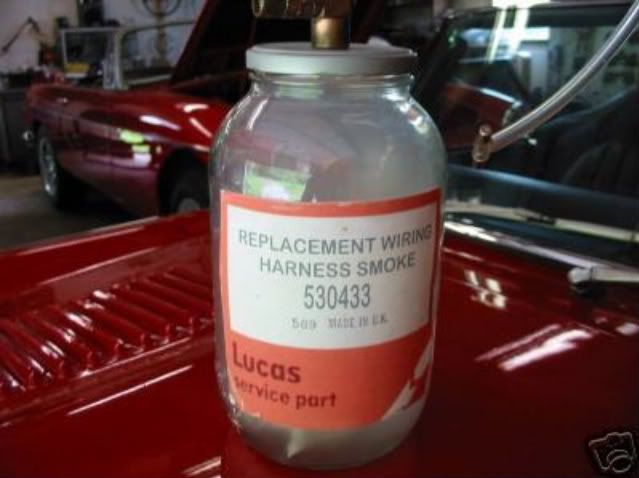
do you subscribe to MiniWorld? I recommend this too - GREAT tech articles every month. Not cheap but worth it. http://www.miniworld.co.uk/
you need to invest in the Haynes book . . . .
among many many other things you need that are in there are the pretty decent wiring diagrams.....
MiniMania has it - as do many other sources . . .
second remember this name .... you may hear it many many times in the future
L U C A S
here's a very important part to keep on hand at all times
do you subscribe to MiniWorld? I recommend this too - GREAT tech articles every month. Not cheap but worth it. http://www.miniworld.co.uk/

4th Gear
Joined: Sep 2007
Posts: 542
Likes: 0
From: Chandler, AZ
Look for the black wire with the melted insulation  Just kidding. Seriously though start at the trouble area and work your way toward the starter solenoid (inside wing by the clutch end of the engine). If it's not a blown fuse then it's likely that the 12v feed wire that powers those circuits has a break in it - likely between the dash area and the engine area. When I replaced my wiring harness I found a sheet metal screw that had pierced a wire which caused it to melt then break (long before I acquired the car). Hopefully yours is easier to fix.
If you don't have any luck let me know and I'll see if I can find a wiring diagram for your car that indicates the wire color/circuit for those systems.
Cheers,
Jeff
Just kidding. Seriously though start at the trouble area and work your way toward the starter solenoid (inside wing by the clutch end of the engine). If it's not a blown fuse then it's likely that the 12v feed wire that powers those circuits has a break in it - likely between the dash area and the engine area. When I replaced my wiring harness I found a sheet metal screw that had pierced a wire which caused it to melt then break (long before I acquired the car). Hopefully yours is easier to fix.If you don't have any luck let me know and I'll see if I can find a wiring diagram for your car that indicates the wire color/circuit for those systems.
Cheers,
Jeff
Trending Topics
OVERDRIVE
Joined: Jul 2006
Posts: 7,037
Likes: 283
From: Melbourne, FL
given the description of the particular lights out
I don't see an obvious circuit failure (only parts of a circuit are failing IMHO)
which TO ME suggests circuit tracing
Arn't we thankful the Mini electrical system is so simple and we ALL have good volt/amp meter?
I don't see an obvious circuit failure (only parts of a circuit are failing IMHO)
which TO ME suggests circuit tracing
Arn't we thankful the Mini electrical system is so simple and we ALL have good volt/amp meter?
Thread Starter
|
3rd Gear
Joined: Feb 2007
Posts: 169
Likes: 0
Well I did find a blown in-line fuse... It's listed as a 50A. I don't have a spare for that high an Amperage, going to run out and get one now. It was on a line following the choke cable into the dash, thinking this was the power to the light switch.
This makes sense to me, I believe first position on the switch would handle instrument light, license plate light, and tail lights.
I guess we'll know more when I get the fuse replaced.
I'll pick up some Lucas smoke too while I'm at it
This makes sense to me, I believe first position on the switch would handle instrument light, license plate light, and tail lights.
I guess we'll know more when I get the fuse replaced.
I'll pick up some Lucas smoke too while I'm at it
OVERDRIVE
Joined: Jul 2006
Posts: 7,037
Likes: 283
From: Melbourne, FL
OK
maybe you found your problem ... certainly there is a break at the blown fuse.
But let's think about what this blown fuse might be trying to tell us.
50 amps is HUGE in an automobile. 20 is huge. We're talking about a couple of lights .... small lights. How did the line draw over 50 amps to blow the fuse. I suspect there MUST be a short - HELLLLLOOOOOO Mr Lucas. Or there WAS a short (water in a light fixture) that might now be gone. My ancient TQM training taught me to ask WHY 5 times to try to get to the root of the problem.
I'd replace this fuse with a 20 amp and see what happens. If it blows then I'm gonna suspect a problem down the line some place.
Some people solve the problem of a fuse blowing over and over by continuing to increase the fuse size until it does not blow anymore. Not a recommended solution.
Many times when you buy a generic inline fuse holder they have a HUGE fuse in there, this does not stop you from puttin in a properly sized fuse for the application.
Just some thoughts I have...
I have just enough electrical knowledge to respect electricity and recognize that I don't fully understand it (despite enough college credits in the field to have a Masters in EE) nor every aspect of my car's electrical system. But I'm gaining on it. On Friday I'll tackle replacing my dizzy and trying to solve the miss problem that rose when I tried to replace by points with the 'fool proof Pertronix Ignitor II'
sigh
maybe you found your problem ... certainly there is a break at the blown fuse.
But let's think about what this blown fuse might be trying to tell us.
50 amps is HUGE in an automobile. 20 is huge. We're talking about a couple of lights .... small lights. How did the line draw over 50 amps to blow the fuse. I suspect there MUST be a short - HELLLLLOOOOOO Mr Lucas. Or there WAS a short (water in a light fixture) that might now be gone. My ancient TQM training taught me to ask WHY 5 times to try to get to the root of the problem.
I'd replace this fuse with a 20 amp and see what happens. If it blows then I'm gonna suspect a problem down the line some place.
Some people solve the problem of a fuse blowing over and over by continuing to increase the fuse size until it does not blow anymore. Not a recommended solution.
Many times when you buy a generic inline fuse holder they have a HUGE fuse in there, this does not stop you from puttin in a properly sized fuse for the application.
Just some thoughts I have...
I have just enough electrical knowledge to respect electricity and recognize that I don't fully understand it (despite enough college credits in the field to have a Masters in EE) nor every aspect of my car's electrical system. But I'm gaining on it. On Friday I'll tackle replacing my dizzy and trying to solve the miss problem that rose when I tried to replace by points with the 'fool proof Pertronix Ignitor II'
sigh
Thread Starter
|
3rd Gear
Joined: Feb 2007
Posts: 169
Likes: 0
Capt -
Couldn't agree more about finding the root cause. I put in a 25A and it blew instantly. So I began tracing the line. I first started with the left headlamp to check the wiring. As soon as I pulled it out I saw it... The leads for the driving lamp were touching. A few snips later and some new crimp connectors and it looked good. I then checked the other headlight and taillights but they looked good.
I put in another fuse and thus far all looks good. Now some may be wondering about a 50a vs 25a fuse. But from what I can gather a Lucas 50 is a set for a constant 17-20a with an immediate blow at 50a. Based on what I read with sfe and agc fuses, I went with a sfe 25 as they blow quicker than a acg one. Not sure if my conversion is correct or not...
Couldn't agree more about finding the root cause. I put in a 25A and it blew instantly. So I began tracing the line. I first started with the left headlamp to check the wiring. As soon as I pulled it out I saw it... The leads for the driving lamp were touching. A few snips later and some new crimp connectors and it looked good. I then checked the other headlight and taillights but they looked good.
I put in another fuse and thus far all looks good. Now some may be wondering about a 50a vs 25a fuse. But from what I can gather a Lucas 50 is a set for a constant 17-20a with an immediate blow at 50a. Based on what I read with sfe and agc fuses, I went with a sfe 25 as they blow quicker than a acg one. Not sure if my conversion is correct or not...

4th Gear
Joined: Sep 2005
Posts: 385
Likes: 0
Last edited by joltfreak; Nov 23, 2010 at 08:54 PM.

Thread
Thread Starter
Forum
Replies
Last Post
igzekyativ
MINIs & Minis for Sale
34
Jul 16, 2020 12:54 PM
triple5soul
R50/R53 :: Hatch Talk (2002-2006)
21
Jul 29, 2016 04:27 AM
igzekyativ
MINIs & Minis for Sale
28
Dec 23, 2015 10:36 AM