


M7... 180 Degree F Thermostat


Thread Starter
|
6th Gear
Joined: Jul 2002
Posts: 3,446
Likes: 10
From: L.A ca
M7... 180 Degree F Thermostat
We are pleased to announce the immediate availability of the new M7 180 degree F thermostat. We have been trying different combinations for the past few weeks and after extensive testing found this range to be the optimum . If you ever noticed how crisp and responsive your car was after that initial warm up and wanted to keep that feeling for the rest of the day this is the answer. Not only does the engine maintain its fresh start power the under hood temperatures are greatly diminished as noted below. Now when your car sits after a hard run it won't cook and dry out everything under the hood as bad as it did in the stock configuration. If you have ever gone and tried to work on your motor in anything less than 60 min you know what I am talking about. For those of you wondering why every mod costs so much how does $29.95 for the M7 Thermostat sound to you? Considering the stock factory unit costs over $40 I think you will agree this is a good price for a cool idea 
Randy
Team M7
Here's the # from today, measured from hard driving
1. IC manifold (in to IC) Mini Thermostat = 98 degrees. M7 Thermostat = 70 degrees
Delta = 18 degrees
2. Upper coolant hose Mini Thermostat = 190 degrees M7 Thermostat= 179 degrees
Delta = 11 degrees
3. SC at pulley shaft housing Mini Thermostat = 178 degrees M7 Thermostat =160 degrees
Delta = 18 degrees
4. Head at thermostat Mini Thermostat = 174 degrees M7 Thermostat = 153 degrees
Delta = 21 degrees
5. Idle with A/C Mini thermostat = 214 degrees M7 Thermostat =
185 degrees
Delta = 29 degrees
6. Coolant temp hard driving Mini Thermostat = 212 degrees M7 Thermostat = 180 degrees
Delta = 32 degrees
7. Outside Temp 80 degrees
8. Humidity 55%
9. Barometer 29.98 in
10.Test Instruments
a/ Snap On Tool's MT 3500 scanner
b/ Dwyer IR thermometer
Randy
Team M7
Here's the # from today, measured from hard driving
1. IC manifold (in to IC) Mini Thermostat = 98 degrees. M7 Thermostat = 70 degrees
Delta = 18 degrees
2. Upper coolant hose Mini Thermostat = 190 degrees M7 Thermostat= 179 degrees
Delta = 11 degrees
3. SC at pulley shaft housing Mini Thermostat = 178 degrees M7 Thermostat =160 degrees
Delta = 18 degrees
4. Head at thermostat Mini Thermostat = 174 degrees M7 Thermostat = 153 degrees
Delta = 21 degrees
5. Idle with A/C Mini thermostat = 214 degrees M7 Thermostat =
185 degrees
Delta = 29 degrees
6. Coolant temp hard driving Mini Thermostat = 212 degrees M7 Thermostat = 180 degrees
Delta = 32 degrees
7. Outside Temp 80 degrees
8. Humidity 55%
9. Barometer 29.98 in
10.Test Instruments
a/ Snap On Tool's MT 3500 scanner
b/ Dwyer IR thermometer

6th Gear
Joined: Apr 2003
Posts: 3,957
Likes: 2
From: a canyon, south Bay Area
I don't check the Vendor Announcements that often, but I'm glad that I did tonight. Those are very impressive deltas Randy!
I recently got the CarChip E/X to clear codes and do some data logging, and just tonight I decided to download my last 20 or so trips, and one of the criteria that I gather is coolant temp. I will try to attach the Excel sheet that reveals a rather mundane journey (no real hard driving) a little over an hour long, on a day that was a bit over 80 degrees ambient, if I recall correctly.
As one can see, I got around 223 degrees for a max (idle, not moving), with many 200+ readings (I have data recorded every 5 seconds). Again, this was not even driving hard, at least by my definition (one can see my speeds and intake manifold pressure to see what type of driving made for these temps).
Those temp drops are fantastic; better for the engine's health/longevity, and with the lower engine bay temps, that's got to be beneficial for performance.
I'm interested!
Looks like xls is not a valid extension Let me try putting it into Word... That is too large, so txt it is (harder to read though)
I recently got the CarChip E/X to clear codes and do some data logging, and just tonight I decided to download my last 20 or so trips, and one of the criteria that I gather is coolant temp. I will try to attach the Excel sheet that reveals a rather mundane journey (no real hard driving) a little over an hour long, on a day that was a bit over 80 degrees ambient, if I recall correctly.
As one can see, I got around 223 degrees for a max (idle, not moving), with many 200+ readings (I have data recorded every 5 seconds). Again, this was not even driving hard, at least by my definition (one can see my speeds and intake manifold pressure to see what type of driving made for these temps).
Those temp drops are fantastic; better for the engine's health/longevity, and with the lower engine bay temps, that's got to be beneficial for performance.
I'm interested!
Looks like xls is not a valid extension
Let me try putting it into Word... That is too large, so txt it is (harder to read though)
Last edited by TonyB; Jul 1, 2004 at 11:31 PM.
Thread Starter
|
6th Gear
Joined: Jul 2002
Posts: 3,446
Likes: 10
From: L.A ca
Originally Posted by J-Didi
Will it work on CVT model? How hard is it to install?
Randy
Team M7
www.m7tuning.com


Banned
Joined: Mar 2003
Posts: 2,859
Likes: 0
From: Plymouth, MN
Now this is a great announcement.
Very nicely done. I haven't installed it, and (of course) I don't think it will make any performan ce difference, but I agree with the numbers aspect.
Thanks for a good announcement.
Thanks for a good announcement.

6th Gear
Joined: Jun 2003
Posts: 3,589
Likes: 2
From: Oregon, USA
Why am I getting a vbulletin error when I try to view the thermostat pic? Says I don't have permission to view it.
Trending Topics

Banned
Joined: Mar 2003
Posts: 2,859
Likes: 0
From: Plymouth, MN
Another graph from the other thread.
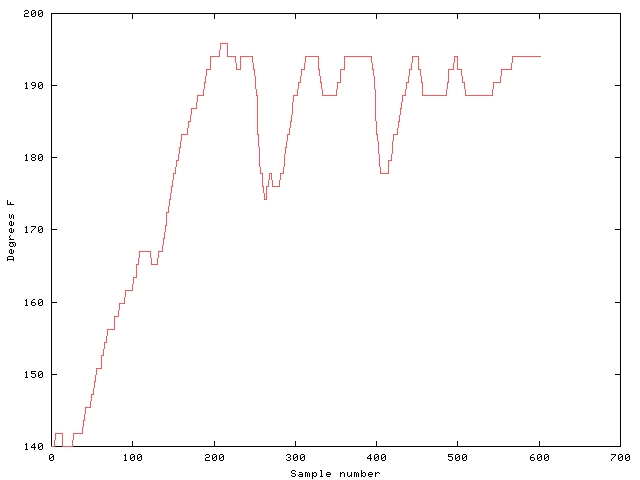
2002 MINI Cooper 5-speed normal driving with the normal thermostat.
(TonyB, send me your excel spreadsheet to kilian@bobodyne.com and I'll post a graph for you)


1st Gear
Joined: Jul 2003
Posts: 36
Likes: 0
From: Texas
Ok, im confused. We just learned about cooling systems yesterday and from what i recall;
A thermostat is designed to open at a set temperature to allow coolant to flow through the radiator and cool off, if it is not at that temperature the coolant will be circulated around the block through the water pump until it reaches that temperature and the thermostat opens, thereby allowing it to be cooled by ambient air. When reviewing my notes, cars of the 1980's ran 180 degree thermostats because that was thought to be optimal, but when running a 180 degree thermostat you get worse gas mileage, and more cylinder wear because the lubricants inside the engine are not at the optimal temperature(in comparison to a 196 degree thermostat). SO, cars of today run 196 degree thermostats because they burn less gas, and have less cylinder wear.
So this 180 degree thermostat is going to replace my 196 degree thermostat and make my car feel cooler, and more "crisp" at the cost of increased engine wear and worse gas mileage? I already think my mileage is bad anyways....
Dont mean to criticize your product Randy, but is that information skewed at all? If so please feel free to correct me, i am just learning...
Will.
A thermostat is designed to open at a set temperature to allow coolant to flow through the radiator and cool off, if it is not at that temperature the coolant will be circulated around the block through the water pump until it reaches that temperature and the thermostat opens, thereby allowing it to be cooled by ambient air. When reviewing my notes, cars of the 1980's ran 180 degree thermostats because that was thought to be optimal, but when running a 180 degree thermostat you get worse gas mileage, and more cylinder wear because the lubricants inside the engine are not at the optimal temperature(in comparison to a 196 degree thermostat). SO, cars of today run 196 degree thermostats because they burn less gas, and have less cylinder wear.
So this 180 degree thermostat is going to replace my 196 degree thermostat and make my car feel cooler, and more "crisp" at the cost of increased engine wear and worse gas mileage? I already think my mileage is bad anyways....
Dont mean to criticize your product Randy, but is that information skewed at all? If so please feel free to correct me, i am just learning...
Will.
Last edited by sevin626; Jul 2, 2004 at 10:58 AM.
Thread Starter
|
6th Gear
Joined: Jul 2002
Posts: 3,446
Likes: 10
From: L.A ca
Originally Posted by sevin626
Ok, im confused. We just learned about cooling systems yesterday and from what i recall;
A thermostat is designed to open at a set temperature to allow coolant to flow through the radiator and cool off, if it is not at that temperature the coolant will be circulated around the block through the water pump until it reaches that temperature and the thermostat opens, thereby allowing it to be cooled by ambient air. When reviewing my notes, cars of the 1980's ran 180 degree thermostats because that was thought to be optimal, but when running a 180 degree thermostat you get worse gas mileage, and more cylinder wear because the lubricants inside the engine are not at the optimal temperature(in comparison to a 196 degree thermostat). SO, cars of today run 196 degree thermostats because they burn less gas, and have less cylinder wear.
So this 180 degree thermostat is going to replace my 196 degree thermostat and make my car feel cooler, and more "crisp" at the cost of increased engine wear and worse gas mileage? I already think my mileage is bad anyways....
Dont mean to criticize your product Randy, but is that information skewed at all? If so please feel free to correct me, i am just learning...
Will.
A thermostat is designed to open at a set temperature to allow coolant to flow through the radiator and cool off, if it is not at that temperature the coolant will be circulated around the block through the water pump until it reaches that temperature and the thermostat opens, thereby allowing it to be cooled by ambient air. When reviewing my notes, cars of the 1980's ran 180 degree thermostats because that was thought to be optimal, but when running a 180 degree thermostat you get worse gas mileage, and more cylinder wear because the lubricants inside the engine are not at the optimal temperature(in comparison to a 196 degree thermostat). SO, cars of today run 196 degree thermostats because they burn less gas, and have less cylinder wear.
So this 180 degree thermostat is going to replace my 196 degree thermostat and make my car feel cooler, and more "crisp" at the cost of increased engine wear and worse gas mileage? I already think my mileage is bad anyways....
Dont mean to criticize your product Randy, but is that information skewed at all? If so please feel free to correct me, i am just learning...
Will.
I don't think we can compare cars 20 years old with the engines of today . Fuel management, engine materials , combustion chamber design and even the fuel itself have changed in many ways. As for getting worse gas mileage I would need to seethe numbers on that myself. personally my mini gets so much better mileage than my other toy ( 7 MPG ) I don't really factor that in when i have made my other changes , headers bigger injectors , tires etc. As that is a real concern for many people we will try to keep a eye on that but at this point have no numbers for you either way. If it does prove to hurt the cars mileage in any way this would be in keeping with most performance improvements however and to me the mere fact that it is running cooler sitting in traffic on the San Diego Fwy is well worth it IMHO.
Lubricants not reaching optimal temp? I am not an expert in that area by any means but we have been told that 180 Degrees F was well within optimal operating range of all engine components including lubricants. The recommended oil viscosity is 5 to 30 from what I recall which would work well at the lower temp. If you have numbers to the contrary would love to see them .
Increased engine wear ? I cant see how running your motor at a higher temp is always good for it.The fuel may burn a bit more efficiently but at what cost? Just the longer cool down time every time you turn it off has to wear out your wiring , rubber seals and on and on. The main reason the cars are set this high from the factory is to pass smog. They are ALL set to run a high temp in order to cover the few that are " dirtier " than the rest. A MFG doesn't want to get in a bind selling a car that wont pass smog so they set all cars with a lot of room to spare in that area. In doing so most of the cars are way under the state limits leaving room for improvement IE: 180 Degree thermostat.We have already sent our test mule thru CA smog check in case you were wondering and it passed easily.
I hope I have helped answer a few of your well stated questions and thank you for the post.
Randy
Team M7
www.m7tuning.com

2nd Gear
Joined: Feb 2003
Posts: 115
Likes: 0
From: Southern California
Originally Posted by maxmini
Here's the # from today, measured from hard driving
1. IC manifold (in to IC) Mini Thermostat = 98 degrees. M7 Thermostat = 70 degrees
Delta = 18 degrees
2. Upper coolant hose Mini Thermostat = 190 degrees M7 Thermostat= 179 degrees
Delta = 11 degrees
3. SC at pulley shaft housing Mini Thermostat = 178 degrees M7 Thermostat =160 degrees
Delta = 18 degrees
4. Head at thermostat Mini Thermostat = 174 degrees M7 Thermostat = 153 degrees
Delta = 21 degrees
5. Idle with A/C Mini thermostat = 214 degrees M7 Thermostat =
185 degrees
Delta = 29 degrees
6. Coolant temp hard driving Mini Thermostat = 212 degrees M7 Thermostat = 180 degrees
Delta = 32 degrees
7. Outside Temp 80 degrees
8. Humidity 55%
9. Barometer 29.98 in
10.Test Instruments
a/ Snap On Tool's MT 3500 scanner
b/ Dwyer IR thermometer
It is obvious though that the temps do drop.


Former Vendor
Joined: Jul 2003
Posts: 1,594
Likes: 2
From: los angeles
The coolant temps were read with a scanner directly from the temp sensors
on the block/head. The Ir thermometer with a laser pointer was used for surface temperatures only......
peter
Team M7
www.m7tuning.com
on the block/head. The Ir thermometer with a laser pointer was used for surface temperatures only......
peter
Team M7
www.m7tuning.com

6th Gear
Joined: Oct 2002
Posts: 3,652
Likes: 6
From: Lansdale, PA
Originally Posted by maxmini
We are pleased to announce the immediate availability of the new M7 180 degree F thermostat. We have been trying different combinations for the past few weeks and after extensive testing found this range to be the optimum . If you ever noticed how crisp and responsive your car was after that initial warm up and wanted to keep that feeling for the rest of the day this is the answer. Not only does the engine maintain its fresh start power the under hood temperatures are greatly diminished as noted below. Now when your car sits after a hard run it won't cook and dry out everything under the hood as bad as it did in the stock configuration. If you have ever gone and tried to work on your motor in anything less than 60 min you know what I am talking about. For those of you wondering why every mod costs so much how does $29.95 for the M7 Thermostat sound to you? Considering the stock factory unit costs over $40 I think you will agree this is a good price for a cool idea
Randy
Team M7
Here's the # from today, measured from hard driving
1. IC manifold (in to IC) Mini Thermostat = 98 degrees. M7 Thermostat = 70 degrees
Delta = 18 degrees
2. Upper coolant hose Mini Thermostat = 190 degrees M7 Thermostat= 179 degrees
Delta = 11 degrees
3. SC at pulley shaft housing Mini Thermostat = 178 degrees M7 Thermostat =160 degrees
Delta = 18 degrees
4. Head at thermostat Mini Thermostat = 174 degrees M7 Thermostat = 153 degrees
Delta = 21 degrees
5. Idle with A/C Mini thermostat = 214 degrees M7 Thermostat =
185 degrees
Delta = 29 degrees
6. Coolant temp hard driving Mini Thermostat = 212 degrees M7 Thermostat = 180 degrees
Delta = 32 degrees
7. Outside Temp 80 degrees
8. Humidity 55%
9. Barometer 29.98 in
10.Test Instruments
a/ Snap On Tool's MT 3500 scanner
b/ Dwyer IR thermometer
Randy
Team M7
Here's the # from today, measured from hard driving
1. IC manifold (in to IC) Mini Thermostat = 98 degrees. M7 Thermostat = 70 degrees
Delta = 18 degrees
2. Upper coolant hose Mini Thermostat = 190 degrees M7 Thermostat= 179 degrees
Delta = 11 degrees
3. SC at pulley shaft housing Mini Thermostat = 178 degrees M7 Thermostat =160 degrees
Delta = 18 degrees
4. Head at thermostat Mini Thermostat = 174 degrees M7 Thermostat = 153 degrees
Delta = 21 degrees
5. Idle with A/C Mini thermostat = 214 degrees M7 Thermostat =
185 degrees
Delta = 29 degrees
6. Coolant temp hard driving Mini Thermostat = 212 degrees M7 Thermostat = 180 degrees
Delta = 32 degrees
7. Outside Temp 80 degrees
8. Humidity 55%
9. Barometer 29.98 in
10.Test Instruments
a/ Snap On Tool's MT 3500 scanner
b/ Dwyer IR thermometer
Did you measure any coolant temp while driving or only afterwards?
What is a Snap-On MT 3500? I can't find any reference to it, but there is a Snap-on MT 2500.
What is the initial temp and fully open temp for the stock thermostat (it's rated at 90.5 C or 195F). What is the initial temp and fully open temp for your replacement thermostat (you rate it at 180F)
How hard is it to install the thermostat?

Banned
Joined: Mar 2003
Posts: 2,859
Likes: 0
From: Plymouth, MN
TonyB's data as graphs.

Notice the intake and coolant temperatures go up at the end of the graph when the speed == zero. Cool (Well, HOT)
Also, I think I can see the radiator fan cycling at samples 250 - 300 and again at samples 825 - 900
It's interesting to see the steady-state coolant temperature of right near 195 degrees F from samples 425-550 and again from 600-800 when he's dribing down the freeway at about 55 MPH.
Thread Starter
|
6th Gear
Joined: Jul 2002
Posts: 3,446
Likes: 10
From: L.A ca
Originally Posted by andy@ross-tech.com
Thanks for posting data! It is a refreshing development for your company. I have a few questions:
Did you measure any coolant temp while driving or only afterwards?
What is a Snap-On MT 3500? I can't find any reference to it, but there is a Snap-on MT 2500.
What is the initial temp and fully open temp for the stock thermostat (it's rated at 90.5 C or 195F). What is the initial temp and fully open temp for your replacement thermostat (you rate it at 180F)
How hard is it to install the thermostat?
Did you measure any coolant temp while driving or only afterwards?
What is a Snap-On MT 3500? I can't find any reference to it, but there is a Snap-on MT 2500.
What is the initial temp and fully open temp for the stock thermostat (it's rated at 90.5 C or 195F). What is the initial temp and fully open temp for your replacement thermostat (you rate it at 180F)
How hard is it to install the thermostat?
We were getting real time readings from the 2500 as we drove so to answer the question about the coolant temp I believe we got that number while driving . The idle numbers were back at the shop. Our thermostat opens at rite at about 180 which we further confirmed tonight on our third install. As for what temp the stock one opens at I do not recall as it was too high for our needs at any point. My car continually ran up to 210 to 215 and its not even summer yet. Define " initial temp " please . Not quite sure of what you are looking for there or of how it pertains to the this discussion. Wouldnt the initial temp have everything to do with the local weather? As for how hard is the thermostat to install that is all relative to ones capabilities as a mechanic. Lets say if someone is comfortable with taking the head off this would be a piece of cake. Not saying you need to do that by any means but I am trying to provide a answer to a very open ended question. There is one of the three screws necessary to get the housing off the side of the head that is a bear to get to . Other than that it would be a easy deal for the most part.
Thanks for the post by the way and we were waiting for you to chime in. We were wondering where you had gone off to as you never responded to our offer to provide the intake hose you were looking for back on the 25th?
" Andy looks like a good idea . I think we can come up with that. Peter would like to know how long you would like the hose to be?
Randy
Team M7 "
In any event the offer still stands . thanks again for the support and have a great holiday weekend.
Randy
Team M7
www.m7tuning.com

3rd Gear
Joined: May 2004
Posts: 224
Likes: 0
From: Louisiana
WOW! Randy, I noticed that the data in Trippy's post of TonyB's graph show that when the car stops (or is shut off) is when the engine really seems to COOK! Even if the fan cycles there is still a pretty high temp.
With your thermostat, do you think that the "final" temp after stopping would be correspondingly lower? Seems like it would to me.
I'd love to see the same type of graph with the new tstat.:smile: Looks like there is a lot of interest in this product.
With your thermostat, do you think that the "final" temp after stopping would be correspondingly lower? Seems like it would to me.
I'd love to see the same type of graph with the new tstat.:smile: Looks like there is a lot of interest in this product.
Thread Starter
|
6th Gear
Joined: Jul 2002
Posts: 3,446
Likes: 10
From: L.A ca
Originally Posted by J-Didi
WOW! Randy, I noticed that the data in Trippy's post of TonyB's graph show that when the car stops (or is shut off) is when the engine really seems to COOK! Even if the fan cycles there is still a pretty high temp.
With your thermostat, do you think that the "final" temp after stopping would be correspondingly lower? Seems like it would to me.
I'd love to see the same type of graph with the new tstat.:smile: Looks like there is a lot of interest in this product.
With your thermostat, do you think that the "final" temp after stopping would be correspondingly lower? Seems like it would to me.
I'd love to see the same type of graph with the new tstat.:smile: Looks like there is a lot of interest in this product.
Randy
Team M7
www.m7tuning.com

Banned
Joined: Mar 2003
Posts: 2,859
Likes: 0
From: Plymouth, MN
I predict the same "baking" effect with the new thermostat.
Originally Posted by maxmini
We definatly feel that the lower operating overallof the engine will also help lower the " baking " effect as the motor will never get as hot as it would in the stock configuration.
Tony B will be getting one of our items shortly and perhaps he could re do the same test as he did with the stock and we would have a nice comparison of apples to apples.
Tony B will be getting one of our items shortly and perhaps he could re do the same test as he did with the stock and we would have a nice comparison of apples to apples.
I'm going to make a prdiction you won't like though.
I don't see how a lower temperature thermostat will affect the "Baking" when the car is not moving.
Since the radiator fan will turn on and off at the same temperature as before I am going to predict that the coolant temperatures will rise just as high as with a higher temperature thermostat installed when the car is not moving and is running.
There I said it. A prediction that can be tested. Now all we need to do is depend on TonyB to try it for us.