


Suspension Greasable Heim joint control arms


Greasable Heim joint control arms
I recently replaced my H-spoprt control arms with greasable heim joint ones from Out Pace Racing. (Based on the spherical bearing manual I read at Boeing): I went with these because I’m not a fan of teflon lined ball joints; the glass-teflon ones are somewhat better, but nothing matches a greased steel on steel joint for service life as long as you keep them greased and clean.
I went with 3/4 “ diameter rod ends and paid a little extra for 4130 over mild steel. The Out Pace arms are not made specifically for the Mini, so I had to scrounge a few pieces to make them work, shown in this picture.
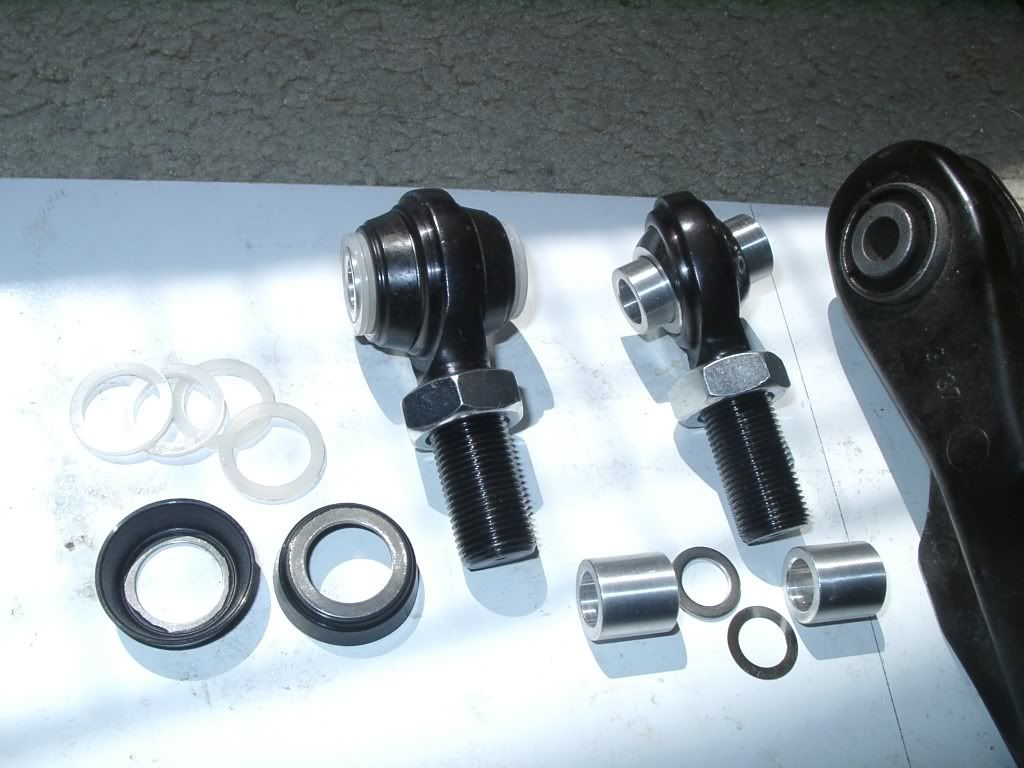
I made the each of solid posts that go between the attach flanges on the car from a couple of 3/4” o.d. aluminum spacers and a couple of shim washers. I sealed the ends with steel/rubber hickies from Midwest Controls. The nylon washers were used to locate the arms in the center of the slot on the car and to compress the rubber seals.
I shimmed the i.d. of the aluminum spacers down to the metric attach bolt o.d. using beer can aluminum. Since this was a high class install, I didn’t skimp and went with Pabst Draft instead of Pabst Blue Ribbon. I got one arm’s worth of shims from each beer can. So, just like Moss Motors or somebody rates parts installs by the number of wrenches required, I rate this as a four beer install. I lined up the arms exactly at the start:
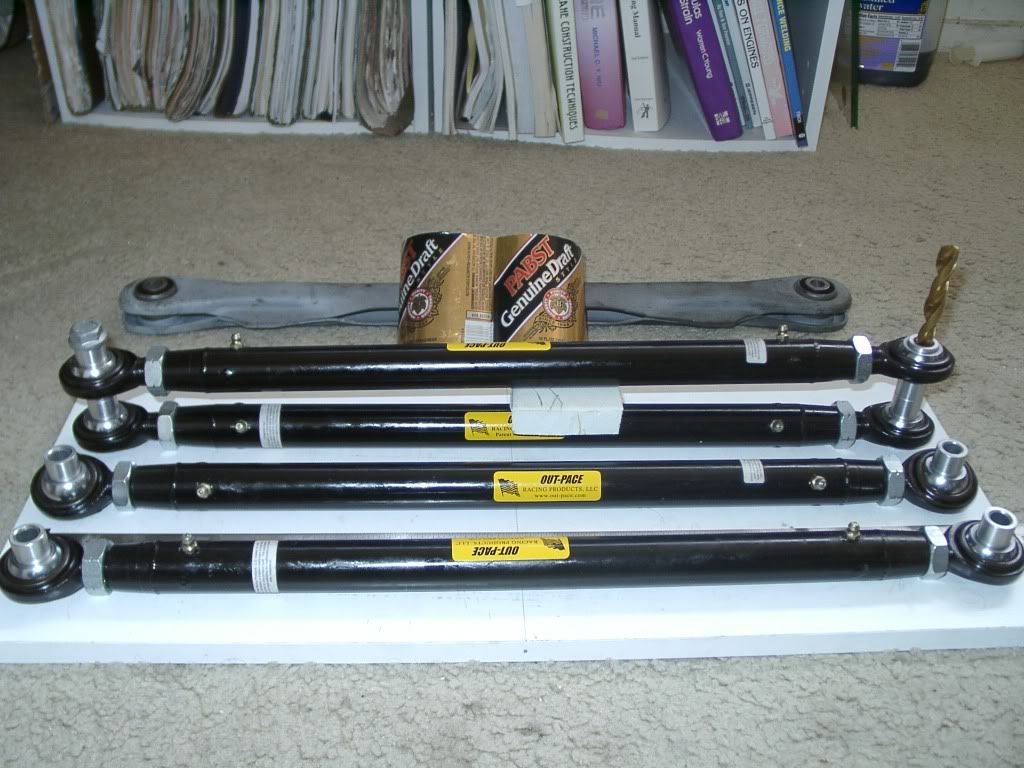
Here are the arms installed.

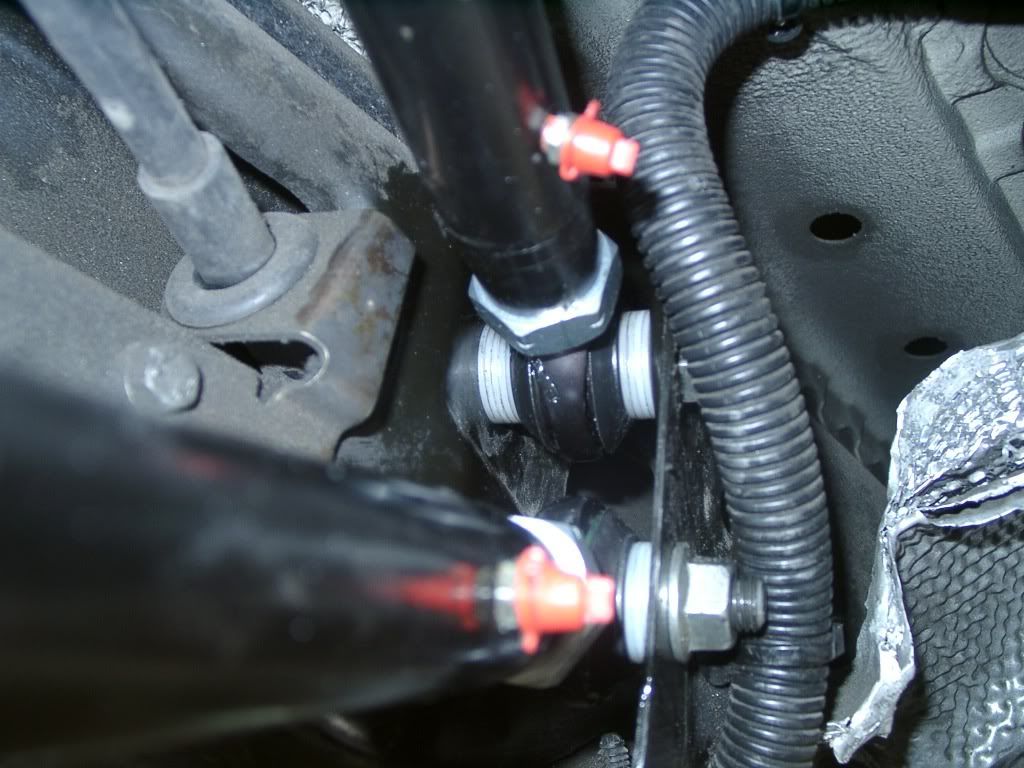
The second shot shows the nylon spacers locating the arms and squishing the seals up against the rod ends.
I haven’t pushed the car hard enough in turns yet to slide it, but a couple of things are obvious. First, the claim that heim joints aren’t as comfortable as rubber bushed ones is totally bogus; these are MORE comfortable than the stockers and the H-sports; the car just seems to glide more smoothly over bumps instead of bouncing. This is really hard to describe because I’m not a racer/hotshot driver, but what I just said is the best way I know how.
Secondly, the back end just seems more solid or planted. Again, this is hard to describe and I need to drive it harder to be sure.
I went with 3/4 “ diameter rod ends and paid a little extra for 4130 over mild steel. The Out Pace arms are not made specifically for the Mini, so I had to scrounge a few pieces to make them work, shown in this picture.
I made the each of solid posts that go between the attach flanges on the car from a couple of 3/4” o.d. aluminum spacers and a couple of shim washers. I sealed the ends with steel/rubber hickies from Midwest Controls. The nylon washers were used to locate the arms in the center of the slot on the car and to compress the rubber seals.
I shimmed the i.d. of the aluminum spacers down to the metric attach bolt o.d. using beer can aluminum. Since this was a high class install, I didn’t skimp and went with Pabst Draft instead of Pabst Blue Ribbon. I got one arm’s worth of shims from each beer can. So, just like Moss Motors or somebody rates parts installs by the number of wrenches required, I rate this as a four beer install. I lined up the arms exactly at the start:
Here are the arms installed.
The second shot shows the nylon spacers locating the arms and squishing the seals up against the rod ends.
I haven’t pushed the car hard enough in turns yet to slide it, but a couple of things are obvious. First, the claim that heim joints aren’t as comfortable as rubber bushed ones is totally bogus; these are MORE comfortable than the stockers and the H-sports; the car just seems to glide more smoothly over bumps instead of bouncing. This is really hard to describe because I’m not a racer/hotshot driver, but what I just said is the best way I know how.
Secondly, the back end just seems more solid or planted. Again, this is hard to describe and I need to drive it harder to be sure.


no, they do not squeak; they're greased.
they also don't klunk or click-clack, at least given the cornering i've done so far (= less than sliding.)
additional information on the parts:
the steel arms are 1 1/8" o.d. my pictures show 18" long upper arms and 17" lower arms, but i now think that the 18" uppers are a bit too long; 17" would be ok for both. if you get a different rod end size, you may need different length arms. i believe aluminum hex arms are available in 17.5" length, which would probably also be ok for length, depending on how much you lower the car. the stock arms are 20 & 59/64" c-c (534mm); with 3/4" rod ends, the 18" arms give a 20 & 1/16th" c-c minimum length (so they can't be used unless you are lowering the car); the 17" arms are an inch shorter, so some threads would be hanging out of the upper arms using this length.
the aluminum spacers i used are from---ready----wait for it-----aluminum spacers.com. they are nominally 3/4" o.d. x 3/4" long x .509" i.d. i had to hand lap fit them down to the precision .500" bore on the rod ends.
the inner stainless shim washers are from mcmaster carr (actually seastrom brand.) both are nominally .75" o.d. x .500" i.d. one is nominally .062", the other nominally .010" the o.d.s on these also had to be reduced slightly to fit the rod end bore.
two of the spacers and one of each of the washers were stacked up to give the equivalent of the measured stock width = 1.572"
the nylon washers were also seastrom/mcmaster carr. they are .75" i.d. x 1.0" o.d. x .0625" i used 9 of these on each end in conjunction with the midwest controls 3/4" i.d. seals.
pabst was purchased from ralph's. (toungue sticking out smiley.)
even the expensive 4130 stuff from out pace all came to $319 for 4 arms. i suspect that one of the mini vendors could come up with machined pieces to fit these instead of the kluge i used and still be competive in price with the other arm sets on the market......
they also don't klunk or click-clack, at least given the cornering i've done so far (= less than sliding.)
additional information on the parts:
the steel arms are 1 1/8" o.d. my pictures show 18" long upper arms and 17" lower arms, but i now think that the 18" uppers are a bit too long; 17" would be ok for both. if you get a different rod end size, you may need different length arms. i believe aluminum hex arms are available in 17.5" length, which would probably also be ok for length, depending on how much you lower the car. the stock arms are 20 & 59/64" c-c (534mm); with 3/4" rod ends, the 18" arms give a 20 & 1/16th" c-c minimum length (so they can't be used unless you are lowering the car); the 17" arms are an inch shorter, so some threads would be hanging out of the upper arms using this length.
the aluminum spacers i used are from---ready----wait for it-----aluminum spacers.com. they are nominally 3/4" o.d. x 3/4" long x .509" i.d. i had to hand lap fit them down to the precision .500" bore on the rod ends.
the inner stainless shim washers are from mcmaster carr (actually seastrom brand.) both are nominally .75" o.d. x .500" i.d. one is nominally .062", the other nominally .010" the o.d.s on these also had to be reduced slightly to fit the rod end bore.
two of the spacers and one of each of the washers were stacked up to give the equivalent of the measured stock width = 1.572"
the nylon washers were also seastrom/mcmaster carr. they are .75" i.d. x 1.0" o.d. x .0625" i used 9 of these on each end in conjunction with the midwest controls 3/4" i.d. seals.
pabst was purchased from ralph's. (toungue sticking out smiley.)
even the expensive 4130 stuff from out pace all came to $319 for 4 arms. i suspect that one of the mini vendors could come up with machined pieces to fit these instead of the kluge i used and still be competive in price with the other arm sets on the market......
Last edited by flyboy2160; May 29, 2008 at 08:19 AM. Reason: spelling and grammar

thanks matt.
 but imported beer would cost MORE
Trending Topics


4th Gear
Joined: May 2007
Posts: 411
Likes: 0
From: Los Angeles, CA
I haven’t pushed the car hard enough in turns yet to slide it, but a couple of things are obvious. First, the claim that heim joints aren’t as comfortable as rubber bushed ones is totally bogus; these are MORE comfortable than the stockers and the H-sports; the car just seems to glide more smoothly over bumps instead of bouncing. This is really hard to describe because I’m not a racer/hotshot driver, but what I just said is the best way I know how.
It's more comfortable because (if your car is lower than stock) the original suspension pieces that were designed to perform best at original height are placed in a bind when lowering the car. The heim joint arms relieve this bind allowing for better suspension travel. The arms look great! Good job.
i put the h-sports on when i first lowered it (if i recall, barely over an inch) with eibach springs and stock shocks. at that time, i didn't think the eibachs made the ride stiffer.
the car is now lower with bc coilovers. the heim joints have made this ride height seem much softer/glide more easily over bumps.
but, as an eibach tech guy first pointed out to me, the car is still within the suspension travel range of the original setup. i've always called the stock and h-sport rubber bushings "poor man's heim joints." perhaps they just get closer to their limit and thus become non-linearly stiffer???? or the eibachs and the h-sport spring rates just work ok together?????
man, i wish mini engineers would post on these forums......even if they had to waive all responsibility for what they said....

6th Gear
Joined: Jan 2003
Posts: 3,301
Likes: 1
Tires and bushing deflect, making these essentially uncontrolled springs. I too noticed the smoothness after installing rod ends on my car. The back end was also incredibly stable...I could approach turns recklessly as well. Unfortunately for me, I drive about 60K miles a year on really bad roads and the rod ends eventually wore out. But for those of you who do not eat up the world in your cars, this is a great mod!!!
Nice work Flyboy2160
Nice work Flyboy2160
the boeing data i recall indicates that the dirt getting into the joint and acting as a lapping compound loosens the joints up (structural failure doesn't loosen them). the teflon-only lined ones will just creep under load; they're ok for lightly loaded mechanisms, but no way for anything with real structural loads.
dry film lubed ones are now common,but they will also wear out if subjected to dirt.
What binds on the rear?
If you've got adjustable control arms in the back, they don't bind if they are adjusted.... The stockers will have a slight bit of deformation when lowered, but it's a tiny effect.
But now that your control arms are all nice and tight, whatcha gonna do about the rubber at the front of the trailing arm?
Matt
But now that your control arms are all nice and tight, whatcha gonna do about the rubber at the front of the trailing arm?
Matt

6th Gear
Joined: Jan 2003
Posts: 3,301
Likes: 1
Doc,
Not that you posed the question to me, but I was amazed by the stability of the back end with these rod ends and the stock trailing arm bushing. I did invest some time thinking about alignments, however; with the Powerflex LCA bushing up front, I noticed that toe settings need to be somewaht more precise. Or maybe I should write, can be more precise. I've always asked for a toe setting that is just barely 'in'. When the car is under throttle load or running down the highway, the wheels typically toe in more with the stock bushing. Not so with the Powerflex bushing and by extension I wonder about finding that sweet spot with a nearly non-compliant setup in the rear. I just never went there because of the miles I put on the car and nasty roads, salt and all.
If my mini were weekend car, I would opt for a very large rod end type joint in the trailing arm.
As an aside, anyone retaining the stock control arms should remember to torque these with the full weight of the car on the chassis to prevent pre-loading or damaging the bushings. Rod ends don't care!
Not that you posed the question to me, but I was amazed by the stability of the back end with these rod ends and the stock trailing arm bushing. I did invest some time thinking about alignments, however; with the Powerflex LCA bushing up front, I noticed that toe settings need to be somewaht more precise. Or maybe I should write, can be more precise. I've always asked for a toe setting that is just barely 'in'. When the car is under throttle load or running down the highway, the wheels typically toe in more with the stock bushing. Not so with the Powerflex bushing and by extension I wonder about finding that sweet spot with a nearly non-compliant setup in the rear. I just never went there because of the miles I put on the car and nasty roads, salt and all.
If my mini were weekend car, I would opt for a very large rod end type joint in the trailing arm.
As an aside, anyone retaining the stock control arms should remember to torque these with the full weight of the car on the chassis to prevent pre-loading or damaging the bushings. Rod ends don't care!
 do you remember the most excellent south park episode about starbucks/underpants gnomes?:
1. cheap beer
2. cheap beer
3.............
4. nice solid trailing arm joint
Doc,
Not that you posed the question to me, but I was amazed by the stability of the back end with these rod ends and the stock trailing arm bushing. I did invest some time thinking about alignments, however; with the Powerflex LCA bushing up front, I noticed that toe settings need to be somewaht more precise. Or maybe I should write, can be more precise. I've always asked for a toe setting that is just barely 'in'. When the car is under throttle load or running down the highway, the wheels typically toe in more with the stock bushing. Not so with the Powerflex bushing and by extension I wonder about finding that sweet spot with a nearly non-compliant setup in the rear. I just never went there because of the miles I put on the car and nasty roads, salt and all.
If my mini were weekend car, I would opt for a very large rod end type joint in the trailing arm.
As an aside, anyone retaining the stock control arms should remember to torque these with the full weight of the car on the chassis to prevent pre-loading or damaging the bushings. Rod ends don't care!
Not that you posed the question to me, but I was amazed by the stability of the back end with these rod ends and the stock trailing arm bushing. I did invest some time thinking about alignments, however; with the Powerflex LCA bushing up front, I noticed that toe settings need to be somewaht more precise. Or maybe I should write, can be more precise. I've always asked for a toe setting that is just barely 'in'. When the car is under throttle load or running down the highway, the wheels typically toe in more with the stock bushing. Not so with the Powerflex bushing and by extension I wonder about finding that sweet spot with a nearly non-compliant setup in the rear. I just never went there because of the miles I put on the car and nasty roads, salt and all.
If my mini were weekend car, I would opt for a very large rod end type joint in the trailing arm.
As an aside, anyone retaining the stock control arms should remember to torque these with the full weight of the car on the chassis to prevent pre-loading or damaging the bushings. Rod ends don't care!
given heim joint control arms, how much of a difference does the poly trailing arm bushing make?
i do NOT race or track my car, just drive with 'spirit' on the street. i do however, push it enough to easily notice the difference made by the heim joint control arms.
thanks.
6th Gear
Joined: Jan 2003
Posts: 3,301
Likes: 1
I was referring to the front lower control arm bushing - relating it to a lack of compliance and to alignment setting potential.
IE developed poly rear trailing arm inserts for that bushing a while back. The few folks I trust here who have used it wrote about a very sketchy back end after the install
A number of pure race setups use some sort of ball/socket rod end in the trailing arm. I can only speculate that a true ball joint with free range of motion will only make handling better. I cannot say if it will be less comfortable.
The big question about the stock bushing is, does it toe in under load on the outside wheel? This aids stability...but the folks at IE think this bushing rear steers - toes out under load on the outside wheel. This may be true if the control arms allow a lot of compliance.
I can only say I was very happy with 8 rod ends and the stock trailing arm bushing...but Doc raises a great question and you appear to have the momentum and information to do us all some good here. I simply drive too many miles on this car to consider this type of mod...and it's a company car...I hate investing lots in a car that does not belong to me...with 130K miles on it now.
IE developed poly rear trailing arm inserts for that bushing a while back. The few folks I trust here who have used it wrote about a very sketchy back end after the install
A number of pure race setups use some sort of ball/socket rod end in the trailing arm. I can only speculate that a true ball joint with free range of motion will only make handling better. I cannot say if it will be less comfortable.
The big question about the stock bushing is, does it toe in under load on the outside wheel? This aids stability...but the folks at IE think this bushing rear steers - toes out under load on the outside wheel. This may be true if the control arms allow a lot of compliance.
I can only say I was very happy with 8 rod ends and the stock trailing arm bushing...but Doc raises a great question and you appear to have the momentum and information to do us all some good here. I simply drive too many miles on this car to consider this type of mod...and it's a company car...I hate investing lots in a car that does not belong to me...with 130K miles on it now.
Last edited by meb; May 30, 2008 at 08:21 AM.

Very nice work Flyboy! They look very sturdy. How exactly would the zerk fittings lube anything? I don't see anyway for the grease to get from the inside of the tube to the heim joint.
Thanks and Cheers,
Ryan
Thanks and Cheers,
Ryan
the rod end shanks have a through hole

this usually leads into a shallow groove in the housing so that the grease flows all the way around the ball before squishing out through the miniscule gap between the ball and the race.
the tube interior is blocked just inboard of each zerk fitting so the grease can only go up into the rod end.
Last edited by flyboy2160; May 31, 2008 at 09:17 AM. Reason: grammar
My question was more rhetorical than anything else...
But I'm not sure the loads on the trailing arm bushing, it's a real long lever arm and the rear wheels aren't driven.....
But the point I was making indirectly is that one should think about this stuff, as everything is only as good as the worst link.. Pure race? Big ol' spherical is probably the way to go. But then again, suspension design has gotten very, very good. Wonder if improving the control arms screws with any designed in load based steer effect, if it's really there?
Matt
But the point I was making indirectly is that one should think about this stuff, as everything is only as good as the worst link.. Pure race? Big ol' spherical is probably the way to go. But then again, suspension design has gotten very, very good. Wonder if improving the control arms screws with any designed in load based steer effect, if it's really there?
Matt
if you look at the rear suspension as a large triangle, how far the wheel end of the trailing arm can rotate in a horizontal plane depends, but not entirely, on how far the control arms let that end move.
with rubber bushings in the control arms, the arms are somewhat "flexible" in their length. this flexibility allows the trailing arm to more easily rotate horizontally, thus allowing a lateral load to change the toe/steer the wheel.
if the control arm joint compliance is removed, the end of the trailing arm away from the the trailing arm bushing is now "solid." thus the rotation of outboard end the trailing arm is much less. so the toe should remain more constant under a lateral load.
....unless, of course, the designers wanted this toe change.....
Last edited by flyboy2160; May 31, 2008 at 07:05 AM. Reason: spelling,grammar,gibberish sentence structure

You're talking about angles..
free body diagrams? we don't need no stinking free body diagrams....
if you look at the rear suspension as a large triangle, how far the wheel end of the trailing arm can rotate in a horizontal plane depends, but not entirely, on how far the control arms let that end move.
with rubber bushings in the control arms, the arms are somewhat "flexible" in their length. this flexibility allows the trailing arm to more easily rotate horizontally, thus allowing a lateral load to change the toe/steer the wheel.
if the control arm joint compliance is removed, the end of the trailing arm away from the the trailing arm bushing is now "solid." thus the rotation of outboard end the trailing arm is much less. so the toe should remain more constant under a lateral load.
....unless, of course, the designers wanted this toe change.....
if you look at the rear suspension as a large triangle, how far the wheel end of the trailing arm can rotate in a horizontal plane depends, but not entirely, on how far the control arms let that end move.
with rubber bushings in the control arms, the arms are somewhat "flexible" in their length. this flexibility allows the trailing arm to more easily rotate horizontally, thus allowing a lateral load to change the toe/steer the wheel.
if the control arm joint compliance is removed, the end of the trailing arm away from the the trailing arm bushing is now "solid." thus the rotation of outboard end the trailing arm is much less. so the toe should remain more constant under a lateral load.
....unless, of course, the designers wanted this toe change.....
But this is a bit academic. I'm guessing that the control arms are the leading cause of complience issues. But then Meb was talking about a couple people who did stiffer inserts for the front trailing arm bushing that noticed differences. This would mean that the deflection there does contribute to something.....
6 of one, half dozen of the other!

Matt