When you click on links to various merchants on this site and make a purchase, this can result in this site earning a commission. Affiliate programs and affiliations include, but are not limited to, the eBay Partner Network.
R56 Cooper S AC System only supposed to blow at 60 F ?!
Stock Problems/IssuesDiscussions related to warranty related issues and repairs, or other problems with the OEM parts and software for MINI Clubman (R55), Cooper and Cooper S(R56), and Cabrio (R57).
R56 Cooper S AC System only supposed to blow at 60 F ?!
Guys,
The AC in my 2008 Cooper S has seemed kinda weak lately and Ive been getting what Im pretty sure is a refrigerant smell inside the cabin at startup. (not engine coolant, but rather R134a refrigerant). SO I assumed I had a refrigerant leak.
I checked low and high pressures using an AC gauge set. I cannot get the pressures above 30 psi low side and 90 high side on a 75 degree day. I added 12 oz of R134a with UV leak finder dye and leak stopper. Still...pressures are the same, and car only cools to 60F at the center vent, window open, not recirculating cabin air, on a 75 degree day.
So my buddy looks through his ALLDATA account and finds that its only supposed to cool to 60 F!!!! WTF. Most systems cool to near 45 F.
While poking around looking for any signs of a leak using a black light and yellow glasses I realize the heater core is blazing hot; both lines, in and out of the core, even though I'm asking for no heat.
I'm confused about the heater core being 200+ degrees on both in and out pipes and why AC is only supposed to cool to 60F.
Anyone have any experience here? Anyone know the Cooper Specific pressure readings for the AC system?
The generic pressure table is:
Click the image to open in full size.
ALL DATA 64 50 ... A/C performance test (R134a)
Observe the following conditions prior to the A/C performance test:
Connect BMW diagnosis system. Check of the fault memory (no faults in the fault memory).
Attach a thermometer with separate display device to the head restraint and route the display device wiring out of the passenger compartment outward.
Perform the test in a suitable workshop area with an ambient temperature above 18 °C.
Vehicle temperature should be approximately the same as the ambient temperature in the workshop.
Engine must be at operating temperature.
Heat passenger compartment:
"A/C button" is not activated during the heating process
Close all windows and doors.
Set air recirculation function.
Select air distribution mode for footwell and defrosting.
On vehicles with CID: In A/C menu (CID) in Air distribution index tab: select 100 % footwell for driver and front passenger and 100 % defrosting for driver (this applies here to driver and front passenger)
Maximum temperature setting
Maximum blower speed
Start engine
Cool down passenger compartment:
Turn on air conditioning compressor with "A/C button" at a vehicle interior temperature of 45 °C (measured at the head restraint).
On vehicles with MAX AC button:
Activation of MAX AC (= maximum cooling power)
On vehicles without MAX AC button:
Set maximum cooling power by means of following steps:
Setting minimum temperature
Blower setting maximum
Stratification maximum cold (4 blue bars)
Only ventilation open
Close remaining flaps (air outlet only from centre fresh air grille, left and right)
After 5 minutes measure both ventilation temperatures with a thermometer at the same time (fresh air grille centre, left and right). The measured temperature must be
I can't speak on the temps, mine are well below 60 when cruising. That may be the reason, if you're sitting or rolling affects the temperature at the vent. Have your run a vacuum leak test to see if there's a leak? If not I'd stop using leak sealer and find the leak, that stuff can do more harm than good unless you don't care and are getting rid of the car of course. If you can't find it it's best to have a professional check it out. I'll check alldata tonight and see what your buddy was reading. From my understanding AC systems are basically the same from car to car. I see no reason BMW/MINI would have an abnormal vent temp reading for a properly functioning system considered normal.
Ya Ive been checking the temp while driving and it still too high, but according to ALLDATA, within spec. That spec must be wrong because its blown colder in the past.
I havent run a vacuum test yet. That's my next move. I dont have a way to capture the old refrigerant.
But I added dye and havent seen any leaks. The evaporator is hidden under the dash so I havent been able to check it yet.
Some people hate leak sealer, some people say it works great. Its not my first choice but I dont think I have much to lose.
Vacuum test should be your first move, leak sealer your very last. You may have a clogged expansion valve or maybe you need a new drier, so it's very possible that you don't have a leak or maybe all of the above. For future reference try just adding 134 instead of adding 134 and dye and leak sealer.
ASE master techs say to never use leak sealer unless you've written off the vehicle/repair. It's kind of a last resort as it clumps up and break off of a leak it has clogged and clog up narrow passage ways within the system.
As I said, it could be any number of things, compressor, expansion valve, leaky condenser. I'd pay a shop a diag fee then do the repair myself. I'll check out alldata and a MINI mech friend on my end just to be sure. Will reply with my findings.
Ya I was thinking the same thing. Expansion valve is clogged. I was gonna order a new evaporator valve and receiver/drier and o-rings. Then again, it could be the compressor starting to fail. Im gonna double check the belt is on tight around compressor. Car has 145k miles on it but not Im not junking her.
Why would I smell refrigerant on start up if there wasnt a leak? Hence I used leak stopper and UV dye.
I don't think you'd smell R134, maybe the oil in the line I guess. For you to smell a refrigerant leak you'd loose all of it in like 3 minutes and you'd hear it hissing, it'll be a HUGE leak if you can smell it. On that note though, if you smell something funky and had cooling issues the evaporator under the dash would be my first plan of action. You'd hear your belt squeal when you turn on your AC if it's loose. Don't buy anything, pay to get the problem diagnosed before replacing or adding anything. Not throwing parts at a car is rule #1 when it comes to repairs.
It's the oil. In order to diagnose you really need to be with the car troubleshooting and eliminating possibilities. No 2 repairs are the same especially on an AC system. There's a reason nobody chimed in all day on an AC issue. This case there is several variables, you think you smell oil so I'd take apart the dash and look for the green glitter... Other than that it can be any number of components, your best bet is to have it diagnosed if tearing apart the dash yields no results. Or since winter is upon us just tough it out till summer and save your shekels for a diagnosis.
Im gonna check the evaporator, but frankly I think its the expansion valve.
ALL DATA implies the the heater core is always receiving coolant and the HVAC system varies cabin temp via the flap motors which vary flow onto the heater core, or not or evaporator, or not or both.
If you think that you have an issue with your A/C system but you are not sure which component is causing the malfunction it is a good idea to hook your compressor up to a pressure gauge.
An A/C System that is working properly should have 150 PSI on the high side and 30 PSI on the low side.
Obviously the main issue that people deal with when they have a broken A/C system is that the air coming out the vents is not cold enough. Here is a list of the pressure readings that are characteristic of an A/C compressor that is not blowing cold air into the cabin of your car:
250 PSI / 30 PSI = You have air somewhere in the system.
250 PSI / 50 PSI = The system is overcharged and the condenser is not cooling. Condenser may be blocked.
225 PSI / 80 PSI = It is likely that the expansion valve is opened too wide (not the case if your A/C system has an orifice tube) Also, you could have too much refrigerant in the system.
200 PSI / 70 PSI = There is a blockage somewhere in your system either before or at the expansion device.
160 PSI / 10 PSI = It is possible that the evaporator is frosted, the low pressure piping is faulty, or the expansion valve might be clogged. Check the evaporator, piping, and expansion valve to locate the source of the issue.
150 PSI / 30 PSI = There is water in the system.
150 PSI / >10 PSI = Your expansion valve might be stuck open, or there could be a leak somewhere you in your system.
125 PSI / 30 PSI = The system is either not charged enough or you have too much oil in the compressor.
100 PSI /100 PSI = The compressor is not engaging because there is no power coming to it or you have a burnt coil.
The typical complaint for an AC problem is the AC blows warm air. This condition has a few possible causes: the AC system could be low on refrigerant, an electrical problem may not be allowing the compressor to turn on, there could be an internal problem in the system, or perhaps there is a problem with the heater/AC controls. Since the most common problem is usually the refrigerant, we will start there.
Three-Part Series
This series is divided into three parts. The AC system operation, AC system service, and the diagnosis of a malfunctioning system. To be able to service and repair an AC system, read through all three articles.
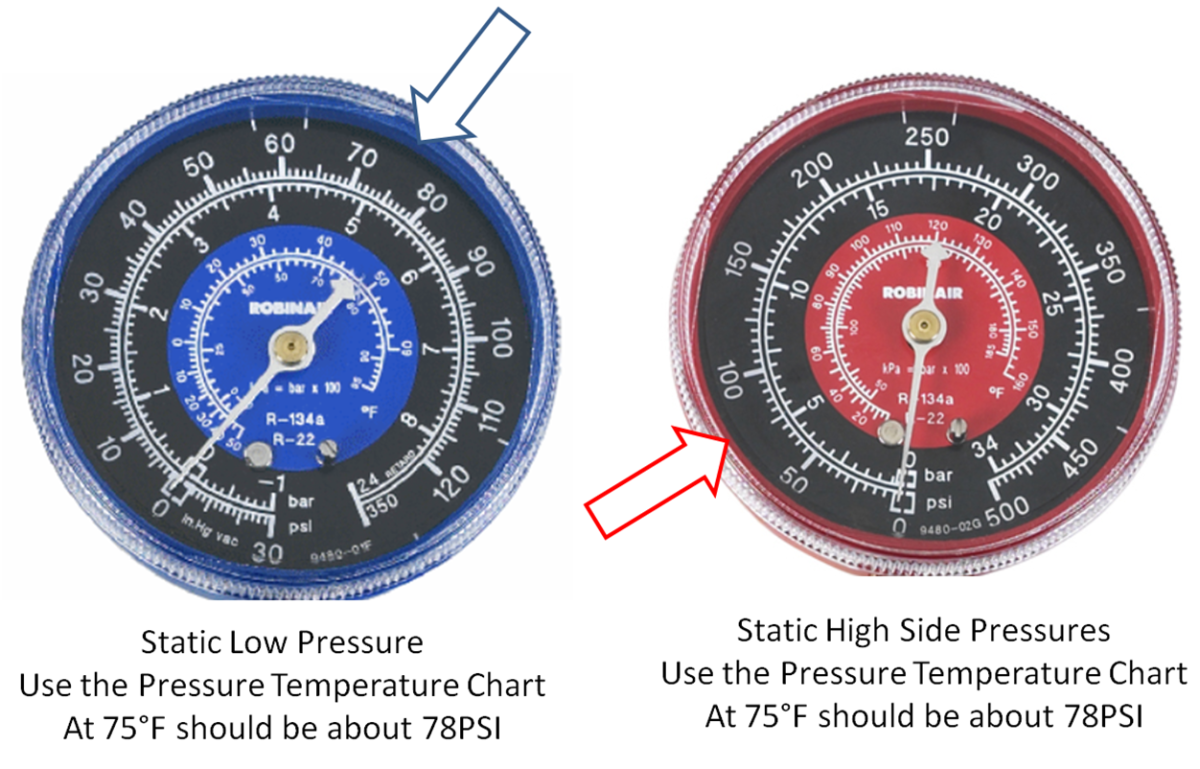
Static Pressure means the system is not running. Compare this pressure with the ambient temperature to gauge the amount of refrigerant in the system. Less than the chart indicate low refrigerant charge and higher may indicated an overcharge.
Static Pressures
There is a relationship between the pressure in the system and temperature. A temperature pressure chart can be used to compare the pressure of the refrigerant at a given temperature. Since there is no way to know exactly how much refrigerant is in the system, without removing it and measuring it, we will use the pressure and compare it to a pressure temperature chart.
Hook up a gauge set or recovery machine.
Record the pressures. High and Low Side should be equal.
Measure the ambient temperature.
Does the pressure match the temperature pressure chart?
If the pressure matches this means the refrigerant level is close.
If the pressure is lower than the chart, the refrigerant level is low. The system is probably leaking.
If the pressure is zero, that is atmospheric pressure and means the system has a big leak.
If the pressure is higher than the chart, it is either overcharged or may have air (non-condensable) in the system.
Leak Testers and Refrigerant Identifiers
If the Static Pressure is low, a leak is probably present. Use the leak tester for larger leaks and the Dye with a black light for smaller leaks. Identify the refrigerant before hooking up to a recovery machine.
Running System Pressures
Start the engine and operate the AC system. Perform a visual check to see if the compressor is running.
Was a click heard when the AC was engaged? Is the center hub turning?
Observe the pressure gauges. Does the low side pressure start going down and the high side going up?
After the system runs for awhile, raise the RPMs up to about 1,500 RPMs.
The system should be about 25 to 30 psi on the low side and 200 to 250 psi on the high side. If the ambient temperature is higher or lower than normal (70 to 80°F) the pressures will go up or down accordingly.
Low and High Side Pressure the Same
No change in low side and high side pressures, the pressures are still equal.
Double check to see if the compressor clutch is engaged. If the center hub is turning, the compressor is not pumping.
Shut the engine off and rotate the center hub by hand. Is there any resistance?
The compressor may be faulty.
Higher Pressure on the Gauges
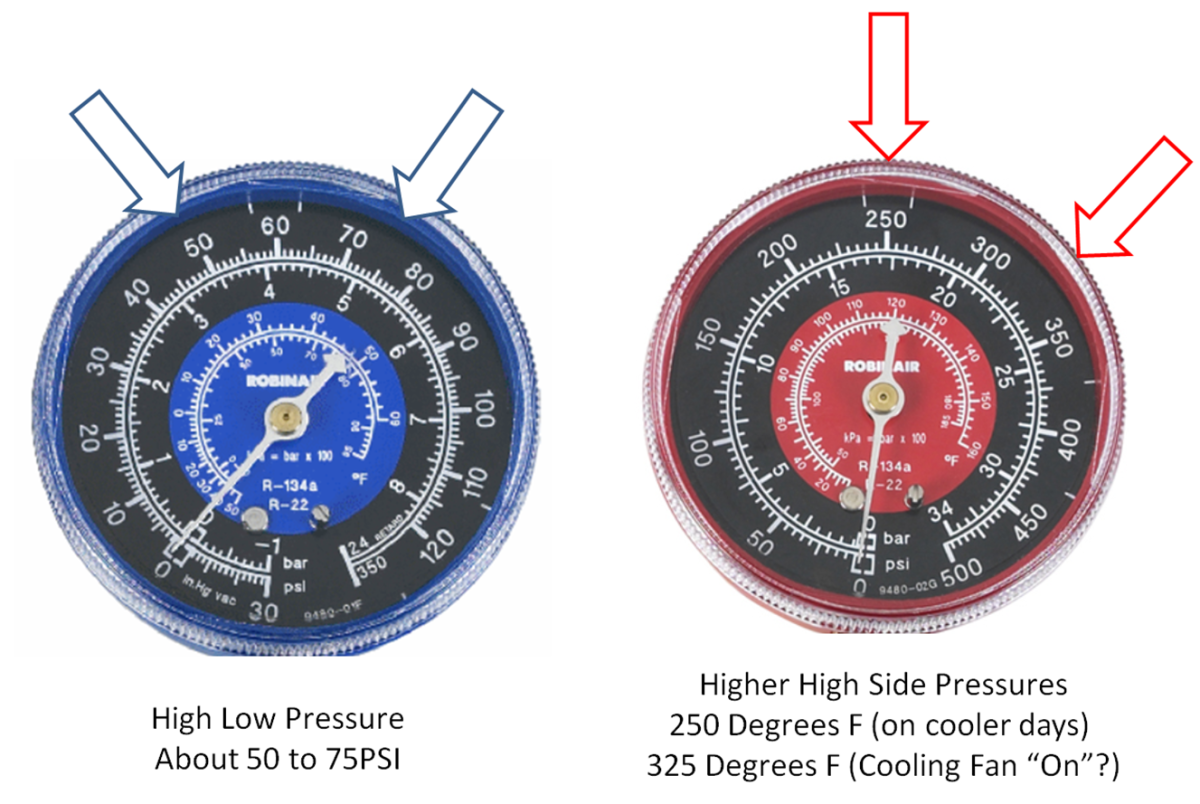
Higher Pressure on both the High and Low side may indicate an overcharge or lack of cooling at the Condenser.
Higher-Than-Normal Pressures
Higher than normal pressures on both high and low side with the correct amount of refrigerant, could mean a problem with air flow thru the condenser.
Is the condenser or cooling fan working?
Does the condenser have bent or dirty fins?
Is there blockage inside the condenser?
Lower High and Low Pressures
Lower pressures may indicate low refrigerant level or a weak compressor.
Lower Low and High Side Pressures
Lower than normal pressures on both high and low side, with the correct amount of refrigerant, could mean a problem building pressure in the system or too much heat is being removed at the condenser. Is the ambient temperature low?
With the system running place a fender cover in front of the condenser and observe the pressure.
Does the pressure go up? Can the compressor build the pressure? If not the compressor may be worn out.
Is the cooling fan running constantly? A pressure switch or sensor could be bad.
Lower Low Side and Higher High Side Pressures
This condition usually means there is a restriction in the system or the TXV/Orifice Tube is blocked or closed. Feel the lines, is there a pressure/temperature drop at the TXV/Orifice Tube?
With a drop, there may be a restriction at the TXV or Orifice Tube.
With no drop, there may be a restriction upstream from the TXV or Orifice Tube. Follow the liquid line back towards the condenser to see if you can feel a pressure/temperature drop.
Higher Low Side and Lower High Side Pressures
Too much refrigerant is flowing into the evaporator.
The TXV is stuck open or the thermal bulb is not sensing the temperature correctly.
The orifice tube is too large of an opening or the o-ring sealing the outside of the orifice tube is not sealing.
System Pressures Are Normal, but Warm Air Is Blowing Out of Vents
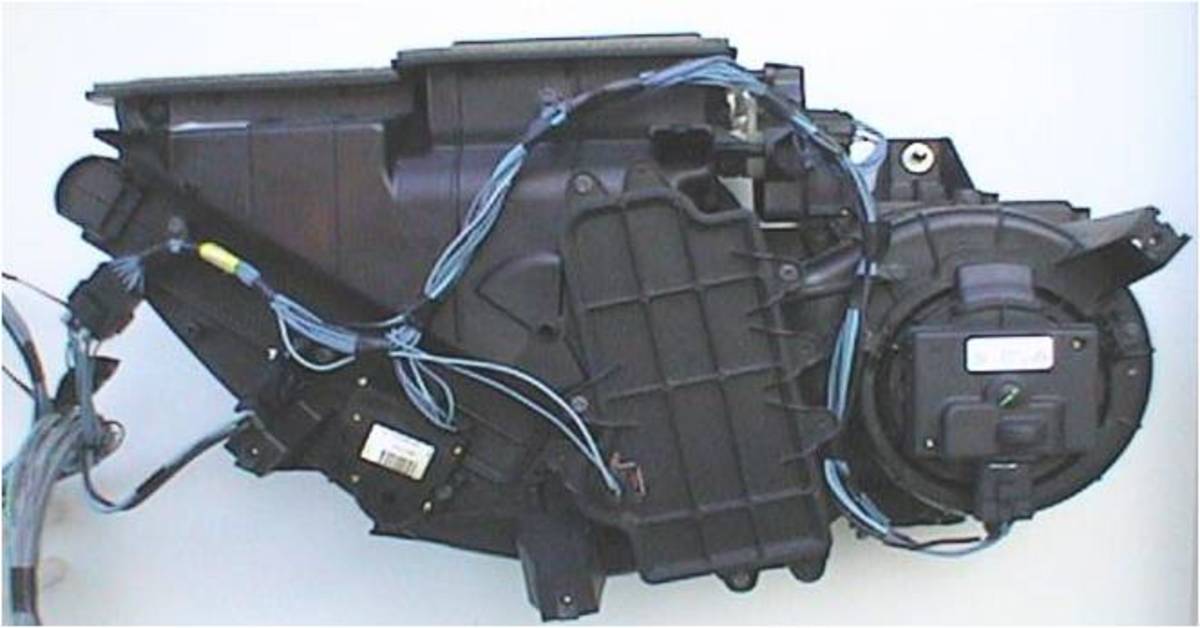
Some times the refrigerant part of the system is not where the problem lies. The AC and Heater operate out of the same box or plenum typically under the dash. Doors control the direction of the airflow created by the electric blower motor. Depending on the system, there are at least three to four doors controlled by cables, vacuum actuators or electronic motors.
These doors are:
Hot/Cold temperature door - controls the amount of airflow through the heater core. During AC (Cold) operation, this door may force the air to bypass the heater core. When the temperature lever is set to Hot, all the air is forced through the heater core to use the heat from the engine coolant to heat the cab.
Fresh Air/Recirculate door - This door selects whether the air is drawn from the outside or circulate the air inside the vehicle. Recirculating the cooler drier air inside the passenger compartment can help maintain a cooler temperature instead of cooling the hot moist outside air. Typically some outside air is always added to keep the passenger compartment pressurized to prevent exhaust from entering the passenger compartment.
Floor/Vent/Defrost door or doors - This door or a combination of doors controls where the cooled or heated air is sent. Floor mode typically for heater operation since heat rises. Vent out the center of the dash for AC operation. Top of the dash to defrost the windshield during cold weather. There may also be combinations of floor/vent or floor/defrost to accommodate different situations.
AC Heater Plenum
The AC Heater box or plenum is located under the dash. Electronic actuators with position sensors are very popular to move the doors to direct the airflow and control temperature.
With or Without Hot Water Valve Systems
There are two basic designs for the airflow:
All the airflow goes thru both the evaporator then the heater core. A hot water valve closes the flow of hot coolant thru the heater core during the AC operation. If this valve doesn’t close, the AC cold air will be heated by the heater core. If the valve sticks closed, there will be no heat. The result is hot air out the vents. In the defrost mode, the air will be dehydrated by the evaporator then heated by the heater core for hot dry air on the windshield.
The airflow goes thru the evaporator and a door directs the air either thru the heater core or around the heater core directed by the HOT to COLD selector. During AC COLD operation, the “Blend Door” routes the cold air around the heater core. During Heat operation, all the air passes thru the Evaporator and the Heater Core. When the temperature is set in between, part of the air will pass thru the Heater Core. No hot water valve is needed because in cool mode the door closes off airflow thru the heater core.
When the Air passes thru the evaporator and heater core as in example 1 above, a hot water valve is used to shut off the HOT water to the heater core. These Hot Water Valves can be; Cable operated, Air Operated and Electric Solenoid operated.
Door Controls and Actuators
To control the airflow thru the heater box or plenum a series of doors are used. To control these doors a variety of actuators have been used such as:
Manual cable operated doors have been around a long time. Cables connect levers in the dash control to the doors. When a lever is moved back and forth, like the hot/cold lever, it moves the door from one position to another. Typically moving the lever quickly from one extreme to the other results in a thumping sound as the door hits the stops. The Hot/Cold door would control airflow around or thru the heater control. Cables popping off or improper adjustments are typically what will go wrong with this style of control.
Vacuum operated actuators, used on cars and light duty trucks use (gas) engine vacuum to act upon a diaphragm which is connected to the doors. As the controls are moved, a hissing sound is heard. Vacuum leaks are the biggest problem with this type of control. If the vacuum supply is disconnected, the controls usually default to putting air on the windshield. Diesel engine light trucks using vacuum controlled systems use an electric or belt driven vacuum pump to supply the vacuum.
Pneumatic actuators operate similar to the vacuum type, except the trucks air system pressure is used to move the actuator diaphragms. Hissing under the dash could be from a leaking actuator or connection.
Electronic actuators use an electric motor to position the doors. These electric motors usually have a sensor built in to allow the system to know the location of the doors. When the controls are moved, a small electric motor buzz can usually be heard.
Service Tip: A common problem with all the actuator types are paper clips, pens, keys and other foreign objects falling down into the heater box from the dash defroster vents and jamming the doors. This could also strip out the door connection to the actuator rod.
Cabin Filter
Many vehicles today have a cabin filter to filter the incoming air from outside the vehicle. The filter looks like a small air filter from a car. Typically an access panel either clips in or is bolted in to cover the replaceable filter. The filter may be located under the dash or on the heater box in the engine compartment. This filter is often overlooked until it is entirely plugged up and causes very little airflow into the cab.
If the cabin filter is dirty the result will be low airflow. This may cause the AC or heater output to be reduced. Many times this is confused with poor AC or Heater performance due to the fact that the low airflow cannot keep the vehicle cool/warm.
Dirty Evaporator
The dirt on this evaporator has restricted the airflow and caused a lack of cooling.
Dirty Evaporator
The airflow across the evaporator is used for cooling the air. If dirt, fuzz, leaves or plastic bags are covering the surface, the airflow will be reduced along with the cooling capacity. The AC system may be in good working order but the air cannot have the heat removed as it should. The complaint will be lack of cooling the same condition as a plugged cabin filter.
If you've ever pointed a compressed air hose at your face, or held a compressed air tool after long use, you've already got some idea of how compressed gases rapidly cool down while expanding out to the atmosphere. Your AC system works the same way, using the cooling effects of expanding gas to chill the air in your cabin. But that gas needs some room to expand, and low pressure to expand into; overcharge the AC system with coolant, and you wind up with a system that acts more like a big oil pump than a nozzle blowing cool, decompressing air into your face.
Inefficient Cooling
The most obvious sign of an overcharged AC system is poor cooling. Without room to depressurize the coolant, the AC system simply stops functioning. You might still get a cool breeze coming from the vents, but just as often you could get room-temperature or even hot air. Some systems will shut themselves off if they detect improper pressure release in the system. Be glad if yours does; it may be saving you from a hefty repair bill.
Compressor Noise
The compressor might make excessive noise, the sound of it struggling to shove liquid coolant through a tiny nozzle designed for gas molecules. This doesn't happen in every case, since some AC compressors are designed with a bypass to prevent excess internal pressure from straining the pump. If you've ever heard a power steering pump going bad, then you'll have some idea of what a struggling AC compressor sounds like.
High Pressure Readings
An overcharged AC will show higher than normal pressure and temperature readings. The compressor works harder to try balancing out the system, which results in more pressure. The higher the pressure, the higher the temperature rise as a result. This causes even more pressure to build, resulting in a cascade failure of cooling capacity.
Struggling Engine
An AC compressor can draw a significant amount of power from the engine, never more so than when it's trying to push a gallon of coolant through a one-ounce nozzle. This excessive power draw can cause the compressor's drive belt to slip and screech, which generally precedes a loud snap and belt failure. Or, the belt may hang on, and sap power from the engine. In this case, you may end up with a low or fluctuating idle, sluggish acceleration and excessive loss of fuel economy when the AC is running.
Broken Compressor
This is often the inevitable end result of a chronically overcharged system. The compressor is your AC system's heart, and eventually it's going to respond the same way your heart would if you had chronic high blood pressure. Internal seals will fail, valves will cease to function, the pump will fail and the system will ultimately flatline.
Excellent write up..... I'm going to add a couple thoughts here
Most people think if it's not blowing cold air out the vents, they automatically assume that adding more refrigerant is going to fix the problem. For those that blindly add refrigerant, how do you know how much to add? How do you know how much is still left in the system? Overcharging a 134-a system even by a few ounces is putting a large strain on the entire AC system. If you don't know how to properly diagnose the situation, go to someone who can
About store bought refrigerant in those little cans, a lot of them have leak sealer in the cans. Leak sealer is a bandaid at best.
Most if not all repair shops will connect their AC unit up to your car to evacuate the remaining refrigerant that is left in your car's system. If you tell them that you installed sealer in your car, they will refuse to do anything with your car unless you replace everything in the AC system.
If you don't tell them about the sealer that you installed, and they connect the AC machine and proceed to evacuate the system, the sealer will plug up the shops AC unit and you may be forced to repair or replace the shop equipment due to your sealer being involved.
Excellent write up..... I'm going to add a couple thoughts here
Most people think if it's not blowing cold air out the vents, they automatically assume that adding more refrigerant is going to fix the problem. For those that blindly add refrigerant, how do you know how much to add? How do you know how much is still left in the system? Overcharging a 134-a system even by a few ounces is putting a large strain on the entire AC system. If you don't know how to properly diagnose the situation, go to someone who can
About store bought refrigerant in those little cans, a lot of them have leak sealer in the cans. Leak sealer is a bandaid at best.
Most if not all repair shops will connect their AC unit up to your car to evacuate the remaining refrigerant that is left in your car's system. If you tell them that you installed sealer in your car, they will refuse to do anything with your car unless you replace everything in the AC system.
If you don't tell them about the sealer that you installed, and they connect the AC machine and proceed to evacuate the system, the sealer will plug up the shops AC unit and you may be forced to repair or replace the shop equipment due to your sealer being involved.
Just more food for thought here
Bryan
Leak sealer is dangerous for the expansion orifice etc but Ive never had a shop ask me if I used leak sealer. They run the R134a through a filter before they reuse it.
Leak sealer is dangerous for the expansion orifice etc but Ive never had a shop ask me if I used leak sealer. They run the R134a through a filter before they reuse it.
They don't need to ask. Most have a test kit that they use before they hook up their recovery equipment to your system. The sealant detection kit has a tiny orifice that is designed to mimic an A/C leak. If sealant is present in the system, it will quickly solidify in the disposable test cartridge and cause the flow meter to show “no flow”. The use of refrigerant sealants became really prevalent with R134a, especially when people tried to swap refrigerants on old R-12 systems when they couldn't get freon anymore. R134a is a smaller molecule that can pass through microscopic pores easier than R-12 would, and required updated sealed barrier hoses and updated viton o-rings, else it would seep right through the hoses and joints. People were looking for a shortcut, thus sealant in the R134a. And yes, that sealant will contaminate and potentially damage and ruin expensive recovery systems.
I'm a mechanical engineer. I got a mobile AC tech license back in the day so I could legally buy R-12 back when it was becoming scarce, and so I could convert my old cars the right way (flush and clean evaporator, compressor, condenser of any mineral oil, replace pressure switches, hoses, seals and receiver dryer, add correct amount of PAG oil, then recharge)....sometimes it worked, but some compressors couldn't handle it and would die from the "black death" due to lack of lubrication at the higher pressures and lower lubrication that R134a runs at. PAG oil isn't as miscible in R134a as mineral oil is in R-12.
Now we are faced with this problem again since R134a is being chased out. I highly recommend DIY type people (like myself) to stock up on some cans of it (without sealant) while you can, enough to completely recharge your Cooper. Shops can still use R134a for the meanwhile, but it will become scarce. In my state, retail stores were banned from selling it in July of 2021. I have my own equipment, vacuum pump, gauge set, and an accurate digital scale to measure how much refrigerant I put in. I'll will typically go and have my system recovered before I work on it, as many shops will do it for free if you give them the refrigerant, which they of course test for sealant before they do. Once I put my gauges on and didn't get any pressure due to a broken condenser (took a high speed rock to it), so I didn't bother trying to recover it that time. For the most part, AC problems are a PITA and leaks should be rare. Seems like over the last 10 years, the times I needed to recover and evacuate the car's AC system was when I was replacing a leaking heater core. It is blissful knowing that the Mini heater core can be replaced easily enough, without having to tear out the dash and disturb the AC system. That was well thought out.
Last edited by GPzJeffrey; Sep 3, 2024 at 04:58 AM.
They don't need to ask. Most have a test kit that they use before they hook up their recovery equipment to your system. The sealant detection kit has a tiny orifice that is designed to mimic an A/C leak. If sealant is present in the system, it will quickly solidify in the disposable test cartridge and cause the flow meter to show “no flow”. The use of refrigerant sealants became really prevalent with R134a, especially when people tried to swap refrigerants on old R-12 systems when they couldn't get freon anymore. R134a is a smaller molecule that can pass through microscopic pores easier than R-12 would, and required updated sealed barrier hoses and updated viton o-rings, else it would seep right through the hoses and joints. People were looking for a shortcut, thus sealant in the R134a. And yes, that sealant will contaminate and potentially damage and ruin expensive recovery systems.
I'm a mechanical engineer. I got a mobile AC tech license back in the day so I could legally buy R-12 back when it was becoming scarce, and so I could convert my old cars the right way (flush and clean evaporator, compressor, condenser of any mineral oil, replace pressure switches, hoses, seals and receiver dryer, add correct amount of PAG oil, then recharge)....sometimes it worked, but some compressors couldn't handle it and would die from the "black death" due to lack of lubrication at the higher pressures and lower lubrication that R134a runs at. PAG oil isn't as miscible in R134a as mineral oil is in R-12.
Now we are faced with this problem again since R134a is being chased out. I highly recommend DIY type people (like myself) to stock up on some cans of it (without sealant) while you can, enough to completely recharge your Cooper. Shops can still use R134a for the meanwhile, but it will become scarce. In my state, retail stores were banned from selling it in July of 2021. I have my own equipment, vacuum pump, gauge set, and an accurate digital scale to measure how much refrigerant I put in. I'll will typically go and have my system recovered before I work on it, as many shops will do it for free if you give them the refrigerant, which they of course test for sealant before they do. Once I put my gauges on and didn't get any pressure due to a broken condenser (took a high speed rock to it), so I didn't bother trying to recover it that time. For the most part, AC problems are a PITA and leaks should be rare. Seems like over the last 10 years, the times I needed to recover and evacuate the car's AC system was when I was replacing a leaking heater core. It is blissful knowing that the Mini heater core can be replaced easily enough, without having to tear out the dash and disturb the AC system. That was well thought out.







 Ya, since you're noticing an odor get in there and good luck!