


R56 Engine Coolant Flush?


Thread Starter
|
1st Gear
Joined: Jun 2008
Posts: 39
Likes: 0
Engine Coolant Flush?
Hey Guys, just wondering what coolant is best for the MCS, no winter here so "freezing" problems not an issue.(Puerto Rico)
Down here we use a 50/50 ready to use formula. Any brand recommended more than others?
Appreciate the feedback, thank's!
Steve...
Down here we use a 50/50 ready to use formula. Any brand recommended more than others?
Appreciate the feedback, thank's!
Steve...


+1 for the MINI OEM Coolant , that's all I use other then Zerex G-05 as my second choice.
Mixed 50/50 with distilled water and you are good to go.
Here is the part number: 82140031133
http://www.ecstuning.com/Search/82140031133/
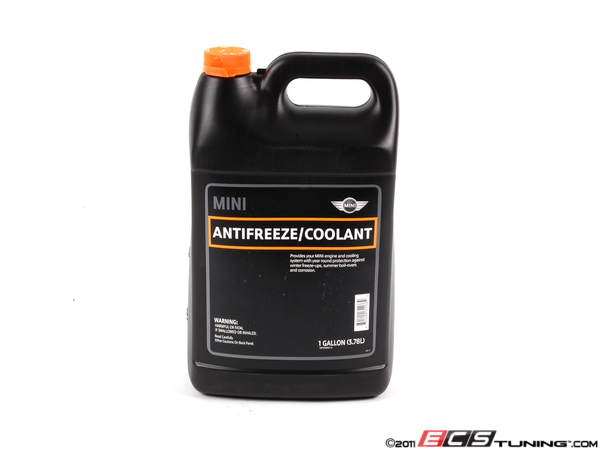
Mixed 50/50 with distilled water and you are good to go.
Here is the part number: 82140031133
http://www.ecstuning.com/Search/82140031133/
__________________

MINI Guru/ MINI Owner Since 2004 | NEW Lifetime Part Replacement | Local Pickup
Milltek | Genuine MINI | Forge Motorsport | NM Engineering | ECS Performance | M7 Speed
Customer Service Hours: 8am-8pm EST|Sales Team Hours: 8am-11pm | SAT 10am-7pm 800.924.5172
MINI Guru/ MINI Owner Since 2004 | NEW Lifetime Part Replacement | Local Pickup
Milltek | Genuine MINI | Forge Motorsport | NM Engineering | ECS Performance | M7 Speed
Customer Service Hours: 8am-8pm EST|Sales Team Hours: 8am-11pm | SAT 10am-7pm 800.924.5172
Last edited by ECSTuning; Mar 4, 2013 at 11:38 AM.

If in doubt, go OEM.
Corrosion protection is the main thing of coolant over plain water in your case.
Any quality antifreeze/coolant will work in a pinch (NO-DEX Cool), but a drive to the local bmw/MINI dealer is a good excuse for a drive...or just order it. Good thing about using OEM, if your drain/fill is not 100% perfect, no-worries about mixing different brands....
and Zerex G-05 is considered to be the aftermarket equivalent of the OEM...may/may-not be hard to find in some areas.
Corrosion protection is the main thing of coolant over plain water in your case.
Any quality antifreeze/coolant will work in a pinch (NO-DEX Cool), but a drive to the local bmw/MINI dealer is a good excuse for a drive...or just order it. Good thing about using OEM, if your drain/fill is not 100% perfect, no-worries about mixing different brands....
and Zerex G-05 is considered to be the aftermarket equivalent of the OEM...may/may-not be hard to find in some areas.


2nd Gear
Joined: Jan 2007
Posts: 59
Likes: 1
Trending Topics
There is several post about this that are related to changing out the thermostat housing or water pump. But in the end you will have to refill the coolant and the procedure to get the air out. Recommend OEM MINI Coolant like above. Just remember: Mixed 50/50 with distilled water (dependent on area ) and you are good to go. Are you just doing a coolant flush? Or fixing a leak?
Several post:
https://www.northamericanmotoring.co...-question.html
https://www.northamericanmotoring.co...rmostat-2.html
https://www.northamericanmotoring.co...e-uk-guys.html
Thanks and I hope that helps.
Several post:
https://www.northamericanmotoring.co...-question.html
https://www.northamericanmotoring.co...rmostat-2.html
https://www.northamericanmotoring.co...e-uk-guys.html
Thanks and I hope that helps.
__________________
MINI Guru/ MINI Owner Since 2004 | NEW Lifetime Part Replacement | Local Pickup
Milltek | Genuine MINI | Forge Motorsport | NM Engineering | ECS Performance | M7 Speed
Customer Service Hours: 8am-8pm EST|Sales Team Hours: 8am-11pm | SAT 10am-7pm 800.924.5172
MINI Guru/ MINI Owner Since 2004 | NEW Lifetime Part Replacement | Local Pickup
Milltek | Genuine MINI | Forge Motorsport | NM Engineering | ECS Performance | M7 Speed
Customer Service Hours: 8am-8pm EST|Sales Team Hours: 8am-11pm | SAT 10am-7pm 800.924.5172

2nd Gear
Joined: Jan 2013
Posts: 128
Likes: 2
From: Northern MD
I have always used Prestone non- silicate 50/50 mix in all my cars and never had a problem- look at the ingredients, they are usually the same even down to the percentage. Just did the Mini, and my Bmw has been on several road trips with no problems.......hell, even my motorcycle. I had a Toyota dealer "warn" me about having the wrong "color", But he really couldn't answer me when we compared the ingredients to the Prestone.

6th Gear
Joined: Apr 2013
Posts: 1,894
Likes: 8
From: Philly PA
I have always used Prestone non- silicate 50/50 mix in all my cars and never had a problem- look at the ingredients, they are usually the same even down to the percentage. Just did the Mini, and my Bmw has been on several road trips with no problems.......hell, even my motorcycle. I had a Toyota dealer "warn" me about having the wrong "color", But he really couldn't answer me when we compared the ingredients to the Prestone.

First, never mix coolant.
Ever.
Second, the OEM coolants are based on the metals and plastics that the vehicle design uses. Things like head gasket material, waterpump impellers, heater core side tanks and so on.
I only ever use OEM coolants, yes, aftermarket is fine, but only if it meets (or is rebottled) by the OEM.
Universal coolants are bad news.. You dont know based off of color if they are OAT, HOAT, PHOAT or non OAT types, like IAT. Most of the over the counter crap is all based off "safe" levels of one or the other.. How much is "safe"? Well just listen to the add on the radio.. oh, wait.. they dont tell you do they?
http://www.gates.com/downloads/Gates...h_Bulletin.pdf
Whats it cost to make sure your heater core, waterpump, head gasket, or other expensive parts are protected?
Is that worth saving $10-$20 over?
More for your reading pleaseure.
http://www.underhoodservice.com/Arti...uirements.aspx
Here are reasons for different opinions on European Coolants
In the US market, a phosphate inhibitor is included in many formulas to provide several important functions that help reduce automotive cooling system damage. The benefits provided by the phosphate include:
So IMO you can decide for yourself.
http://www.underhoodservice.com/Arti...uirements.aspx
Here are reasons for different opinions on European Coolants
In the US market, a phosphate inhibitor is included in many formulas to provide several important functions that help reduce automotive cooling system damage. The benefits provided by the phosphate include:
- Protect aluminum engine components by reducing cavitation corrosion during high speed driving.
- Provide for corrosion protection to ferrous metals.
- Act as a buffer to keep the antifreeze mixture alkaline. This prevents acid build-up that will damage or destroy metal engine parts.
So IMO you can decide for yourself.
2nd Gear
Joined: Jan 2013
Posts: 128
Likes: 2
From: Northern MD
Thanks for the postings....... I've had nothing but good experience with Prestone and that's a lot of cars and a lot of miles .....but I understand if someone wants to stick to OEM, especially if you're still in warranty. This topic has been beat to death on other lubrication forums. Cheers.


6th Gear
Joined: Apr 2013
Posts: 1,894
Likes: 8
From: Philly PA
I'm a Master Level ASE tech (plus L1 and X1 cert)., and I teach Automotive Technology at a local Community College.
You guys putting in the wrong fluids keep me, and my students who go on to join the tech workforce in business.
Lets just say in my time dealing with European cars since 93' I've seen more than a few water pump impellers dissolved, heads fail, rotted intakes, and cooling system woes.
It's simply not worth skimping on. I'm not saying you have to march out to the dealer, but you should research who makes the OEM fluids and stick to them.
People forget the chemistry in today's cars is as complex as the electronics.
You guys putting in the wrong fluids keep me, and my students who go on to join the tech workforce in business.
Lets just say in my time dealing with European cars since 93' I've seen more than a few water pump impellers dissolved, heads fail, rotted intakes, and cooling system woes.
It's simply not worth skimping on. I'm not saying you have to march out to the dealer, but you should research who makes the OEM fluids and stick to them.
People forget the chemistry in today's cars is as complex as the electronics.
I'm a Master Level ASE tech (plus L1 and X1 cert)., and I teach Automotive Technology at a local Community College.
You guys putting in the wrong fluids keep me, and my students who go on to join the tech workforce in business.
Lets just say in my time dealing with European cars since 93' I've seen more than a few water pump impellers dissolved, heads fail, rotted intakes, and cooling system woes.
It's simply not worth skimping on. I'm not saying you have to march out to the dealer, but you should research who makes the OEM fluids and stick to them.
People forget the chemistry in today's cars is as complex as the electronics.
You guys putting in the wrong fluids keep me, and my students who go on to join the tech workforce in business.
Lets just say in my time dealing with European cars since 93' I've seen more than a few water pump impellers dissolved, heads fail, rotted intakes, and cooling system woes.
It's simply not worth skimping on. I'm not saying you have to march out to the dealer, but you should research who makes the OEM fluids and stick to them.
People forget the chemistry in today's cars is as complex as the electronics.

6th Gear
Joined: Apr 2013
Posts: 1,894
Likes: 8
From: Philly PA
1993 was 20 years ago and many things have changed since then. I guess you are still from the old school of though. I am not trying to argue with you just saying things have changed and products have changed many times over since then. So if you get the same specs of whatever product you use and same quality there should be no issues.
Needless to say, Coolant is a "hot topic" since hybrids now use ground fault circuits and aftermarket coolants void warrantees with OEMs. Even the act of adding tap water will shut down the Chevy Volt.
Stuff changes every year, its my job to stay on top of it.
Its not a hobby, its my job.
My point is, other than a MSDS, care to show my "specs" showing that Prestone is the same as BMW/Mini OEM?
what you need to look at is BASF specs.
http://www.glysantin.com/15-1-Produc...w.html?pid=g48
http://www.glysantin.com/files/basf_...iew_a4_e_1.pdf
Mini coolant is G48.
you won't find Prestone meeting those specs.
Ask yourself this, if its "all the same" why would Mini spec G30 coolant for the Cooper D and then G48 for the Gasoline cars?
Guess its not all the same then is it? It's nice to do things the right way and take proper care of a car instead of trying to be different and doing all this research to use an alternative fluid all to save enough money to buy a hamburger..
Last edited by danjreed; May 20, 2013 at 08:54 AM.
Yea, real old school. Two weeks of factory based training form GM, Ford, and Honda since last year.
Needless to say, Coolant is a "hot topic" since hybrids now use ground fault circuits and aftermarket coolants void warrantees with OEMs. Even the act of adding tap water will shut down the Chevy Volt.
Stuff changes every year, its my job to stay on top of it.
Its not a hobby, its my job.
My point is, other than a MSDS, care to show my "specs" showing that Prestone is the same as BMW/Mini OEM?
what you need to look at is BASF specs.
http://www.glysantin.com/15-1-Produc...w.html?pid=g48
http://www.glysantin.com/files/basf_...iew_a4_e_1.pdf
Mini coolant is G48.
you won't find Prestone meeting those specs.
Ask yourself this, if its "all the same" why would Mini spec G30 coolant for the Cooper D and then G48 for the Gasoline cars?
Guess its not all the same then is it?
Not trying to say your wrong but anti-freeze is anti-freeze unless you want to start dishing out details such as ingredients they all use then I'd love to have that conversation.
Ask yourself this, if its "all the same" why would Mini spec G30 coolant for the Cooper D and then G48 for the Gasoline cars?
So I quote again
Here are reasons for different opinions on European Coolants
In the US market, a phosphate inhibitor is included in many formulas to provide several important functions that help reduce automotive cooling system damage. The benefits provided by the phosphate include:
In the US market, a phosphate inhibitor is included in many formulas to provide several important functions that help reduce automotive cooling system damage. The benefits provided by the phosphate include:
- Protect aluminum engine components by reducing cavitation corrosion during high speed driving.
- Provide for corrosion protection to ferrous metals.
- Act as a buffer to keep the antifreeze mixture alkaline. This prevents acid build-up that will damage or destroy metal engine parts.
Also are you saying we should only use OEM oil? Only mini windshield washer fluid? Or is it OK to you comparable quality products?
6th Gear
Joined: Apr 2013
Posts: 1,894
Likes: 8
From: Philly PA
This is simple. The coolant MINI recommends is due to the fact of their water being extremely hard.
So I quote again
So, I am not arguing with you so much as I disagree that OEM coolant is the only one to use. If you get the right type that is compatible with your vehicle there should be no issues.
Also are you saying we should only use OEM oil? Only mini windshield washer fluid? Or is it OK to you comparable quality products?
So I quote again
So, I am not arguing with you so much as I disagree that OEM coolant is the only one to use. If you get the right type that is compatible with your vehicle there should be no issues.
Also are you saying we should only use OEM oil? Only mini windshield washer fluid? Or is it OK to you comparable quality products?
Stop and ask yourself what is different between the two cars..
Um.. engine materials perhaps?
And yes, I only use oil that meets the specs. (Hense the Mobil 1 0W40)..
Show me please a list of Prestone products that meet or exceed the G48 Mini specs?
Please show me!
What is Coolant?
For starts, the basis of coolant is usually antifreeze and water in a 50/50 ratio, mixed in with usually 3% additives. Antifreeze increases boiling point and decreases freezing point. Water conducts heat faster and holds much more heat than antifreeze. Half and half gives you a good compromise between the two, and antifreeze actually requires water to work properly.
The rest of the stuff is mainly corrosion protection, and a little bit for bittering agents for safety, coloring for identification, ant-foaming, etc...
The safest bet is to either use your car's recommended coolant, or look up the specifications, MSDS, or datasheets for the antifreeze you're thinking of buying and trying to avoid some of the additives that might cause problems in your situation. If you are going to use tap water, avoid phosphates. If you are going to do long service intervals, look into hybrid organic acid technologies. etc... In general, G-05 and G-48 formulations are good choices as they are hybrid technologies that have a long service interval and safe with clean tap water. The biggest difference being that G48 does not contain nitrates, which are excellent for cavitation protection but can combine with other chemicals to form nitrosamines which are carcinogenic.
For starts, the basis of coolant is usually antifreeze and water in a 50/50 ratio, mixed in with usually 3% additives. Antifreeze increases boiling point and decreases freezing point. Water conducts heat faster and holds much more heat than antifreeze. Half and half gives you a good compromise between the two, and antifreeze actually requires water to work properly.
Ethylene Glycol is moderately poisonous stuff that is the most common and best working antifreeze. It is clear, odorless, and syrupy, and has a slightly sweet taste. Usually you will not be able to taste it in coolant though as it is out flavored by bittering agents to prevent humans and animals from drinking it. Ethylene glycol does break down over time and is why coolant doesn't last forever. Just in plain air, it will breakdown within a few weeks.
Propylene glycol (or methyl ethyl glycol) is just like ethylene glycol but doesn't do as good a job as coolant and isn't toxic.
Water covers 2/3rds of the planet. It's best to use distilled/deionized water, but it's actually suitable to use tap water if you know the mineral levels and have a tap water safe coolant. What you don't want are minerals in your cooling system, and the requirements for tap water by BMW are: clear, without suspended matter, pH from 6.5-8.0, less than 357ppm calcium, less than 100mg/L Chloride, and less than 100mg/L sulfate. Some manufacturers suggest even lower calcium levels. Calcium is bad because when dissolved calcium heats up, it precipitates out of the water as sand or forms as scale on hot surfaces. Ok, so now you know about 97% of what's in coolants.
Additives - The Last 3%Propylene glycol (or methyl ethyl glycol) is just like ethylene glycol but doesn't do as good a job as coolant and isn't toxic.
Water covers 2/3rds of the planet. It's best to use distilled/deionized water, but it's actually suitable to use tap water if you know the mineral levels and have a tap water safe coolant. What you don't want are minerals in your cooling system, and the requirements for tap water by BMW are: clear, without suspended matter, pH from 6.5-8.0, less than 357ppm calcium, less than 100mg/L Chloride, and less than 100mg/L sulfate. Some manufacturers suggest even lower calcium levels. Calcium is bad because when dissolved calcium heats up, it precipitates out of the water as sand or forms as scale on hot surfaces. Ok, so now you know about 97% of what's in coolants.
The rest of the stuff is mainly corrosion protection, and a little bit for bittering agents for safety, coloring for identification, ant-foaming, etc...
Inorganic Acid Technology (IAT)
Conventional coolant that has been used for the past 60+ years made of inorganic salts, which sacrificially protect from corrosion not too different than a zinc plating on a steel bolt. The bad thing is that with hard water and/or time, these additives get used up and turn into sand, literally, hard, rocklike sand, which will grind away any seal or bearing exposed to the coolant. Usually a 2 year lifespan.
-Silicates good for preventing aluminum corrosion but precipitate with use.
-Phosphates good for preventing steel corrosions but precipitate with hard water.
Organic Acid Technology (OAT)
Doesn't use silicates and phosphates but instead use carboxylate, sebacate, or 2-ethylhexanoic acid (2-EHA). Beware of 2-EHA, because it is a plasticizer, which means it softens plastics. Usually a 3 year lifespan and slightly more expensive than inorganic acid technology.
Hybrid Organic Acid Technology (HOAT)
Same as Organic Acid Technology, but usually with a small amount of silicates or phosphates to extend the useable life without the problems. Usually Japanese manufacturers add phosphates from past problems with silicates and water pump seals, while european manufacturers add silicates due to commonly hard water in Europe. This is the primary coolant used by manufacturers due to the extremely long service life. Usually a 4+ year lifespan and slightly more expensive than organic acid technology, but the cheapest when used with extended drain intervals.
How to pick the right stuff?Conventional coolant that has been used for the past 60+ years made of inorganic salts, which sacrificially protect from corrosion not too different than a zinc plating on a steel bolt. The bad thing is that with hard water and/or time, these additives get used up and turn into sand, literally, hard, rocklike sand, which will grind away any seal or bearing exposed to the coolant. Usually a 2 year lifespan.
-Silicates good for preventing aluminum corrosion but precipitate with use.
-Phosphates good for preventing steel corrosions but precipitate with hard water.
Organic Acid Technology (OAT)
Doesn't use silicates and phosphates but instead use carboxylate, sebacate, or 2-ethylhexanoic acid (2-EHA). Beware of 2-EHA, because it is a plasticizer, which means it softens plastics. Usually a 3 year lifespan and slightly more expensive than inorganic acid technology.
Hybrid Organic Acid Technology (HOAT)
Same as Organic Acid Technology, but usually with a small amount of silicates or phosphates to extend the useable life without the problems. Usually Japanese manufacturers add phosphates from past problems with silicates and water pump seals, while european manufacturers add silicates due to commonly hard water in Europe. This is the primary coolant used by manufacturers due to the extremely long service life. Usually a 4+ year lifespan and slightly more expensive than organic acid technology, but the cheapest when used with extended drain intervals.
The safest bet is to either use your car's recommended coolant, or look up the specifications, MSDS, or datasheets for the antifreeze you're thinking of buying and trying to avoid some of the additives that might cause problems in your situation. If you are going to use tap water, avoid phosphates. If you are going to do long service intervals, look into hybrid
organic acid technologies. etc... In general, G-05 and G-48 formulations are good choices as they are hybrid technologies that have a long service interval and safe with clean tap water. The biggest difference being that G48 does not contain nitrates, which are excellent for cavitation protection but can combine with other chemicals to form nitrosamines which are carcinogenic.
6th Gear
Joined: Apr 2013
Posts: 1,894
Likes: 8
From: Philly PA
What is Coolant?
organic acid technologies. etc... In general, G-05 and G-48 formulations are good choices as they are hybrid technologies that have a long service interval and safe with clean tap water. The biggest difference being that G48 does not contain nitrates, which are excellent for cavitation protection but can combine with other chemicals to form nitrosamines which are carcinogenic.
organic acid technologies. etc... In general, G-05 and G-48 formulations are good choices as they are hybrid technologies that have a long service interval and safe with clean tap water. The biggest difference being that G48 does not contain nitrates, which are excellent for cavitation protection but can combine with other chemicals to form nitrosamines which are carcinogenic.
thats a nice copy/paste from an e46 forum ... but no specs from Prestone.... sorry.
It proves the point. G-05 is just as good and Prestone meets that requirement.