


ATTN: 2nd-Gen Turbo Owners with Oil Catch Cans (OCC)


3rd Gear
Joined: Jul 2007
Posts: 240
Likes: 1
From: west 'burbs of Chicago
No, probably not [...and I see wandrur beat me to the punch]. It's pretty typical to see white stuff too in the OCC effluents due to the interesting combinations of oil and water in the mix.
There are several photos over in the BSH OCC Thread that will confirm it as a common occurrence.
Dan, glad it's paying off for you.
There are several photos over in the BSH OCC Thread that will confirm it as a common occurrence.
Dan, glad it's paying off for you.
Just wish I'd done it sooner.
Did my first drain on with the BSH oil catch can:

Car info: 2009 R55 JCW
Current Date: 9/10/2011
Current Mileage: 9107 miles
Miles since Last Emptied: 567 miles
Notes:
- first time to drain out since installation; only removed ~0.5 ounce of oil
- found out that oil crankcrase was overfilled appoximately ~0.3 quart for first ~250 miles of driving
- removed excessive oil and catch can level seemed to not increase; will confirm with future driving with crankcase filled to proper level
- no water condensation found in mixture
Observation: being in Colorado where the weather stays significantly dry, there was no water condensation within the can, rubber lines, or the oil mixture. Car is driven on 20+ min trips with no short trip occurding to make sure engine is up to running temp for a good portion of being out. It was noted that the oil level was higher than the max reading on dip stick, and oil had been collecting right away in the OCC. After removing the excess oil in the crankcase, it appeared that the level (through the OCC dipstick) never increased after such. To confirm, I'll follow up with results making sure the crankcase is not overfilled.
My preliminary thoughts: overfilled crankcases could be part of the reason of intake valve carbon build-up.
- Erik
Car info: 2009 R55 JCW
Current Date: 9/10/2011
Current Mileage: 9107 miles
Miles since Last Emptied: 567 miles
Notes:
- first time to drain out since installation; only removed ~0.5 ounce of oil
- found out that oil crankcrase was overfilled appoximately ~0.3 quart for first ~250 miles of driving
- removed excessive oil and catch can level seemed to not increase; will confirm with future driving with crankcase filled to proper level
- no water condensation found in mixture
Observation: being in Colorado where the weather stays significantly dry, there was no water condensation within the can, rubber lines, or the oil mixture. Car is driven on 20+ min trips with no short trip occurding to make sure engine is up to running temp for a good portion of being out. It was noted that the oil level was higher than the max reading on dip stick, and oil had been collecting right away in the OCC. After removing the excess oil in the crankcase, it appeared that the level (through the OCC dipstick) never increased after such. To confirm, I'll follow up with results making sure the crankcase is not overfilled.
My preliminary thoughts: overfilled crankcases could be part of the reason of intake valve carbon build-up.
- Erik
Completed the second drain on the BSH oil catch can:
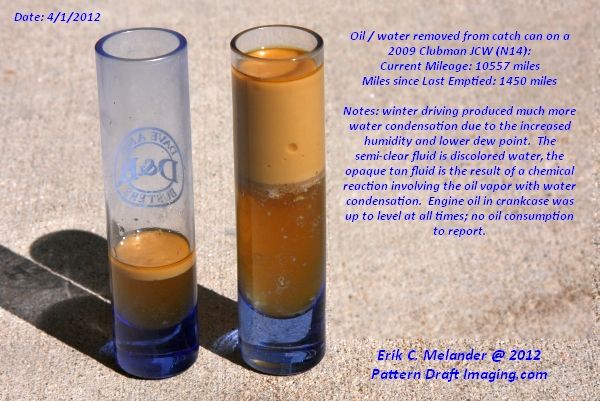
Car info: 2009 R55 JCW
Current Date: 4/1/2012
Current Mileage: 10557 miles
Miles since Last Emptied: 1450 miles
Notes:
- winter driving produced much more water condensation due to increased humidity and lower dew point
- the semi-clear fluid is discolored water, the opaque tan fluid is the result of a chemical reaction involving the oil vapor with water condensation (very frothy)
- engine oil in crankcase was up to level (no overfilled) at all times; no oil consumption to report
Observation: was a semi wet and cooler Colorado winter. Car is driven on 20+ min trips with no short trips occurring to make sure engine is up to running temp for a good portion of being out.
Thoughts: increased humidity and lower dew point was the cause of the water condensation when the engine cooled after running.
- Erik
Car info: 2009 R55 JCW
Current Date: 4/1/2012
Current Mileage: 10557 miles
Miles since Last Emptied: 1450 miles
Notes:
- winter driving produced much more water condensation due to increased humidity and lower dew point
- the semi-clear fluid is discolored water, the opaque tan fluid is the result of a chemical reaction involving the oil vapor with water condensation (very frothy)
- engine oil in crankcase was up to level (no overfilled) at all times; no oil consumption to report
Observation: was a semi wet and cooler Colorado winter. Car is driven on 20+ min trips with no short trips occurring to make sure engine is up to running temp for a good portion of being out.
Thoughts: increased humidity and lower dew point was the cause of the water condensation when the engine cooled after running.
- Erik
Third (3rd) drain on my BSH oil catch can:

Car info: 2009 R55 JCW
Current Date: 11/16/2012
Current Mileage: 13913 miles
Miles since Last Emptied: 3356 miles
Notes:
- summer driving produced very little water condensation, but provided approximately the same amount of oil residue.
- This time, the oil has a distinct gasoline smell, however is not extremely flammable.
- The semi-clear fluid is discolored (oxidized rust) water is on the bottom
- the tan separating layer is the result of a chemical reaction involving the oil vapor with water condensation
- the dark brown translucent fluid on top is the oil / gas mixture.
- Engine oil in crankcase was up to level at all times; no oil consumption to report.
Observation: very dry, hot and smoky summer in Colorado due to wildfires; car was driven on longer trips along with 20+ min daily grind to the office.
Thoughts: nothing new to report; steadily watching collection of fluids.
- Erik
Car info: 2009 R55 JCW
Current Date: 11/16/2012
Current Mileage: 13913 miles
Miles since Last Emptied: 3356 miles
Notes:
- summer driving produced very little water condensation, but provided approximately the same amount of oil residue.
- This time, the oil has a distinct gasoline smell, however is not extremely flammable.
- The semi-clear fluid is discolored (oxidized rust) water is on the bottom
- the tan separating layer is the result of a chemical reaction involving the oil vapor with water condensation
- the dark brown translucent fluid on top is the oil / gas mixture.
- Engine oil in crankcase was up to level at all times; no oil consumption to report.
Observation: very dry, hot and smoky summer in Colorado due to wildfires; car was driven on longer trips along with 20+ min daily grind to the office.
Thoughts: nothing new to report; steadily watching collection of fluids.
- Erik

Hummm, what are you using to suck out the catch can? Perhaps I should empty mine since it has been installed since the August MITM. 
Last I checked the dip stick it did not show anything. :(
Btw, installed by Clint at MITM with a good fog application, not much fog.
Don
Last I checked the dip stick it did not show anything. :(
Btw, installed by Clint at MITM with a good fog application, not much fog.
Don

Where is it mounted exactly ?
I actually remove it from the vehicle to drain.
Once drained, I clean it out with a solvent to remove any sediment.
I'd be curious what, if any, you're pulling out Don. Keep me in the loop.
- Erik
Once drained, I clean it out with a solvent to remove any sediment.
- Erik
Mine didn't show on the stick either, but still pulled the amount shown in the shot glass.
- Erik
- Erik

Former Vendor
Joined: Mar 2011
Posts: 435
Likes: 4
From: Baltimore MD Area
Given what I have seen on VW DGFI pictures and posted shots of intakes valves on other threads here (NAM), I would say that running w/o one is quite a crap-shoot.
I am seeing more and more water residue and less oil in mine here as the temps drop in the NorthEast, but would solidly recommend to anyone that is interested in delaying or dodging the expensive carbon removal procedure that this is a very cost-effective investment in keeping your engine clean(er) and running in peak condition. Cheap insurance.
I am seeing more and more water residue and less oil in mine here as the temps drop in the NorthEast, but would solidly recommend to anyone that is interested in delaying or dodging the expensive carbon removal procedure that this is a very cost-effective investment in keeping your engine clean(er) and running in peak condition. Cheap insurance.
Former Vendor
Joined: Mar 2011
Posts: 435
Likes: 4
From: Baltimore MD Area
Cloud, if you've ever used a canopener, you can do this. Its pretty simple, my kit includes all parts required, and requires only a razor knife and screw driver for installation. Thats it. Complete detailed instructions are included (with pictures) and no tools are required to empty and reinstall once the hoses are attached. Takes less than 20 minutes. The hose clamps at the catch can side use wing-nut fittings (an IHC world exclusive) and dont even require a screwdriver to drain or reinstall.
Dealers don't typically install aftermarket parts, espcially carry-in parts, because any damaged or improperly engineered pieces they would be liable for. They just dont want the aggravation or legal exposure, and I can't really fault them as such, when there are so many stupid and frivolous lawsuits pending.
Dealers don't typically install aftermarket parts, espcially carry-in parts, because any damaged or improperly engineered pieces they would be liable for. They just dont want the aggravation or legal exposure, and I can't really fault them as such, when there are so many stupid and frivolous lawsuits pending.

1st Gear
Joined: Oct 2012
Posts: 44
Likes: 0
Cloud, if you've ever used a canopener, you can do this. Its pretty simple, my kit includes all parts required, and requires only a razor knife and screw driver for installation. Thats it. Complete detailed instructions are included (with pictures) and no tools are required to empty and reinstall once the hoses are attached. Takes less than 20 minutes. The hose clamps at the catch can side use wing-nut fittings (an IHC world exclusive) and dont even require a screwdriver to drain or reinstall.
Dealers don't typically install aftermarket parts, espcially carry-in parts, because any damaged or improperly engineered pieces they would be liable for. They just dont want the aggravation or legal exposure, and I can't really fault them as such, when there are so many stupid and frivolous lawsuits pending.
Dealers don't typically install aftermarket parts, espcially carry-in parts, because any damaged or improperly engineered pieces they would be liable for. They just dont want the aggravation or legal exposure, and I can't really fault them as such, when there are so many stupid and frivolous lawsuits pending.
As for frequency, I've been tackling it every 1500 - 3000 miles depending on driving conditions and weather.
But a local hands-on MINI owner or local MINI independent shop would.
Honestly, it's a cake-walk to install and there's many (including myself) who been through this and can give you pointers.
Also, the archives have plenty of photos to document installation and details on such; it's not rocket science.
- Erik
Former Vendor
Joined: Mar 2011
Posts: 435
Likes: 4
From: Baltimore MD Area
Retarded eh? Okay, well, I would say the worst scenario would be that you would have to order a new stock PCV hose if you butchered up the existing piece too badly, but I can't see any lasting permanent or expensive damage coming out of that. You have any motorhead friends near by?
Okay, well, I would say the worst scenario would be that you would have to order a new stock PCV hose if you butchered up the existing piece too badly, but I can't see any lasting permanent or expensive damage coming out of that. You have any motorhead friends near by?

6th Gear
Joined: Sep 2005
Posts: 12,295
Likes: 1
From: Prescott, AZ, USA
Glad I stumbled upon this thread!
I had fuel injector flush and decarbon service on 9/21, and been paying more for Chevron or Shell gas since, but Trigger still runs bad under sudden and hard acceleration. Looks like this is a solution I need to consider, even though it doesn't look cool or add horsepower.
I had fuel injector flush and decarbon service on 9/21, and been paying more for Chevron or Shell gas since, but Trigger still runs bad under sudden and hard acceleration. Looks like this is a solution I need to consider, even though it doesn't look cool or add horsepower.
Former Vendor
Joined: Mar 2011
Posts: 435
Likes: 4
From: Baltimore MD Area
Kurt, you are mostly correct. An OCC doesnt ADD hosepower, as such, it prevents you from LOSING horsepower by keeping the intake valves clean(er), maintaining intake air flow volume and swirl pattern consistency, and extending or eliminating the periods that the decarbonizing procedure is required, which you just performed. Now would be the ideal time to add an OCC system as your intake valves should now be show-room clean and prevent them from recruding (if thats an actual word, LOL), and it just so happens that Im offering free shiping until 16 December. Using branded gasoline will not slow down the recurrence of valve fouling, but will help protect your expensive 1500PSI injectors.
I am planning someday (maybe next spring?) to bring my now-classic (20 yrs in MD) 92 Pontiac Grand Prix and drive the Mother Road out of Chicago. When I roll into Arizona whats a good hole-in-the-wall place to visit?
Using branded gasoline will not slow down the recurrence of valve fouling, but will help protect your expensive 1500PSI injectors.I am planning someday (maybe next spring?) to bring my now-classic (20 yrs in MD) 92 Pontiac Grand Prix and drive the Mother Road out of Chicago. When I roll into Arizona whats a good hole-in-the-wall place to visit?
Former Vendor
Joined: Mar 2011
Posts: 435
Likes: 4
From: Baltimore MD Area
Just emptied my OCC again a couple hours ago, another 400mL of milkshake, again appears to be mostly water. Not a noticable gasoline smell, more like a baked oil smell, which being a turbo would be completely expected. Im still wondering when the factory will wake up and start installing these OE, but then, they would lose their $550+ service charges for walnut shelling, wouldn't they?
6th Gear
Joined: Sep 2005
Posts: 12,295
Likes: 1
From: Prescott, AZ, USA
Kurt, you are mostly correct.
...
Using branded gasoline will not slow down the recurrence of valve fouling, but will help protect your expensive 1500PSI injectors.
I am planning someday (maybe next spring?) to bring my now-classic (20 yrs in MD) 92 Pontiac Grand Prix and drive the Mother Road out of Chicago. When I roll into Arizona whats a good hole-in-the-wall place to visit?
...
Using branded gasoline will not slow down the recurrence of valve fouling, but will help protect your expensive 1500PSI injectors.
I am planning someday (maybe next spring?) to bring my now-classic (20 yrs in MD) 92 Pontiac Grand Prix and drive the Mother Road out of Chicago. When I roll into Arizona whats a good hole-in-the-wall place to visit?
I don't believe the walnut shell service did anything. Read elsewhere about the Seafoam treatment, which disolves the carbon (?).
Check out my The Official Route 66 thread yet? So many hole-in-the-wall places, depends on your taste. PM me before your trip!

I am going to install my BSH OCC this weekend. Should be fun since I DL the file for the instructions on BSH website! I will post back when I drive the car for 5K miles on my N18 engine.
What's your confusion with such? Let me know what questions you have.
There's photos (if you haven't viewed) on the first page for the installation.
- Erik
There's photos (if you haven't viewed) on the first page for the installation.
- Erik

3rd Gear
Joined: Jul 2012
Posts: 296
Likes: 0
From: Nebraska
I am new to working on cars. I read the installation but it did not seem clear. I am sure it will make more sense once I start. Again just a little new. This site really helps.
* http://www.bshspeedshop.com/bshstore...structions.pdf
- Erik
6th Gear
Joined: Sep 2005
Posts: 12,295
Likes: 1
From: Prescott, AZ, USA
I installed the catch can today. For being mechanically challenged, it took about 1.5 hours. My only complaint is the screw for mounting the can is a tad short.
Don't know why I got the Dual Boost Tap, now I'll have to get a boost gauge.
Don't know why I got the Dual Boost Tap, now I'll have to get a boost gauge.