When you click on links to various merchants on this site and make a purchase, this can result in this site earning a commission. Affiliate programs and affiliations include, but are not limited to, the eBay Partner Network.
Picked up some JCW aero kit side skirts at my local pick-you-own parts yard last week. I couldn't believe they showed up there! Someone else had already gotten the front and rear aero bumper covers by the time I got to it.
Unfortunately the yard put the car up on wheels that were resting on the side skirts which damaged them, but after checking out some repair methods on youtube and various websites, I think they should be completely fixable. Going to try to get them repaired and installed this summer, and will try to update my progress on this thread.
I've already made some progress from these pictures. A little work with the heat gun and most of the warping is out. Next step is going to be doing some plastic welding, or plastic epoxy, and/or plastic body filler.
Unfortunately, the salvage yards don’t realize the aero bumpers and skirts are usually the most valuable part of the car, I’m sure you stole the skirts, nice find. Good luck with the repairs. For me, the skirts are the best part of the kit.
......I've already made some progress from these pictures. A little work with the heat gun and most of the warping is out. Next step is going to be doing some plastic welding, or plastic epoxy, and/or plastic body filler.
Nice score on the aero skirts!
Glad you found a video on using a heat gun to repair/reform ABS. Many others just try to fix/fill with body putty (not a choice I'm fond of). The shape in the ABS is a still there in the original material. It just needs the right kind of persuasion to get it back = (heat gun).
I agree with your choice for plastic welding the cracks. I would use a shaft type soldering iron from the back and melt (solder) right down the middle of the crack. If you have any scrap pieces of ABS, - Cut some small strips and use them as feed to bridge, strengthen and fill in any voids.
I think you will also find ABS/welds sand out and Dremel pretty well. Afterwards I would use Epoxy or JB Weld plastic weld for finishing and feathering out small imperfections..
I don't mean to sound pretentious - Just very enthusiastic for you about restoring/repairing your great find
Thanks for all the suggestions and advice! I have all the materials ready to go - cheap Harbor Freight plastic welder, Permatex plastic epoxy, a Evercoat epoxy filler for plastic bumpers, masking tape, sand paper, and primer. Hopefully will be able to work a little on them on Monday.
Thanks for the heads up on PUR, but I think these are actually regular thermoplastic, just based on their black appearance on the back and the ease with which I could mold them back into shape with the heat gun. Next time I work on them, I'll confirm and snap a picture.
I've seen some pictures of a scuffed up aero front bumper and just going off that, I think that one is PUR.
Thanks for the heads up, confirmed they are marked as PUR GF20. The plastic part that attaches underneath is PP-EPDM.
Been reading and learning about working with PUR. The GF20 means it's 20% glass fiber. Apparently PUR is more common on custom parts like this since it's cheaper than thermoplastics for low volume parts. Most high volume parts are also not PUR as apparently it's not recyclable.
At any rate, the "weld" made specifically for PUR is more like a hot glue adhesive repair since PUR does not melt when heated, it just breaks down. I've been on the fence on using the Harbor Freight plastic welder or Permatex Black Plastic weld epoxy for the crack repairs. Leaning towards the Permatex since the HF welder doesn't specifically mention PUR plastics....but neither does the Permatex.
Got them cleaned off yesterday. The blue paint came off with a little rubbing alcohol. Ready to experiment with the epoxy tonight on a crack on the bottom that will never be seen.
Made some progress on these. I started to repair the parts that won't be seen first. Sanded with 80 grit and used Permatex plastic weld epoxy to repair. I'm pretty impressed with the epoxy so far. The clip feels very secure.
For a crack on the bottom, I dremeled out a ridge for the epoxy. This is the technique suggested for PUR plastic and a plastic welder, so I figured it would work well for the epoxy too. This crack is practice and testing for the cracks on the front. The epoxy worked really well for this. Seems to be holding strong, but is flexible as I bend the plastic
The sanding for the epoxy shows another problem I'll need to deal with. The black around the edge isn't the color of the plastic like on the normal side skirts - it's painted on. There's a texture to it too that makes it match the arch trim pieces. I'm thinking of lightly sanding and trying SEM trim black to touch it up.
A missing clip mount on one of them. I have one I cut off some base cooper side skirts I'll be trying to glue on.
The screw here was stuck with rust/crud and I cracked the plastic getting it out. The plastic weld epoxy fixed it with no trouble. Again, feels very strong.
Nice work. Good thinking using the clips from a stock skirt, that didn’t occur to me. There was a particular structured paint used for the texture black parts of the skirts available from MINI, but NLA now. Most use various brands of bumper/trim paint, some may match better than others. If you’re thinking of finishing off the skirts with the JCW entry sill covers (NLA) there are excellent reproductions here. https://whatageek.co.uk/shop/gel-sill-strips/
I have those exact sill covers on my existing skirts. I'm hoping I'll be able to get them off without damaging them and then re-glue. Good to see there are some reproductions available if I'm not successful.
I saw a few textured paint options, but was worried it wouldn't match, and they tend to be expensive too. I'm hoping there's still enough texture after a light sanding that the regular SEM trim black will do the trick. As long as it's close enough....
It seems the black on these might need regular touch-ups from rocks, etc. chipping off the black paint.
Seems the stones mostly hit in front of the vent, and mostly the thin ridge of body color paint before the black. Careful removing the OEM sill covers, the gel is set on a thin strip of aluminum, which will bend and kink easily, keep it flat as possible. Also when mounting the skirts, although not absolutely necessary, they use a strip of double sided foam tape under the sill to help keep it tight to the body.
With the back glued, the front was pretty close to flat again, as the sanding reveals.
Dremeled out a little for the epoxy along the front of the crack.
Epoxy in and sanded.
Used this bit for the little indention between the yellow paint and the black trim part on the bottom to fix the cracks there.
Thankfully a lot of sizes to choose from to find the best match. I ended up using a few different bits for different stages of the repair.
Again, a little dremeled out for the epoxy to go in.
Epoxy in and ready for sanding.
The three epoxies I've been using for the project. Each has their strengths/weaknesses.
Permatex was my go-to for gluing cracks on the back and reattached one of the clip mounts. It is non-sag, which is a huge plus, and sets really fast. The closest to "real" welding. The cured epoxy is flexible too, which is another plus.
The JB-Weld was to attach a PP replacement clip on the back. Apparently the Permatex won't adhere to PP. This does sag, and cures more slowly than the Permatex. Generally harder to work with than the Permatex. Final bond seems very strong, but is not flexible.
The Evercoat Body Shop epoxy was for repairs that will need to be flat and painted eventually. The other two epoxies don't sand flat easily, but the Evercoat does.
Next up (hopefully this week), wet sanding both at 400 grit and primer on the spots I repaired.
Great tutorial. I’ll bookmark this one. Cracked skirts are super common, always good to have a DIY thread. Thanks for posting the products and tools used.
A few pictures of the repaired posts on the back. After comparing to the other side, these are not in the exact right spot, so I may end up having to cut off and re-glue them....hopefully not, but we'll see.
A few pictures of the primer sanded. The body shop was not a fan of spray can primer and actually removed it and applied 2K primer. If you plan on getting things painted professionally, you probably want to use 2K primer or just have the body shop handle it.
After wet sanding the black part, most of the texture was gone, so I decided I'll just be repainting the texture coating and black. This made painting the pieces easier for the body shop, and is the method the instruction sheet recommends - black texture and trim paint should be last.
Had to do a lot of sanding on this groove after priming for it to match the unrepaired part of the groove. Overall, I'm pretty happy with the match.
Sanding out a few minor nicks along the bottom edge. These probably won't be noticeable after the black trim paint is on and the panels are on the car.
Back from the body shop in BRG and ready for the black texture and trim paint which I'll be doing myself....hopefully this weekend!
The paint match looks to be very close, but it will be easier to compare once they're on the MINI. I had this shop paint a front bumper for me a few years ago, and they had a pretty amazing book of many different shades of BRG that we could hold up to the car in the sun to find the best match. They were able to use that same match from then for painting these. While on the topic of paint...in my experience, the color consistency of BRG from the factory appears to be pretty amazing. I swapped a passenger door about two years ago, and it's completely unnoticeable, and that was a 2006 door on a 2003 MINI.
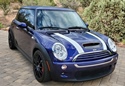
Not looking too bad for almost 200k miles (less than 400 miles to go!).
For the texture coating, I used the SEM products pictured below. They worked well and I definitely recommend them for this. The other nice thing about using these is I'll be able to do touch-ups in the future as needed too.
First, masked the edge with 3M 471 vinyl masking tape. If you need a sharp masking line, this is the stuff to use! The mask line is very sharp, and it bends for curves really well too.
After masking, I did three coats of the texture coating from around 2 feet away. Pulled the masking tape off right after the third coat. After letting that dry for about a day, I masked again, and did a light sand on the texture coating with 400 grit. I was really easy on the sanding, afraid I'd sand the texture off too much. In reality, I could've sanded a little more than I did to match the wheel arch trim. On the finished skirt, up close, you can tell the side skirts have more texture than the wheel arch trim, but once you're a few feet away, you can't tell.
Finally finished with three medium coats of the trim black paint.
This is the 3M 471 vinyl masking tape.
Mounting tape like this is required under the sill plate since these don't use clips like the standard side skirts.
Good adhesion promotor like this will help the double-sided tape stick really well. When I pulled these side skirts off the donor MINI, this tape was no longer sticking to the body of the car. I'm hoping using this stuff helps it hold for the long haul.
I used this to re-stick the JCW sill plates that were on my old side skirts. So far it's working well.
The install went pretty smoothly. I was surprised by some very small rust spots under the old side skirts. Specks of dirt/sand can get under the sill plate, and over time those are pinched and rub through the paint on the body under the side skirts. I cleaned them and covered with touch-up paint before installing the new side skirts. I also discovered I need to do some more rust repair on the notorious pinch weld under the door weather-stripping some time soon. I repaired that many years ago, but apparently didn't do too well on one spot....
One of the clip mounting posts on the back of the side skirt I repaired was off by about 5mm vs. the one that wasn't damaged. After testing the flex of the mount, I decided that post placement was not going to work. I cut it off and re-glued with the Permatex plastic weld the night before install day. I'm really glad I did that last minute adjustment - it snapped in perfectly on the install, which I'm sure it wouldn't have if I didn't make the adjustment.
I'm loving the look of the side skirts and am really happy how it all turned out. When I first picked these up, I was wondering if I made a mistake with the damage they had, but repairing these really wasn't too bad. Hopefully this thread inspires some others to salvage more of these JCW side skirts!
Many thanks for taking the time to document the process so thoroughly and sharing it!
Such a great contribution to help others toward a tried 'n true solution as the prep and materials aspect can be a huge hurdle and it's so great to have that already sorted instead of going in blind and experimenting, a truly good gift of time-savings here, so much appreciation.
Your method and technique is excellent and the end result is awesome.
Last month I finally got lucky and scored a set of skirts at a junkyard but sadly a sloppy forklift driver damaged the driver side pretty badly, and I will try to fix and salvage to have as a spare set, and this thread is tremendously helpful.