When you click on links to various merchants on this site and make a purchase, this can result in this site earning a commission. Affiliate programs and affiliations include, but are not limited to, the eBay Partner Network.
my top motor cover came off no problem with my tower brace still installed. leaned it in the corner of my garage. looks easy enough to change plugs. what is the make & model # of the best & longest-lasting plugs ? I guess Gap would be good to know too. thanx yeh, I imagine one o' these years I'll need new ones, might as well know it all now. 2015 2.0 L
I had mine changed with the OEM brand. On my 1.5L, changing the plugs required a special-sized socket tool to fit in the holes—check to see if this is true on the 2.0L.
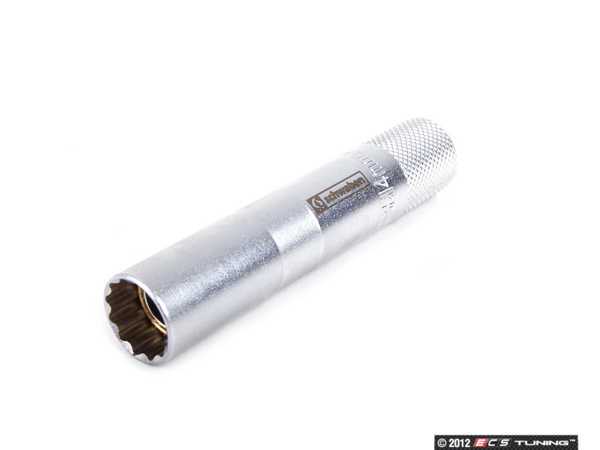
I know the plugs are smaller than 13/16. when you buy a set of plugs, get a socket to fit. I think 5/8. a plug socket with a spomge in there to grab the plug so it comes out with the socket when you unscrew it.
Indeed, you need the socket pictured in the post above. The plugs and socket are smaller than "old school standard" and an old school socket won't even fit in the hole.
The plugs are not hex head, they are a star-head (I don't know the technical term, but they exactly match that socket). The socket also has a rubber ring/sponge/you get the idea inside it to grip the plug insulator.
I don't know what the state of things is now, but forum posts here and elsewhere discussing my Cooper S (F56) have noted that Mini has multiple suppliers of plugs under the same part: Champion and NGK are what I see discussed the most, with a loud note from lots of people that the Champion plugs are not the choice for good performance or consistent performance over time. I have also seen BERU plugs discussed as being sold by Mini under the same part number as Champion and NGK.
On various Mini parts sites they sell plug sets as well as the socket. I just did my plugs yesterday, and they are are BERU.
Other details: you don't gap them and you don't use anti-seize. They are pre-gapped, and the coating on the plugs from the factory handles the anti-seize question.
On my F56 the change was straightforward. The only wrinkle was getting the foam insulator off the HPFP without damaging it (the insulator also covers the coils for cylinders 3 and 4). This YouTube video for the non-S (go to the 28 second mark):
For spark plug replacement, why does one need to unplug the wire from the ignition coil? Seemed unnecessary. The video missed a step to blow out debris in the coil area with compressed air before taking the spark plugs out.
For spark plug replacement, why does one need to unplug the wire from the ignition coil? Seemed unnecessary. The video missed a step to blow out debris in the coil area with compressed air before taking the spark plugs out.
Might be out of an abundance of caution. Don't know. The factory howto instruction does make reference to risks of igniting fuel, presumably from all that HPFP tubing and connection nearby.
The factory instruction also looks to be:
(1) disconnect a very large electrical connector sitting in front of the intake tube
(2) disconnect the electrical connector from the ignition coil
(3) blow out the debris in the spark plug well before removing the plug
(4) remove the plug
Notably, the same instruction, or at least the one I've seen, makes no mention of getting that foam brick off from on top of coils 3 and 4 -- in fact, the brick isn't pictured or mentioned at all, it's just conveniently not there. Thank goodness for YouTube, at least in terms of seeing someone actually get that thing out of there "nicely."
In my case none of the electrical connectors were coming off without a fight, so much that I'm starting to wonder if there is some secret to disconnecting F56 connectors period (seriously, I started looking for answers, didn't find any). So I left the plugs plugged in. I was not happy about the amount of flex I had to put on the wires -- not going to make that a regular thing if I have a choice in the future.
Having worked on a different GDI engine for a good spell (not a MINI, but BMW/MINI plastic definitely isn't somehow "more resilient") where heat and age had made all the coil electrical connectors brittle, I'm thinking a lot about how to allow them to detach without said fight -- but also how to treat them with significant care going forward.
Originally Posted by Stu-mon
I think Bosch plugs will happen. Does anybody know roughly how long all plugs last ? 50K, 75K, 100K ?
Factory-specified replacement interval is 60K miles (execute every 6th oil change, with every oil change factory specified for 10K miles).
There is forum discussion out there about the sharp divergence between this interval and how long iridium plugs are supposed to last in general (routinely stated as a minimum of 100K miles). I think the upshot there is that if one would like to find out whether BMW/MINI knows what they're talking about in saying to replace the plugs 40K sooner (meaning every 60K rather than every 100K), they either get to test on their own car or talk to some folks who have. I'm not testing on mine
Might be out of an abundance of caution. Don't know. The factory howto instruction does make reference to risks of igniting fuel, presumably from all that HPFP tubing and connection nearby.
The factory instruction also looks to be:
(1) disconnect a very large electrical connector sitting in front of the intake tube
(2) disconnect the electrical connector from the ignition coil
(3) blow out the debris in the spark plug well before removing the plug
(4) remove the plug
Notably, the same instruction, or at least the one I've seen, makes no mention of getting that foam brick off from on top of coils 3 and 4 -- in fact, the brick isn't pictured or mentioned at all, it's just conveniently not there. Thank goodness for YouTube, at least in terms of seeing someone actually get that thing out of there "nicely."
In my case none of the electrical connectors were coming off without a fight, so much that I'm starting to wonder if there is some secret to disconnecting F56 connectors period (seriously, I started looking for answers, didn't find any). So I left the plugs plugged in. I was not happy about the amount of flex I had to put on the wires -- not going to make that a regular thing if I have a choice in the future.
Having worked on a different GDI engine for a good spell (not a MINI, but BMW/MINI plastic definitely isn't somehow "more resilient") where heat and age had made all the coil electrical connectors brittle, I'm thinking a lot about how to allow them to detach without said fight -- but also how to treat them with significant care going forward.
Factory-specified replacement interval is 60K miles (execute every 6th oil change, with every oil change factory specified for 10K miles).
There is forum discussion out there about the sharp divergence between this interval and how long iridium plugs are supposed to last in general (routinely stated as a minimum of 100K miles). I think the upshot there is that if one would like to find out whether BMW/MINI knows what they're talking about in saying to replace the plugs 40K sooner, they either get to test on their own car or talk to some folks who have. I'm not testing on mine
Thank you for sharing your experience. I did not get the part about igniting fuel through the ignition coil... How fuel is involved there?
As far as the connectors, I see there is the VAG Connector Removal Tool (https://www.ecstuning.com/b-schwaben.../002916sch01a/) or use a flat head to carefully pull the tab out, then remove. Did you actually try this? I think wrapping tape on the flat head should do it to avoid breaking the tabs.
In terms of replacement interval, it think it depends on if one is running a tune or not. If so replacement between 35 - 40 K seems cheap insurance.
Thank you for sharing your experience. I did not get the part about igniting fuel through the ignition coil... How fuel is involved there?
As far as the connectors, I see there is the VAG Connector Removal Tool (https://www.ecstuning.com/b-schwaben.../002916sch01a/) or use a flat head to carefully pull the tab out, then remove. Did you actually try this? I think wrapping tape on the flat head should do it to avoid breaking the tabs.
In terms of replacement interval, it think it depends on if one is running a tune or not. If so replacement between 35 - 40 K seems cheap insurance.
Re the fuel/electrical question:
Everything involving the electrical on the ignition is just that, electrical. You don't mix electricity (including static electricity) and gasoline unless you want really exciting times. I'm not the manufacturing engineer for BMW/MINI here, but given that you have electrical and fuel handling in physical proximity and that the BMW/MINI instructions for this also have warnings about static discharge, I think the nature of the concern is clear.
I'm guessing you already know that the shiny metal structure under the foam block that has to be removed is the HPFP, and that all the tubing (mostly metal) running to and from it contains gasoline (which, by the way, is pressurized - more fun for combustion, by design for use by the engine, less by design if you have an unintended ignition by some means).
Re the sticking electrical connector:
The connector removal tool at the ECS link looks like a neat item for a connector that isn't sticking. Unfortunately, my connectors (or at least the first one, which was the only one I bothered to try to disconnect) not only had a sticky release tab, but the connector itself still didn't want to come off even after getting the release tab to proper position. The connector itself simply wouldn't budge, probably due to a combination of heat and dirt. I would have taken contact cleaner to to connector to try to free it up before trying to pull it off with a tool.
The connector removal tool won't do a lick of good if your trouble is release tabs that stick. And it may or may not work for other connectors. For example, I don't see how one would use it on the larger connector previously mentioned.
More on point though, connectors with sticky release tabs are a problem I've encountered multiple times on the MINI. In fairness, the problem is almost certainly that one has to pressure them "just right." But what "just right" means depends on the connector style, and I seem to run into having to figure that out quite a bit on the MINI. Since I've been underhood on cars for a few decades now, I'm sure I'll figure out the magic eventually; but for now I'm happy to just sort of glare at my engine from time to time.
I've learned the hard way not to force *any* plastic parts on the MINI. So since it wasn't necessary to get the connector off to pull the coil from its chamber, I left the connector attached. But at some point in the future I'll figure out how to "unstick" those, because I prefer not to flex the coil wires unless I have no choice.
Re the plug replacement interval:
Spark plug tech that is way more basic than iridium-anythings, on cars that are way older than the MINI, used to have replacement intervals at the 60K mile mark. An example would be my mid-90s-vintage Subaru, and the interval is proven (348K miles and still going strong in my case). With that in mind I'm not sure a shorter than 60K plug replacement interval on sturdier, newer plug tech (that tech itself rated for longer durations than 60K anyway) is really "insurance" so much as not getting full productive use out of each run of plugs. But YMMV, and there are definitely usage scenarios where one can wear plugs down faster. Only you will really know whether you are working your engine, and therefore your plugs, that hard.
FYI, when I replaced my plugs before putting the car on the dyno, the OEM plugs were: BMW 12 12 0 040 551.
That's the box. The plug itself bears the following: CHAMPION RERX4ZWYPB
Caveat emptor however, as my car is JCW.
Cheers,
Charlie
Those Champion plugs are exactly the ones I just pulled out of my 2017 MCS, and that I replaced with BERU Z366 plugs also sold by BMW/MINI under the same BMW part number (12 12 0 040 551). The BMW part number apparently has at least 3 manufacturers (Champion, BERU, and I gather NGK) underneath.
I purchased the NGK 94201 from ECS and have not installed them... Based on the research the community trust NGK over Champion but I have not seen and test results. I think either one will do just fine.
NGK are good, i think BMW shopped for a new contract on the plugs, they don't look like the old Champion plugs at autozone. Made in france so they fancy and romantic spark plugs.
So I’ve just pulled my F57 out of storage and received all kinds of service-related messages. The one that surprised me pertains to the spark plugs. Why would my car be saying the spark plugs need changing at only 40,000 miles/4 years old?
My comment was more about not understanding why the car is calling for new spark plugs so soon. Aren’t they on a fixed interval (60,000 miles or every 6th oil change, whichever comes first)? I’m only heading into oil change #4 and only have ~34,000 miles on the odometer (the car says new plugs are needed in ~8,000 miles or February 2022).