


Drivetrain Thinking of upping boost? Considerations before you do.


Thinking of upping boost? Considerations before you do.
We at FrankenTurbo have been testing our hybrid turbocharger on the 1.6L N14 engine for quite some time now. Working with several tuners we've uncovered a number of challenges during the process. And while we've been happy with the "results", I felt it was a good idea to start a conversation here about the realities. So this is my introduction to the MINI community: I'm starting off by saying that "before you think about dessert, you need to eat your peas."
The first item I want to discuss is ignition timing and its relationship to the 10.6:1 compression ratio in that motor. The Cooper S has really high compression for a turbocharged motor. This is great for low-end responsiveness and a host of other things, but not so good for turbocharging. So before undertaking any kind of performance increase, you need to guard against mis-firing, pre-detonation & knock. Your tuner will be able to define an ignition timing map that's a good complement to raised boost, but that map is going to be based on the assumption of good mechanicals under the hood. But what if something under the hood is "out of whack"? For example, here's a nice look at the valve cover on these engines:
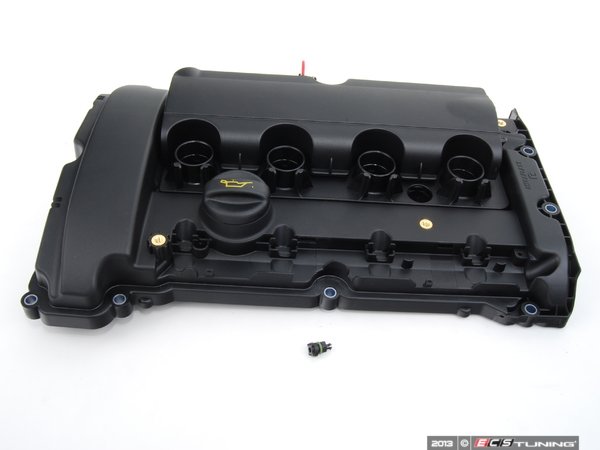
Inside this cover is the PCV valve, a component of your emissions system. It's responsible for managing engine vapors and making sure they are routed into the cylinders to be combusted, rather than simply being vented off. But if this valve fails -- which it's certainly known to do -- it can create a big hazard to your motor. That's because those vapors in the PCV system contain motor oil, and when too much oil gets into the air/fuel mixture, the octane rating is reduced. Combine raised boost with lowered octane and you have the makings of a big repair bill.
While we were working with Buckhead Imports in Georgia, they encountered terrible detonation when tuning our turbo. The engine hated raised boost. And it was only through some hunting around in the breather system that they found the smoking gun of a failed PCV valve: the recirculation hoses were FILLED with engine oil. That engine oil was pooling in the downstream hoses and then getting blasted into the intake tract during boost.
Yes, it's true that when the PCV valve sticks open, the ECU should throw codes . But it didn't. And so our FrankenTurbo tuning project almost turned into a disaster. During the year we have worked with several tuners to perform this kind of diligence. And their feedback has helped us to refine the product as well as uncover the stumbling blocks. The Cooper S engine is just not a "bolt-on-and-go" prospect. Yet while there are pitfalls out there (stuck PCV valves among them) there's also a whole lot of potential. And that's why we at FrankenTurbo have developed the F21M.
In the coming days I plan to post more about that potential -- and about the FUN. But I want to start with the caveats. And forum members' comments are more than welcome to the thread.
thx
Doug Harper
FrankenTurbo
The first item I want to discuss is ignition timing and its relationship to the 10.6:1 compression ratio in that motor. The Cooper S has really high compression for a turbocharged motor. This is great for low-end responsiveness and a host of other things, but not so good for turbocharging. So before undertaking any kind of performance increase, you need to guard against mis-firing, pre-detonation & knock. Your tuner will be able to define an ignition timing map that's a good complement to raised boost, but that map is going to be based on the assumption of good mechanicals under the hood. But what if something under the hood is "out of whack"? For example, here's a nice look at the valve cover on these engines:
Inside this cover is the PCV valve, a component of your emissions system. It's responsible for managing engine vapors and making sure they are routed into the cylinders to be combusted, rather than simply being vented off. But if this valve fails -- which it's certainly known to do -- it can create a big hazard to your motor. That's because those vapors in the PCV system contain motor oil, and when too much oil gets into the air/fuel mixture, the octane rating is reduced. Combine raised boost with lowered octane and you have the makings of a big repair bill.
While we were working with Buckhead Imports in Georgia, they encountered terrible detonation when tuning our turbo. The engine hated raised boost. And it was only through some hunting around in the breather system that they found the smoking gun of a failed PCV valve: the recirculation hoses were FILLED with engine oil. That engine oil was pooling in the downstream hoses and then getting blasted into the intake tract during boost.
Yes, it's true that when the PCV valve sticks open, the ECU should throw codes . But it didn't. And so our FrankenTurbo tuning project almost turned into a disaster. During the year we have worked with several tuners to perform this kind of diligence. And their feedback has helped us to refine the product as well as uncover the stumbling blocks. The Cooper S engine is just not a "bolt-on-and-go" prospect. Yet while there are pitfalls out there (stuck PCV valves among them) there's also a whole lot of potential. And that's why we at FrankenTurbo have developed the F21M.
In the coming days I plan to post more about that potential -- and about the FUN. But I want to start with the caveats. And forum members' comments are more than welcome to the thread.
thx
Doug Harper
FrankenTurbo

4th Gear

Joined: Aug 2012
Posts: 411
Likes: 0
From: Denver, CO
Oil Catch Can is a waste of money on these cars. It does nothing to prevent the carbon build up or trap those oil vapors effectively. The valves and intake track need to be cleaned by hand or media blasted (yes, even with a working PCV valve). Methanol injection kits help prevent some build up, but if you already have build up it certainly won't clear it out. Even then, methanol injection doesn't completely prevent build up. Just an issue that requires monitoring.

Oil Catch Can is a waste of money on these cars. It does nothing to prevent the carbon build up or trap those oil vapors effectively. The valves and intake track need to be cleaned by hand or media blasted (yes, even with a working PCV valve). Methanol injection kits help prevent some build up, but if you already have build up it certainly won't clear it out. Even then, methanol injection doesn't completely prevent build up. Just an issue that requires monitoring.
 It's like a band-aid on a gunshot wound

Oil Catch Can is a waste of money on these cars. It does nothing to prevent the carbon build up or trap those oil vapors effectively. The valves and intake track need to be cleaned by hand or media blasted (yes, even with a working PCV valve). Methanol injection kits help prevent some build up, but if you already have build up it certainly won't clear it out. Even then, methanol injection doesn't completely prevent build up. Just an issue that requires monitoring.

4th Gear
Joined: Jan 2013
Posts: 329
Likes: 1
From: Massachusetts
I agree with the carbon issue. There is no preventing that. But what about those who want to keep excess vapors out of the Turbo and Intercooler? I understand it won't keep it all out, but wouldn't there be benefit in keeping the amount of oil vapot as low as possible?
according to Doug, it is possible for the PCV valve to fail, allowing the turbo to suck up a bunch of oil from the intake....so wouldnt putting some sort of intermediary between the PCV and the Turbo to catch oil be a good idea?
Thanks. This is another maintenance consideration before raising power output. These engines, with the fuel being injected directly into the cylinders, lack the cleaning effect of fuel being sprayed past the intake valves. So any plans for a car with significant mileage need to include carbon build-up removal.
Trending Topics

Hello everybody, I just want to throw in my 2 cents on this upgrade. I have this turbo currently on my car and aided in the testing phase of the product. There are a lot of things to keep in consideration prior to this installation. Number check all areas for oil leaks! This meaning your valve cover of timing chain tensioner. These leaking areas can be a result of the dreaded PVC failure. Make sure you have everything updated as far as parts prior to installation meaning (new or recently updated timing chain tensioner, also check tensioner guides for wear, recently replace the high pressure fuel pump, and that you have the updated water pump).
Now as far as the controversy of carbon build up in the n14. I've had car since July of 2010. I changed oil every 5k miles, along with cleaning my air filter etc. I am also a spirited driver hahah. I currently have 70,000 miles on the car and drive it daily. Recently I had to battle with a check engine light that turned out to be the high pressure fuel pump (common failure of the r56). Anywho while trying to diagnose the problem since there were no faults besides misfires and cold start problems, I decided to check my chain guides and valves to check for carbon build up. To my surprise everything still looked brand new,even the head (which usually gets stained from old oil). Then I checked my valves, also to my surprise barely and buildup. This being said if you take care of you car it will take care of you.
Now as far as the controversy of carbon build up in the n14. I've had car since July of 2010. I changed oil every 5k miles, along with cleaning my air filter etc. I am also a spirited driver hahah. I currently have 70,000 miles on the car and drive it daily. Recently I had to battle with a check engine light that turned out to be the high pressure fuel pump (common failure of the r56). Anywho while trying to diagnose the problem since there were no faults besides misfires and cold start problems, I decided to check my chain guides and valves to check for carbon build up. To my surprise everything still looked brand new,even the head (which usually gets stained from old oil). Then I checked my valves, also to my surprise barely and buildup. This being said if you take care of you car it will take care of you.

5th Gear
Joined: Jul 2012
Posts: 777
Likes: 1
From: Richardson, TX
Over the past 18 months or so since installing a catch can, I've collected nearly a gallon of milky smelly water from it. Here in Texas is gets really hot in the summer and when the temps go up, there is nothing in the catch can. But when it starts getting under 50, and if you make short trips, your accumulation of crap could get high enough to where you might be filling it up in a week. It's the effect of condensation. You do not want it to fill up. Is it doing any good. Donno. I think that if you can keep something off the valves you have at least staved off the wolves for awhile.

2nd Gear
Joined: Dec 2011
Posts: 111
Likes: 1
I can't say my catch can is helping but every 2-3 weeks it's full of oil and water. I'd have to guess less then 10% oil. It's very humid down here in the south and it's keeping quite a bit of water from going through my intake track. It can't be hurting.
I have been mowing over a turbo upgrade. When I do the swap I'm planing on changing the oil lines, adding an oil cooler and flushing the coolant. I clean my air filter probably once a month. I travel a lot of back roads and my engine compartment is always filthy. Plus I know you need to keep clean air going through the turbo.
I have been mowing over a turbo upgrade. When I do the swap I'm planing on changing the oil lines, adding an oil cooler and flushing the coolant. I clean my air filter probably once a month. I travel a lot of back roads and my engine compartment is always filthy. Plus I know you need to keep clean air going through the turbo.

We've been working with a number of tuners for over a year now. And while we've definitely seen that the F21M can be run safely on stock software, I can't answer your question about compatibility with Evolve's aftermarket software.
This is definitely a question for your tuner. If you are concerned that the ECU mapping is too aggressive for the octane fuel you are using, your tuner should evaluate your engine's performance data and make any revisions necessary.
This is definitely a question for your tuner. If you are concerned that the ECU mapping is too aggressive for the octane fuel you are using, your tuner should evaluate your engine's performance data and make any revisions necessary.
With the race fuel question I was referring to your Pcv oil statements above about oil lowering the octane. I would think it would balance some of that out and with a decat pipe no worries of killing a catalyst brick
Sorry to have let this thread go dormant. I'll have some tuning data posted shortly. We are anticipating results from Neuspeed, Madness Motorworks & Buckhead Imports. First up, though, will be results from C2Motorsports.
Thx
Thx

2nd Gear
Joined: Sep 2014
Posts: 119
Likes: 0
From: Winnipeg, MB + Vancouver, BC
Sorry to have let this thread go dormant. I'll have some tuning data posted shortly. We are anticipating results from Neuspeed, Madness Motorworks & Buckhead Imports. First up, though, will be results from C2Motorsports.
Thx
Thx
Thanks!
At this stage only one company, Neuspeed in California, has an F21M-specific file. We have yet to have their solution beta-tested, but the base car's owner was pleased by the results. I can post the dyno here if anyone in the SoCal area would be interested in trying this combination themselves.

2nd Gear
Joined: Oct 2013
Posts: 122
Likes: 0
From: Southern California
I'm waiting to see what this turbo can do on a DNA stage 3 JCW, very interested to say the least. As far as a catch can goes, I run one and empty mine every two months or so (weekend car), only get about 30cc or so from it. Anything removed will be beneficial as far as decreasing the coating effect within the charge system. Catch cans work without a doubt and I wouldn't run mine without one. I had a chance to see this first hand when I took the car back to stock recently, hot and cold lines both had residue...wonder what the Helix looks like inside after 30K.......

Thread
Thread Starter
Forum
Replies
Last Post
Indimanic
Stock Problems/Issues
1
Aug 19, 2015 11:08 AM
ki7hy
F55/F56 :: Hatch Talk (2014+)
3
Aug 12, 2015 07:07 PM
Ambient Thermal Management
Drivetrain (Cooper S)
0
Aug 7, 2015 12:27 PM