


Solo Cornering on 3 wheels - good or bad?


Thread Starter
|
OVERDRIVE - Racing Champion

Joined: Feb 2003
Posts: 15,262
Likes: 72
From: Mililani, Hawaii
Cornering on 3 wheels - good or bad?
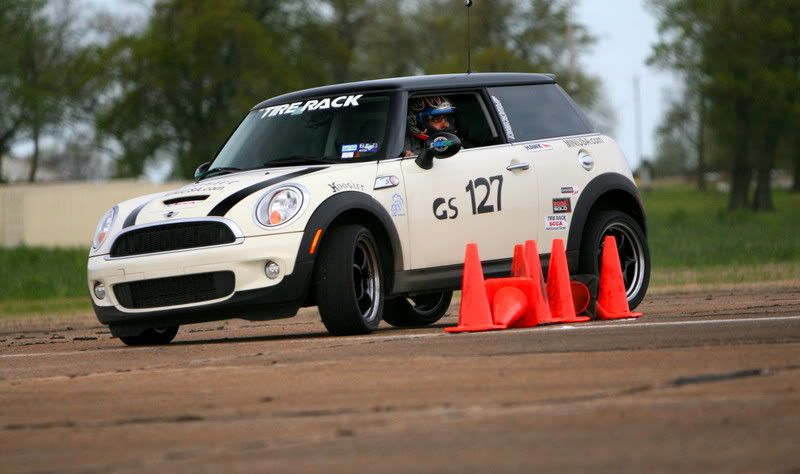
During autocross I notice certain cars has a distinct and stronger tendency to three wheel through corners.
So I wonder if that isn't something that could be-
Good? showing one is a max speed but still maintaining control
Bad? if overdone by taking corners too fast.
Exploited or maximized in some way
Dialed out by suspension tuning- to make better use of all four tires
Minimized by allowing for less weight transfer in the corner
Minimized by slower corner entry to allow for faster exit.
I suppose the best way to judge changes would be to get
some sort of data aquisition tool computer to record entry and exit speeds and g-forces in tight turns and see what might work.
Of course results will vary with suspension upgrades, wheels, tires, and course surfaces but as a discussion it might be interesting to see what small changes can be done to make improvements on run times.
I notice the best/fastest cars in my area don't three wheel. Front wheel drive cars with short wheel base can three wheel and powerful rear drive cars and lift the front wheel on the inner side.
So I wonder if that isn't something that could be-
Good? showing one is a max speed but still maintaining control
Bad? if overdone by taking corners too fast.
Exploited or maximized in some way
Dialed out by suspension tuning- to make better use of all four tires
Minimized by allowing for less weight transfer in the corner
Minimized by slower corner entry to allow for faster exit.
I suppose the best way to judge changes would be to get
some sort of data aquisition tool computer to record entry and exit speeds and g-forces in tight turns and see what might work.
Of course results will vary with suspension upgrades, wheels, tires, and course surfaces but as a discussion it might be interesting to see what small changes can be done to make improvements on run times.
I notice the best/fastest cars in my area don't three wheel. Front wheel drive cars with short wheel base can three wheel and powerful rear drive cars and lift the front wheel on the inner side.

4th Gear
Joined: Mar 2007
Posts: 346
Likes: 0
From: Sedona, AZ.
I find that if I enter the turn correctly (and it's not a decreasing radius) all 4 stay on the ground. I dog pee when I need to trail brake or come into the turn too hot and need to stand on the brakes and turn at the same time. IMO the "dog pee" manuever is an indication of poor turn-in angle (not enough) and should be avoided...though I'm not convinced that it slows you down any in doing it. Then again if you time it correctly you could use it to avoid an apex cone by lifting the tire over the base of the cone (technique used primarilly by the masters who when on course have the ability to know how to rub the cone with the rear tire and keep it in place.

2nd Gear
Joined: Mar 2006
Posts: 80
Likes: 1
From: Louisville
Dialed out by suspension tuning- to make better use of all four tires
Should be, but not always possible, i.e. class rules, short wheelbase-I always see CRX's on 3 wheels. Definitely not the fastest way around the track. Usually caused by too much sway bar.
Should be, but not always possible, i.e. class rules, short wheelbase-I always see CRX's on 3 wheels. Definitely not the fastest way around the track. Usually caused by too much sway bar.

5th Gear
Joined: Nov 2005
Posts: 633
Likes: 0
From: Elyria, Ohio
I don't think there is necessarily anything wrong with lifting the inside rear tire. With my setup, I can lift a rear tire during steady state cornering and still be understeer prone. If I soften the rear bar to get that inside rear tire back on the ground to gain more rear grip, I'm only going to be MORE understeer prone. To me, the fact that the tire is off the ground doesn't mean anything, how the car is behaving is what drives setup changes.
Jason
Jason

4th Gear
Joined: Jun 2007
Posts: 593
Likes: 2
From: Montreal
Weight transfer is to the ourside front and will basicaly just mean there is no weight on the inside rear. The inside tire has the least weight on it anyway if it didn't lift and is doing very little. Actualy, It lost traction long before it lifted off the road, as soon as the suspension is in dropp. A large rear bar will limit wheel dropp so you will notice it more then with out a rear bar, but the same thing is in place.
The end result is that the front needs to be stiffer to stop if from happening. but is it bad?
As long and the front outside tire can handle all that load on it and still corner then your ok, otherwise more front spring will be in order.
I used to make sure my SM civic ran only 1" off the ground on the rear, to know that i am get all the weight on the front but not more then is nexccicary. If your rear is like 5 inches of the ground more front spring is needed.
On the other side of the coin, RWD lift the front on corner exit.
http://farm1.static.flickr.com/65/19...97d279.jpg?v=0
The end result is that the front needs to be stiffer to stop if from happening. but is it bad?
As long and the front outside tire can handle all that load on it and still corner then your ok, otherwise more front spring will be in order.
I used to make sure my SM civic ran only 1" off the ground on the rear, to know that i am get all the weight on the front but not more then is nexccicary. If your rear is like 5 inches of the ground more front spring is needed.
On the other side of the coin, RWD lift the front on corner exit.
http://farm1.static.flickr.com/65/19...97d279.jpg?v=0

3rd Gear
Joined: Jul 2007
Posts: 269
Likes: 0
From: Fort Worth
Ok, since GS's rules make new springs really of out of the question, could shocks correct this a little? I'm not lifting the inside 5", more like 2.5". It's about 1/2-1" more than the guy who's fastest in GS, though.

6th Gear
Joined: Jun 2003
Posts: 3,589
Likes: 2
From: Oregon, USA
Have you seen any of the Koni Challenge or SpeedWorld races? Most of the front wheel drive cars will lift the inside rear on all corners. Don't know if it is the best set-up, but they must know something.....
Trending Topics

6th Gear


Joined: Jun 2006
Posts: 4,168
Likes: 403
I raised this question on the SCCA Forums (http://sccaforums.com/forums/307103/...ad.aspx#307103) to see if any of the truly fast MCS autocrossers will comment.
Cheers,
Charlie

Cheers,
Charlie
5th Gear
Joined: Nov 2005
Posts: 633
Likes: 0
From: Elyria, Ohio
I think we need to specify exactly what we are talking about here. minihune talks about 3 wheeling "THROUGH" corners, cmt52663's post on SCCAFORUMS talks about 3 wheeling at "CORNER ENTRY". These are two different things, one is steady state, the other is transient. For me, 3 wheels in either case isn't a cause for concern, but I think it is important to recognize that these are two distinctly different cases.
Jason
Jason
Jason
Jason
6th Gear
Joined: Jun 2006
Posts: 4,168
Likes: 403
good point Jason - and my other assumption was that minihune was talking about G Stock (no rear bar change allowed - only front bar and shocks)
my STX MCS does not do this - ever. that's possibly due to the combination of H&R coil overs and rear bar.
if I was running stock and had Koni DA shocks (or similiar) I'd be tempted to explore compression damping on the front and a bit of rebound to the back end - the theory would be to dampen the combination of pitch and roll encountered on entry, with brakes on and initiating turn in.
would it make the car faster? mebbe not.
I shall hang out and see who else pops up with more info...
ps: that was Danny Pedroza, photo courtesy of Craig Wilcox!
my STX MCS does not do this - ever. that's possibly due to the combination of H&R coil overs and rear bar.
if I was running stock and had Koni DA shocks (or similiar) I'd be tempted to explore compression damping on the front and a bit of rebound to the back end - the theory would be to dampen the combination of pitch and roll encountered on entry, with brakes on and initiating turn in.
would it make the car faster? mebbe not.
I shall hang out and see who else pops up with more info...
ps: that was Danny Pedroza, photo courtesy of Craig Wilcox!
3rd Gear
Joined: Jul 2007
Posts: 269
Likes: 0
From: Fort Worth
Well, according to the info on that car being for sale, the only difference between his setup and mine is the shocks and the tires. His car seems much more poised than mine in comparable photos. I'm not gonna blame it all on the shocks, my driving style is "Oh crap, I shoulda braked there", but the next thing I buy is a set of Konis. Thank you for that info!
6th Gear
Joined: Jun 2006
Posts: 4,168
Likes: 403
I wouldn't necessarily extrapolate directly from a Honda to a Mini, but the author of this post clearly feels that stock FWD have this trait and has learned to tolerate it...
http://sccaforums.com/forums/permali...ad.aspx#307129
Hey minihune - please weigh in here? Your pot mate, I'm just stirring it!

http://sccaforums.com/forums/permali...ad.aspx#307129
Hey minihune - please weigh in here? Your pot mate, I'm just stirring it!
Thread Starter
|
OVERDRIVE - Racing Champion
Joined: Feb 2003
Posts: 15,262
Likes: 72
From: Mililani, Hawaii
Thanks all for the lively discussion.
The question was meant to be general as it applies to all MINIs during performance driving and specifically my observation during autocross that is it very common to see MINIs three wheel at "corner entry" but not necessarily sustaining that for too long about 2 seconds.
My concern is that although three wheeling happens, it be minimized in order to maintain as much balance of weight transfer to the outside wheels. In my book the wheels on the outside are working very hard and don't need to be stressed more than is required in a sharp and fast turn.
I wonder about easing speed just a little on a sharp turn to reduce weight shift and possibly minimizing lifting of the inside rear wheel. Since the ground surface is essentially flat one could keep contact through the turn and then apply more power coming out of the turn with all four tires on the ground and with better exit speed.
Essentially "slow in" and "fast out" in tight corners. Easier said than done since you'd want to keep enough speed on and not have to brake too hard coming in to the turn which would force more weight to the front tires and lift the rears which would contribute to three wheeling.
That's why I think the data logger that shows speeds through corners will be helpful- done with lifting the wheel and without lifting to see how it differs in entry and exit speeds.
I can tolerate a little wheel lift but I feel I may be loosing a bit of speed by lifting too much or for too long. I do see other FWD cars lift the wheel through the entire turn- not usually the MINIs. I can't imagine that to be optimal.
The question was meant to be general as it applies to all MINIs during performance driving and specifically my observation during autocross that is it very common to see MINIs three wheel at "corner entry" but not necessarily sustaining that for too long about 2 seconds.
My concern is that although three wheeling happens, it be minimized in order to maintain as much balance of weight transfer to the outside wheels. In my book the wheels on the outside are working very hard and don't need to be stressed more than is required in a sharp and fast turn.
I wonder about easing speed just a little on a sharp turn to reduce weight shift and possibly minimizing lifting of the inside rear wheel. Since the ground surface is essentially flat one could keep contact through the turn and then apply more power coming out of the turn with all four tires on the ground and with better exit speed.
Essentially "slow in" and "fast out" in tight corners. Easier said than done since you'd want to keep enough speed on and not have to brake too hard coming in to the turn which would force more weight to the front tires and lift the rears which would contribute to three wheeling.
That's why I think the data logger that shows speeds through corners will be helpful- done with lifting the wheel and without lifting to see how it differs in entry and exit speeds.
I can tolerate a little wheel lift but I feel I may be loosing a bit of speed by lifting too much or for too long. I do see other FWD cars lift the wheel through the entire turn- not usually the MINIs. I can't imagine that to be optimal.

2nd Gear
Joined: May 2007
Posts: 103
Likes: 0
From: Round Rock, TX


Lifting the inside wheel is just the nature of the MCS, CRXs, Sciroccos, etc. FWD cars with great weight distribution will all do it and I see nothing wrong with it.
The above pictures were taken of the East course at Nationals last year entering a tight corner at the end of a fast section. It only lifts on corner entry, but i've never carried it all the way around the corner. The 2nd pic is the exit of that same turnaround.
There's no reason to try and correct it. The front wheels/tires do 75% of the work, the rear tires just keep it stable and planted on transitions, albeit a very important 25%.

1st Gear
Joined: Dec 2007
Posts: 15
Likes: 0
keeping it planted
There's a distinction to be between maximum steady state grip and transitional response.
Four wheels on the ground = maximum grip.
Three wheels on the ground = reduce grip at the back and increase the relative grip at the front= tighten a FWD car line
Four wheels on the ground = maximum grip.
Three wheels on the ground = reduce grip at the back and increase the relative grip at the front= tighten a FWD car line
6th Gear
Joined: Jun 2006
Posts: 4,168
Likes: 403
here the car is oversteering slightly with the throttle closed as I tighten the line. max weight at the LF corner (RR has not lifted)

from the other side, LR droops but remains in contact - far less roll in this setup than a GS setup

The suspension is from Turners: http://www.turnermotorsport.com/html...UCT_ID=50417-2 with the 18mm rear bar included.
Unfortunately, even the H&R Website does not list the spring rates: http://hrsprings.com/scripts/appguid...|%20Cooper%20S
The front bar is stock, and there are Hotchkis lower control arms out back.
As a contrast, here's an H Stock Cooper (driven by Mr. Gj Dixon)

from the other side, LR droops but remains in contact - far less roll in this setup than a GS setup
The suspension is from Turners: http://www.turnermotorsport.com/html...UCT_ID=50417-2 with the 18mm rear bar included.
Unfortunately, even the H&R Website does not list the spring rates: http://hrsprings.com/scripts/appguid...|%20Cooper%20S
The front bar is stock, and there are Hotchkis lower control arms out back.
As a contrast, here's an H Stock Cooper (driven by Mr. Gj Dixon)
Last edited by cmt52663; Jun 26, 2008 at 05:43 AM.
5th Gear
Joined: Nov 2005
Posts: 633
Likes: 0
From: Elyria, Ohio
Another variable we need to keep in mind here, GJ's H Stock car is on R compound tires that have quite a bit more grip than street tires on Charlie's STX car. This probably makes the reduced roll from the suspension mods appear even more extreme.
Jason
Jason
6th Gear
Joined: Jun 2006
Posts: 4,168
Likes: 403
true indeed, but the difference is not more that 10% IMHO
the STX setup on Z1s will top out at about 1.15g in good conditions
the Hoosier AS306 SP setup on the same car was around 1.22 as I recall
I sure don't have access to Mr. Dixon's data, but given the absence of camber I wouldn't expect that car to be doing much more than 1.2 either
Anyone got more data?
the STX setup on Z1s will top out at about 1.15g in good conditions
the Hoosier AS306 SP setup on the same car was around 1.22 as I recall
I sure don't have access to Mr. Dixon's data, but given the absence of camber I wouldn't expect that car to be doing much more than 1.2 either
Anyone got more data?

6th Gear
Joined: Feb 2007
Posts: 1,521
Likes: 17
I'm new to the auto-cross deal, and have seen this and been following along here. Seems most don't think is "real" bad, and that it usually comes from braking into the corner ( and some setup too ). Being FWD, you have the power whenever you are ready to hit the gas and as long as your not "drifting" thru the corner it's probably not slowing you down any. If anything, a tad bit of drift might help get the rear end pointed in the right direction so you can get on the gas sooner. My 2 cents..
6th Gear
Joined: Jun 2006
Posts: 4,168
Likes: 403
I'm new to the auto-cross deal, and have seen this and been following along here. Seems most don't think is "real" bad, and that it usually comes from braking into the corner ( and some setup too ). Being FWD, you have the power whenever you are ready to hit the gas and as long as your not "drifting" thru the corner it's probably not slowing you down any. If anything, a tad bit of drift might help get the rear end pointed in the right direction so you can get on the gas sooner. My 2 cents..
i've spent four years finding out how to get controllable, on-demand oversteer from a car that initially understeered like a cute little piglet!
at this point, with the suspension as described, I tip the balance with tire pressures. 35f/35r and the car is neutral and safe in sweepers, off-ramps and such. 38f/48r and the car will drift easily if i close the throttle. in competition that drift does exactly what you say - allowing early throttle application and good exit speed.
mind you this is a solo setup - i wouldn't ever try it on a road race course!
part of the trick is running -2.5 at the front end and only -1.0 at the rear... if I was braver I'd take another .5 out of the back...
6th Gear
Joined: Feb 2007
Posts: 1,521
Likes: 17
Thanks cmt52663, nice to see what others are doing with pressures, and camber etc. I have noticed some of the same with the 35/35 pressure and gone higher in rear on some auto cross stuff but have never been to the range of 48!!! Maybe I need to though..Currently running stock camber f/r
except it's lowered all around and do have some neg. camber in rear from this. Not sure how much yet..
except it's lowered all around and do have some neg. camber in rear from this. Not sure how much yet..
6th Gear
Joined: Jun 2006
Posts: 4,168
Likes: 403
i was also surprised - the test approach and data are in the STX subforum
this is 195/55-15 on a 15x7 Kosei K1 rim, so other firments may vary quite a bit
i had never run so high on any other tire
</end of offtopic>
but with respect to 3 wheeling, if the class rules permit it I'd try and tune it out
the SCCA thread, although unleavened by of the top MCS pilots, also pointed me to shock tuning as an approach (where spring rates cannot change)
the notion offered was (assumes DA shocks)
1. investigate increased compression on the front, and then perhaps
2. investigate increased rebound in the rear
the bottom line though seems to be that it isn't necessarily a problem - perhaps preference would be a better term!
this is 195/55-15 on a 15x7 Kosei K1 rim, so other firments may vary quite a bit
i had never run so high on any other tire
</end of offtopic>
but with respect to 3 wheeling, if the class rules permit it I'd try and tune it out
the SCCA thread, although unleavened by of the top MCS pilots, also pointed me to shock tuning as an approach (where spring rates cannot change)
the notion offered was (assumes DA shocks)
1. investigate increased compression on the front, and then perhaps
2. investigate increased rebound in the rear
the bottom line though seems to be that it isn't necessarily a problem - perhaps preference would be a better term!
6th Gear
Joined: Jun 2006
Posts: 4,168
Likes: 403
an unarguably expert opinion on G Stock setup for MCS
Folks,
The SCCA thread I started on this matter just bore definitive fruit - you may find it here:
http://sccaforums.com/forums/thread/307103.aspx (Tony Savini weighed in)
Another excellent discussion may be found here: https://www.northamericanmotoring.co...ad.php?t=30594 (Great discussion)
Cheers,
Charlie
The SCCA thread I started on this matter just bore definitive fruit - you may find it here:
http://sccaforums.com/forums/thread/307103.aspx (Tony Savini weighed in)
Another excellent discussion may be found here: https://www.northamericanmotoring.co...ad.php?t=30594 (Great discussion)
Cheers,
Charlie
Thread Starter
|
OVERDRIVE - Racing Champion
Joined: Feb 2003
Posts: 15,262
Likes: 72
From: Mililani, Hawaii
Folks,
The SCCA thread I started on this matter just bore definitive fruit - you may find it here:
http://sccaforums.com/forums/thread/307103.aspx (Tony Savini weighed in)
Another excellent discussion may be found here: https://www.northamericanmotoring.co...ad.php?t=30594 (Great discussion)
Cheers,
Charlie
The SCCA thread I started on this matter just bore definitive fruit - you may find it here:
http://sccaforums.com/forums/thread/307103.aspx (Tony Savini weighed in)
Another excellent discussion may be found here: https://www.northamericanmotoring.co...ad.php?t=30594 (Great discussion)
Cheers,
Charlie
Tony S wrote:
Just saw your post for the 1st time. The wheel up attitude of the Mini is completely normal and common among all the top cars. (see pic to your left) The R56 gets a bunch more air under there due to it's soft spring package. Since I'm trying to dial more rotation into the car most of the time... maybe 3 is actually better than 4 after all.
To that I would say, sure you can live with 3 wheeling but is it really acceptible or more of a compromise given the suspension, course design (tight corners) and speeds used.
At slower speeds, corners with greater turning radius (potentially higher speeds) and on grippy surfaces there can be little to no three wheeling.
In theory it is always better to make use of your tires' fullest traction capabilities which usually means keep your tires on the ground if you can. An abrupt change in weight will lift tires on the inside edge during a hard turn or in the back with hard braking. By watching your corner entry speed, steering smoothly, and easing on the brake you can minimize three wheeling to some extent but maybe not eliminate it. Minimal transient lifting could yield faster times which is always the bottom line but it could be a fine line before spending too much air time and slowing the time through the corner.
Using a data logger one could watch a MINI corner hard, time the air time and look at the corner entry and exit speeds as well as time in the corner. Anything that yields a faster exit speed would be worth the compromise.
The other aspect is whenever you are on less wheels you will wear your three tires more/faster which becomes the budgetary price to pay. I notice many of the rear wheel drive cars that never lift a wheel have really good tread wear, they use the same tires for 2 seasons vs my fast wearing tires that are toast in less than a season on the same surface and they are going faster than I most of the time. (Some are somewhat lighter in weight).