


Interior/Exterior Rear Seat Delete Cabinet Project


Thread Starter
|
6th Gear
Joined: Mar 2007
Posts: 7,578
Likes: 5
From: Paradise
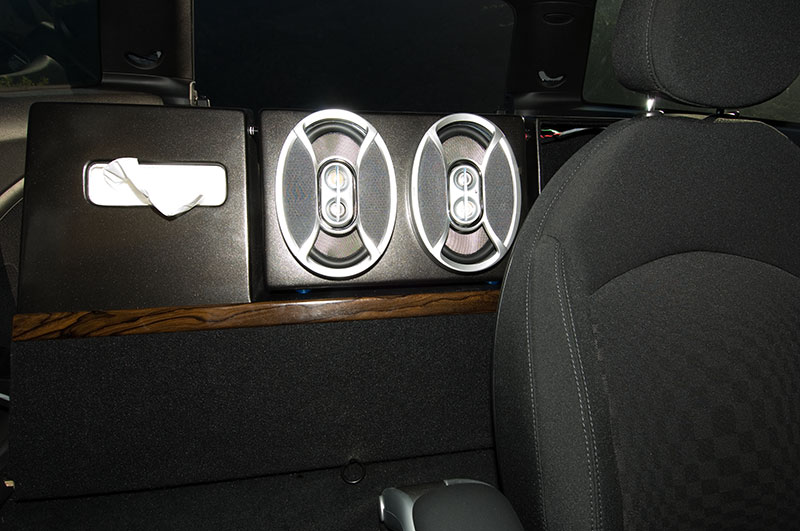
No bass from the NHT 1.5. Just mids and highs. So, as I first thought, it seems the amp isn't putting out bass in either channel for the 6x9s. I don't know whether this was by design, or damage to the amp. Not sure whether it came that way, or I did something to it. However, I doubt that MINI would cover it under warranty after my adding new speakers.
Porting experiments will have to wait for a new amp. Hey Unixgal, I need to hear your system.
Porting experiments will have to wait for a new amp. Hey Unixgal, I need to hear your system.
Last edited by Robin Casady; Oct 25, 2007 at 06:17 PM. Reason: afterthoughts
Thread Starter
|
6th Gear
Joined: Mar 2007
Posts: 7,578
Likes: 5
From: Paradise
Regarding the design of the speaker box. Before starting the project I spoke to Crutchfield tech support (bought the Kappas from them) about it. They told me it didn't matter what size the box was. Seems they don't agree with Infinity on that. Looks like I'll have to upgrade the rest of the system before I find out who's right and how much it matters.
Thread Starter
|
6th Gear
Joined: Mar 2007
Posts: 7,578
Likes: 5
From: Paradise
After a long exchange with Infinity tech support, I received this:
"I had a chance to view your enclosure and I would not recommend porting
it since no matter how high you tune the box, the port will be way too
long and that can be detrimental to the performance also. What I would
recommend is that you lightly fill each cabinet chamber with poly fill
(Dacron poly) in order to eliminate as many standing waves and reduce
transient distortion in the box."
I already have acoustic batting in the box.
"I had a chance to view your enclosure and I would not recommend porting
it since no matter how high you tune the box, the port will be way too
long and that can be detrimental to the performance also. What I would
recommend is that you lightly fill each cabinet chamber with poly fill
(Dacron poly) in order to eliminate as many standing waves and reduce
transient distortion in the box."
I already have acoustic batting in the box.


6th Gear
Joined: Apr 2007
Posts: 1,488
Likes: 0
From: Coralville, Iowa
After a long exchange with Infinity tech support, I received this:
I already have acoustic batting in the box.
I already have acoustic batting in the box.
Since the amplifier definitely has a problem and we don't know yet about the speaker boxes, I would wait until the new amp is in place to decide if anything needs to be done to the boxes.
I have used both polyfill and fiberglass insulation treated to prevent glass fibers from getting into voice coils. They work equally well.
Not sure what the guy is saying about the port, but once again it may be moot. See what the amp does. You may get the sound you want without surgery


OVERDRIVE


Joined: Aug 2006
Posts: 7,201
Likes: 8
From: Norfolk, VA
I wouldn't go with porting, either. For most speakers, the recommended enclosure size for a ported application is *larger* than the recommended sealed enclosure size. Also, because of the way ports work, the portion of the port that's inside the box actually reduces the effective volume of the enclosure by an amount equal to the volume of the port, and it sounds like you don't have any enclosure volume to spare.
As for the acoustic batting you have in the box, I would suggest picking/pulling at it to make it as "fluffy" and loose as possible. Also, make sure it fills the entire volume of the box, and not just lining the sides with it. Polyfill and similar materials work because the loose fibers convert the sound energy of the waves in the box into kinetic energy (motion) by wiggling and vibrating in response to the sound waves. This reduces the pressure waves bouncing around inside the box and makes the speaker behave as if it were in a larger enclosure than it's really in. The fibers of the polyfill/batting need to be free to move in order to convert the pressure waves into motion, which is why you want it to be as fluffy as possible.
As for the acoustic batting you have in the box, I would suggest picking/pulling at it to make it as "fluffy" and loose as possible. Also, make sure it fills the entire volume of the box, and not just lining the sides with it. Polyfill and similar materials work because the loose fibers convert the sound energy of the waves in the box into kinetic energy (motion) by wiggling and vibrating in response to the sound waves. This reduces the pressure waves bouncing around inside the box and makes the speaker behave as if it were in a larger enclosure than it's really in. The fibers of the polyfill/batting need to be free to move in order to convert the pressure waves into motion, which is why you want it to be as fluffy as possible.
Thread Starter
|
6th Gear
Joined: Mar 2007
Posts: 7,578
Likes: 5
From: Paradise
Did a Google search on Polyfill and here is what NASA has to say:
"POLYFILL uses the current graphics device's own polygon filling methodology when possible. For some devices, polygon filling is designed to avoid filling a given pixel more than once when neighboring polygons (that is, polygons with shared edges) are drawn. If the resulting pixel fill from POLYFILL is unsatisfactory, consider using DRAW_ROI instead."

Another source says that Polyfil increases the effective size of the box by 10% on boxes that are too small. Oh well, better than nothing, I guess.
Fluffing the batting is no problem. I would expect it to have at least as good anti-reflection properties as Polyfil. The cotton fibers would probably vibrate, much like the Polyfill fibers do. I assume that is how it stops the transmission of sound. However it may not have as good airflow through it as Polyfil would -- if that matters.
"POLYFILL uses the current graphics device's own polygon filling methodology when possible. For some devices, polygon filling is designed to avoid filling a given pixel more than once when neighboring polygons (that is, polygons with shared edges) are drawn. If the resulting pixel fill from POLYFILL is unsatisfactory, consider using DRAW_ROI instead."
Another source says that Polyfil increases the effective size of the box by 10% on boxes that are too small. Oh well, better than nothing, I guess.
Fluffing the batting is no problem. I would expect it to have at least as good anti-reflection properties as Polyfil. The cotton fibers would probably vibrate, much like the Polyfill fibers do. I assume that is how it stops the transmission of sound. However it may not have as good airflow through it as Polyfil would -- if that matters.
OVERDRIVE
Joined: Aug 2006
Posts: 7,201
Likes: 8
From: Norfolk, VA
Thanks - I knew something looked wrong when I typed "polyfill" - added an extra "l" by mistake.
The batting should work just fine, as long as you fluff it and spread it throughout the volume of the box. There's really no "airflow" inside a sealed enclosure, since the movement of the speaker pressurizes all parts of the interior equally and instantly.
The batting should work just fine, as long as you fluff it and spread it throughout the volume of the box. There's really no "airflow" inside a sealed enclosure, since the movement of the speaker pressurizes all parts of the interior equally and instantly.
6th Gear
Joined: Apr 2007
Posts: 1,488
Likes: 0
From: Coralville, Iowa
The polyfill I've used is the light, fluffy stuff you find in the fabrics section of the department or crafts store -- very low density, almost like cotton candy. It should fill the cavity but not be packed in. I used to staple a piece of pantyhose over the back of the woofer to keep the polyfill away from the speaker cone.
Thread Starter
|
6th Gear
Joined: Mar 2007
Posts: 7,578
Likes: 5
From: Paradise
Thanks ScottRiqui and oldsbear. You've been quite helpful. Design ideas for a complete remake of the cabinet are wandering around in my head. Not sure I'll redo it or not, but after a little time has passed...
The front wall would be full height with a shelf on top that goes all the way back to the boot cover.
The speakers on the shelf facing up (perhaps that wouldn't be good for the sound?) and full height cabinets below them having a space of about 1.25 cu. ft.
The Kleenex port would be in the center near the top of the front surface for good access between the seats.
Perhaps a sliding door below the Kleenex for access from the front seats. There could even be modular cabinets to fit behind there, but be removed for hauling stuff.
Hmm...
The front wall would be full height with a shelf on top that goes all the way back to the boot cover.
The speakers on the shelf facing up (perhaps that wouldn't be good for the sound?) and full height cabinets below them having a space of about 1.25 cu. ft.
The Kleenex port would be in the center near the top of the front surface for good access between the seats.
Perhaps a sliding door below the Kleenex for access from the front seats. There could even be modular cabinets to fit behind there, but be removed for hauling stuff.
Hmm...
Thread Starter
|
6th Gear
Joined: Mar 2007
Posts: 7,578
Likes: 5
From: Paradise
If the stock HIFI system didn't distort, I'd probably be happy with it.
Even the Kappa 693.7i are giving some distortion in the mid-highs. I wonder if that is the amp, or the enclosure? The Kappas, at least, aren't as muddy as the stock speakers.
Even the Kappa 693.7i are giving some distortion in the mid-highs. I wonder if that is the amp, or the enclosure? The Kappas, at least, aren't as muddy as the stock speakers.
6th Gear
Joined: Apr 2007
Posts: 1,488
Likes: 0
From: Coralville, Iowa
I have not noticed muddiness in my Mini's HiFi. It sounds very crisp and clean at the top end. I have noticed a midrange peakiness or resonance. However, when I move my head farther toward the center of the car, it disappears. Nothing scientific here, and it's not too practical to be leaning in various directions to get better sound
 So I'm accepting it as just a fact of life that a car's interior is not a great listening room. There are just too many (and close) room boundaries.
A good pair of headphones would tell whether it was room effects giving the problem.
You could also go to the known sound of your home stereo amplifier. Connect it to your Kappas, installed in the Cooper. Because of their very low impedance, keep the volume low, and don't have any other speakers connected at the same time in parallel, as that will lower the impedance even more.
This would give you a good sense of where the distortion is coming from -- the speakers or the amp.
OVERDRIVE
Joined: Aug 2006
Posts: 7,201
Likes: 8
From: Norfolk, VA
Just about any modern amplifier is going to sound "clean", regardless of brand/construction, unless you're playing it so loud that it's beginning to "clip" and distort. If you're getting frequency-dependent distortion/muddiness when you don't have the stereo cranked way up, I agree that it sounds like you're getting acoustic effects from the size/shape of the car's cabin.
You could also try listening for the distortion with the windows up and with the windows down, as well as opening/closing the sunroof, if you have one. That will change the acoustic characteristics of the car's cabin enough that it might change or eliminate the distortion, which would give you a clue as to what's causing it.
I doubt the muddiness is from the enclosure behind the speakers. Most car speakers (except subwoofers) are designed for "free air" or "infinite baffle" applications, meaning that as long as the front side of the speaker is isolated from the back side, the size/shape/"air-tightness" of the space behind the speaker doesn't really have much of an effect on the sound.
You could also try listening for the distortion with the windows up and with the windows down, as well as opening/closing the sunroof, if you have one. That will change the acoustic characteristics of the car's cabin enough that it might change or eliminate the distortion, which would give you a clue as to what's causing it.
I doubt the muddiness is from the enclosure behind the speakers. Most car speakers (except subwoofers) are designed for "free air" or "infinite baffle" applications, meaning that as long as the front side of the speaker is isolated from the back side, the size/shape/"air-tightness" of the space behind the speaker doesn't really have much of an effect on the sound.

 Major thread resurrection...my bad!!

2nd Gear
Joined: Mar 2010
Posts: 85
Likes: 1
From: Maryland
wow, very impressive work!~ good job man!

Thread
Thread Starter
Forum
Replies
Last Post