


I've had three analyses done on our two MINIs so far, and they all show some level of fuel dilution (1.2%-1.5%). Those numbers aren't dangerous by any stretch, but it seems to be the limiting factor on the service life of the oil.
The three samples were:
1) Factory-fill oil after 11,500 miles (her car)
2) Factory-fill oil after 12,500 miles (my car)
3) Dealer-installed oil after 9,000 miles (my car)
In all three cases, the additive levels in the oil were still good, but the viscosity, acid/base ratio, and flashpoint were outside of the desired ranges.
I'm trying to establish what are "typical" fuel dilution numbers for the R53/R52 'S' engine so I can figure out if there's something wrong with our cars, or if these numbers are normal.
So, if you've had an analysis done on your oil, please let me know:
1) Fuel dilution level
2) Brand/weight of oil
3) Any fuel/oil additives that you used
4) How many miles were on the oil when you had it tested
5) Who performed the analysis (Some places measure the fuel dilution directly using a mass spectrometer, while others only estimate it from the flashpoint).
Thanks,
The three samples were:
1) Factory-fill oil after 11,500 miles (her car)
2) Factory-fill oil after 12,500 miles (my car)
3) Dealer-installed oil after 9,000 miles (my car)
In all three cases, the additive levels in the oil were still good, but the viscosity, acid/base ratio, and flashpoint were outside of the desired ranges.
I'm trying to establish what are "typical" fuel dilution numbers for the R53/R52 'S' engine so I can figure out if there's something wrong with our cars, or if these numbers are normal.
So, if you've had an analysis done on your oil, please let me know:
1) Fuel dilution level
2) Brand/weight of oil
3) Any fuel/oil additives that you used
4) How many miles were on the oil when you had it tested
5) Who performed the analysis (Some places measure the fuel dilution directly using a mass spectrometer, while others only estimate it from the flashpoint).
Thanks,
Hmm - was hoping for at least some input. Hasn't anyone had their oil analyzed? It doesn't have to be a long-interval sample - even a sample after 3,000-5,000 miles would be great.

Functioning Lunatic
Were do you send the oil? How much do they need? Can you take the dripings off the dip stick?
Good idea to compile information to deturmine a possible problem.
Good idea to compile information to deturmine a possible problem.
I use Terry Dyson's service (www.dysonanalysis.com). He subcontracts out most of the actual testing to outside labs, but does some tests on his own, and then interprets the results of both his tests and the lab's tests.
It's the interpretation that's really the important part. Any qualified lab can do the analysis - it's interpreting what the numbers actually *mean* that takes skill and experience. (It's kind of like having x-rays done at the hospital - any qualified technician can perform the x-ray procedure, but it's the doctors that actually interpret the results.)
As for the oil sample itself, they need about two ounces. So, more than you can get from "dipstick drippings", but not enough that you need to add "make-up oil" afterwards.
It's the interpretation that's really the important part. Any qualified lab can do the analysis - it's interpreting what the numbers actually *mean* that takes skill and experience. (It's kind of like having x-rays done at the hospital - any qualified technician can perform the x-ray procedure, but it's the doctors that actually interpret the results.)
As for the oil sample itself, they need about two ounces. So, more than you can get from "dipstick drippings", but not enough that you need to add "make-up oil" afterwards.

5th Gear
I'll have some data for you in December. I'm taking the sample tomorrow and sending it to Blackstone.
Do you remember if you drove the car for any length of time before taking the sample? The Blackstone instructions say to drive the car for 20 minutes and then take the sample. They said that idling in the garage or not driving it for any length of time would cause the reading to be high for fuel in the oil.
Do you remember if you drove the car for any length of time before taking the sample? The Blackstone instructions say to drive the car for 20 minutes and then take the sample. They said that idling in the garage or not driving it for any length of time would cause the reading to be high for fuel in the oil.
Thanks - I look forward to seeing your results. The oil was at normal operating temperature when I pulled the samples. Since I extract the samples through the dipstick tube, it's a lot easier with the oil hot.

5th Gear
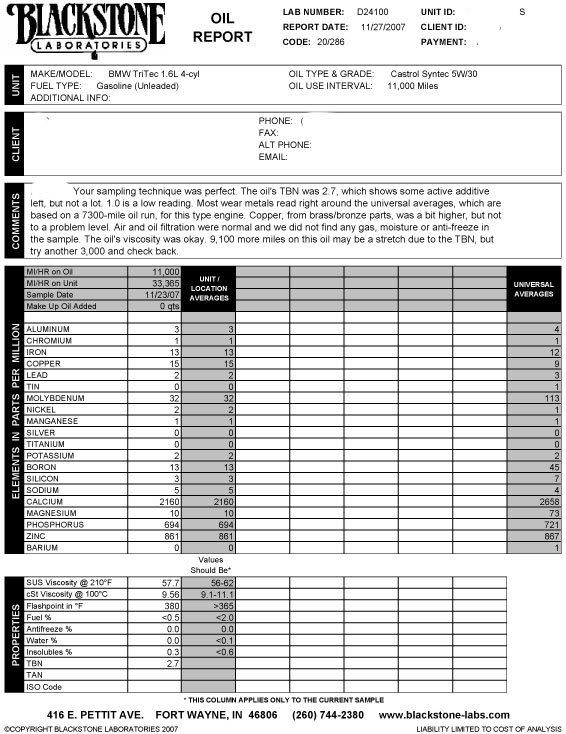
Got my results from Blackstone back a lot sooner than expected. Mailed it Saturday and got it back Tuesday. 
Lets see if I can answer your questions...
1) Fuel dilution level. BlackStone calls is a Fuel %. Mine was <0.05. Average is <2.0
2) Brand/weight of oil. Castrol 5W/30
3) Any fuel/oil additives that you used. None.
4) How many miles were on the oil when you had it tested. 11,000. Mini computer said I have 9k left before the change. Blackstone said the TBN level was only 2.7, so I should probably change in the next 3k miles. I agree since this will also be at the 12 month mark.
5) Who performed the analysis (Some places measure the fuel dilution directly using a mass spectrometer, while others only estimate it from the flashpoint). Blackstone Labs. Unsure what equipment they use. I'll see if I can post the entire report tomorrow after I scratch out all my personal info.
Lets see if I can answer your questions...
1) Fuel dilution level. BlackStone calls is a Fuel %. Mine was <0.05. Average is <2.0
2) Brand/weight of oil. Castrol 5W/30
3) Any fuel/oil additives that you used. None.
4) How many miles were on the oil when you had it tested. 11,000. Mini computer said I have 9k left before the change. Blackstone said the TBN level was only 2.7, so I should probably change in the next 3k miles. I agree since this will also be at the 12 month mark.
5) Who performed the analysis (Some places measure the fuel dilution directly using a mass spectrometer, while others only estimate it from the flashpoint). Blackstone Labs. Unsure what equipment they use. I'll see if I can post the entire report tomorrow after I scratch out all my personal info.
Thanks so much for the post. If you can't manage to post the entire report, could you tell me what the Total Acid Number (TAN) was, to go along with the Total Base Number?
You fuel dilution number is a lot better than I've seen on either of my MINIs, either with the stock airbox or the aftermarket cold-air intakes. Are you using the stock airbox?
Thanks again,
You fuel dilution number is a lot better than I've seen on either of my MINIs, either with the stock airbox or the aftermarket cold-air intakes. Are you using the stock airbox?
Thanks again,
5th Gear
Sorry. I didn't get a TAN. It was an additional $10 and I was more interested in TBN.
I'm running a stock airbox and filter. I don't idle the car much and the interstate is about 2 miles from my house, so I get in and hit the highway. I think that helps.
I'm sending in one for my truck next and that pig idles all the time. That one will be very interesting to get back.
I'm running a stock airbox and filter. I don't idle the car much and the interstate is about 2 miles from my house, so I get in and hit the highway. I think that helps.
I'm sending in one for my truck next and that pig idles all the time. That one will be very interesting to get back.
Oh well - thanks for the followup. I was just curious about the TAN since TBN starts off high when the oil is new and lowers over time, while TAN starts off low and increases over time. The "conventional wisdom" is that the oil is just about at the end of its life when the two numbers are equal.
After 9,000 miles, my TBN was down to 3.5, and the TAN was up to 3.78, so it was about due for a change. If your TBN was down to 2.7, I'm really curious how high the TAN had gotten.
I'm not sure how highway-versus-city driving affects oil life. Of the 9,000 miles on my last sample, 6,000 of it was from two long road trips (Virginia to Texas and back, and Virginia to California, but that 9,000 miles seemed to be harder on the oil than the 12,500 miles I put on the factory-fill oil on my car, or the 11,500 miles my wife put on the factory-fill oil in her car.
After 9,000 miles, my TBN was down to 3.5, and the TAN was up to 3.78, so it was about due for a change. If your TBN was down to 2.7, I'm really curious how high the TAN had gotten.
I'm not sure how highway-versus-city driving affects oil life. Of the 9,000 miles on my last sample, 6,000 of it was from two long road trips (Virginia to Texas and back, and Virginia to California, but that 9,000 miles seemed to be harder on the oil than the 12,500 miles I put on the factory-fill oil on my car, or the 11,500 miles my wife put on the factory-fill oil in her car.
5th Gear
From what I've read, idling has the potential to introduce more fuel to the oil. We'll see if that holds true for my truck. Blackstone said to drive the car before sampling and not to just idle in the driveway for 20 minutes otherwise the fuel % could be effected.

6th Gear
NAPA sells oil analysis kits, with directions where to send the samples.
http://www.napaonline.com/MasterPage...+Kit&VehCode=N
http://www.napaonline.com/MasterPage...+Kit&VehCode=N