


Drivetrain ECU Mod Qs


Thread Starter
|
4th Gear
Joined: Oct 2002
Posts: 587
Likes: 0
There've been a lot of threads on modifying the ECU, but I haven't seen these questions answered.
Firstly, do the flash-based options like STM or the more recently mentioned Revo allow changes to all of the parameters or just some? (e.g. Timing and fuel)
If you can change everything, why would this option differ from a piggyback chip or chip replacement? (Or more specifically, why would Randy see results from applications like a piggyback chip but not the flash solution? Unless one route gives you access to changes the other doesn't.)
Finally, I don't understand the relative differences between the progress some companies have made, when others seem stalled in development. What I mean by this is that it seems like once the code is cracked that the author of the solution would be re-selling it to multiple companies for their own development. Is it the case that some companies really are that much more adept at reverse-engineering the software than others? Has anyone successfully pulled this off?
It's fascinating stuff, and I hope it reaches the point where the Audi/VW aftermarket has.
Jeff
Firstly, do the flash-based options like STM or the more recently mentioned Revo allow changes to all of the parameters or just some? (e.g. Timing and fuel)
If you can change everything, why would this option differ from a piggyback chip or chip replacement? (Or more specifically, why would Randy see results from applications like a piggyback chip but not the flash solution? Unless one route gives you access to changes the other doesn't.)
Finally, I don't understand the relative differences between the progress some companies have made, when others seem stalled in development. What I mean by this is that it seems like once the code is cracked that the author of the solution would be re-selling it to multiple companies for their own development. Is it the case that some companies really are that much more adept at reverse-engineering the software than others? Has anyone successfully pulled this off?
It's fascinating stuff, and I hope it reaches the point where the Audi/VW aftermarket has.
Jeff

3rd Gear
Joined: Nov 2002
Posts: 160
Likes: 0
From: Libertyville, Illinois
Hi Jeff,
The ECU is certainly the final key to modifying engine performance on all new cars. The flash solution is the most desirable method. It requires no cutting of the factory harness and it needs no additional hardware. Some companies' expertise is in breaking codes and some companies' expertise lies in the tuning of engines. The place that offers both, the soonest, is the winner. With Audi and VW, as you said, the advances have been fantastic. The Mini tuning market is still in its infancy, by comparison. My company and Randy's company tune the cars, but don't have electrical engineers on staff. I have in the past, but it's hard to keep them busy on a full time basis. Once we have the control we need to program the ECUs, we can apply our engine tuning knowledge and dyno tune each engine/mod/combo to its maximum potential. In the mean time, several companies are offering flash mods and we are trying their software to see how it works.
Sol Snyderman
http://www.perfectpowerinc.com
The ECU is certainly the final key to modifying engine performance on all new cars. The flash solution is the most desirable method. It requires no cutting of the factory harness and it needs no additional hardware. Some companies' expertise is in breaking codes and some companies' expertise lies in the tuning of engines. The place that offers both, the soonest, is the winner. With Audi and VW, as you said, the advances have been fantastic. The Mini tuning market is still in its infancy, by comparison. My company and Randy's company tune the cars, but don't have electrical engineers on staff. I have in the past, but it's hard to keep them busy on a full time basis. Once we have the control we need to program the ECUs, we can apply our engine tuning knowledge and dyno tune each engine/mod/combo to its maximum potential. In the mean time, several companies are offering flash mods and we are trying their software to see how it works.
Sol Snyderman
http://www.perfectpowerinc.com


4th Gear
Joined: Jan 2003
Posts: 344
Likes: 0
From: Toronto, Canada
Another thing to keep in mind frieduck is expectations. The MINI ECU tuning, short of a miracle, will never reach what is capable with the VW/Audi 1.8t engine. As those engines are turbo charged the computer controls making more boost. Hold onto the pressure longer (don't open the waste gate) and you've got more boost. This doesn't apply to a supercharged engine. That being said I still think more than the 5-8hp we're seeing is possible say 15-20hp. Just don't expect an ECU in the MINI that can produce an extra 30+hp and 50+lb/ft of torque. Granted I'd love for someone to prove me wrong.

Paul

6th Gear
Joined: Oct 2002
Posts: 3,652
Likes: 6
From: Lansdale, PA
I've had sockets installed in ECU's in previous cars and would never do that again. Here's a brief history of socketing:
In the olden days (like, y'know, back in the mid-90's) some ECU's were equipped from the factorty with PLCC chips. These had very sturdy legs that wrap under the chip, like this:
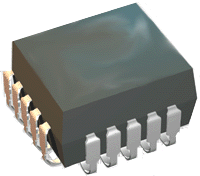
The PLCC chips fit snugly into sockets, that are soldered directly to the circuit board:

PLCC chips are designed to be removed and install by hand (with a little pick tool). PLCC's may be rated for 10's of thousands of insertions and removals without failure. If you are interested in inserting and removing chips, PLCC's are GOOD!
PLCC chips are often only once writeable (sort of like a CD-R) but the chips are dirt cheap. You could own both a stock chip and a performance chip, and keep one in the ECU while the other lives in a little jewel box in your glove compartment. I had a Neuspeed chip for my '97 VW GTI that worked just like that.
At some point, manufacturers switched to a PSOP layout, in which the legs of the chip are very thin and are splayed outwards, like the image on the top right:

These chips are in no way designed to be used with a socked - EVER. They are to be soldered directly to the circuit board - all 44 of their little legs. This is a one-time operation. The chips are not intended to be removed.
That said, a person with the correct surface-mount electronics skills and equipment can remove a PSOP chip from the circuit board, clean off the legs, and place the PSOP chip into a programmer. Then, the program is saved from the chip to a PC, the chip is erased, and a new program is loaded onto the chip. The PSOP chip is then resoldered to the circuit board by hand (remember, all 44 legs need good solder joints and none can be touching - oh yeah, there is 0.5 mm between legs).
So, a very skilled, patient person with some expensive equipment can remove a stock PSOP chip and install a reprogrammed (or new) PSOP chip. What happens if the end user (who is neither skilled nor patient, and has no surface-mount equipment) wants to change programs? Well, even though you aren't supposed to use sockets for PSOP chips, there ARE PSOP sockets - go figure.
This a coffin-style socket:

This socket is soldered to the circuit board in place of the PSOP chip. The chip is then placed inside the coffin and the doors are closed and snapped shut. This is, IMHO, a horrible design, since you are now relying on 44 separate fingers to maintain contact on the legs of the chip, which were never designed to have anything other than a solder connection. Also, the aligmnent of the legs is critical, so a new, rather than used, chip is pretty much mandatory. I have seen these sockets fail at the worst possible time. You are best to pretend you never heard of them.
Another, similar socket is the slide-lock socket. In this scenario, the socket is soldered to the circuit board. Then, the PSOP chip is set into the socket and a locking frame is placed around the chip. When the frame is slid a few mm, it snaps into place, pressing down on each of the 44 pins. I have also seen these sockets fail at the worst possible time. You are best to pretend you never heard of them as well.
Another approach to socketing PSOP is this. Once the PSOP chip has been desoldered from the circuit board, 44 pins are soldered to the circuit board, pointing straight up. A "daughter board" equipped with 44 holes is then slid onto the pins. This picture shows a daughter board with the 44 holes on the underside left (two rows of 22) and a slide-lock socket holding a PSOP chip:

The daughter board can either have a socket soldered to it (as in the above diagram) or have the PSOP chip soldered directly to pads on the daughter board. Often, chiptuners employing this method will use an encryption chip on the underside of the daughterboard to discourage copying. So, if you buy a swappable setup, you may get one daughter board with the encryption chip and a socket containing the performance PSOP, and another daughter board with only the stock chip soldered directly to it.
I'm not a fan of the daughter board approach since A) you are still relying on 44 separate mechanical connections (88 if you have a socket on the daughter board) rather than soldered connections as the chip and ecu designers intended, B) Removal and insertion of daughter boards can put strain on the pads and traces on the circuit board, causing potential cracks and failure, C) Users opening and touching components in their ecu's can send static electricity to the board, causing permanent damage to sensitive components.
I believe Wetterauer uses a system very much like the daughter board above.
So far, other than the factory PLCC approach (which is still subject to the static discharge concerns) none of the socket methods seem like a good idea. What other alternatives are there?
Well, you could go with a piggy-back system, in which you cut the wires between the ECU and various sensors. The piggback is spliced in and it corrupts the signals to varying degrees, in effect "lying" to the ECU. IMHO, this is a very bad idea as well, since it is throwing the factory's diagnostic capabilities out the window. The ECU no longer actually knows what is in spec or out of spec because its connection to the outside world has been cut and replaced with a distortion of reality.
So far the picture looks pretty bleak for chipping. Well, luckily BMW (and most other manufacturers) have the ability to flash new programs via the diagnostic port on the vehicle. No removal of the ecu, no desoldering, no contact with the chip. Just plug a PC into the car and VOILA! new program.
Some chiptuners have reverse-engineered this process (MTH, Superchips, Revo, Jim Conforti, etc.) and offer flash upgrades.
Of course, flashing only offers the safe way to get a program into the car. What the program contains is still up to the chiptuner and is only as good as the knowledge and skill of the guy writing the code. It is completely possible that a company could have a very good program, but not have a good way to get that program into the car, or vice-versa.
Here's even more chipping info (VW-specific) if you aren't asleep by now:
forums.vwvortex.com/zerothread?id=452845
In the olden days (like, y'know, back in the mid-90's) some ECU's were equipped from the factorty with PLCC chips. These had very sturdy legs that wrap under the chip, like this:
The PLCC chips fit snugly into sockets, that are soldered directly to the circuit board:
PLCC chips are designed to be removed and install by hand (with a little pick tool). PLCC's may be rated for 10's of thousands of insertions and removals without failure. If you are interested in inserting and removing chips, PLCC's are GOOD!
PLCC chips are often only once writeable (sort of like a CD-R) but the chips are dirt cheap. You could own both a stock chip and a performance chip, and keep one in the ECU while the other lives in a little jewel box in your glove compartment. I had a Neuspeed chip for my '97 VW GTI that worked just like that.
At some point, manufacturers switched to a PSOP layout, in which the legs of the chip are very thin and are splayed outwards, like the image on the top right:
These chips are in no way designed to be used with a socked - EVER. They are to be soldered directly to the circuit board - all 44 of their little legs. This is a one-time operation. The chips are not intended to be removed.
That said, a person with the correct surface-mount electronics skills and equipment can remove a PSOP chip from the circuit board, clean off the legs, and place the PSOP chip into a programmer. Then, the program is saved from the chip to a PC, the chip is erased, and a new program is loaded onto the chip. The PSOP chip is then resoldered to the circuit board by hand (remember, all 44 legs need good solder joints and none can be touching - oh yeah, there is 0.5 mm between legs).
So, a very skilled, patient person with some expensive equipment can remove a stock PSOP chip and install a reprogrammed (or new) PSOP chip. What happens if the end user (who is neither skilled nor patient, and has no surface-mount equipment) wants to change programs? Well, even though you aren't supposed to use sockets for PSOP chips, there ARE PSOP sockets - go figure.
This a coffin-style socket:
This socket is soldered to the circuit board in place of the PSOP chip. The chip is then placed inside the coffin and the doors are closed and snapped shut. This is, IMHO, a horrible design, since you are now relying on 44 separate fingers to maintain contact on the legs of the chip, which were never designed to have anything other than a solder connection. Also, the aligmnent of the legs is critical, so a new, rather than used, chip is pretty much mandatory. I have seen these sockets fail at the worst possible time. You are best to pretend you never heard of them.
Another, similar socket is the slide-lock socket. In this scenario, the socket is soldered to the circuit board. Then, the PSOP chip is set into the socket and a locking frame is placed around the chip. When the frame is slid a few mm, it snaps into place, pressing down on each of the 44 pins. I have also seen these sockets fail at the worst possible time. You are best to pretend you never heard of them as well.
Another approach to socketing PSOP is this. Once the PSOP chip has been desoldered from the circuit board, 44 pins are soldered to the circuit board, pointing straight up. A "daughter board" equipped with 44 holes is then slid onto the pins. This picture shows a daughter board with the 44 holes on the underside left (two rows of 22) and a slide-lock socket holding a PSOP chip:
The daughter board can either have a socket soldered to it (as in the above diagram) or have the PSOP chip soldered directly to pads on the daughter board. Often, chiptuners employing this method will use an encryption chip on the underside of the daughterboard to discourage copying. So, if you buy a swappable setup, you may get one daughter board with the encryption chip and a socket containing the performance PSOP, and another daughter board with only the stock chip soldered directly to it.
I'm not a fan of the daughter board approach since A) you are still relying on 44 separate mechanical connections (88 if you have a socket on the daughter board) rather than soldered connections as the chip and ecu designers intended, B) Removal and insertion of daughter boards can put strain on the pads and traces on the circuit board, causing potential cracks and failure, C) Users opening and touching components in their ecu's can send static electricity to the board, causing permanent damage to sensitive components.
I believe Wetterauer uses a system very much like the daughter board above.
So far, other than the factory PLCC approach (which is still subject to the static discharge concerns) none of the socket methods seem like a good idea. What other alternatives are there?
Well, you could go with a piggy-back system, in which you cut the wires between the ECU and various sensors. The piggback is spliced in and it corrupts the signals to varying degrees, in effect "lying" to the ECU. IMHO, this is a very bad idea as well, since it is throwing the factory's diagnostic capabilities out the window. The ECU no longer actually knows what is in spec or out of spec because its connection to the outside world has been cut and replaced with a distortion of reality.
So far the picture looks pretty bleak for chipping. Well, luckily BMW (and most other manufacturers) have the ability to flash new programs via the diagnostic port on the vehicle. No removal of the ecu, no desoldering, no contact with the chip. Just plug a PC into the car and VOILA! new program.
Some chiptuners have reverse-engineered this process (MTH, Superchips, Revo, Jim Conforti, etc.) and offer flash upgrades.
Of course, flashing only offers the safe way to get a program into the car. What the program contains is still up to the chiptuner and is only as good as the knowledge and skill of the guy writing the code. It is completely possible that a company could have a very good program, but not have a good way to get that program into the car, or vice-versa.
Here's even more chipping info (VW-specific) if you aren't asleep by now:
forums.vwvortex.com/zerothread?id=452845

6th Gear
Joined: Oct 2002
Posts: 3,652
Likes: 6
From: Lansdale, PA
Trending Topics
3rd Gear
Joined: Nov 2002
Posts: 160
Likes: 0
From: Libertyville, Illinois
Paul is correct. I neglected to point that out. The turbo Audis and VWs have electronically controlled wastegates. The chip tuners are keeping the wastegates closed longer and building big boost, torque and horsepower numbers as a result. The chip alone can make an incredible difference on the 1.8 turbo engine used in the Beetle, TT and A4, or any turbo engine that runs the boost low for 200,000 mile + longevity. The Mini will benefit from the pulley/ECU combo in a similar manner.
PerfPow
http://www.perfectpowerinc.com
PerfPow
http://www.perfectpowerinc.com


Temporarily Banned
Joined: Oct 2002
Posts: 3,382
Likes: 2
From: Denver
perfpow and I have been working very diligently together to find a solution. I will be receiveing a program tomorrow that was designed for the pulley upgrade and is flashed. I have been promised that it makes very respectable gains. I'll report on Monday when the dyno testing is completed. I'm also working with two other tuners (both are flash programs) so all of the eggs aren't in one basket.
One of the problems with the EMS 2000 is that the ECU isn't a circuit board, it's a ribbon, so everything is very delicate (more so than the Bosch 7.2 for example).
cheese,
Those pins alternate between metric and standard! There are 22 in .04mm and 22 in .0045"
Hey Andy - I watched Formula 51 last night and finally figured out what the dog's bollocks means!
Randy
One of the problems with the EMS 2000 is that the ECU isn't a circuit board, it's a ribbon, so everything is very delicate (more so than the Bosch 7.2 for example).
cheese,
Those pins alternate between metric and standard! There are 22 in .04mm and 22 in .0045"
Hey Andy - I watched Formula 51 last night and finally figured out what the dog's bollocks means!
Randy

2nd Gear
Joined: Feb 2003
Posts: 111
Likes: 0
From: Portland, OR USA
>>Hey Andy - I watched Formula 51 last night and finally figured out what the dog's >>bollocks means!
>>
>>Randy
Sorry to chime in.. but I found this...
Meaning
Excellent - the absolute apex.
Origin
No doubt coined from dogs' habit of licking the aforementioned organs in preference to almost any other activity.

Thread Starter
|
4th Gear
Joined: Oct 2002
Posts: 587
Likes: 0
Thanks Andy, Randy, Sol et al.
It sounds like progress is being made, which is good to hear.
>>In the mean time, several companies are offering flash mods and we are trying their software to see how it works.
Can we take this to mean that someone has successfully reverse-engineered the ECU? Perhaps that would have been a better way of asking my original question.
Is it that you guys (or someone) has cracked the nut and just has to get down to the time-consuming task of tuning the variables, or is there still a lot of hacking going on?
Oh, and thanks for clearing up the mystery of how the chips for the 1.8l VW/Audi engine always made such huge claims. I always wondered why the manufacturers left so much on the table!
Jeff
It sounds like progress is being made, which is good to hear.
>>In the mean time, several companies are offering flash mods and we are trying their software to see how it works.
Can we take this to mean that someone has successfully reverse-engineered the ECU? Perhaps that would have been a better way of asking my original question.
Is it that you guys (or someone) has cracked the nut and just has to get down to the time-consuming task of tuning the variables, or is there still a lot of hacking going on?
Oh, and thanks for clearing up the mystery of how the chips for the 1.8l VW/Audi engine always made such huge claims. I always wondered why the manufacturers left so much on the table!
Jeff
Thread Starter
|
4th Gear
Joined: Oct 2002
Posts: 587
Likes: 0
Oh, almost forgot. See effingpot.com for figuring out what the brits are on about!
(Or watch rallying, WSB and MotoGP on the tube. Much more fun.)
Jeff
(Or watch rallying, WSB and MotoGP on the tube. Much more fun.)
Jeff

Thread
Thread Starter
Forum
Replies
Last Post
GAT
R56 :: Hatch Talk (2007+)
6
Oct 4, 2015 07:27 PM
Mini Mania
Vendor Announcements
0
Sep 25, 2015 12:32 PM