


Drivetrain I just had a 15% pulley installed and I feel the extra power


4th Gear
Joined: Mar 2003
Posts: 540
Likes: 1
From: Calabasas, Los Angeles
>>As much as I would hate to do it, if i were you, the first thing i would try
>>next would be a bottle of octane booster in your next fill up. see if that
>>helps, if yes, then chances are its your fuel or your fuel mix. Ive heard
>>some nasty things about octane boosters eating away fuel lines and
>>causing problems in the injectors on other cars so make sure you want
>>to try this route before you do it.
Don't waste your money on "octane boosters," they won't make a significant difference. Instead, buy some more 93 octane like you use from a gas station that you know is very busy and must get a fresh supply everytime.
>>What's ironic to me is that d-mini-ero seems to be the only one with
>>an ECU upgrade on 15% pully. 15% pully + ECU upgrade should come
>>together if you feel any sign of hesitation. :???:
Oh I wish an ECU upgrade came with the pulley, but when it's over $500, some people gotta buy it another time.
>>next would be a bottle of octane booster in your next fill up. see if that
>>helps, if yes, then chances are its your fuel or your fuel mix. Ive heard
>>some nasty things about octane boosters eating away fuel lines and
>>causing problems in the injectors on other cars so make sure you want
>>to try this route before you do it.
Don't waste your money on "octane boosters," they won't make a significant difference. Instead, buy some more 93 octane like you use from a gas station that you know is very busy and must get a fresh supply everytime.
>>What's ironic to me is that d-mini-ero seems to be the only one with
>>an ECU upgrade on 15% pully. 15% pully + ECU upgrade should come
>>together if you feel any sign of hesitation. :???:
Oh I wish an ECU upgrade came with the pulley, but when it's over $500, some people gotta buy it another time.


2nd Gear
Joined: Jul 2003
Posts: 110
Likes: 2
From: Wittmann, Az
>>BAM! Lean, schmean. 
>>
>>
Andy
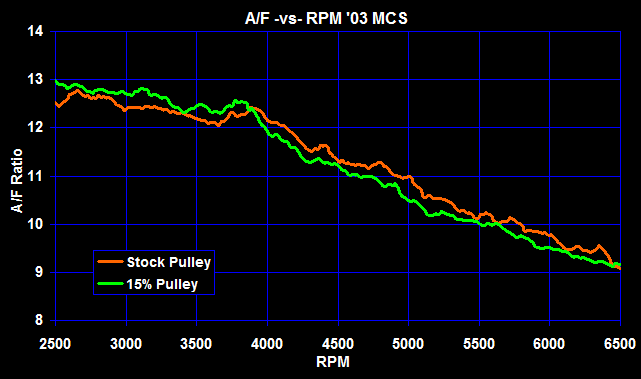
If I'm reading the chart correctly, the pulley is leaning the A/F out slightly up to about 3800 rpm when the computer obviously calls for more fuel as it starts to go rich just when you would think it would go lean. Even the stock A/F is a tad on the lean side down around 2000 to 3000 rpm where the surging/yoyo is happening. If Tiger1 is shifting at 5000 or higher, it seems the a/f ratio shouldn't be the problem as he should be hitting the next gear above 4000 rpm where the a/f ratios match up pretty good. What's your take. You posted the chart but didn't really say anything?
>>
>>
Andy
If I'm reading the chart correctly, the pulley is leaning the A/F out slightly up to about 3800 rpm when the computer obviously calls for more fuel as it starts to go rich just when you would think it would go lean. Even the stock A/F is a tad on the lean side down around 2000 to 3000 rpm where the surging/yoyo is happening. If Tiger1 is shifting at 5000 or higher, it seems the a/f ratio shouldn't be the problem as he should be hitting the next gear above 4000 rpm where the a/f ratios match up pretty good. What's your take. You posted the chart but didn't really say anything?

6th Gear
Joined: Oct 2002
Posts: 3,652
Likes: 6
From: Lansdale, PA
The difference in A/F between those two curves is less that 0.5:1 across the board. BOTH curves are very, very rich.,
The DME controls Air/Fuel mixture in order to maintain power, efficiency, and emissions. A/F is expressed as either a ratio (14.7:1 for example) or as a Lambda value. With iso-octane ("ideal" gasoline), Lambda of 1.0 is equal to 14.7:1 A/F. This is known as "Stoichiometric", a condition where there is a perfect balance between oxygen molecules and the various hydrogen and carbon based molecules in petroleum. With the oxygenated gasoline that most of us use, actual A/F ratio of 15:1 is closer to stoichiometric.
If Lambda is greater than 1.0, then there is a surplus of air and the engine is running lean. If Lambda is less than 1.0, then there is a surplus of fuel and the engine is running rich. It should be noted that the ratios are mass-based, not volume-based.
So, why don't we always run at 1.0 all the time? Well, we do MOST of the time. At cruise and idle, mixture is held tightly to 1.0 to keep the catalytic convertor at optimal efficiency, so the emissions are minimized. However, when we need acceleration, the mixture gets richer. Why? Maximum power is made between 0.85 to 0.95 Lambda (12.5 to 14.0 A/F with iso-octane). So, under acceleration, mixtures get richer. Sometimes you want to get even richer under acceleration to keep detonation (pre-ignition of the mixture from excess cylinder temperatures) away.
Here's another thread discussing A/F ratio:
https://www.northamericanmotoring.co...mp;topic=12916
The DME controls Air/Fuel mixture in order to maintain power, efficiency, and emissions. A/F is expressed as either a ratio (14.7:1 for example) or as a Lambda value. With iso-octane ("ideal" gasoline), Lambda of 1.0 is equal to 14.7:1 A/F. This is known as "Stoichiometric", a condition where there is a perfect balance between oxygen molecules and the various hydrogen and carbon based molecules in petroleum. With the oxygenated gasoline that most of us use, actual A/F ratio of 15:1 is closer to stoichiometric.
If Lambda is greater than 1.0, then there is a surplus of air and the engine is running lean. If Lambda is less than 1.0, then there is a surplus of fuel and the engine is running rich. It should be noted that the ratios are mass-based, not volume-based.
So, why don't we always run at 1.0 all the time? Well, we do MOST of the time. At cruise and idle, mixture is held tightly to 1.0 to keep the catalytic convertor at optimal efficiency, so the emissions are minimized. However, when we need acceleration, the mixture gets richer. Why? Maximum power is made between 0.85 to 0.95 Lambda (12.5 to 14.0 A/F with iso-octane). So, under acceleration, mixtures get richer. Sometimes you want to get even richer under acceleration to keep detonation (pre-ignition of the mixture from excess cylinder temperatures) away.
Here's another thread discussing A/F ratio:
https://www.northamericanmotoring.co...mp;topic=12916

>If I'm reading the chart correctly, the pulley is leaning the A/F out slightly up to about 3800 rpm
yah, that's what the graph is showing. He's being sarcastic.
but im wondering if tiger1's ecu is responding fast enough for it to
send extra fuel. the motor is suppose to run rich, but if you alter
the boost then even though it might be rich for other motors tiger1's
car might sense it as being in a spontaneous leaner condition for
his motor.
generally speaking:
12.1:1 - Very Rich
15.1:1 - Stoich
17.1:1 - Lean
who knows, tiger1 might not be shifting correctly.
_________________
03MCS IB/Blk: 123, Aerokit, R90 17x7, Anthrasite Int, TK5 16x7, 6CDMP3, etc.

yah, that's what the graph is showing. He's being sarcastic.
but im wondering if tiger1's ecu is responding fast enough for it to
send extra fuel. the motor is suppose to run rich, but if you alter
the boost then even though it might be rich for other motors tiger1's
car might sense it as being in a spontaneous leaner condition for
his motor.
generally speaking:
12.1:1 - Very Rich
15.1:1 - Stoich
17.1:1 - Lean
who knows, tiger1 might not be shifting correctly.
_________________
03MCS IB/Blk: 123, Aerokit, R90 17x7, Anthrasite Int, TK5 16x7, 6CDMP3, etc.

6th Gear
Joined: Jun 2002
Posts: 3,359
Likes: 1
From: New Jersey
What's your take. You posted the chart but didn't really say anything?

2nd Gear
Joined: Jul 2003
Posts: 110
Likes: 2
From: Wittmann, Az
Guys Guys
You all act like I was personally attacking Andy. I was only looking for more info regarding the chart. I don't pretend to be an expert, but the a/f ratios listed below as I have been told are good for normally aspirated motors, not supercharged motors.
12.1:1 - Very Rich
15.1:1 - Stoich
17.1:1 - Lean
You all act like I was personally attacking Andy. I was only looking for more info regarding the chart. I don't pretend to be an expert, but the a/f ratios listed below as I have been told are good for normally aspirated motors, not supercharged motors.
12.1:1 - Very Rich
15.1:1 - Stoich
17.1:1 - Lean

Thread
Thread Starter
Forum
Replies
Last Post
squawSkiBum
MINI Parts for Sale
15
Oct 2, 2015 09:21 AM
iamcamkeenan
R50/R53 :: Hatch Talk (2002-2006)
3
Aug 10, 2015 03:31 PM