


Drivetrain RMW Prototype Fluid dampner


RMW Prototype Fluid dampner
Here it is...........it's been in development now for quite some time. This is the first prototype so it will go on the car this week for fitment. It is a SFI certified fluid dampner. The first of it's kind for a Mini Cooper 
It's possible we will have some billet oil pump gears to go with it
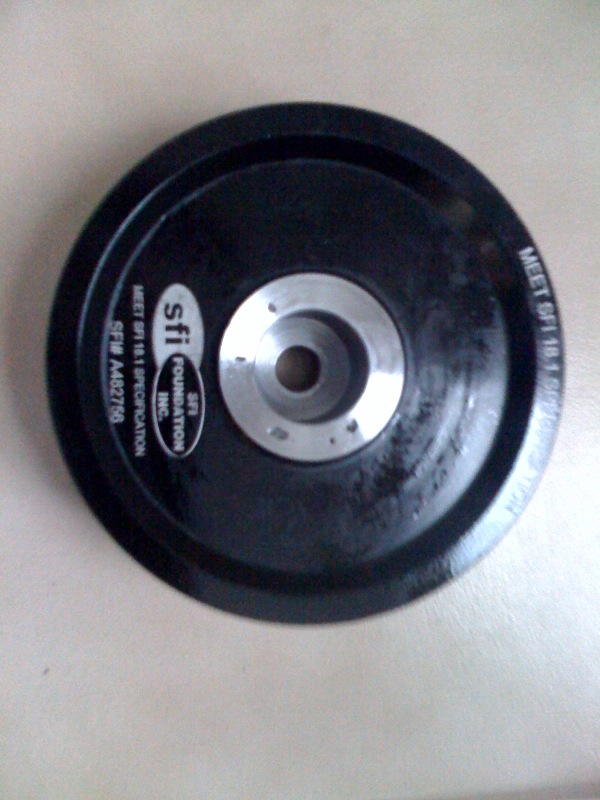
It's possible we will have some billet oil pump gears to go with it

the 05-06 stocker on the untrustworthly bathroom scale says 6lbs
the fluid dampner is 7lbs, so about the same as the 02-04 stock pulley
You won't have to worry about it coming apart like the stockers


Trending Topics

OK, so I am dampner newb!
Please explain as briefly as possible how an 05 or 06 engine can benefit by adding weight to the crank pulley. Sounds like this is much more reliable? Are the dampning capabilities superior to OEM, and therefore generally resulting in a smoother running engine that does not vibrate itself to death?
I would expect a detrimental affect on low rpm revving due to the added weight, but maybe it is not significant?
Just seeking to understand..........
Please explain as briefly as possible how an 05 or 06 engine can benefit by adding weight to the crank pulley. Sounds like this is much more reliable? Are the dampning capabilities superior to OEM, and therefore generally resulting in a smoother running engine that does not vibrate itself to death?
I would expect a detrimental affect on low rpm revving due to the added weight, but maybe it is not significant?
Just seeking to understand..........
http://www.fluidampr.com/HOWITWORKS.htm
go to here and read up..........
it's good info why the fluid damper is much better than the rubber that's used in the stocker
OK, so I am dampner newb!
Please explain as briefly as possible how an 05 or 06 engine can benefit by adding weight to the crank pulley. Sounds like this is much more reliable? Are the dampning capabilities superior to OEM, and therefore generally resulting in a smoother running engine that does not vibrate itself to death?
I would expect a detrimental affect on low rpm revving due to the added weight, but maybe it is not significant?
Just seeking to understand..........
Please explain as briefly as possible how an 05 or 06 engine can benefit by adding weight to the crank pulley. Sounds like this is much more reliable? Are the dampning capabilities superior to OEM, and therefore generally resulting in a smoother running engine that does not vibrate itself to death?
I would expect a detrimental affect on low rpm revving due to the added weight, but maybe it is not significant?
Just seeking to understand..........
http://www.fluidampr.com/HOWITWORKS.htm
it weighs no more than the 02-4 crank pulley
it won't come apart like the factory (which they do all the time)
Homework assignment accepted....
Sounds good, but it is too heavy, get it to 5lbs and the appeal will be much greater! I need as much help with low rpm response as I can get.
Sounds good, but it is too heavy, get it to 5lbs and the appeal will be much greater!
I need as much help with low rpm response as I can get.
Last edited by mini_racer; Jan 12, 2009 at 07:58 PM.
you just don't get it


Now why silicone fluid over solid rubber?
Rubber can only take so any heat cycles before it degrades to the point of failure. Silicone fluid can handle the heat better and being contained in a sealed structure it won't leak out. Rubber is tuned to deal with a certain frequency. Silicone fluid can work at multiple frequencies. Of course there are drawbacks to Silicone as well that one should be aware of too. Cost is greater for one. Also being a viscous liquid temperature is a factor. There is a small volume of air in the void with the silicone fluid, it has to be there to allow for expansion under higher temps. This mean when the car sits for a while especially in cold climates the pulley will need to warm some before you go zinging out to high RPMs or it might give a lumpy feel. Then again you shouldn't be jumping in and running it out to high RPM until the engine and fluids are warmed.
Hope this helps.

6th Gear
Joined: Aug 2007
Posts: 1,798
Likes: 11
From: CT
So in bullets:
MINI stock flywheel = 27 pounds
Clutchmasters LW = 11 pounds (according to JSC speed)
So swapping those out represents a 59% drop in weight.
The alta lightweight crank is supposedly 2.3 pounds lighter than stock, so:
Stock = 6lbs (05-06)
ALTA = 2.7
So swapping that gives you a 38% percent reduction in weight.
However both of those are on a per part basis. A much better way (and in fact that logical way) of would be to compare the reduction in mass of a specific part to all of the rotating parts. So for example (simplifying here):
27 pound flywheel + 6 pound crank pulley + 1pound SC pulley (IDK) + 1 alternator (IDK) + 1 AC pulley (IDK) = 36 pounds.
Those number still neglect the things attached to the pulleys themselves, and the pressure plates. This is just meant as an approximation and can still be used to illustrate the point. So now lets look at weight reductions:
36 - 16 (deference in weight between light and standard) = 20lbs with a flywheel swap. This would result in a 44.4% decrease in rotating mass.
36 - 2.3 (difference in pulleys) = 33.7 which result in only a 6.4% decrease in rotating mass, which isnt much.
There, I have just explained why a crank pulley swap shouldn't be expected to make a big difference in terms of free revving. You would be much better served taking out the transmission yourself putting in a good flywheel and clutch and in the process due away with the stupid prone to glazing/breaking BMW part. The same applies here, replace a piece of junk BMW part that likes to break itself with something better. Although I suppose if you really wanted to though you could do both...
EDIT: That said all of this completely ignores moment of inertia, but that would only put things in favor of the flywheel anyway...
Last edited by Some Guy; Jan 14, 2009 at 01:28 AM.

Since someone will ask
MOI is moment of inertia. See http://en.wikipedia.org/wiki/Moment_of_inertia to be bored to tears or if you can't sleep for an in-depth explanation including formulas written hieroglyphics to us English readers.
MOI is moment of inertia. See http://en.wikipedia.org/wiki/Moment_of_inertia to be bored to tears or if you can't sleep for an in-depth explanation including formulas written hieroglyphics to us English readers.
On a race car when every ounce is pared and the engine needs to last till the checkered flies one pound would make a difference. On the street car that you want to last too 100K + miles one pound will make no difference. Unlike the OEM one where the rubber separates from the metal the fluid filled damper will not come apart. You gain longevity at the cost of a slight weight penalty.
My point about the weight was not just commenting on one more pound of dead weight added to the car, it was specific to one more pound of rotational mass. All things being equal, lighter is much better especially when connected to the crank (e.g. lighter flywheels).
Certainly one pound in the cabin will make no difference, but one pound here may affect low rpm response. Maybe it is not enough to make a difference, but that is where I was going.
Yeah, I know what you are going to say....'then go and get a lighter flywheel and more than make up the difference'. Ok already, I just need to finish wearing out this OEM clutch.

Teach an inept teen to drive a stick, order clutch parts first.