Suspension Rear Control Arms


Thread Starter
|
5th Gear


Joined: Nov 2004
Posts: 1,044
Likes: 19
From: Bedford, TX.
Rear Control Arms
How important are these for a car? Im wanting to put some lowering springs on my MCS and everyone is telling me i need to put lower control arms on at the same time, cause without them i cant get a good alignment due to the fact that the stock ones arent very adjustable, and that suspension usually throws the camber out of range for adjust that the stock can do. So how necessary are they?

4th Gear
Joined: Jun 2005
Posts: 436
Likes: 0
From: Northern VA
How important are these for a car? Im wanting to put some lowering springs on my MCS and everyone is telling me i need to put lower control arms on at the same time, cause without them i cant get a good alignment due to the fact that the stock ones arent very adjustable, and that suspension usually throws the camber out of range for adjust that the stock can do. So how necessary are they?

6th Gear
Joined: Sep 2005
Posts: 1,111
Likes: 0
From: MINIapolis
After lowering with H-Sports, I had -1.6 and -1.8 camber in the back. I went with adj. control arms because I was worried I'd have too much camber. Turns out I didn't. But of course, YMMV. If you're going with a lower drop (more than 1") it'll be more out of spec...
6th Gear
Joined: Sep 2005
Posts: 1,111
Likes: 0
From: MINIapolis
I might be mistaken, but I think there are a couple dif. H&R springs out there. I think these are the most common though, and they lower 1.2 f / 1.3r on an S.
If you're looking at doing it economically, and doing all the work yourself, maybe hold off on the control arms. Of course, on the other hand.. Say you do only springs, get an alignment and find out you have too much camber, then need to go back, do control arms, and get ANOTHER alignment. And if you're not DIYing? Might make sense to buy now.
If nothing else, they're lighter, stronger, and extra bling (for ppl crawling underneath your car).
If you're looking at doing it economically, and doing all the work yourself, maybe hold off on the control arms. Of course, on the other hand.. Say you do only springs, get an alignment and find out you have too much camber, then need to go back, do control arms, and get ANOTHER alignment. And if you're not DIYing? Might make sense to buy now.
If nothing else, they're lighter, stronger, and extra bling (for ppl crawling underneath your car).
4th Gear
Joined: Jun 2005
Posts: 436
Likes: 0
From: Northern VA
and can cause extra noise, i'm taking out my helix's b/c the heim joints are too loud, I figure I can get aligned w/ the stock ones in just fine
6th Gear
Joined: Sep 2005
Posts: 1,111
Likes: 0
From: MINIapolis
Really? I've only had my Helixs on a week now (replaced the lowers only), but have noticed no additional noise from the rear. Did they get nosier as they aged?
Trending Topics

Yes...
This may seem like a hassle, but it lets you explore the car, find part number, and see how things go together so it's worth learning about it.
Matt
Not sure...
I've done some via e-mail with Classic Auto Campus, and they give NAM members 20% off in stock parts.... But the best service I've gotten from them is by calling direct.
Matt
Matt

Thread Starter
|
5th Gear
Joined: Nov 2004
Posts: 1,044
Likes: 19
From: Bedford, TX.
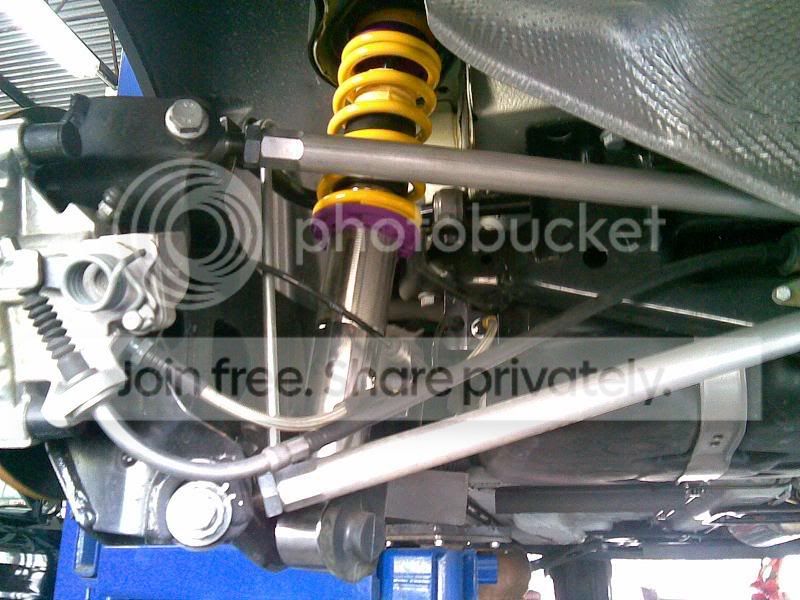
I dont need a blow up for diagnostic i was just thinking of seeing what they look like on the car. As in a photograph. Never mind i did my own search and found this.

but can anyone tell me what i am seeing here, is that 2 sets of control arms?
but can anyone tell me what i am seeing here, is that 2 sets of control arms?
6th Gear
Joined: Sep 2005
Posts: 1,111
Likes: 0
From: MINIapolis

No, but yeah. Follow obnoxious' advice. This is a pretty disorienting perspective. I'm not even sure what's going on here and I was the one installing em / taking the picture.


OVERDRIVE

Joined: Aug 2006
Posts: 7,201
Likes: 8
From: Norfolk, VA
If you're only going to replace one set, most people go with the lower set, since that's what will give you the additional camber adjustment you need after installing lowering springs, or when trying to optimize your car for autocross or other track use.
Replacing the upper set as well saves some more weight, and gives you additional control of the caster, should you need it. Both the upper and lower arms are physically indentical, so doing the uppers as well just involves just buying an additional pair of whatever arms you decide on.
If your'e planning on autocrossing under SCCA classing rules, there are some potential "gotchas" regarding control arms. They're not legal in Stock class (GS or HS), but that shouldn't be surprising. If you're in STS or STX, you can replace control arms, but only *one* set, either upper or lower. Also, in STS/STX, you can't replace the arms with ones that use a different type of rod end bushing than the stock arms. The stock arms have simple cylindrical rubber bushings, so that means that you can't replace them with arms from Alta or Helix that have heim joints on the ends. Basically, any control arm description that mentions "articulated ends", "heim joints", or "pillow ball" ends wouldn't be class-legal in STS/STX. Arms like the H-Sport that have cylindrical bushings are fine. Again, this only matters if you're considering autocrossing under SCCA classing rules.
The point was
Now the Mini has a "Multi-link" rear suspension. This is really a catch all phrase to mean that it's a suspension that doesn't exactly meet the definition of a "standard" suspension type.
What the Mini really has is a trailing arm rear suspension, with the main suspension member being attatched to the chassis in front of the wheel. The control arms located the wheel end of the trailing arm laterally. The connect to the sub-frame near the center of the car.
Matt

6th Gear
Joined: Jan 2003
Posts: 3,301
Likes: 1


6th Gear
Joined: Jan 2007
Posts: 3,362
Likes: 1
From: Winston-Salem, NC
Back to the original ?. Does everyone agree that a drop of 1" or less (H-sport,TSW,etc springs) does not require new control arms and that the stock arms will adjust enough for speck? Dang I sound like Matlock...
6th Gear
Joined: Jan 2003
Posts: 3,301
Likes: 1
If you consider the JCW kit for a moment...10mm drop, a hair less than 1/2", and the post 05 control arm can compensate (apparently) for the change in camber.
We could assume then that the lower control arm will correct the camber value associated with a 10mm drop. A one inch drop is roughly 2.5 times a 10mm drop. Stock rear camber is about 1.33 deg neg. If you end up somewhere in the 1.5-1.8 deg neg area you should be okay. Obviously this is relative all other suspension considerations...you might need at least 2 deg neg up front.
As a note, tire wear should not be much more than normal with neg camber values below 2 deg up front or in the rear.
We could assume then that the lower control arm will correct the camber value associated with a 10mm drop. A one inch drop is roughly 2.5 times a 10mm drop. Stock rear camber is about 1.33 deg neg. If you end up somewhere in the 1.5-1.8 deg neg area you should be okay. Obviously this is relative all other suspension considerations...you might need at least 2 deg neg up front.
As a note, tire wear should not be much more than normal with neg camber values below 2 deg up front or in the rear.
6th Gear
Joined: Jan 2003
Posts: 3,301
Likes: 1
Webb bar - if you look thru all the crap, you can see the red bushing that holds the bar to the rear sub-frame - to the left of the upper spring perch.
I was on the phone with Don yesterday while your car was in for some work
I was on the phone with Don yesterday while your car was in for some work