


R58 Ding 1000 miles!


Ding 1000 miles!
Trying to break in the coupe asap. Might be edging past that 4500rpm mark a bit now. Offered to be office delivery car for the week. My day job is interfering with my driving!!!
Who else drives extra the first few weeks just to break the car in?
Who else drives extra the first few weeks just to break the car in?

4th Gear
Joined: Sep 2003
Posts: 337
Likes: 0
From: Tampa, FL
Drove mine as much as possible the first couple of weeks so I could feel better about oil change #1 after about 1k miles, just before I went off on a road trip to the vicinity of the Dragon & thereabouts.
Of course, I don't follow the gentle break-in theory. My Coupé saw 6k RPM's multiple times in its first 15 minutes off the lot. (Along with lots of extra engine braking & varying of RPM's & engine load)
My first "official" oil change will be my 4th actual oil change. Less than 1k miles left until Service #1.
Of course, I don't follow the gentle break-in theory. My Coupé saw 6k RPM's multiple times in its first 15 minutes off the lot. (Along with lots of extra engine braking & varying of RPM's & engine load)
My first "official" oil change will be my 4th actual oil change. Less than 1k miles left until Service #1.

2nd Gear
Joined: Feb 2012
Posts: 97
Likes: 0
From: Eastern PA
i usually drive the cars the way i would normally drive them.
the only thing i'd watch is 1st 1000 miles of varying RPM drives and no steady RPM for more than 5 minutes at a time (meaning no real long distance highway driving)
so far i've never had a problem including some cars that had more than 100,000 miles in the end.
the only thing i'd watch is 1st 1000 miles of varying RPM drives and no steady RPM for more than 5 minutes at a time (meaning no real long distance highway driving)
so far i've never had a problem including some cars that had more than 100,000 miles in the end.

2nd Gear
Joined: Mar 2012
Posts: 94
Likes: 0
From: Carolinas
I drove mine hard from the first minute. I've rebuilt engines on other plataforms and based on advice from long time builders, cars need to set their rings in the pistons for long term wear. The best way to do this is hit high rpms and high vacuum in the early days of a turbo engine.
Haven't babied the car per se, but I also didn't run it in last weekends autoX with just 400 miles either. I'm more of the break it in like you will use it camp.
Will be putting her on the dyno this weekend for the official 'ready to use' ceremony
Will be putting her on the dyno this weekend for the official 'ready to use' ceremony

2nd Gear
Joined: May 2006
Posts: 85
Likes: 0
From: Austin, TX
I've done about 300 miles this first week. Driving a little easier than I normally would but past 4500rpms plenty. After 500 miles I'll probably get on it a bit more. Then at 1000 miles do an oil change and go nuts.

2nd Gear
Joined: Jan 2012
Posts: 68
Likes: 0
From: San Diego, CA
My car arrives in 3 weeks so I want to treat her right.
Alan
Trending Topics

2nd Gear
Joined: Feb 2012
Posts: 97
Likes: 0
From: Eastern PA
I keep hearing this oil change at 1000 miles, but have never really seen the logic, why is it important? From that point should you go into a regular interval program (insert you fav mileage interval here)? Do you reset the oil clock every time? It been awhile since I had a MINI.
My car arrives in 3 weeks so I want to treat her right.
Alan
My car arrives in 3 weeks so I want to treat her right.
Alan
with that in mind, here is what i found why it's important to change oil during or after your first break-in period.
in quote "Most of the wearing in process happens immediately, creating a lot of metal in the oil. Plus, the amount of leftover machining chips and other crud left behind in the manufacturing process is simply amazing !! You want to flush that stuff out before it gets recycled and embedded in the transmission gears, and oil pump etc..."
4th Gear
Joined: Sep 2003
Posts: 337
Likes: 0
From: Tampa, FL
... here is what i found why it's important to change oil during or after your first break-in period.
in quote "Most of the wearing in process happens immediately, creating a lot of metal in the oil. Plus, the amount of leftover machining chips and other crud left behind in the manufacturing process is simply amazing !! You want to flush that stuff out before it gets recycled and embedded in the transmission gears, and oil pump etc..."
in quote "Most of the wearing in process happens immediately, creating a lot of metal in the oil. Plus, the amount of leftover machining chips and other crud left behind in the manufacturing process is simply amazing !! You want to flush that stuff out before it gets recycled and embedded in the transmission gears, and oil pump etc..."
A lot of tiny metal shards from that process end up in your break-in oil. Ideally, I would have changed my oil after 200-250 miles, but I was too busy. The longer you run the break-in oil, the more chance the tiny metal shavings have to slip into places where you don't want them.
Whether you're going to "drive it like you stole it" or follow MINI's factory recommendations for a gentle break-in, and regardless of planning to change your oil every 2.5k or go with the factory's ~15k mile oil change intervals, I'd strongly suggest paying for an oil change somewhere in the 200-1,000 mile range just to get rid of the detritus; the metallic flotsam and jetsam; the funk of the break-in period.

2nd Gear
Joined: Jan 2012
Posts: 68
Likes: 0
From: San Diego, CA
Good to know thank you.
2nd Gear
Joined: Jan 2012
Posts: 68
Likes: 0
From: San Diego, CA
Precisely. There is a lot of metal shearing that takes place during the first few miles of break-in. When you hear about "seating" the rings, this refers to the rings & cylinder walls sort of mutually shaving their adjoining surfaces down to matching profiles. They are designed to wear quite a bit during break-in and gradually fit together better & better. This is why a brand new engine can actually GAIN a few hp after the first few hundred miles- because the internal parts actually fit better after break-in.
A lot of tiny metal shards from that process end up in your break-in oil. Ideally, I would have changed my oil after 200-250 miles, but I was too busy. The longer you run the break-in oil, the more chance the tiny metal shavings have to slip into places where you don't want them.
Whether you're going to "drive it like you stole it" or follow MINI's factory recommendations for a gentle break-in, and regardless of planning to change your oil every 2.5k or go with the factory's ~15k mile oil change intervals, I'd strongly suggest paying for an oil change somewhere in the 200-1,000 mile range just to get rid of the detritus; the metallic flotsam and jetsam; the funk of the break-in period.
A lot of tiny metal shards from that process end up in your break-in oil. Ideally, I would have changed my oil after 200-250 miles, but I was too busy. The longer you run the break-in oil, the more chance the tiny metal shavings have to slip into places where you don't want them.
Whether you're going to "drive it like you stole it" or follow MINI's factory recommendations for a gentle break-in, and regardless of planning to change your oil every 2.5k or go with the factory's ~15k mile oil change intervals, I'd strongly suggest paying for an oil change somewhere in the 200-1,000 mile range just to get rid of the detritus; the metallic flotsam and jetsam; the funk of the break-in period.

3rd Gear
Joined: Jan 2006
Posts: 232
Likes: 0
From: Arlington, VA
I know this is a subject that has been debate here on NAM over and over.
Here's Edmunds.com's take
5. When you buy a new car, change your oil at 3,000 miles to remove metal particles from the engine break-in process. There might be a grain of truth to this, according to the experts at Blackstone. Oil samples from engines during the first 3,000 miles of driving show elevated "wear-in" metal levels, coming from the pistons and camshafts, says Ryan Stark, Blackstone's president. But he added, "To me, it doesn't make that much difference because if the filings are big enough to cause damage, they will be taken out by the oil filter."
However, a Honda spokesman says its cars come from the factory with a special oil formulation for the break-in period. Honda advises owners to not change the oil early. Stark said Blackstone Laboratories' test of Honda's break-in oil shows it contains molybdenum-disulfide, an anti-wear additive. But Stark said Honda is the only manufacturer he knows that's using special break-in oil. The take-away? If there are any special break-in recommendations from the manufacturer, follow them. And consider analyzing the oil at 3,000 miles.
http://www.edmunds.com/car-care/top-...motor-oil.html
Here's Edmunds.com's take
5. When you buy a new car, change your oil at 3,000 miles to remove metal particles from the engine break-in process. There might be a grain of truth to this, according to the experts at Blackstone. Oil samples from engines during the first 3,000 miles of driving show elevated "wear-in" metal levels, coming from the pistons and camshafts, says Ryan Stark, Blackstone's president. But he added, "To me, it doesn't make that much difference because if the filings are big enough to cause damage, they will be taken out by the oil filter."
However, a Honda spokesman says its cars come from the factory with a special oil formulation for the break-in period. Honda advises owners to not change the oil early. Stark said Blackstone Laboratories' test of Honda's break-in oil shows it contains molybdenum-disulfide, an anti-wear additive. But Stark said Honda is the only manufacturer he knows that's using special break-in oil. The take-away? If there are any special break-in recommendations from the manufacturer, follow them. And consider analyzing the oil at 3,000 miles.
http://www.edmunds.com/car-care/top-...motor-oil.html

6th Gear
Joined: Jul 2010
Posts: 1,476
Likes: 8
From: Chicago
-Steven
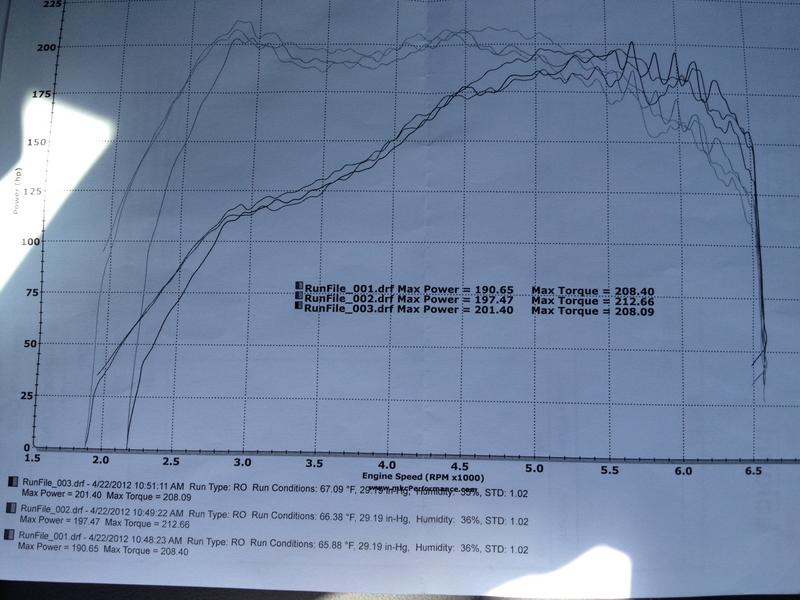
So I crashed my brother's SRT-4 dyno day. The numbers where about what I expected. Had 1450 miles on her when they strapped her onto the dynojet.
No huge numbers, but love that long flat power band. So the stated fly-wheel numbers are what you actually get at the wheels.
Wished I could have recorded some audio. The JCW exhaust with the resonator removed howled at 6500rpm

No huge numbers, but love that long flat power band. So the stated fly-wheel numbers are what you actually get at the wheels.
Wished I could have recorded some audio. The JCW exhaust with the resonator removed howled at 6500rpm
6th Gear
Joined: Jul 2010
Posts: 1,476
Likes: 8
From: Chicago
So I crashed my brother's SRT-4 dyno day. The numbers where about what I expected. Had 1450 miles on her when they strapped her onto the dynojet.
No huge numbers, but love that long flat power band. So the stated fly-wheel numbers are what you actually get at the wheels.
Wished I could have recorded some audio. The JCW exhaust with the resonator removed howled at 6500rpm
Attachment 59994
No huge numbers, but love that long flat power band. So the stated fly-wheel numbers are what you actually get at the wheels.
Wished I could have recorded some audio. The JCW exhaust with the resonator removed howled at 6500rpm
Attachment 59994
 I knew Mini/BMW underrated the numbers, but didn't think we would see those at the wheels
 -Steven
2nd Gear
Joined: Mar 2012
Posts: 94
Likes: 0
From: Carolinas
So I crashed my brother's SRT-4 dyno day. The numbers where about what I expected. Had 1450 miles on her when they strapped her onto the dynojet.
No huge numbers, but love that long flat power band. So the stated fly-wheel numbers are what you actually get at the wheels.
Wished I could have recorded some audio. The JCW exhaust with the resonator removed howled at 6500rpm
Attachment 59994
No huge numbers, but love that long flat power band. So the stated fly-wheel numbers are what you actually get at the wheels.
Wished I could have recorded some audio. The JCW exhaust with the resonator removed howled at 6500rpm
Attachment 59994
2nd Gear
Joined: Mar 2012
Posts: 94
Likes: 0
From: Carolinas
Precisely. There is a lot of metal shearing that takes place during the first few miles of break-in. When you hear about "seating" the rings, this refers to the rings & cylinder walls sort of mutually shaving their adjoining surfaces down to matching profiles. They are designed to wear quite a bit during break-in and gradually fit together better & better. This is why a brand new engine can actually GAIN a few hp after the first few hundred miles- because the internal parts actually fit better after break-in.
A lot of tiny metal shards from that process end up in your break-in oil. Ideally, I would have changed my oil after 200-250 miles, but I was too busy. The longer you run the break-in oil, the more chance the tiny metal shavings have to slip into places where you don't want them.
Whether you're going to "drive it like you stole it" or follow MINI's factory recommendations for a gentle break-in, and regardless of planning to change your oil every 2.5k or go with the factory's ~15k mile oil change intervals, I'd strongly suggest paying for an oil change somewhere in the 200-1,000 mile range just to get rid of the detritus; the metallic flotsam and jetsam; the funk of the break-in period.
A lot of tiny metal shards from that process end up in your break-in oil. Ideally, I would have changed my oil after 200-250 miles, but I was too busy. The longer you run the break-in oil, the more chance the tiny metal shavings have to slip into places where you don't want them.
Whether you're going to "drive it like you stole it" or follow MINI's factory recommendations for a gentle break-in, and regardless of planning to change your oil every 2.5k or go with the factory's ~15k mile oil change intervals, I'd strongly suggest paying for an oil change somewhere in the 200-1,000 mile range just to get rid of the detritus; the metallic flotsam and jetsam; the funk of the break-in period.
When I built a new engine, I'd . . .
- put new oil in the engine after rebuild
- start it up and let it idle for 45 minutes to get the engine warm and lubricated
- change the oil
- drive it like I stole it for about 300-500 miles
- change the oil
- drive it normal and do recommended oil changes.
I would use Brad Penn racing oil. Never had any issue with an engine

2nd Gear

Joined: Nov 2011
Posts: 114
Likes: 1
From: Portland, OR
I am a low mileage driver only 600 miles in the last 4 months. I missed the 20 mile change oil, should I do it now or wait until I hit a 1000 miles?
http://www.popularmechanics.com/cars...k-in-a-new-car
http://www.popularmechanics.com/cars...k-in-a-new-car

Thread
Thread Starter
Forum
Replies
Last Post
devicemanager
MINI Parts for Sale
13
Jun 17, 2016 06:18 PM
R50/53 Guidance on selling a 2005 S
Toolman
R50/R53 :: Hatch Talk (2002-2006)
8
Jan 20, 2016 06:50 AM
gmonde
MINIs & Minis for Sale
1
Sep 8, 2015 06:37 AM
Powershift
MINIs & Minis for Sale
1
Aug 16, 2015 05:14 PM