When you click on links to various merchants on this site and make a purchase, this can result in this site earning a commission. Affiliate programs and affiliations include, but are not limited to, the eBay Partner Network.
I have both I started with the cat back and installed the header later. The only real difference you will notice in sound is while you are in the power band starting at about 3k rpm I know people with only a cat back still louder than me. I wouldn't trade it for any other system.
Are the pops and burbles louder/more frequent than stock? Does it sound more throaty?
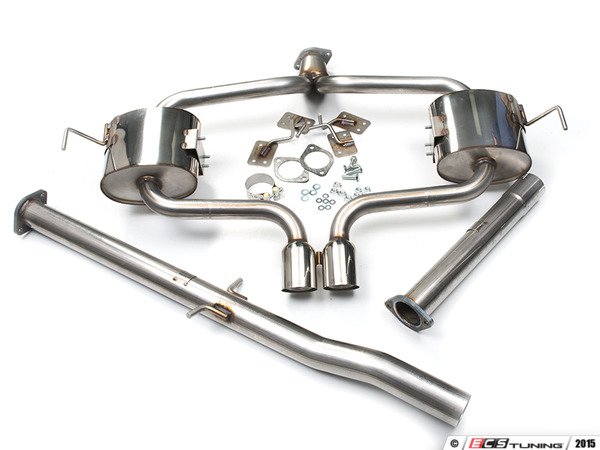
The Milltek come in the resonated and NON resonated (louder) that can be paired with the high flow header, we have them in stock and FREE Shipping for a Limited time. Also there has been a price drop recently on most systems. With the high flow header I have heard the sound is a little louder then the stock header. Sounds good and no drone.
R53 MINI Cooper S/JCW Milltek and headers options:
The complete system is a bit louder than with a stock header--IMO still a very tasteful sound level. A couple of things you should know about the Milltek header: it is constructed with a HJS catalyst, which is a German-made, high-metal-content cat that performs as well as a factory cat and is high-flow. It's the only cat that I'm aware of that does so. They are very expensive. You should also be aware that the primary ports on the header flange are not substantially bigger than the stock exhaust ports on the head, so if you are considering a ported head like the Jesus head, the Milltek header is not the best choice, unless you want to do a lot of work with a grinding tool. I've done it: it's about 2 hours of shop labor to match port a Milltek header to a Jesus head. For a stock head, the ports are plenty big. That having been said, the Milltek ports are considerably bigger than a couple of other aftermarket headers--this is important folks! Know the port size on your header flanges before buying it.
The complete system is a bit louder than with a stock header--IMO still a very tasteful sound level. A couple of things you should know about the Milltek header: it is constructed with a HJS catalyst, which is a German-made, high-metal-content cat that performs as well as a factory cat and is high-flow. It's the only cat that I'm aware of that does so. They are very expensive. You should also be aware that the primary ports on the header flange are not substantially bigger than the stock exhaust ports on the head, so if you are considering a ported head like the Jesus head, the Milltek header is not the best choice, unless you want to do a lot of work with a grinding tool. I've done it: it's about 2 hours of shop labor to match port a Milltek header to a Jesus head. For a stock head, the ports are plenty big. That having been said, the Milltek ports are considerably bigger than a couple of other aftermarket headers--this is important folks! Know the port size on your header flanges before buying it.
This statement is filled with false information. The ports on the Milltek header are identical to the stock manifold that came off my car. The are sitting side by side in my living room and I just finished measuring them. The tubes are a little larger however that's useless since the ports are too small for the tubes I would say 30% of the tube is blocked by the smaller ports. They are .5 cm smaller than my JCW head so I'm shopping for a dremel tool right now to try and fix this issue. I don't think headers should be smaller than the ports on the head. But if you get a Milltek for your JCW or aftermarket head you will have the same issue I have now.
This thread has SO much miss-information. For the sake of anyone doing a search:
You want ZERO back-pressure, or, to be more precise, an ideal exhaust on an NA motor creates the inverse of back-pressure, it creates suction. More commonly referred to as scavenging.
The very best NA exhaust design will create a negative pressure in the chamber during overlap by using acoustic tuning. The negative pressure will draw more air in to the chamber than any back-pressured exhaust can. As a result you will see significant gains at ALL rpm, if done right if two conditions are met:
1: First condition is that the ECU is tuned to make use of the scavenging, if it's not, the gains will be much lower and the engine will run lean.
2: The stock exhaust doesn't already provide notable scavenging, which it almost certainly doesn't.
This is true of ALL NA motors, with no exception.
Take that back-pressure myth and file it under "things that were used to market substandard parts and get people to buy them".
As for do I know what I'm talking about, here is a Dyno of my NA 2.3 liter motor in one of my motorcycles (a street legal land speed racing bike) an exhaust I specced out and had built. The exhaust added 11 HP over the previous off the shelf aftermarket header setup I was using, which itself added 30hp over stock with zero engine changes besides a return.
The more flow capability in the head and the longer the overlap period, the bigger the effect scavenging will have to boost power.
What Claviger said. But, scavenging because of the tuneup (ECM), no, not so much ?!?. This is a mechanical thing, cam design, header design, after cat. exhaust design thing and a bit of final cylinder head design ! NO...engine runs its best with exhaust back pressure. When was the last time ANYONE...saw a plugged up exhaust system an ANY type of race engine (trying to win races anyway !) ?
The freer flowing the better...no matter if the engine is - naturally aspirated, belt driven supercharger or exhaust driven super charger.
100%. I think I miss conveyed my intent, I was trying to get across, only, that the potential power gains will not be realized unless the vehicle is retuned to account for the increased scavenging.
The extra charge will require changes to timing and fueling to maximize the torque output, naturally.
I'm currently running Magna flow headers with sport cats and had the flex pipe go on me, huge exhaust leak so had to bring it to the shop. Flex pipe is a common problem with R53 headers. A friend of mine runs Milltek exhaust and only heard good things about it.
The problem we see is people have shot engine mounts/trans mount and or leaking motor mounts which lets the engine move too much and cause the flex pipe to work as a damper to the engine then it leaks.
On the oem exhaust it does the same thing but its separate completely then has to be rewelded.
As a conclusion to this saga, I just wanted to update this thread, now that the header has been installed.
Installation went splendidly, and there weren't any major issues. It bolted up really easily with everything. Just let it be known that while the header came with a gasket, it was the gasket that goes between the header and the cat-back section of the exhaust; and didn't come with the gasket that attaches to the exhaust ports of the head.
That had to be ordered separately. I just ordered an OEM MINI gasket, for like 10 bucks. Not too hard to find.
The sound when driving isn't too different when you're at half-throttle or less. If you push the pedal down more aggressively than that, the exhaust wakes up into a much more noticeable roar. The sound is certainly well-tuned and crisp. I took a rare long road trip yesterday with my family, and I found myself intentionally not pushing the loud pedal too much, because I felt it would be a bit too loud for them.
BUT when I'm alone, I am deep into the throttle, and loving the sound overall. It is definitely louder! I know it's lame to say it, but it sounds more like a race car.
Overall, quite happy with this mod, but if your MINI is a daily driver/commuter car with many long freeway miles, I'd not recommend it. The sound would likely get on your nerves after a while.
Hello, just wondered if you were still around after all these years, I am about to do the same as you did after ten years of miltek rear box. I now plan on adding the header, with high flow cat. My oem header is now causing a vibration in the steering wheel and needs replaced
just wonders if the miltek header held up well? And if it impacted the torque at low speeds / if you remember any performance gains or loss



 With the high flow header I have heard the sound is a little louder then the stock header. Sounds good and no drone.