


Drivetrain M7 thermostat? How's it work?


Thread Starter
|
4th Gear
Joined: May 2003
Posts: 336
Likes: 0
From: Mennnnnner
M7 thermostat? How's it work?
https://www.northamericanmotoring.co...ad.php?t=27708
anything to keep the car running cooler.
so. How does it work? I thought thermostats just measured engine temps? or is it part of a heat management system that takes measures to prevent the car temp reaching a certain level? does it become a heat consuming mechanical virus machine with big sharp teeeeeeeth?! I am utterly clueless how the part (stock or aftermarket) "thermostat" works.
also, as a disclaimer, this is in no way, shape or form, a hostile post against m7's product. I am just curious and want to learn how a certain part works, as i simply have no clue other than the simple word meaning. An explanation on how the stocker works, and how the m7's unit would do the things that were measured and hence, claimed.
the only experience i have with thermostats is this: my blessed 94 corolla (that had 150k miles on it) had it's thermostat break, and all of a sudden, it just wouldnt stay warm (inside the where people are sitting). Now, this was all during winter, and before the thermstat broke, the car would warm up, and the heater would warm things up.
anything to keep the car running cooler.
so. How does it work? I thought thermostats just measured engine temps? or is it part of a heat management system that takes measures to prevent the car temp reaching a certain level? does it become a heat consuming mechanical virus machine with big sharp teeeeeeeth?! I am utterly clueless how the part (stock or aftermarket) "thermostat" works.
also, as a disclaimer, this is in no way, shape or form, a hostile post against m7's product. I am just curious and want to learn how a certain part works, as i simply have no clue other than the simple word meaning. An explanation on how the stocker works, and how the m7's unit would do the things that were measured and hence, claimed.
the only experience i have with thermostats is this: my blessed 94 corolla (that had 150k miles on it) had it's thermostat break, and all of a sudden, it just wouldnt stay warm (inside the where people are sitting). Now, this was all during winter, and before the thermstat broke, the car would warm up, and the heater would warm things up.

6th Gear
Joined: Apr 2003
Posts: 3,957
Likes: 2
From: a canyon, south Bay Area
I can't speak for the MINI's thermostat, but with others, I seem to recall that a certain metal, or maybe two were involved. As the engine's water heats to a specific point, the metal expands, opening-up and allowing for flow that starts the cooling process... Very crude explanation, but that is sort of how they worked before. Maybe the newer thermostats these days are different...
Last edited by TonyB; Jul 1, 2004 at 11:46 PM.


Can't tell you how M7's works, but the thermostat is used to keep water from flowing through the radiator when it is below 'x' degrees. Thus the engine gets to operating temperature more quickly than if water were flowing from startup. In the miata it was standard practice to swap out the stock 180(?) degree unit for a 160degree unit for (aftermarket) supercharged cars. Our conclusion in that arena was that it lowered initial operating temperatures, but didn't affect temperatures at heat soak, as the 160d unit didn't flow any more at wide open than the stocker.
From the deltas that M7 is quoting, they would have to be flowing quite a bit more water than the stock unit at high temps, allowing the radiator to transfer the heat away from the engine.
From the deltas that M7 is quoting, they would have to be flowing quite a bit more water than the stock unit at high temps, allowing the radiator to transfer the heat away from the engine.

4th Gear
Joined: Mar 2003
Posts: 540
Likes: 1
From: Calabasas, Los Angeles
Sounds pretty cool.. how come the engine engineers didn't just come out with a lower temperature sensor from the get-go? Does it make the cooling system wear out faster or should that be of no concern? Thanks for another new product, we can tell the MINI crowd wants it, hehe.

The only drawback's I can think of are fuel mileage will possibly drop some, slower warmup in Winter and less heat from heater in cold weather. That could be solved by changing seasonally.
Last edited by norm03s; Jul 2, 2004 at 07:58 AM. Reason: adding text

6th Gear
Joined: Jun 2002
Posts: 3,359
Likes: 1
From: New Jersey
Originally Posted by norm03s
The only drawback's I can think of are fuel mileage will possibly drop some, slower warmup in Winter and less heat from heater in cold weather. That could be solved by changing seasonly.

6th Gear
Joined: Jan 2003
Posts: 1,816
Likes: 2
From: New Jersey
Originally Posted by Antranik
Sounds pretty cool.. how come the engine engineers didn't just come out with a lower temperature sensor from the get-go? Does it make the cooling system wear out faster or should that be of no concern? Thanks for another new product, we can tell the MINI crowd wants it, hehe.
I would go the local autoparts store and buy the 180 stat for a Dodge Neon before I shelled out $30 bucks for that thing. My experience has been that there is a lot of cost saving "parts bin engineering" with pieces such as this on Chrysler engines. I'm not saying it will definately fit but there's a pretty good chance.
--
Cheese
Last edited by macncheese; Jul 2, 2004 at 06:00 AM.
Trending Topics

6th Gear
Joined: Aug 2002
Posts: 2,253
Likes: 0
From: NY NY
if the new thermostat is less flow restrictive at wide open, it could potentially be more useful on high ambient temp days, regardless of the target engine temp settings (180, 210 0r in between). I have found my car runs at 210-215 city driving (assuming AC and fan off) where presumably the stock thermostat is WO and the temp is limited by radiator water and airflow. On the highway, with vastly improved airflow, the temp will drop to around 185-190, here presumably the thermostat is throttling back flow to hold the temp.
When the fan kicks on, city driving temps drop from 210 to about 195, implying airlow is the limiting factor.
When the fan kicks on, city driving temps drop from 210 to about 195, implying airlow is the limiting factor.
6th Gear
Joined: Jun 2002
Posts: 3,359
Likes: 1
From: New Jersey
Originally Posted by Bisch
If the flow is greatly increased, how will that affect the "cavitation" theory on the 19% pulley cars. If the flow resistence is reduced, will that create more of a possibility of cavitation?

3rd Gear
Joined: Jan 2004
Posts: 269
Likes: 0
From: Highland Village, TX
Originally Posted by Bisch
If the flow is greatly increased, how will that affect the "cavitation" theory on the 19% pulley cars. If the flow resistence is reduced, will that create more of a possibility of cavitation?
I do know that my MCS runs better before it get to full operating temp. If the cooling system can keep the temps at 180 this might be a great idea. Sometimes puting in a cooler thermostat results in overheating, because the water circulates to quickly and doesn't stay in the radiator long enough to cool. Some people have tried to run without a thermostat at all and ended up over heating. The thermostat is responsible for stabalizing the operating temps. Go too low on the thermostat and you can create the same problem as if you where running no thermostat. If the Mini cooling system can maintain 180 in very hot weather I'd go for it. I think I will now go lift the hood and see how much of B$%^ it is to change.
Banned
Joined: Mar 2003
Posts: 2,859
Likes: 0
From: Plymouth, MN
Stock thermostat coolant temperatures.
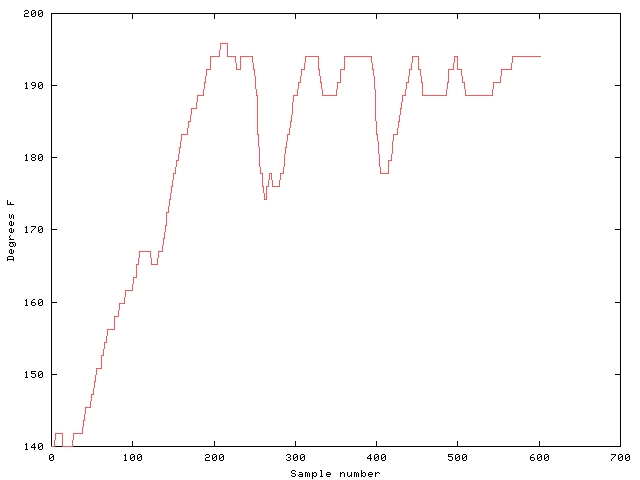
Coolant temperature reported by the OBD-II system for a 2002 MINI Cooper 5-speed during local and highway driving.
By the way, the temperature guage remained dead-center whenever the temperature was greater than about 165 degrees-F
Banned
Joined: Mar 2003
Posts: 2,859
Likes: 0
From: Plymouth, MN
Could you explain this theory in a little more detail?
Originally Posted by RLmini
Sometimes puting in a cooler thermostat results in overheating, because the water circulates to quickly and doesn't stay in the radiator long enough to cool.(Bolding added by Trippy)
From what I remember through the murk of the years.
The amount of heat removed by the radiator and transferred to the air is only related to the temperature difference between the surface of the radiator and the air. The rate of flow of the coolant has nothing to do with it.
Now, I would think that having 180 degree-F coolant entering into the radiator will provide less cooling than 200 degree-F coolant entering into the radiator, but if it is not enough cooling to balance the heat generated by the engine, the coolant temperature will go up until they do balance.
I do agree that if the coolant is flowing 976 miles-per-hour through the radiator that the situation may be different, but I am specifically talking about the small increase in flow caused by adding a less restrictive thermostat into the entire engine, tubing, radiator system.
So, I'm respetfully asking for a more detailed explanation of how a small increase in coolant flow can cause reduced cooling capacity in an automotive radiator.
3rd Gear
Joined: Jan 2004
Posts: 269
Likes: 0
From: Highland Village, TX
Great graph! It looks like the stock thermostat is a 195. it looks like you can also see the thermostat opening and closing on the graph. I would love to see the same graph in 100 degree weather with 180 degree thermostat.

6th Gear
Joined: Jun 2003
Posts: 1,432
Likes: 0
Originally Posted by RLmini
A thermostat won't have any effect on cavitation. I read the vendor annoucement and it seems like a good idea to me. Older cars often had 180 degree thermostats and we sometimes went to 160 and got a little better performance but the heater became marginal. The heater should work fine with a 180. New cars seem to be set up to run at higher temps. I don't know why but it may be because they run leaner for better mileage and emmissions. Maybe higher operating temps help with complete combustion for better emissions.
I do know that my MCS runs better before it get to full operating temp. If the cooling system can keep the temps at 180 this might be a great idea. Sometimes puting in a cooler thermostat results in overheating, because the water circulates to quickly and doesn't stay in the radiator long enough to cool. Some people have tried to run without a thermostat at all and ended up over heating. The thermostat is responsible for stabalizing the operating temps. Go too low on the thermostat and you can create the same problem as if you where running no thermostat. If the Mini cooling system can maintain 180 in very hot weather I'd go for it. I think I will now go lift the hood and see how much of B$%^ it is to change.
I do know that my MCS runs better before it get to full operating temp. If the cooling system can keep the temps at 180 this might be a great idea. Sometimes puting in a cooler thermostat results in overheating, because the water circulates to quickly and doesn't stay in the radiator long enough to cool. Some people have tried to run without a thermostat at all and ended up over heating. The thermostat is responsible for stabalizing the operating temps. Go too low on the thermostat and you can create the same problem as if you where running no thermostat. If the Mini cooling system can maintain 180 in very hot weather I'd go for it. I think I will now go lift the hood and see how much of B$%^ it is to change.
Originally Posted by Bisch
If the flow is greatly increased, how will that affect the "cavitation" theory on the 19% pulley cars. If the flow resistance is reduced, will that create more of a possibility of cavitations?
Here chew on this awhile,
http://www.mae.wmich.edu/labs/Therma...al_results.htm
Last edited by norm03s; Jul 2, 2004 at 08:26 AM. Reason: spelling

[QUOTE=Antranik].... how come the engine engineers didn't just come out with a lower temperature sensor from the get-go? ..........QUOTE]
"The only drawback's I can think of are fuel mileage will possibly drop some, slower warmup in Winter and less heat from heater in cold weather."
in addition to the emissions issue mentioned above, there is another very important consideration for getting the oil temp at least during PART of the operation cycle to 180F and perhaps even to 212F: getting it hot enough to vaporize water. if you don't get this out of the oil, the engine life will be much shorter.
i've read a technical article about this, but i don't have the link handy. i'll look and post it later.
"The only drawback's I can think of are fuel mileage will possibly drop some, slower warmup in Winter and less heat from heater in cold weather."
in addition to the emissions issue mentioned above, there is another very important consideration for getting the oil temp at least during PART of the operation cycle to 180F and perhaps even to 212F: getting it hot enough to vaporize water. if you don't get this out of the oil, the engine life will be much shorter.
i've read a technical article about this, but i don't have the link handy. i'll look and post it later.
3rd Gear
Joined: Jan 2004
Posts: 269
Likes: 0
From: Highland Village, TX
Originally Posted by Trippy
This doesn't pass the "Trippy-physics smell test" probably because I got a C- in my last thermodynamics class about 18 years ago.
From what I remember through the murk of the years.
The amount of heat removed by the radiator and transferred to the air is only related to the temperature difference between the surface of the radiator and the air. The rate of flow of the coolant has nothing to do with it.
Now, I would think that having 180 degree-F coolant entering into the radiator will provide less cooling than 200 degree-F coolant entering into the radiator, but if it is not enough cooling to balance the heat generated by the engine, the coolant temperature will go up until they do balance.
I do agree that if the coolant is flowing 976 miles-per-hour through the radiator that the situation may be different, but I am specifically talking about the small increase in flow caused by adding a less restrictive thermostat into the entire engine, tubing, radiator system.
So, I'm respetfully asking for a more detailed explanation of how a small increase in coolant flow can cause reduced cooling capacity in an automotive radiator.
From what I remember through the murk of the years.
The amount of heat removed by the radiator and transferred to the air is only related to the temperature difference between the surface of the radiator and the air. The rate of flow of the coolant has nothing to do with it.
Now, I would think that having 180 degree-F coolant entering into the radiator will provide less cooling than 200 degree-F coolant entering into the radiator, but if it is not enough cooling to balance the heat generated by the engine, the coolant temperature will go up until they do balance.
I do agree that if the coolant is flowing 976 miles-per-hour through the radiator that the situation may be different, but I am specifically talking about the small increase in flow caused by adding a less restrictive thermostat into the entire engine, tubing, radiator system.
So, I'm respetfully asking for a more detailed explanation of how a small increase in coolant flow can cause reduced cooling capacity in an automotive radiator.
3rd Gear
Joined: Jan 2004
Posts: 269
Likes: 0
From: Highland Village, TX
Cavitation is more of a problem when the thermostat is closed, not open. I would be much more worried about how a pulley speeds the water pump up than the slight improvent in flow of a thermostat.
Your engine will heat up just as quickly with a 180 or a 195, it will just stop heating up at 180 instead of 195. In both cases the thermostat is closed until it reaches it's opening temp.
Your engine will heat up just as quickly with a 180 or a 195, it will just stop heating up at 180 instead of 195. In both cases the thermostat is closed until it reaches it's opening temp.
Originally Posted by RLmini
Trippy I can only share my real world experiences with my drag cars and hot rods. Many of us would bore our cylinders when rebuilding our engines. The thinner cylinder walls often caused cooling challenges. Often we would have overheating problems with a 180 thermostat and so we would just through in a 160 only to find things got even worse. Because of the the extra engine heat the cooling system could not stabalize at 160 so the temps just continued to rise until we boiled over. By going to a 190 or 195 the system would in most cases would stabalize and not over heat. If this didn't work we had to modify the colling system with larger radiators, better fans, water wetter etc...
The reason for this was to slow down the coolant flow through the head so there would be more heat transfer to the coolant. If this practice was not followed you were cooking off the exhaust valve's in short order.
6th Gear
Joined: Jun 2003
Posts: 1,432
Likes: 0
Originally Posted by norm03s
If there even is a cavitation issue and then only at high RPM decreasing resistance of water flow would also decrease cavitation as long as pressure remained the same within the cooling system..
Here chew on this awhile,
http://www.mae.wmich.edu/labs/Therma...al_results.htm
Here chew on this awhile,
http://www.mae.wmich.edu/labs/Therma...al_results.htm

3rd Gear
Joined: Jan 2004
Posts: 269
Likes: 0
From: Highland Village, TX
Norm03's, exactly right!
We never thought of restricting the head but we did try replacing the thermostat with a restictor plate with various size holes in it. This worked well on the drag strip for a quarter mile run but wasn't to good on the street. If a cooling system can't stabalize at 180 it is not going to stabalize at 160, which is why going up to a 190-195 gave us a better chance.
This is why I would like to see if I can get away with a 180 down here in Texs where we have Summer, then Super Summer and then Summer again.
We never thought of restricting the head but we did try replacing the thermostat with a restictor plate with various size holes in it. This worked well on the drag strip for a quarter mile run but wasn't to good on the street. If a cooling system can't stabalize at 180 it is not going to stabalize at 160, which is why going up to a 190-195 gave us a better chance.
This is why I would like to see if I can get away with a 180 down here in Texs where we have Summer, then Super Summer and then Summer again.
Banned
Joined: Mar 2003
Posts: 2,859
Likes: 0
From: Plymouth, MN
How large were these restrictors?
Originally Posted by norm03s
Part of the kit was engine block restrictors tapped into the block to restrict water flow through the head.
As I said, GREATLY increasing the flow may change the cooling characteristics, but I don't think changing from one thermostat to another one with better flow will make a difference since the entire radiator is still a BIG restriction.
And I'm keeping an open mind. It's pretty clear that I might be wrong here.
3rd Gear
Joined: Jan 2004
Posts: 269
Likes: 0
From: Highland Village, TX
Originally Posted by Trippy
How large was the hole in the restrictor and how large was the hole without the restrictor?
As I said, GREATLY increasing the flow may change the cooling characteristics, but I don't think changing from one thermostat to another one with better flow will make a difference since the entire radiator is still a BIG restriction.
And I'm keeping an open mind. It's pretty clear that I might be wrong here.
As I said, GREATLY increasing the flow may change the cooling characteristics, but I don't think changing from one thermostat to another one with better flow will make a difference since the entire radiator is still a BIG restriction.
And I'm keeping an open mind. It's pretty clear that I might be wrong here.
I think we are confusing a couple of things. Some thermostat makers claim better flow which most of us car guys just took as BS. While thermostats open at different temps they flowed about the same once open. The point is running no thermostat creates way too much flow and the water is in and out of the radiator before is has cooled sufficiently so you can just watch your temp climb gradually higher and higher until you have a big mess under the car.
Banned
Joined: Mar 2003
Posts: 2,859
Likes: 0
From: Plymouth, MN
OK. I'm not sure how I was supposed to take your post then.
Originally Posted by RLmini
While thermostats open at different temps they flowed about the same once open.
Originally Posted by RLmini
Sometimes puting in a cooler thermostat results in overheating, because the water circulates to quickly and doesn't stay in the radiator long enough to cool.
Sometimes puting in a cooler thermostat results in overheating, because the water circulates to quickly and doesn't stay in the radiator long enough to cool.
If you are now saying you posted that in error, I understand what you are talking about now.
Thanks for the correction. I'm better informed now than I was this morning.
This is a nice thread.