


Suspension racing swaybars on a daily driver


Thread Starter
|
4th Gear
Joined: Jan 2008
Posts: 381
Likes: 0
racing swaybars on a daily driver
im looking to do some new sway bars to really cut down on the understeer and i found the hochkiss track kit for a reasonable price. is there any serious downside to running really stiff sway bars on a daily driver? ride quality is not a huge issue. also, will the sway bars and strut braces reduce the understeer alot? thanks

6th Gear
Joined: Mar 2006
Posts: 1,737
Likes: 4
From: Los Angeles
are you talking about this one?
http://www.hotchkis.net/p-737-mini-c...-rear-bar.aspx
i have the competition rear sway and that's plenty stiff.
on the h-sport site for the race bar it clearly says:
"Note: This bar is for competition use only and is not intended to be used on the street."
http://www.hotchkis.net/p-737-mini-c...-rear-bar.aspx
i have the competition rear sway and that's plenty stiff.
on the h-sport site for the race bar it clearly says:
"Note: This bar is for competition use only and is not intended to be used on the street."
I have a 22mm rear sway bar on the middle hole and I like it a lot!
The ride is a bit stiffer but I enjoy it. Wife doesn't like it so much but since it is my daily driver (100 miles a day) I have to deal with it.
The ride is a bit stiffer but I enjoy it. Wife doesn't like it so much but since it is my daily driver (100 miles a day) I have to deal with it.

6th Gear
Joined: Jan 2006
Posts: 1,808
Likes: 3
im looking to do some new sway bars to really cut down on the understeer and i found the hochkiss track kit for a reasonable price. is there any serious downside to running really stiff sway bars on a daily driver? ride quality is not a huge issue. also, will the sway bars and strut braces reduce the understeer alot? thanks


4th Gear

Joined: Jul 2007
Posts: 350
Likes: 4
From: Westminster, CO
im looking to do some new sway bars to really cut down on the understeer and i found the hochkiss track kit for a reasonable price. is there any serious downside to running really stiff sway bars on a daily driver? ride quality is not a huge issue. also, will the sway bars and strut braces reduce the understeer alot? thanks
http://store.webbmotorsports.com/ind...roducts_id=138
And includes end-links too

Banned
iTrader: (2)
Joined: Oct 2005
Posts: 3,499
Likes: 0
From: Car Nut Since 1987, Owner Since Fall 2005, Vendor Since Fall 2007
The Ireland Engineering Sway bar is also very adjustable and comes with end links for only $189.00.
Trending Topics


4th Gear
Joined: Apr 2006
Posts: 309
Likes: 1
+1 I put the Alta 19mm on mine and set it on the second position. I wouldn't want it any stiffer as a daily driver.

3rd Gear
Joined: Oct 2005
Posts: 244
Likes: 0
From: Norfolk
I have been flirting with this for a while. Could you describe in more detail what else you noticed? Is it a lot stiffer? How about in the turns? Does it really help there?
Thanks : )

Vendor & Moderator :: MINI Camera and Video & c3 club forum
iTrader: (6)
I'm still running the RSpeed 22mm bar on the softest setting on my '05 MCS and previous to that my '03 MC. I love it. Combined with adjustable lower control arms and end links--a recent addition--it's even more improved. And the IE fixed camber plates up front, my setup feels about perfect.

5th Gear
Joined: Apr 2006
Posts: 945
Likes: 4
From: CT
I keep it on the stiffest setting becuase I like the "no roll", flat feeling when driving. You will notice that understeer is drastically reduced, if not eliminated, and the steering may feel a bit more responsive, as the car will go exactly where you tell it to. You will definitely feel the lateral Gs more so because the increased stiffness does not cushion the car when cornering.

4th Gear
Joined: Mar 2006
Posts: 459
Likes: 6
From: Renton, Washington
I also have the Hotchkis 25.5mm comp rear bar & 27mm front bar- Here's what I found:
Full stiff on both bars was fun on perfectly flat dry roads. However, it caused more tire spinning & the anti-lock system kicked-in more on off-camber roads & driveways.
I finally ended-up running full soft settings for both bars to alleviate traction problems. My car still has a lot less understeer than stock & the hollow bars saved 10 lbs ; )
Full stiff on both bars was fun on perfectly flat dry roads. However, it caused more tire spinning & the anti-lock system kicked-in more on off-camber roads & driveways.
I finally ended-up running full soft settings for both bars to alleviate traction problems. My car still has a lot less understeer than stock & the hollow bars saved 10 lbs ; )

6th Gear
Joined: Nov 2003
Posts: 2,349
Likes: 2
From: Concord, California
[quote=etalj;2002283]...>>>as the job of a swaybar is to lift the inside wheel up when the outside wheel is loaded up,>quote
Here is a photo of my sway bar doing just that !

I do Auto-x and track and srtreet...
Once you move to sway bars (and usually suspension mods) you are suiting the car to YOUR type and style of driving.
I run a H sport comp rear bar only (yes adjustable end links on the front with fuly adjustable coil overs and other suspensin and fram mods )
When you move to Front sway bars IMHO you need to be really deep into some custom suspension.
I am NOT a big beliver that the MINI for any situation other than full on racing (track) needs a bigger front bar. Seen a lot do it with no real improvement.
I have mentioned this before...If you are trying to eliminate UNDERSTEER...
If you move to a bigger bar in front and rear the effect of the rear bar is not now as noticable.... so the rear needs to be even bigger <stiffer>
For Auto x I run about 1/2 way stiff on suspension and full stiff on the rear bar ... GREAT "rotation", >>>ie no <alright way less> understeer. and if you touch the brakes or back off the gas the rear comes around a bit >>> that is what we want ! .
.. NOT on the street though !
Quick story... at a Auto-x a fellow MINI driver was having LOTS of understeer on all stock components..At the end of the day we did soom fun runs... I disconnected his front bar at the end links and in a 45 sec course he picked up 1.5 sec with WAY LESS understeer (proof to play with rear bar only ...
For a track day I usually move the bar to the mid setting as I dont want that much ratation.
For street which is mostly spirited ... I stay on mid ... in rain I would move to soft ... (remember I can play with compression and rebound so sometime I "work around" the sway setting as I can adjust all 4 coilovers without laying on the ground in about 1 min.
No real cookie cutter answer as YOUR, needs, driving style , and location (track, aito-x, street) are different.
My general advice is leave the front get an adjustable on the rear
Here is a photo of my sway bar doing just that !
I do Auto-x and track and srtreet...
Once you move to sway bars (and usually suspension mods) you are suiting the car to YOUR type and style of driving.
I run a H sport comp rear bar only (yes adjustable end links on the front with fuly adjustable coil overs and other suspensin and fram mods )
When you move to Front sway bars IMHO you need to be really deep into some custom suspension.
I am NOT a big beliver that the MINI for any situation other than full on racing (track) needs a bigger front bar. Seen a lot do it with no real improvement.
I have mentioned this before...If you are trying to eliminate UNDERSTEER...
If you move to a bigger bar in front and rear the effect of the rear bar is not now as noticable.... so the rear needs to be even bigger <stiffer>
For Auto x I run about 1/2 way stiff on suspension and full stiff on the rear bar ... GREAT "rotation", >>>ie no <alright way less> understeer. and if you touch the brakes or back off the gas the rear comes around a bit >>> that is what we want ! .
.. NOT on the street though !
Quick story... at a Auto-x a fellow MINI driver was having LOTS of understeer on all stock components..At the end of the day we did soom fun runs... I disconnected his front bar at the end links and in a 45 sec course he picked up 1.5 sec with WAY LESS understeer (proof to play with rear bar only ...
For a track day I usually move the bar to the mid setting as I dont want that much ratation.
For street which is mostly spirited ... I stay on mid ... in rain I would move to soft ... (remember I can play with compression and rebound so sometime I "work around" the sway setting as I can adjust all 4 coilovers without laying on the ground in about 1 min.
No real cookie cutter answer as YOUR, needs, driving style , and location (track, aito-x, street) are different.
My general advice is leave the front get an adjustable on the rear
Last edited by COR BLMY; Jan 26, 2008 at 10:02 AM. Reason: Bad spelling ... ! and to add photo

6th Gear
Joined: Jan 2003
Posts: 3,301
Likes: 1
Except...that as soon as the inside tire leaves the ground, there is no more contribution in weight tranfer from the swaybar. And that's how you can tell, with any given setup, if the swaybar is too stiff. Obviously if you are on a road course with many turns and the wheels lifts off just slightly thru some of the tight stuff, you've reached that bar's best setting for that venue.
I Still have my Webb bar set nearly full soft with all else stock. Works just fine. $500.00 is a lot of money for basically stock rotational needs. It's a relic from past days and I have the potentially to dial a little more or less balance in. On snow tires driven on cold roads covered with sand and salt and...snow...a little less rotation is just peachy with me.
I Still have my Webb bar set nearly full soft with all else stock. Works just fine. $500.00 is a lot of money for basically stock rotational needs. It's a relic from past days and I have the potentially to dial a little more or less balance in. On snow tires driven on cold roads covered with sand and salt and...snow...a little less rotation is just peachy with me.
6th Gear
Joined: Nov 2003
Posts: 2,349
Likes: 2
From: Concord, California
Except...that as soon as the inside tire leaves the ground, there is no more contribution in weight tranfer from the swaybar. And that's how you can tell, with any given setup, if the swaybar is too stiff. Obviously if you are on a road course with many turns and the wheels lifts off just slightly thru some of the tight stuff, you've reached that bar's best setting for that venue.
I Still have my Webb bar set nearly full soft with all else stock. Works just fine. $500.00 is a lot of money for basically stock rotational needs. It's a relic from past days and I have the potentially to dial a little more or less balance in. On snow tires driven on cold roads covered with sand and salt and...snow...a little less rotation is just peachy with me.
I Still have my Webb bar set nearly full soft with all else stock. Works just fine. $500.00 is a lot of money for basically stock rotational needs. It's a relic from past days and I have the potentially to dial a little more or less balance in. On snow tires driven on cold roads covered with sand and salt and...snow...a little less rotation is just peachy with me.
as the photo is "cool" ... it did let me SEE that I had a bad set up.
My goal is to still keep the tires ... ALL of them on the ground.
This photo (thanks..JIMZ68)
was proof that: 1 or more things were happening ...
1. my rear bar was set to stiff
2. my front suspension was to soft (allowing "dip")
3. my tires are the stickiest in the world and I am still overdriving them

OK ... so it wasn't #3
I was at 25 on a scale of 30 being the stifest on my coilovers...
I was way to stiff... moved it to 18 and the next run wasn't as cool looking but was then very balanced.
If I was not able to adjust the rear suspension I could have gone softer on the bar and, had almost the same result.
Last edited by COR BLMY; Jan 26, 2008 at 11:33 AM.
understeer (or oversteer) is a condition that exists at the limits of a car's adhesion. if you are experiencing this regularly on the street, you need to address your driving style. on the track, however, one is encouraged to take the car to its limits.....just my thoughts.

5th Gear
Joined: Nov 2005
Posts: 633
Likes: 0
From: Elyria, Ohio
Jason
Exactly...
as the photo is "cool" ... it did let me SEE that I had a bad set up.
My goal is to still keep the tires ... ALL of them on the ground.
This photo (thanks..JIMZ68)
was proof that: 1 or more things were happening ...
1. my rear bar was set to stiff
2. my front suspension was to soft (allowing "dip")
3. my tires are the stickiest in the world and I am still overdriving them
OK ... so it wasn't #3
I was at 25 on a scale of 30 being the stifest on my coilovers...
I was way to stiff... moved it to 18 and the next run wasn't as cool looking but was then very balanced.
If I was not able to adjust the rear suspension I could have gone softer on the bar and, had almost the same result.
as the photo is "cool" ... it did let me SEE that I had a bad set up.
My goal is to still keep the tires ... ALL of them on the ground.
This photo (thanks..JIMZ68)
was proof that: 1 or more things were happening ...
1. my rear bar was set to stiff
2. my front suspension was to soft (allowing "dip")
3. my tires are the stickiest in the world and I am still overdriving them
OK ... so it wasn't #3
I was at 25 on a scale of 30 being the stifest on my coilovers...
I was way to stiff... moved it to 18 and the next run wasn't as cool looking but was then very balanced.
If I was not able to adjust the rear suspension I could have gone softer on the bar and, had almost the same result.

6th Gear
Joined: Jan 2003
Posts: 3,301
Likes: 1
I agree with your last sentence. But in either case, when the wheel leaves the ground there is no more weight transfer. Remember, a swaybar works thru the endlinks to 'pull down' the suspension...ie, in tension and across the car. Once the inside rear tire leaves the ground, the kinetic twist in the bar begins to unwind. So when the inside rear tire leaves the ground, the outside rear tire cannot contribute to cross weight transfer to the inside front tire.
Geometric weight transfer may occur - still occuring - despite the above condition; this refers to the movement of forces thru the car's suspension based purely upon the loaction and geomerty of suspsnion arms and their relation to the roll centers and its lever arm acting on the center of gravity. This system unto itself contributes to weight transfer, sans springs, shocks and swaybars, as lateral force is generated - wheel is turned.
So although weight is still transfering to different places, the swaybar's role is off line once one tire leaves the ground. This is an extremely complex operation confounded by bushing and tire compliance and body flex and so on and so forth.
Geometric weight transfer may occur - still occuring - despite the above condition; this refers to the movement of forces thru the car's suspension based purely upon the loaction and geomerty of suspsnion arms and their relation to the roll centers and its lever arm acting on the center of gravity. This system unto itself contributes to weight transfer, sans springs, shocks and swaybars, as lateral force is generated - wheel is turned.
So although weight is still transfering to different places, the swaybar's role is off line once one tire leaves the ground. This is an extremely complex operation confounded by bushing and tire compliance and body flex and so on and so forth.
Thats not exactly true. Even with the tire off the ground, the swaybar is still applying force to the spring on that corner of the car. The swaybar is changing your front/rear weight distribution during a corner, 22mm on three wheels is still stiffer than 19mm on three wheels.
Jason
Jason
Last edited by meb; Jan 27, 2008 at 08:49 AM.

3rd Gear
Joined: Mar 2006
Posts: 235
Likes: 1
Ok guys, I have a 2003 MINI Cooper with a HandR 18mm rear sway bar,H-sport springs, Koni yellows, OMP front lower strut brace, Powerflex front control arm bushings, H-sport rear control arms, and Ireland fixed camber plates. My question is, why does my car ride better and feels more controlable with the 18mm rear sway on the softer setting? It is strange because on the stiffest setting the car understeers a little more and is more twitchy on the street and in turns. Is this because is already to stiff with all the other mods i have done? Right now I am runnig 15x6.5 (12lbs) rims on 205/50/15 Bfgoodrich G-force sport tires set 33 cold in front and 32 cold in rear. My Koni yellows are set 1/2 turn from soft front and 1 turn soft in the rear. What you guys think is the deal here?
Alignment numbers:
Front camber: -1.5 passenger -1.9 driver
Front toe: 0 toe
Rear camber: -1
Rear toe: 1/16 toe in
Alignment numbers:
Front camber: -1.5 passenger -1.9 driver
Front toe: 0 toe
Rear camber: -1
Rear toe: 1/16 toe in
5th Gear
Joined: Nov 2005
Posts: 633
Likes: 0
From: Elyria, Ohio
Remember, a swaybar works thru the endlinks to 'pull down' the suspension...ie, in tension and across the car. Once the inside rear tire leaves the ground, the kinetic twist in the bar begins to unwind. So when the inside rear tire leaves the ground, the outside rear tire cannot contribute to cross weight transfer to the inside front tire.
The tension on the inside endlink is lifting the suspension up against the spring, it doesn't care if the tire is touching the ground or not, it is still working against the spring and is linked to the outside.
Geometric weight transfer may occur - still occuring - despite the above condition; this refers to the movement of forces thru the car's suspension based purely upon the loaction and geomerty of suspsnion arms and their relation to the roll centers and its lever arm acting on the center of gravity. This system unto itself contributes to weight transfer, sans springs, shocks and swaybars, as lateral force is generated - wheel is turned.
All we are doing with the variables you mention above is controlling how that transfer is balanced from front and rear.
So although weight is still transfering to different places, the swaybar's role is off line once one tire leaves the ground. This is an extremely complex operation confounded by bushing and tire compliance and body flex and so on and so forth.
It's not really that complex to analyze swaybar function if you look at it one variable at a time.
OK, I guess this is way off topic now, so back to the original post,
If you are just looking to spice things up a bit for the street, you can't go wrong with a 19mm rear bar and a stock front bar.
Jason
6th Gear
Joined: Nov 2003
Posts: 2,349
Likes: 2
From: Concord, California
I am sorry but I must disagree with some statements here..
The sway bar aka "anti roll bar"
Does NOT push up on one side and pull down on the other ... that would make things worse...
OK... hard in a right turn the drivers side suspension is being compressed...
the bar (pick a name you like) ALSO attempts to compress the UNLOADED suspensinon (on the passengers side) ... in an effort to stop / reduce body roll.
A stiffer bar does this with greater force allowing LESS body roll .
Here is some good reading >>>
How sway bars work, and why people use them.
Here's how a sway bar works.
Normally, without a sway bar when the car corners the weight of the chassis
shifts toward the outside of the turn compressing the springs on that side. The
springs on the inside generally extend a little, or do nothing. Relatively to the
chassis itself, it appears that the outside suspension compresses and the inside doesn't.
A sway bar couples the suspensions on each side to each other, *AND* relative
to the chassis. If you could put the car up on a lift and actually compress
the suspension on one side by hand, then a sway bar makes the compression of one
side also try to compress the suspension on the other. Ok.. it's still not
really obvious why that's useful so I'll say the same thing a different way.
A sway bar effectively increases the spring rate on whichever side
is compressed the MOST. If the sway bar were absolutely solid with no
twist so there's a 100% coupling between each side then
an attempt to compress one spring actually becomes an attempt to
compress both springs. It doubles the spring rate. If the bar has some
twist, then it may only increase the spring rate by say 50% on whichever side
is compressed the most.
So you're driving down the road and you go over
a bump that goes across the entire lane. The sway bar
does nothing. Both sides compress normally. You go around a
corner and the chassis starts to lean and compress the outside
suspension and now it's as though you have a bigger spring
out there, so the car remains more level. That's the good part.
Here's the bad part. You hit a bump with only one side, and it
behaves the same way, as though you have a stiffer spring,
so you feel uneven bumps more. You feel it crossing anything
diagonally as well, such as coming into or out of a parking lot
or driveway curb.
That's all the simple "How does a sway bar work?" part.
The real tricky one is.. "What does a sway bar do?"
1. We know it keeps the car more level. So what? Limiting the lean of
the body is good because it means that when you take a quick set into
a turn, that the body isn't still moving sideways after the tires at their
limits. Otherwise you turn in quickly, the tires grip, then the body finally finishes
leaning, when it stops, the tires loose grip. This is especially noticable in most
cars in the slalom where you lean one way then the other and so forth.
2. It limits camber changes. The camber is the angle that the tire leans in or out at the top
relative to the chassis of the car. The camber directly impacts the angle at which the tire
cross section meets the road and thus controls lateral grip. As the suspension compresses
the camber angle generally changes relative to the chassis. With a normal Macpherson
strut that hasn't been lowered, the camber goes from positive to more negative as the
lower A arm swings out straight, and then back to positive as it swings up. That swing
up into positive camber is BAD. At that point the chassis is already leaned over so the
tire may be starting to roll onto its sidewall. Changing the camber even more positive
just just nasty. A big sway bar will prevent the body roll in the first place, and
prevent the suspension compression on the outside which causes the positive camber
change relative to the chassis.
3. Transfer lateral grip from one end of the car to the other.
This one is a real trick to understand, but racers exploit this EVERY time they go
on the track. Their spring rates are often so high, the cars so low, and their
suspension travel so little, that the whole camber and body lean problem is already
a non-issue. The car doesn't lean much with 500 lb springs. They use their bars
to change the balance of the car. Here's the simple rules first.
A big bar on the front, increases rear lateral and motive traction.
A big bar on the rear, increases front lateral and motive traction.
The applications. If the car is understeering, decrease front bar size, or increase
rear bar size. This increases front lateral grip and decreases rear lateral grip
giving the car a more neutral to oversteer feel. Reverse the process for
too much oversteer.
I mentioned motive grip. That's the neat one. Let's say your RWD car is handling ok, but
everytime you get into a corner hard and get on the gas the rear inside tire breaks loose
and spins. You can't accelerate out of the turn. You can go around the turn quite
quickly, but you can't accelerate out, and the guy with traction hooks up and
passes you halfway down the next straight because he came out of the turn going 3-4mph faster.
The reason you're losing the traction at the inside rear, is usually because the rear bar is too big.
As the rear outside suspension compresses, it's actually causing the rear inside suspension to
compress as well (because the bar couples the sides.. remember where we started), and that
decreases the weight on the rear inside tire.
First thing. Decrease size of rear bar. That decouples the sides a bit, let's the inside tire press
down on the road more and thus not spin when you're on the gas.
Here's where it gets really tricky.
If decreasing the size of the rear bar doesn't help enough the next thing you do is
increase the size of the front bar. When the outside front compresses in a corner, it
causes the inside front to compress and may actually lift that tire completely off the
ground. The car is now sitting on 3 tires and guess where the weight that was on
the inside front goes? Outside front? Some of it. The rest goes to the inside rear
where we need more grip. The total weight of the car hasn't changed. It's just been
redistributed, and a sway bar at one end, actually transfered weight to the other
end of the car. Here it is in action on a RWD car.
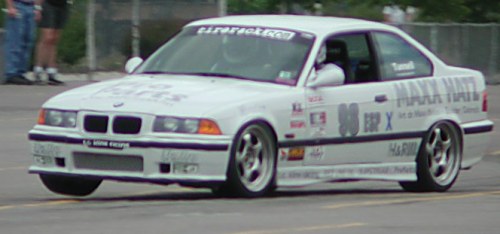
See the inside front tire off the ground. That translates into more motive grip
at the rear, and thus more acceleration, and believe me, that car rockets
out of corners.
All of this trickery applies to a FWD car too, and since the front tires share all of the
motive AND most of lateral traction (because most of the weight is in front), all the things
that happen with big bars at either end are even more extreme. A big front bar stabilizes the body
lean more but also creates a lot more understeer, and may make the inside front tire spin madly under
power in a corner. A big rear bar can't give you back much lateral grip up front, but it can
give you back some motive traction. Basically lettting you
accelerate out of the turn, even when the front end is sliding pretty badly.
The sway bar aka "anti roll bar"
Does NOT push up on one side and pull down on the other ... that would make things worse...
OK... hard in a right turn the drivers side suspension is being compressed...
the bar (pick a name you like) ALSO attempts to compress the UNLOADED suspensinon (on the passengers side) ... in an effort to stop / reduce body roll.
A stiffer bar does this with greater force allowing LESS body roll .
Here is some good reading >>>
How sway bars work, and why people use them.
Here's how a sway bar works.
Normally, without a sway bar when the car corners the weight of the chassis
shifts toward the outside of the turn compressing the springs on that side. The
springs on the inside generally extend a little, or do nothing. Relatively to the
chassis itself, it appears that the outside suspension compresses and the inside doesn't.
A sway bar couples the suspensions on each side to each other, *AND* relative
to the chassis. If you could put the car up on a lift and actually compress
the suspension on one side by hand, then a sway bar makes the compression of one
side also try to compress the suspension on the other. Ok.. it's still not
really obvious why that's useful so I'll say the same thing a different way.
A sway bar effectively increases the spring rate on whichever side
is compressed the MOST. If the sway bar were absolutely solid with no
twist so there's a 100% coupling between each side then
an attempt to compress one spring actually becomes an attempt to
compress both springs. It doubles the spring rate. If the bar has some
twist, then it may only increase the spring rate by say 50% on whichever side
is compressed the most.
So you're driving down the road and you go over
a bump that goes across the entire lane. The sway bar
does nothing. Both sides compress normally. You go around a
corner and the chassis starts to lean and compress the outside
suspension and now it's as though you have a bigger spring
out there, so the car remains more level. That's the good part.
Here's the bad part. You hit a bump with only one side, and it
behaves the same way, as though you have a stiffer spring,
so you feel uneven bumps more. You feel it crossing anything
diagonally as well, such as coming into or out of a parking lot
or driveway curb.
That's all the simple "How does a sway bar work?" part.
The real tricky one is.. "What does a sway bar do?"
1. We know it keeps the car more level. So what? Limiting the lean of
the body is good because it means that when you take a quick set into
a turn, that the body isn't still moving sideways after the tires at their
limits. Otherwise you turn in quickly, the tires grip, then the body finally finishes
leaning, when it stops, the tires loose grip. This is especially noticable in most
cars in the slalom where you lean one way then the other and so forth.
2. It limits camber changes. The camber is the angle that the tire leans in or out at the top
relative to the chassis of the car. The camber directly impacts the angle at which the tire
cross section meets the road and thus controls lateral grip. As the suspension compresses
the camber angle generally changes relative to the chassis. With a normal Macpherson
strut that hasn't been lowered, the camber goes from positive to more negative as the
lower A arm swings out straight, and then back to positive as it swings up. That swing
up into positive camber is BAD. At that point the chassis is already leaned over so the
tire may be starting to roll onto its sidewall. Changing the camber even more positive
just just nasty. A big sway bar will prevent the body roll in the first place, and
prevent the suspension compression on the outside which causes the positive camber
change relative to the chassis.
3. Transfer lateral grip from one end of the car to the other.
This one is a real trick to understand, but racers exploit this EVERY time they go
on the track. Their spring rates are often so high, the cars so low, and their
suspension travel so little, that the whole camber and body lean problem is already
a non-issue. The car doesn't lean much with 500 lb springs. They use their bars
to change the balance of the car. Here's the simple rules first.
A big bar on the front, increases rear lateral and motive traction.
A big bar on the rear, increases front lateral and motive traction.
The applications. If the car is understeering, decrease front bar size, or increase
rear bar size. This increases front lateral grip and decreases rear lateral grip
giving the car a more neutral to oversteer feel. Reverse the process for
too much oversteer.
I mentioned motive grip. That's the neat one. Let's say your RWD car is handling ok, but
everytime you get into a corner hard and get on the gas the rear inside tire breaks loose
and spins. You can't accelerate out of the turn. You can go around the turn quite
quickly, but you can't accelerate out, and the guy with traction hooks up and
passes you halfway down the next straight because he came out of the turn going 3-4mph faster.
The reason you're losing the traction at the inside rear, is usually because the rear bar is too big.
As the rear outside suspension compresses, it's actually causing the rear inside suspension to
compress as well (because the bar couples the sides.. remember where we started), and that
decreases the weight on the rear inside tire.
First thing. Decrease size of rear bar. That decouples the sides a bit, let's the inside tire press
down on the road more and thus not spin when you're on the gas.
Here's where it gets really tricky.
If decreasing the size of the rear bar doesn't help enough the next thing you do is
increase the size of the front bar. When the outside front compresses in a corner, it
causes the inside front to compress and may actually lift that tire completely off the
ground. The car is now sitting on 3 tires and guess where the weight that was on
the inside front goes? Outside front? Some of it. The rest goes to the inside rear
where we need more grip. The total weight of the car hasn't changed. It's just been
redistributed, and a sway bar at one end, actually transfered weight to the other
end of the car. Here it is in action on a RWD car.
See the inside front tire off the ground. That translates into more motive grip
at the rear, and thus more acceleration, and believe me, that car rockets
out of corners.
All of this trickery applies to a FWD car too, and since the front tires share all of the
motive AND most of lateral traction (because most of the weight is in front), all the things
that happen with big bars at either end are even more extreme. A big front bar stabilizes the body
lean more but also creates a lot more understeer, and may make the inside front tire spin madly under
power in a corner. A big rear bar can't give you back much lateral grip up front, but it can
give you back some motive traction. Basically lettting you
accelerate out of the turn, even when the front end is sliding pretty badly.